

In December 2024, the team at multiply.ai invited us to the workshop they hosted on AI Agents at the Google London office.
The full presentation was recorded, and is embedded below. Key highlights:
How we design our agentic systems at Gradient Labs, with our key principle: “what would a human do?” When a person is working on a task, there is a lot that we do not document & take for granted. At Gradient Labs, we bake this implicit expertise into our agent so that it does not need to be instructed down to the last detail. We cover how we capture that human expertise in more depth.
What is the most basic thing that you need to get right? Having an AI agent that knows what to do when it receives (or, critically, doesn’t receive) signals from the outside world. The Gradient Labs agent handles this by being built as a finite state machine.
Is retrieval-augmented generation enough? The promise of RAG hides two important problems: majority of a company’s knowledge is undocumented, and it is rare for “search & reply” to lead to good outcomes. At Gradient Labs, we’ve built a suite of agents that can learn from a company’s historical data. We explain why your knowledge base isn’t enough on its own.
What are AI agent tools? Empowering an AI agent to use tools (APIs) unlocks opportunities for end-to-end automation, but if you wouldn’t allow an employee to access all of the tools in your company, how should an AI agent do so safely? At Gradient Labs, our agent’s choices restrict which tools it can or cannot use. Our guide to choosing a secure AI agent for banking covers what an agent should and should not be able to reach.
How can you prevent both common AI Agent mistakes and industry-specific ones? At Gradient Labs, we guard against both with agent and customer guardrails, because no outcome is safer than a wrong one.
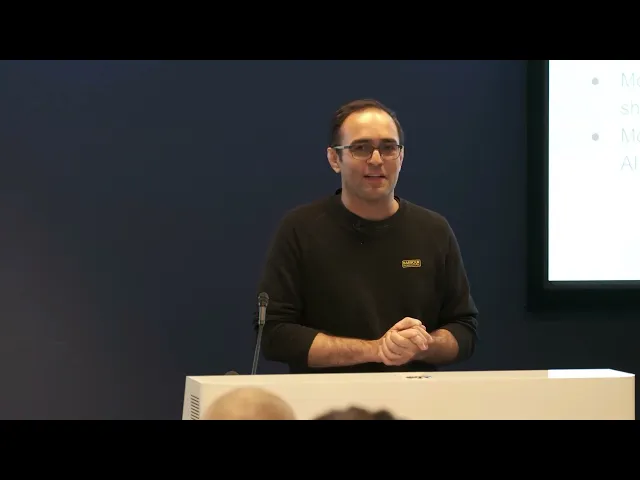
In December 2024, the team at multiply.ai invited us to the workshop they hosted on AI Agents at the Google London office.
The full presentation was recorded, and is embedded below. Key highlights:
How we design our agentic systems at Gradient Labs, with our key principle: “what would a human do?” When a person is working on a task, there is a lot that we do not document & take for granted. At Gradient Labs, we bake this implicit expertise into our agent so that it does not need to be instructed down to the last detail. We cover how we capture that human expertise in more depth.
What is the most basic thing that you need to get right? Having an AI agent that knows what to do when it receives (or, critically, doesn’t receive) signals from the outside world. The Gradient Labs agent handles this by being built as a finite state machine.
Is retrieval-augmented generation enough? The promise of RAG hides two important problems: majority of a company’s knowledge is undocumented, and it is rare for “search & reply” to lead to good outcomes. At Gradient Labs, we’ve built a suite of agents that can learn from a company’s historical data. We explain why your knowledge base isn’t enough on its own.
What are AI agent tools? Empowering an AI agent to use tools (APIs) unlocks opportunities for end-to-end automation, but if you wouldn’t allow an employee to access all of the tools in your company, how should an AI agent do so safely? At Gradient Labs, our agent’s choices restrict which tools it can or cannot use. Our guide to choosing a secure AI agent for banking covers what an agent should and should not be able to reach.
How can you prevent both common AI Agent mistakes and industry-specific ones? At Gradient Labs, we guard against both with agent and customer guardrails, because no outcome is safer than a wrong one.

Share post
Copy post link
Link copied