
Most fintechs have already run an AI pilot. Far fewer fintechs have managed to deploy AI agents that work reliably every day, on a lean team, with real ROI. Research shows that the overwhelming majority of enterprise AI pilots deliver no measurable return, and the gap rarely comes down to the model. It comes down to deployment: the buy-in, the guardrails, the integrations, and the ramp, all of which turn a promising demo into a system a small ops team can run and still pass compliance.
This guide breaks down deploying AI agents in fintech into six steps, in the order a team actually works through them, so your first deployment reaches production and your second one is easier. If you're weighing where the agent could help first, our guide to AI use cases in banking maps the adjacent options across financial services. For the fintech-specific picture, our guide to the best AI use cases for fintechs maps the same ground with fintech examples.
1. Choose an AI agent built for your fintech use case
A generic AI agent is built to answer a question and close the conversation. It handles "what's my limit?" or "how do I order a new card?" well enough, but it tends to plateau around 60% automation on a real fintech operation, because most of your manual work doesn't fit the one question, one answer shape.
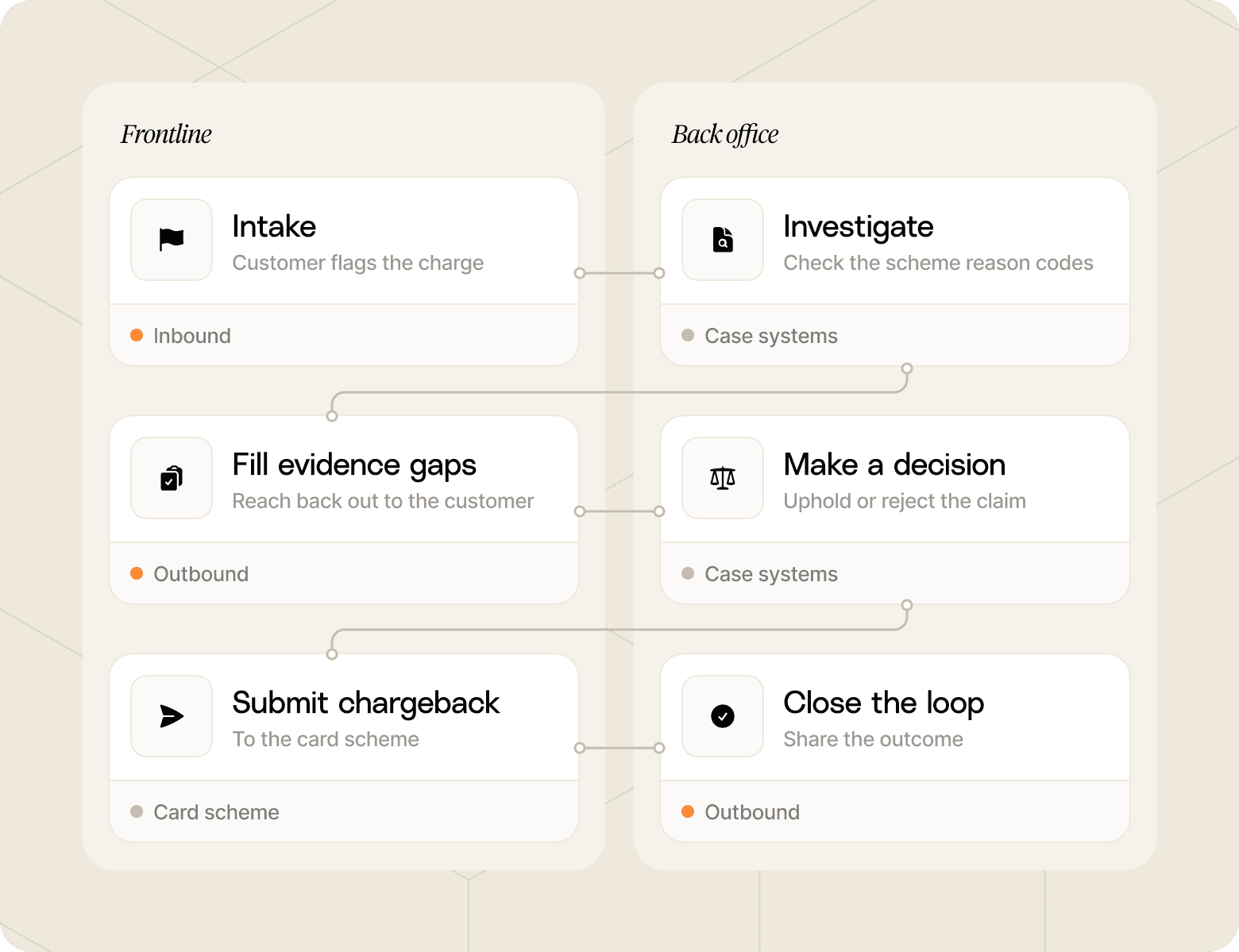
The work that defines a fintech lives a layer deeper. For example, a disputed transaction needs more than a single reply: the customer flags a charge they don't recognise, the case goes into investigation against card scheme reason codes, evidence gets gathered, a decision gets made, the chargeback gets submitted, and someone closes the loop weeks later, all against scheme and regulatory deadlines. Collections, onboarding, complaints, and financial vulnerability run the same way: long processes, not quick answers.
A specialist AI agent like Gradient Labs is better for fintechs on three fronts:
It runs the long process, not just the reply: disputes, collections, KYC, complaints, and more require intake, investigation, decision, follow-up, and close. A specialist agent shares memory and context across every stage of that lifecycle. A generic agent's case stops at the first response.
Compliance is built in: in finance, a wrong answer can be a regulatory breach. You need an agent that runs FS guardrails on every turn, with a full audit trail. Horizontal tools treat compliance as a configuration layer you build and maintain yourself.
It acts inside your systems: resolving a case might require steps such as freezing a card, checking a customers’ account or membership status, or taking a payment. A specialist AI agent connects to your core systems to actually do the work, not just explain it.
Be critical about what you are automating. If it's first-line FAQ, most tools will cope. If it's the back-office work like disputes, collections, or KYC, complex and time-consuming tasks that actually moves your numbers, then you need an AI agent built for the process. That depth is what lifts resolution past the ceiling that stalls generic agents, toward 80–90% in mature deployments.
2. Internal buy-in is the first step to deploying AI agents in fintech
A fintech moves faster than a traditional bank. The decision often sits with an ops lead or a founder rather than a procurement committee, and there are fewer vetoes between a pilot and a live ticket. That speed is an advantage, as long as you don't mistake it for skipping the work that risk and compliance still own.
Three things still decide it, even on a lean team:
Security review: whoever owns information security assesses data handling, retention, encryption, and sub-processors. Come with answers: SOC 2, GDPR with full DSAR handling, AES-256 at rest, and zero-day data retention agreements with every LLM sub-processor.
Compliance review: check the agent against the rules you live under, whether that's FCA Consumer Duty in the UK, Reg E and Reg Z in the US, or PSD2 and the EU AI Act in Europe. The audit trail matters here as much as the model.
Prioritisation: pick the first use case by impact, not by ease. Which procedures and data connections unlock the most volume? That answer sets the order of everything that follows.
Then scope a proof-of-concept around one concrete question: can the agent find the customer, read the account status, and respond correctly under your guardrails? Gradient Labs guarantees the deployment once a use case is scoped. If we don't deliver what we agreed, you get your money back, which puts a floor under the decision for a team that can't afford a failed bet.
3. Teach the AI agent what your best people know
An AI agent knows what you give it, and a knowledge base on its own is never enough. Your best support people carry years of judgement that never made it into a document: the edge cases, the workarounds, the way a sensitive complaint actually gets handled. Getting that into the agent is one of the first steps in a deployment, and at Gradient Labs, three sources feed it:
Knowledge base: your help articles and policies, the documented baseline most teams already have.
Facts: the structured details that don't live in a public knowledge base, like fee schedules, eligibility rules, and cut-off times. These are kept separate because they're precise and they change often.
Notes: your team's working knowledge, the judgement that never got written down. Gradient Labs generates this for you. The AI agent analyses thousands of conversations your team has already handled and extracts how your best people work: the recurring edge cases, the tone they use with a vulnerable customer, and the steps they take when a policy doesn't quite fit. Your team reviews what it surfaces, and it becomes guidance the agent applies from day one.
On top of knowledge sit procedures: your SOPs written as natural-language steps the agent executes, with branching logic for the cases that don't follow the script. Because the agent learns from your real conversation history rather than a blank slate, it starts near your team's standard instead of climbing there through months of escalations.
4. Keep the AI agent compliant even when you move fast
In most industries, a wrong answer from a support agent means a poor experience. In a regulated fintech, it can be a regulatory breach. Moving fast is your edge, but to achieve speed safely, you need the controls to be the platform's job. They should not be a configuration layer your team builds and maintains while shipping everything else.
At Gradient Labs, two kinds of guardrails do this work:
Customer guardrails read the conversation and act on it: detecting a complaint, spotting signs of financial difficulty or vulnerability that trigger obligations like FCA Consumer Duty, and handing off when a human is needed.
Agent guardrails check what the agent is about to say or do: preventing tipping-off on a financial crime case, blocking unlicensed advice, and stopping sensitive data from leaving. They edit the draft before it reaches the customer.
Gradient Labs runs 20+ pre-built financial services guardrails on every turn, with coverage across US (FDCPA, TCPA, Reg E and Reg Z), UK (FCA Consumer Duty, CONC), and EU (PSD2, GDPR, the EU AI Act) rules. Every action, data point, and decision lands in an audit trail your compliance team can review. Horizontal tools treat this as the buyer's homework, and for a regulated fintech that homework is the hard part.
5. Integrate the AI agent through your APIs and MCPs
This is where a fintech has the edge over a traditional bank. Your stack is modern and API-first, so the AI agent can connect to the systems that actually run the business without waiting on a core banking migration. There are two ways to wire it in, and most deployments use both.
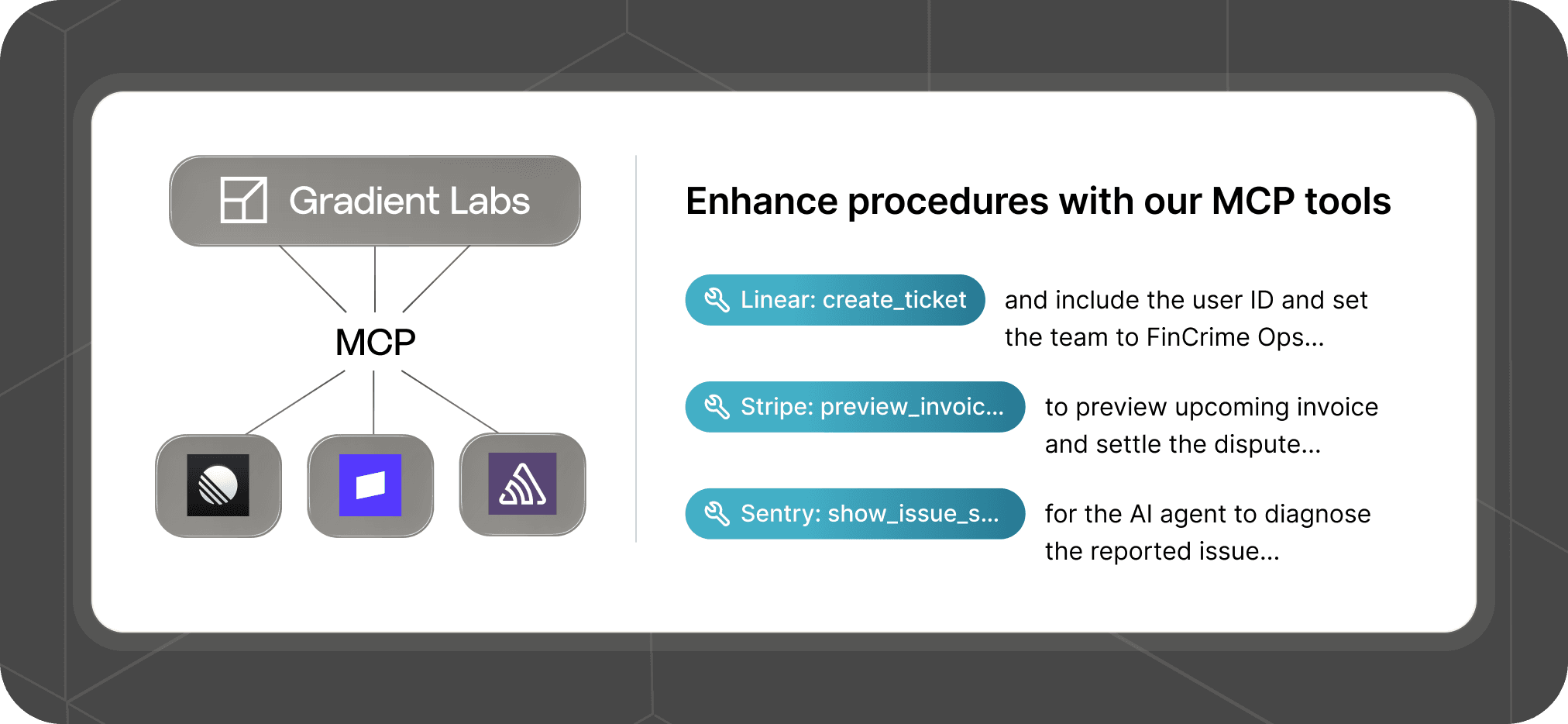
Custom API tools: connect the agent straight to your existing REST endpoints. You define each call, its inputs, and what comes back, so the agent works against the APIs your engineers already maintain.
MCP servers: give the agent a standard way to reach a system without wiring up every endpoint by hand. MCP (Model Context Protocol) is the emerging standard for connecting AI agents to tools, so if you already run an MCP server internally, or a provider like your payments or core banking platform exposes one, the agent connects to it directly.
Answering a question and resolving a case are different jobs. The AI agent earns its return when it can act: freeze a card, check an account status, take a payment, update a case. Sequence the integrations the same way you sequenced the use cases. Connect what unblocks your highest-priority case first, then widen.
This is also where the economics turn. Much of the cost saving arrives past 80% automation, and the climb from 60% to 80% is mostly integration depth: every system the agent can reach is another case it closes through pure automation. Overdue payment collections is a plain example, since the agent can't resolve the case if it can't see the balance and take the payment. Start with one narrow, high-volume process, then add others on the same platform over time, reusing the same connections, guardrails, and audit trail for each.
6. Start with low-risk cases, then ramp as volume grows
Earn trust in increments. A gradual ramp is how you build it, and it matters more for a fintech than you might expect, because your volume rarely sits still. One large digital bank running Gradient Labs started at a controlled volume with full human QA, then moved to 25%, 50%, and 100% as the numbers held, and never rolled back. When 30,000 new accounts landed overnight and support volume tripled in a week, the AI agent absorbed it.
Going live is the start line, not the finish. A mature deployment reaches 80–90% resolution, but day one usually lands around 60%, and the gap closes through a maintenance loop you run after launch:
Watch the handoff rate: every handoff to a human is a case the agent didn't resolve.
Diagnose the root cause: missing knowledge, a gap in a procedure, or a missing integration.
Fix the source, then test and monitor: update the knowledge, procedure, or tool, validate it, and watch the rate move.
From there, growth runs on two axes: breadth (more channels, customers, and languages) and depth (more procedures, more tools, more of the case handled end to end). The proof compounds with it. A large digital bank running Gradient Labs holds 98% QA across half a million conversations and an 84% CSAT, ahead of its human team.
Deployment is the hard part, and it's the part Gradient Labs is built to carry: a finance-native platform, a delivery team that knows fintech, and a guarantee on every use case we scope. If you're choosing where to start, book a demo and we'll plan your first deployment with you.


Elizabeth Shew leads Brand and Advocacy at Gradient Labs, where AI agents handle customer support and back-office work for banks, lenders, and fintechs. Before that, she led customer marketing at Mastercard and built Dynamic Yield's customer marketing programme from the ground up, a decade spent turning customer results into industry-shaping stories. She writes about how support and operations teams actually put AI and technology to work. Before tech, she was a professional dancer in NYC.