
If you are comparing Intercom Fin vs Gradient Labs, you aren't really weighing two different AI platforms; you are weighing two different kinds of jobs for AI to handle. Fin AI (also known as Intercom Fin) publishes resolution rates of up to 65% on frontline chat and sets up quickly. Gradient Labs resolves 60% of conversations on day one and 80–90% in mature deployments, and it runs full support cases end to end across frontline support and back-office work like disputes, collections, and KYC. This guide compares the two fairly: what Fin does well, where its resolution ceiling stops, and why financial services teams typically choose a platform built for the whole operation.
Intercom Fin vs Gradient Labs: the verdict
Here is the short version. If your team already runs Intercom and you want fast automation on common frontline questions ASAP, Fin deserves consideration. If you run a financial services operation where the work spans application follow up, KYC, disputes, lending, and vulnerable customer handling, Gradient Labs is the stronger fit, because it resolves whole cases rather than deflecting first messages.
This table sets the two side by side. The sections that follow profile each platform, then work through resolution rates, back-office coverage, compliance, and how to run a fair evaluation.
Gradient Labs | Fin (formerly Intercom Fin) | |
|---|---|---|
Core purpose | Automate end-to-end customer operations for financial services | Automate frontline customer support for a variety of industries |
Automation focus | Full-depth cases specific to finance, from frontline FAQs to cases that run over days and across teams | High-volume, frontline questions that can be solved in a single session |
Resolution rate | 60% day one, 80–90% mature | 45–50% day one, 65% mature (finance) |
Channels supported | Chat, email, and voice, included with every agent | Chat, email, tickets, and phone |
Voice agent | Built and running in production at scale, a first in finance | Roadmap, with trials launched; general-purpose, broader availability still rolling out |
Helpdesk compatibility | Headless; works out of the box with any tech stack | Native to Intercom; also works with other major helpdesks |
Guardrails | Native out of the box: 20+ financial-services guardrails on every turn | Full security and compliance suite, but no FS-specific guardrails |
Deployment | Delivery team runs the 0→1 migration, typically live in days | Fast self-serve setup with certain helpdesks, especially Intercom, for eCommerce; further guardrails required for finance deployment |
Pricing model | Per-resolution, deployment guarantee | $0.99 per outcome, 50/month minimum. A handoff to a human counts as a billable outcome, so you pay full price even when Fin can't resolve the case |
Best for | Financial organisations seeking to automate more than just inbound FAQs | Teams already on Intercom wanting fast automation for low-touch, high-volume cases, especially eCommerce |
What is Fin AI, and what is it best at?
Fin is Intercom's AI support agent. It runs on Intercom and connects to most major helpdesks, including Salesforce, HubSpot, Freshdesk, Front, and Zoho Desk, so teams can keep their existing setup. Pricing is usage-based at $0.99 per outcome, with a minimum monthly commitment, and you are charged once per conversation. One detail matters when you model the cost: an outcome is not only a resolution. If Fin runs a configured procedure that ends in a handoff to a human, that counts as a billable outcome at the same $0.99. This handoff is not a human-in-the-loop check on a case Fin has solved. It means Fin could not resolve the case and passed it to your team to finish, and you pay the full resolution price anyway.
Fin is at its best in two situations: when Intercom is already your helpdesk, and when you run high-volume eCommerce or consumer support. It sets up very quickly in these scenarios and handles the repeatable queries that fill a retail queue well, like order tracking, returns, refunds, and delivery updates. Intercom says its resolution rate improves roughly 1% each month as it learns from more conversations. On security and privacy it holds ISO 27001, ISO 27018, and ISO 27701, and it complies with GDPR and CCPA.
For a support team already standardised on Intercom and handling high volumes of repeatable, low-touch questions, Fin is a sensible default. The question for a financial services team is what happens to the work that does not fit a single chat reply.
Best for: eCommerce and consumer support teams, especially those already running Intercom.
What is Gradient Labs, and what is it best at?
Gradient Labs is the AI-native customer operations platform for financial services. Rather than a single chatbot, it provides a suite of complementary specialist agents for lending, disputes, and KYC, with frontline support on text and voice included across all three. Each agent takes one piece of manual customer operations work and runs it end to end.
The results show up in two numbers. Agents resolve 60% of conversations on day one, then climb to 80–90% in mature deployments. That climb is not automatic: a dedicated delivery team supercharges each deployment after launch, working an improvement roadmap that identifies the cases the agent does not yet resolve and closes them off in priority order. CSAT runs ahead of human teams on frontline work, because the agent learns each company's tone and handles sensitive conversations, like complaints and vulnerable customers, with care. Gradient Labs also runs voice AI in production at scale, a first in finance.
Yonder, the credit card provider, runs Gradient Labs across frontline support and disputes in production.
"Otto, Gradient Labs' AI agent, has been a game-changer for us. With a 98% CSAT, it delivers superb customer experiences. We especially value how closely Otto matches our tone of voice. We look forward to Otto helping us manage fraud and financial crime alerts more efficiently."
— MC Glover, VP of Strategy and Operations, Yonder
Best for: Financial services firms looking to automate frontline and back-office work from one platform.
Where does Fin's resolution ceiling stop?
The gap between the two platforms is clearest in what a "resolution" actually covers.
Support teams usually sort work into tiers. Tier 1 is the simple, high-volume stuff: a single question with a single answer. A customer asks where their statement is, the agent answers, and the conversation closes. Horizontal agents like Fin handle these well, and that is where the published resolution rates come from. On a complex financial services operation, that kind of work tends to plateau around 60–65%, because the rest of the queue does not fit the single-reply shape.
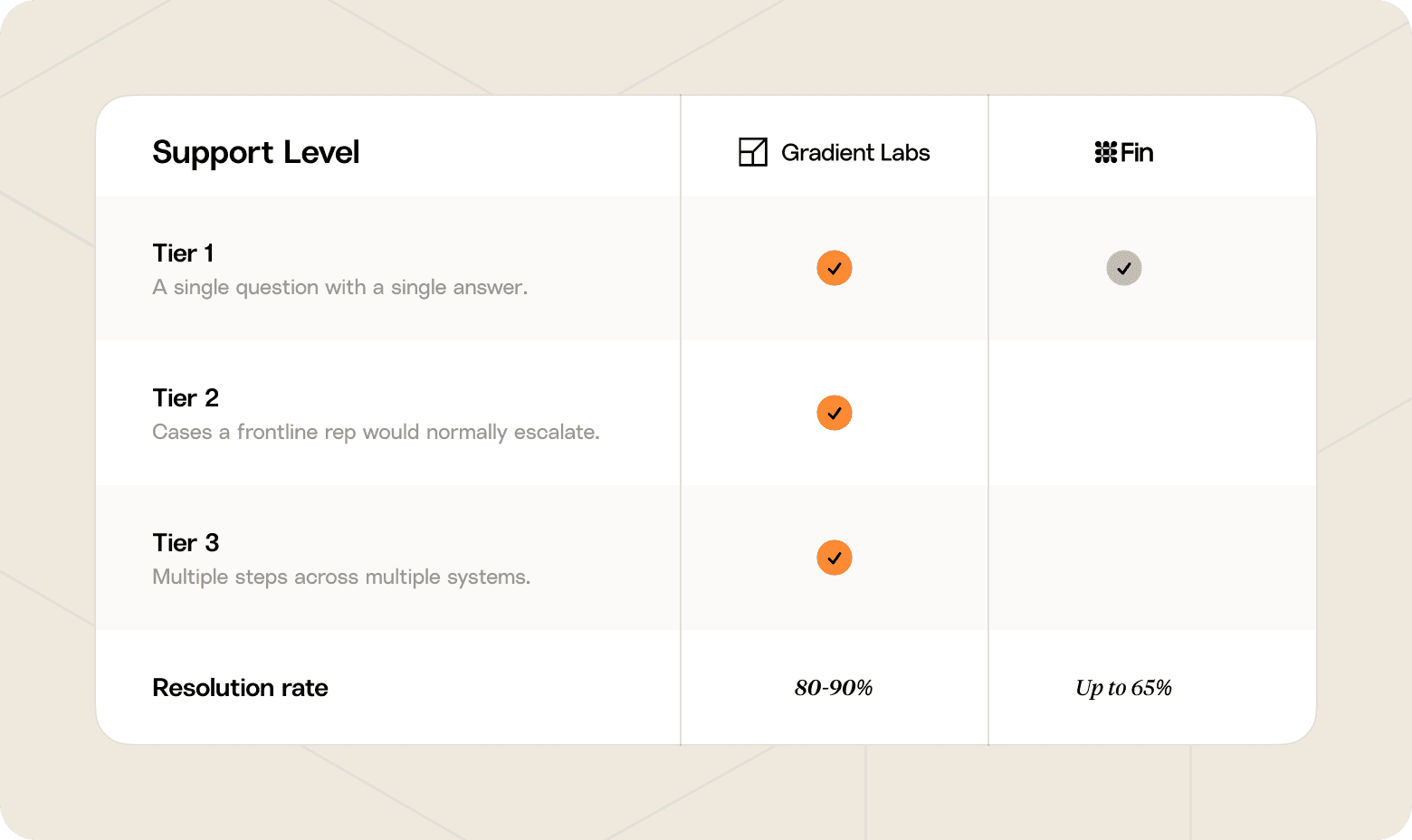
Tiers 2 and 3 are the harder cases that a frontline rep would normally escalate: work that spans multiple steps, systems, and even days rather than one message. For example, a dispute takes around 60 days from intake through investigation, decision, chargeback, and follow-up. A lending relationship runs across application, onboarding, repayment, and collections over years. These cases need an agent that holds context across turns, channels, and days, applies policy at each step, and closes the loop weeks after the first message. A frontline chatbot deflects the opening question and hands the rest to a human.
That is the ceiling financial services teams hit with less specialised tools: the easy questions get automated, and the work that actually runs the operation stays manual.
Beyond the ticket: who handles back-office and end-to-end cases?
This is where Gradient Labs is built differently. It is the only AI agent platform in financial services that runs both frontline interactions and back-office case work on one platform, one delivery team, and one customer relationship.
Take KYC and onboarding. When a new customer's details do not clear an automated check, the same agent takes the case: it requests the missing document, verifies it, runs the identity or business verification checks, and either clears the customer or routes a genuine edge case to a human with the groundwork already done. A frontline-only tool stops at the first question, and a back-office-only specialist never owns the customer conversation.
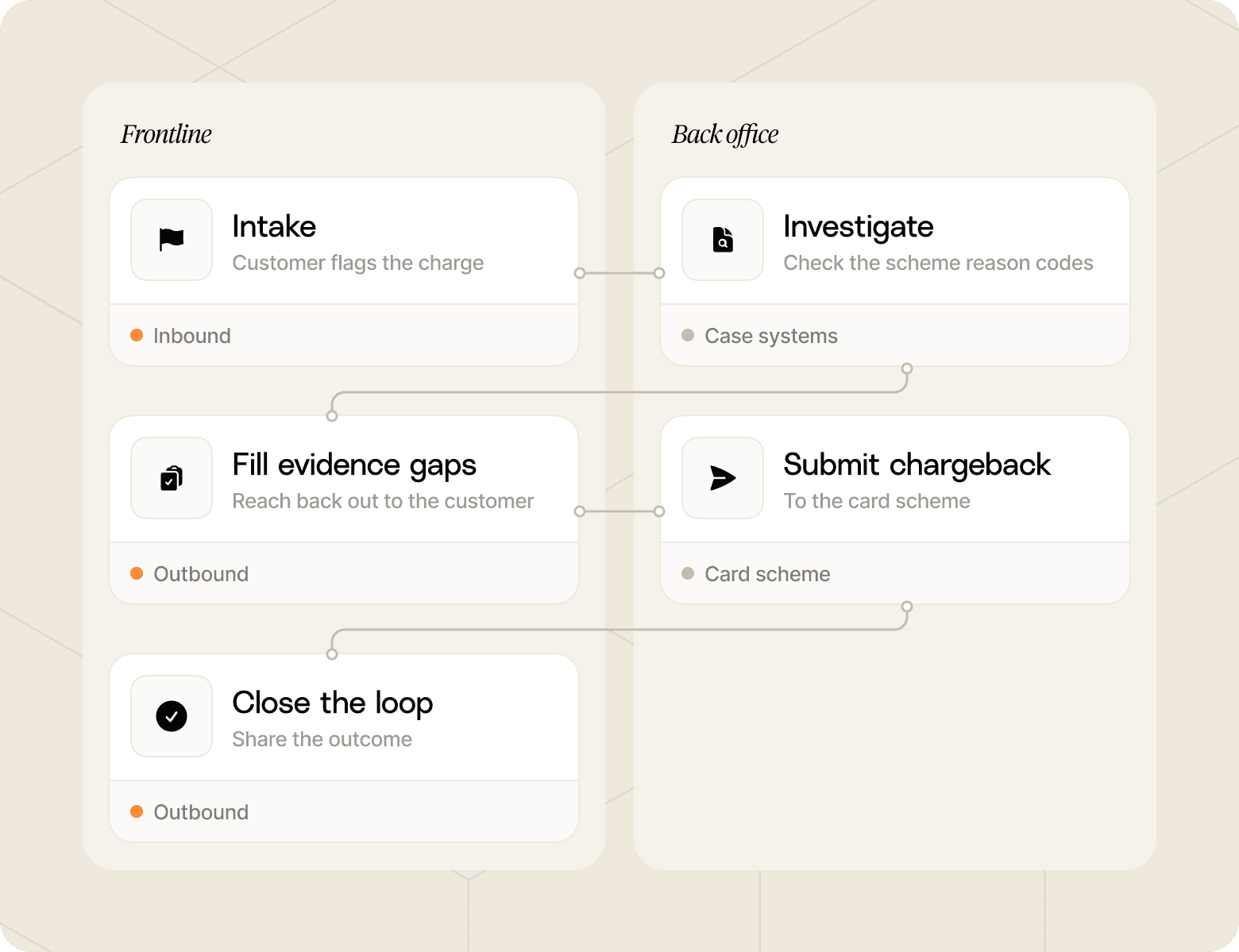
Disputes follow the same shape. A customer flags a charge they do not recognise, and the agent runs intake on the frontline, investigates the case in the back office, reaches back out to fill any evidence gaps, submits the chargeback to the card network, and closes the loop with the outcome. One agent, one relationship, no hand-off to a human necessary. You can see the shape of this in how the Gradient Labs agent handles an investigate a missing payment case.
The same pattern runs in lending. The Lending Agent handles outbound collections end to end: identity verification, balance explanation, negotiation, and hardship detection, adapting tone in the call to reach a fair outcome. Every interaction lands in the CRM with a timestamped audit trail of decisions, disclosures, and consent. The same holds for fraud and financial crime alerts, complaints, and vulnerable-customer handling: the sensitive, multi-step work that decides whether a financial services operation runs cleanly.
The specialist agents share memory and context across every stage of the lifecycle, so a customer who moves from a support question to a dispute to a collections call is not starting cold each time. Adding another agent later runs on the same data, the same guardrails, and the same audit trail. For a financial services operation, that is the difference between automating the reply and automating the work.
Which is the safer bet for a regulated operation?
Compliance is where a comparison for financial services has to get specific. Both platforms hold recognised security certifications. The difference is whether compliance is built into how the agent reasons or layered on afterwards.
Gradient Labs was built for financial services from the ground up. The founders built Monzo's data organisation and ran production machine learning under FCA regulation. More than 20 pre-built financial services guardrails run on every turn. Customer guardrails detect complaints, vulnerability, and financial difficulty and reroute the conversation if needed, while AI agent guardrails catch tipping-off, false promises, and out-of-bounds advice before a reply reaches the customer. Regulatory coverage spans the US, UK, and EU, including FCA Consumer Duty obligations and the EU AI Act. Every action, data point, and reasoning step lands in a full audit trail, and the platform is SOC 2 audited, GDPR compliant, and runs zero-day data retention agreements with every model provider.
A horizontal agent treats compliance as a configuration layer the buyer builds and maintains. For a bank, lender, or insurer, that is the difference between a control that is always on and one your team has to assemble and keep current.
Gradient Labs also guarantees the deployment: once a use case is scoped, you get your money back if it does not deliver what was agreed.
How to run a Fin AI vs Gradient Labs evaluation
A fair evaluation tests each platform on the work you actually need automated, not just the easy questions.
Scope the real work: list the cases that consume your team, including the back-office and edge cases, not only frontline FAQs. A tool that resolves 90% of simple chats but none of your disputes is not solving your biggest cost.
Run a live POC on your own traffic: resolution rate and CSAT only mean something on your customers and your policies. Both platforms support a trial, so test on representative volume.
Measure end to end: track whether each case closes without a human hand-off, not just whether the first message was deflected. Add SLA and audit coverage for back-office work, where CSAT does not apply.
Plum, the savings and investing app, ran exactly this kind of evaluation when selecting their AI agent for customer operations.
"Gradient's AI solution delivered impressive results with minimal effort on our part. The proof of concept made the decision clear, and the rollout was straightforward. Seeing such a high CSAT and resolution rate validated our choice."
— Yoan Yedrowiak, Head of Customer Success, Plum
For more on structuring a vendor evaluation, see our guides on how to choose an AI agent for financial services and taking AI agents from pilot to production.
If you want to see how Gradient Labs handles your hardest cases, book a demo and we will scope a use case with you.


Elizabeth Shew leads Brand and Advocacy at Gradient Labs, where AI agents handle customer support and back-office work for banks, lenders, and fintechs. Before that, she led customer marketing at Mastercard and built Dynamic Yield's customer marketing programme from the ground up, a decade spent turning customer results into industry-shaping stories. She writes about how support and operations teams actually put AI and technology to work. Before tech, she was a professional dancer in NYC.