
If you are choosing an AI customer service agent for a bank, lender, or fintech, Intercom Fin is almost certainly on your shortlist, and for good reason. It serves around 30,000 customers, deflects high-volume questions well, and switches on fast, which is why Salesforce agreed to acquire it for $3.6bn in 2026. The more useful question is not whether Fin is capable, but whether it is the right agent for your use case. That is where the search for an AI customer service alternative to Intercom Fin really starts: with the specific work you need an agent to own. In financial services, the cases that define your support load are regulated, multi-step, and rarely solved by a knowledge-base lookup. This guide maps the alternatives by the job you are using AI to do, so you can select the vendor that best fits your work.
What is Intercom Fin, and what does it do?
Fin (formerly Intercom Fin) is the AI agent built by Intercom, the customer service company that rebranded to Fin in 2026 and was acquired by Salesforce for $3.6bn in June 2026. It is one of the most widely deployed AI customer service agents on the market, with roughly 30,000 customers across verticals, including SaaS, e-commerce, gaming, and healthcare.
Fin does three things well. It deflects high-volume, repetitive questions from a clean knowledge base. It switches on quickly, especially for e-commerce teams already running Intercom. And it answers in natural language across chat, email, and messaging channels. For an e-commerce brand or a SaaS team with tidy help docs and mostly simple queries, Fin is a capable, fast-to-deploy answer bot with a strong security posture behind it.
The limits show up when the work gets harder. Fin is fundamentally a retrieval-and-deflect engine: it finds the most likely answer in your documentation and replies. That model has a ceiling, and in financial services, that ceiling arrives early.
Why financial services teams look for a Fin alternative
The pain is specific, and it is rarely about whether Fin works. It is about where that work stops.
Deflection plateaus on complex work: retrieval-based agents handle the simple top of the queue and stall underneath it. Across the market, deflection-rate tools typically plateau around 60-65% once the easy questions are gone, because a disputed transaction or an arrears case is a multi-step investigation across systems, not a knowledge-base lookup.
Answers, not actions: Fin replies, but it rarely resolves the underlying case. Transactional work like a refund, an account change, or a chargeback needs custom workflows and careful guardrails.
Roadmap uncertainty: the Salesforce acquisition closes in early 2027, folding Fin into Agentforce. Many Fin customers have expressed apprehension about what this will mean for Fin’s long term pricing and roadmap development.
Most teams leaving Fin look first at the other horizontal AI agents, names like Decagon, Sierra, and Ada. They sit in the same lane as Fin: strong frontline chat, the same retrieval-led model, and the same ceiling on complex regulated work. They are worth a look if frontline deflection is your only job to be done. If your hardest 20% is where the cost and risk live, the more useful question is which tool is built for that work, not which one deflects fastest.
What to look for in an AI customer service agent for financial services
Financial services raises the bar on what an AI agent has to do. The same handful of questions separate a tool that handles your easy tickets from one that can run regulated work end to end:
Does it resolve, or only deflect? Deflection contains a ticket and keeps it out of the human queue. Resolution solves the customer's problem across every system the case touches, and the cases that matter most in financial services (a dispute, an arrears conversation, a KYC review) are the ones a deflection tool cannot close.
Are the guardrails financial-grade? A regulated agent has to detect vulnerability, complaints, and financial difficulty, and avoid tipping-off, false promises, and out-of-bounds advice on every turn. Look for guardrails built into the platform and mapped to your regulations, not a configuration layer you assemble yourself and will be in charge of maintaining.
Can it show its working? When a regulator or your risk team asks why the agent did something, you need a full audit trail of every action, data point, and decision, not just a transcript of what it said. Replayable reasoning is what makes an agent defensible in a regulated environment.
Does it go deep on back-office work? Frontline chat is the visible half, but the cost and risk sit in the back office: disputes, collections, onboarding, and document review. An agent that stops at the first reply leaves the expensive work to your team.
Who carries the technical load? Most financial services operations are run by ops leaders, not AI engineers. The right partner absorbs the integration, the procedure design, and the ongoing tuning, so the agent goes live in weeks and stays maintainable by people who know the operation rather than the model.
Where do the cost savings actually come from? The economics of an AI agent work at high automation, not at the price per ticket. The real savings arrive at 80-90% resolution, well above the 60-65% where retrieval tools plateau, and that holds whatever the pricing model. So the question that decides your return is the agent's ceiling: how much of your queue, including the complex back-office cases, can it actually resolve? An agent that handles the hard work reaches the resolution rate where the savings compound.
At a glance: Intercom Fin alternatives compared
The right alternative depends on which layer of Fin you are replacing. This table ranks them for a financial services buyer.
Score any shortlist against these criteria:
Platform | Best for | Guardrails | Resolution | Deployment | Pricing model |
|---|---|---|---|---|---|
Gradient Labs | Regulated FS firms running frontline and back-office on one platform | 20+ FS-native guardrails on every turn | 60% on day one, 80-90% in mature deployments | AI delivery team runs the migration; weeks, not months | Per-resolution, with a deployment guarantee |
Intercom Fin | Intercom teams wanting fast deflection of low-touch, high-volume cases | Configurable guardrails, general-purpose and self-maintained | Strongest on high-volume, clean-KB queries; varies on complex work | Self-serve switch on for eCommerce teams running Intercom; further setup needed for finance | $0.99 per outcome. A handoff to a human counts as a billable outcome, so you pay full price even when Fin can't resolve the case |
eesel AI | Affordable deflection of low-touch cases without a migration | Configurable rules, general-purpose and self-maintained | Depends on your helpdesk and KB quality | Fast setup for eCommerce team; no specific metrics for finance and rule configuration | $0.40 per ticket, flat |
PolyAI | Frontline voice support for low-touch cases | Built-in controls for voice flows | Voice containment (vendor published) | Enterprise build; weeks | Custom, usage-based |
Forethought (now Zendesk) | Agentic actions inside a Zendesk stack | Policy-based, general support and self-maintained | Vendor-published "up to 98%" but not specifically for banking | Integrates with major helpdesks, fastest on Zendesk after guardrails are configured | Custom, via Zendesk |
Gradient Labs' track record in financial services
Gradient Labs is the AI-native customer operations platform built for financial services, and banks, fintechs, lenders, and credit unions run real, regulated work on it today: SteadyPay in lending, Zego in insurance, Plum and Pockit in consumer banking and fintechs, Wise in neobanks.
The proof shows up not just in the breadth of cases Gradient Labs handles, but also in quality, which is where retrieval agents can struggle. At Yonder, a UK credit card business, the agent runs frontline support at a 98% CSAT:
"Gradient Labs' AI agent has been a game-changer for us. With a 98% CSAT, it delivers superb customer experiences. We especially value how closely Otto matches our tone of voice."
— MC Glover, VP of Strategy & Operations, Yonder
Tone and judgement are the things a knowledge-base lookup cannot fake, and they are the things regulated customers notice first.
Gradient Labs: best for regulated, complex financial services work
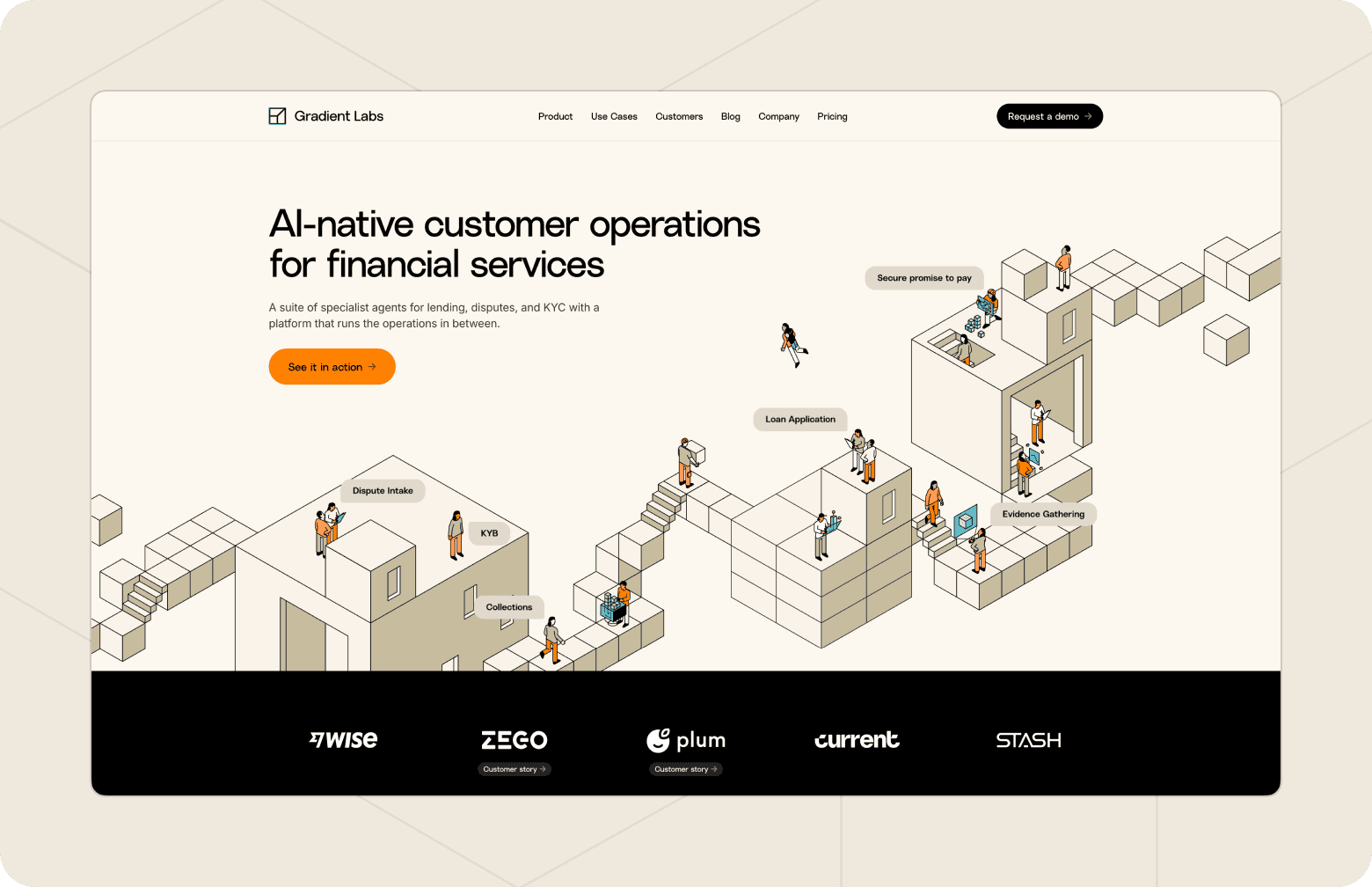
Gradient Labs handles work that makes Fin plateau. It is the only AI agent platform in financial services that runs both frontline customer interactions and the back-office case work underneath the ticket, integrated across one platform, one delivery team, and one relationship. Take disputes resolution, for example. A disputed transaction starts on the frontline when a customer flags a charge, runs investigation and chargeback work in the back office, and closes back on the frontline with the outcome. Fin handles the first reply and stops there; Gradient Labs runs the whole case, from intake to resolution.
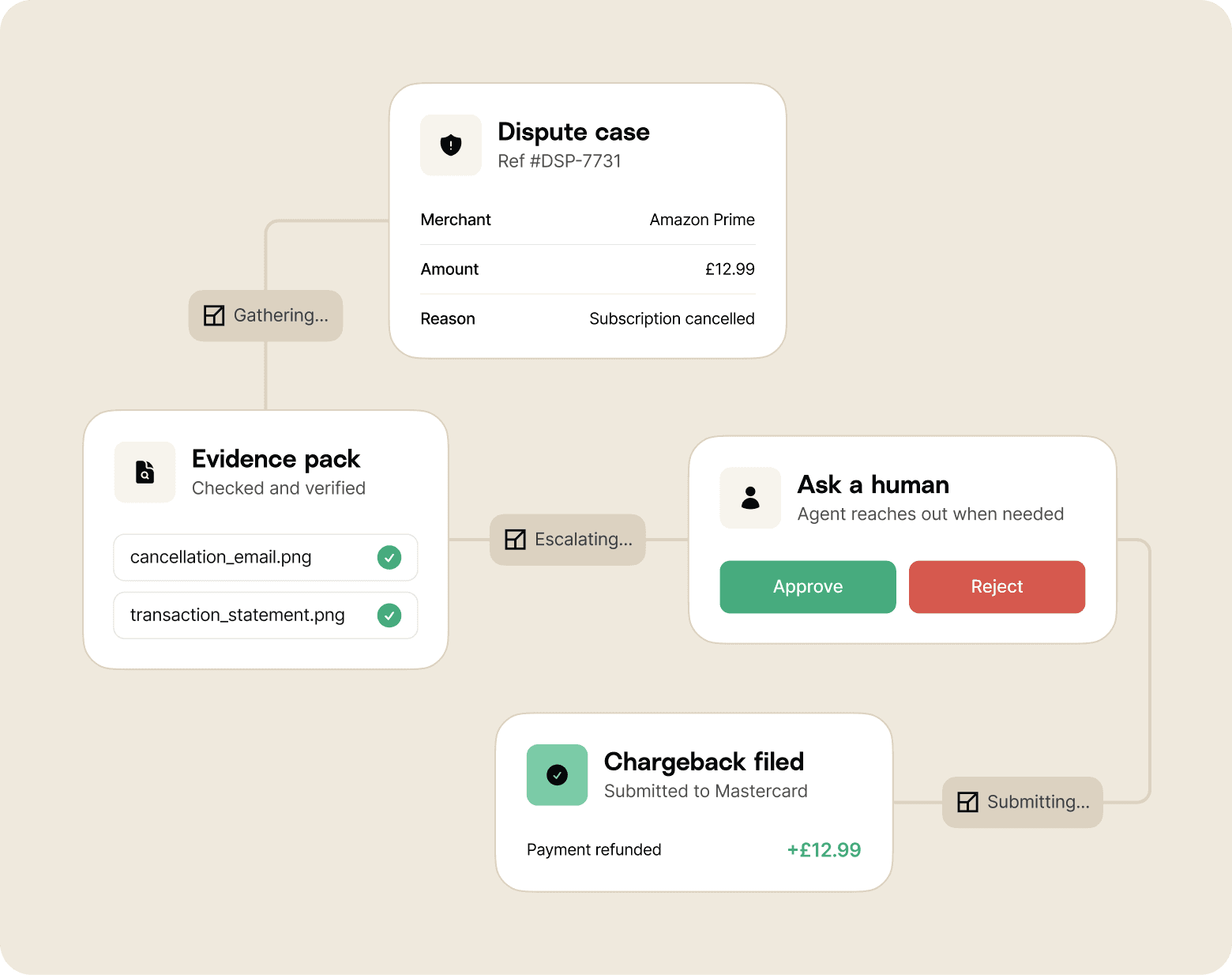
Where it fits: banks, neobanks, lenders, fintechs, and credit unions running customer operations where compliance is non-negotiable and the hard cases matter more than the easy ones. Named work includes overdue payment collections, subscription cancellation disputes, and KYC review.
Where it does not fit: if your queue is genuinely all simple, high-volume FAQ deflection and your knowledge base is already clean and easily maintained, a lighter answer bot may be all you need, and Gradient Labs would be more platform than the job requires.
Why teams pick Gradient Labs over Fin:
Resolution that climbs, not plateaus: deployments start around 60% and Gradient Labs' delivery team takes them to 80-90% in production by refining procedures, adding integrations, and expanding use cases. The partnership closes the gap that retrieval agents cannot.
Financial services in the DNA: Gradient Labs' founders ran Monzo's data organisation under FCA regulation, its engineering team comes from financial services, and 20+ pre-built FS guardrails run on every turn, detecting vulnerability, complaints, and financial difficulty. Coverage spans the FCA's Consumer Duty, US rules like FDCPA and Reg F, and the EU AI Act.
Compliance and audit out of the box: SOC 2 Type II, GDPR with full DSAR handling, zero-day data retention with every LLM sub-processor, and a complete audit trail of every action and the reasoning behind it.
Pricing aligned to delivery: priced per resolution, not a flat subscription. Gradient Labs scopes the use case and guarantees the deployment, with money back if it does not deliver what was agreed.
At SteadyPay, the lending agent makes 33,000 calls a month and converts 60% of engaged customers to committed repayment dates, all within FCA compliance standards. At Zego, CSAT reached 77% against 61% for human agents. For a closer head-to-head, see Intercom Fin vs Gradient Labs.
eesel AI: best for lighter deflection without a migration
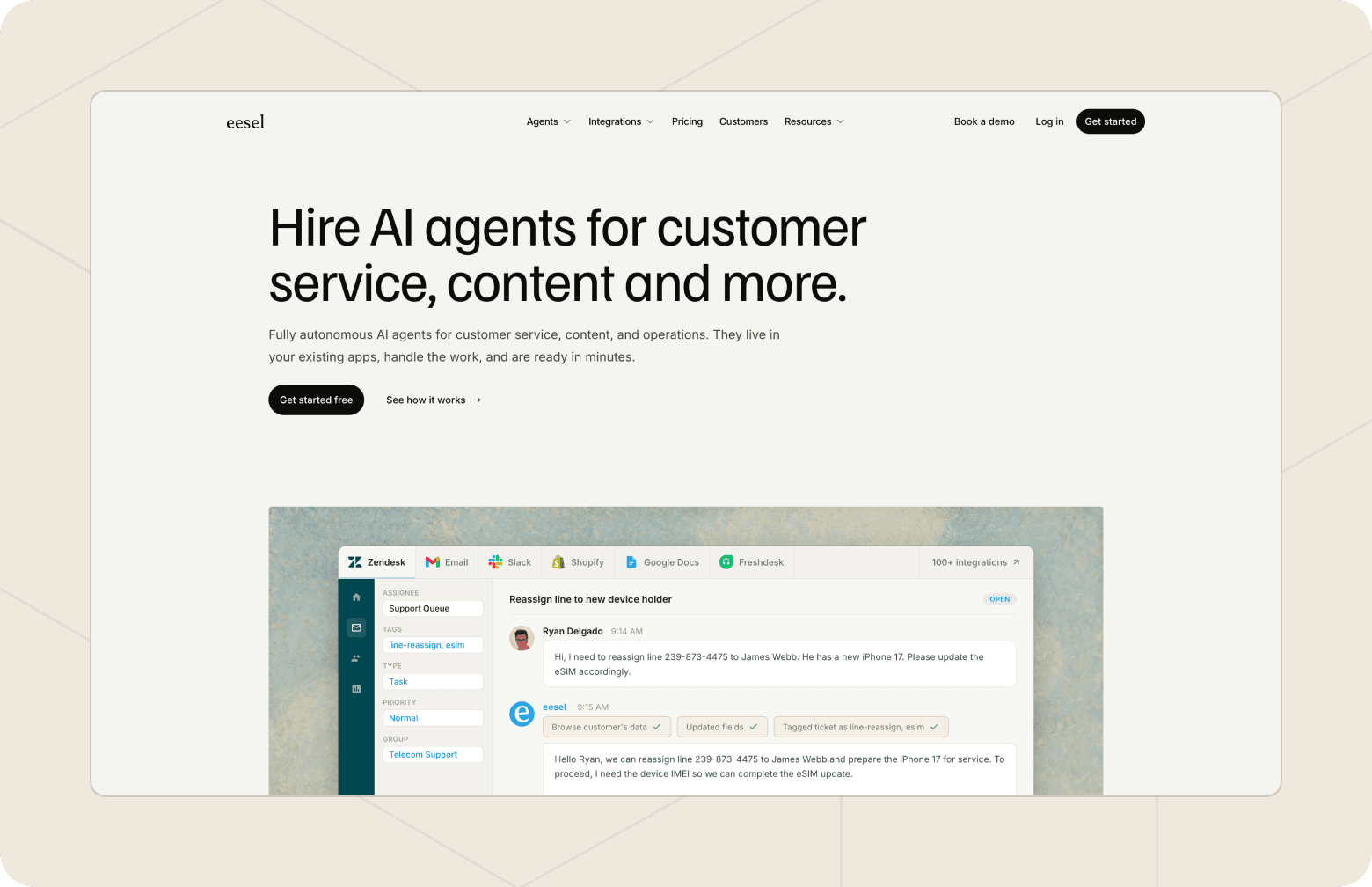
If your problem with Fin is the bill and the lock-in, not the capability, eesel AI is the most direct answer. It is an AI help desk agent that sits on top of the helpdesk you already run, including Zendesk, Freshdesk, Intercom, and Front, so there is no platform migration.
Where it fits: teams that want better, cheaper deflection on a stack they are keeping. Pricing is a flat $0.40 per ticket with no platform fee, which directly answers the per-outcome bill shock that pushes teams off Fin, where you pay for a handoff even when the agent could not resolve the case. eesel publishes customer deployments handling 50,000 to 100,000+ tickets a month.
Where it does not fit: eesel is a deflection layer, not a regulated case-work engine. It does not carry FS-native guardrails or the back-office depth a bank needs for disputes, collections, or KYC. It relocates the deflection ceiling at a better price; it does not break through it.
PolyAI: a solid choice for high volume, low touch voice support
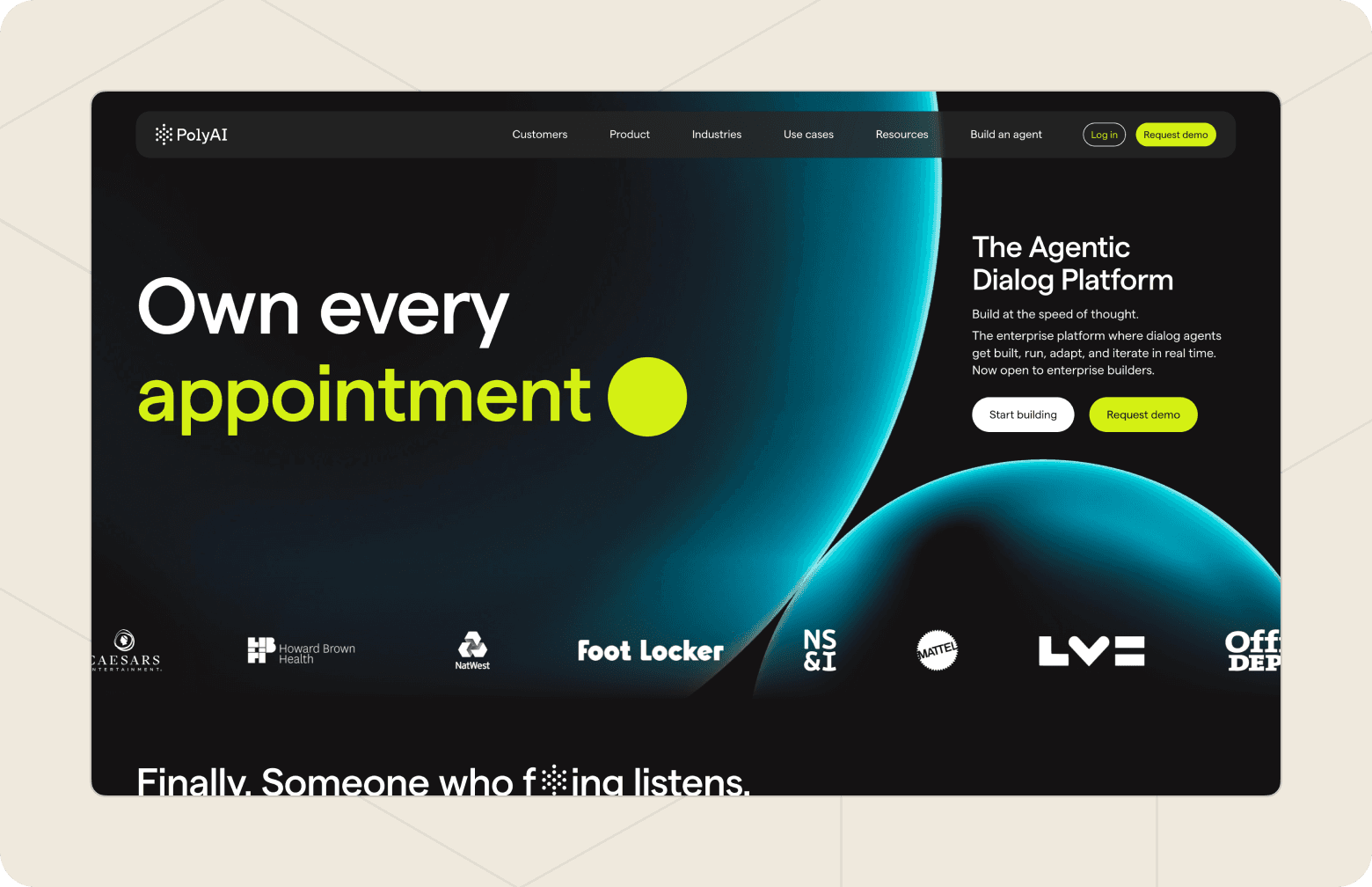
Fin Voice is new to the market and untested, so if the phone is your primary channel and you’re looking for high-volume, low-touch cases only, a specialist voice agent beats a chat tool with voice bolted on by default. PolyAI builds enterprise voice agents, with deployments at enterprise brands.
Where it fits: high-volume, low-touch phone support, IVR replacement, and call routing where natural, real-time voice is the priority for straightforward support cases. It is the clearest answer to the channel Fin handles least convincingly.
Where it does not fit: PolyAI is built around the voice conversation, not the multi-system back-office case that follows it. For a financial institution that needs voice intake to flow into investigation, decisioning, and a written audit trail, PolyAI's voice tool alone leaves the harder half of the work unautomated. Its security credentials are solid: ISO 27001 certified, with PCI-DSS and GDPR compliance. The risk for a regulated lender or bank is conduct, rather than data. As a horizontal voice platform spanning utilities, travel, and retail, PolyAI carries general brand-safety controls, not the always-on financial-services guardrails, such as vulnerability detection, complaints handling, and FCA Consumer Duty obligations, that an FS-native agent applies to every call.
Forethought (now part of Zendesk): best for agentic actions inside a Zendesk stack
Where Fin answers, Forethought is built to act. Its platform is a set of role-based agents around the support workflow: a Triage agent that classifies and routes tickets, a Solve agent that resolves queries and takes actions over your policies, a Discover agent that surfaces knowledge gaps, and a QA agent that scores interactions, with a copilot that assists human agents in real time. Together they reason, decide, and act rather than just retrieving a reply. One caveat is ownership: Zendesk acquired Forethought in March 2026, so it is now part of the Zendesk Resolution Platform rather than an independent vendor.
Where it fits: teams already standardised on Zendesk that want agentic resolution inside that ecosystem.
Where it does not fit: Forethought's agents are organised by support function (triage, solve, QA, and assist), all working around the support ticket. Running a regulated case end to end is a different job. A dispute or a collections matter is more than a ticket to route and close: it is a multi-step investigation that has to gather evidence, apply a decision, write back to the system of record, and leave a defensible audit trail. Gradient Labs' specialist agents share memory and context across the whole lifecycle, from frontline intake to back-office resolution, where Forethought's resolve-and-route model stops at the support layer. It also carries general support guardrails rather than FS-native conduct controls, and leaving Fin to escape lock-in only to adopt Zendesk's stack trades one dependency for another.
How to choose the right Intercom Fin alternative
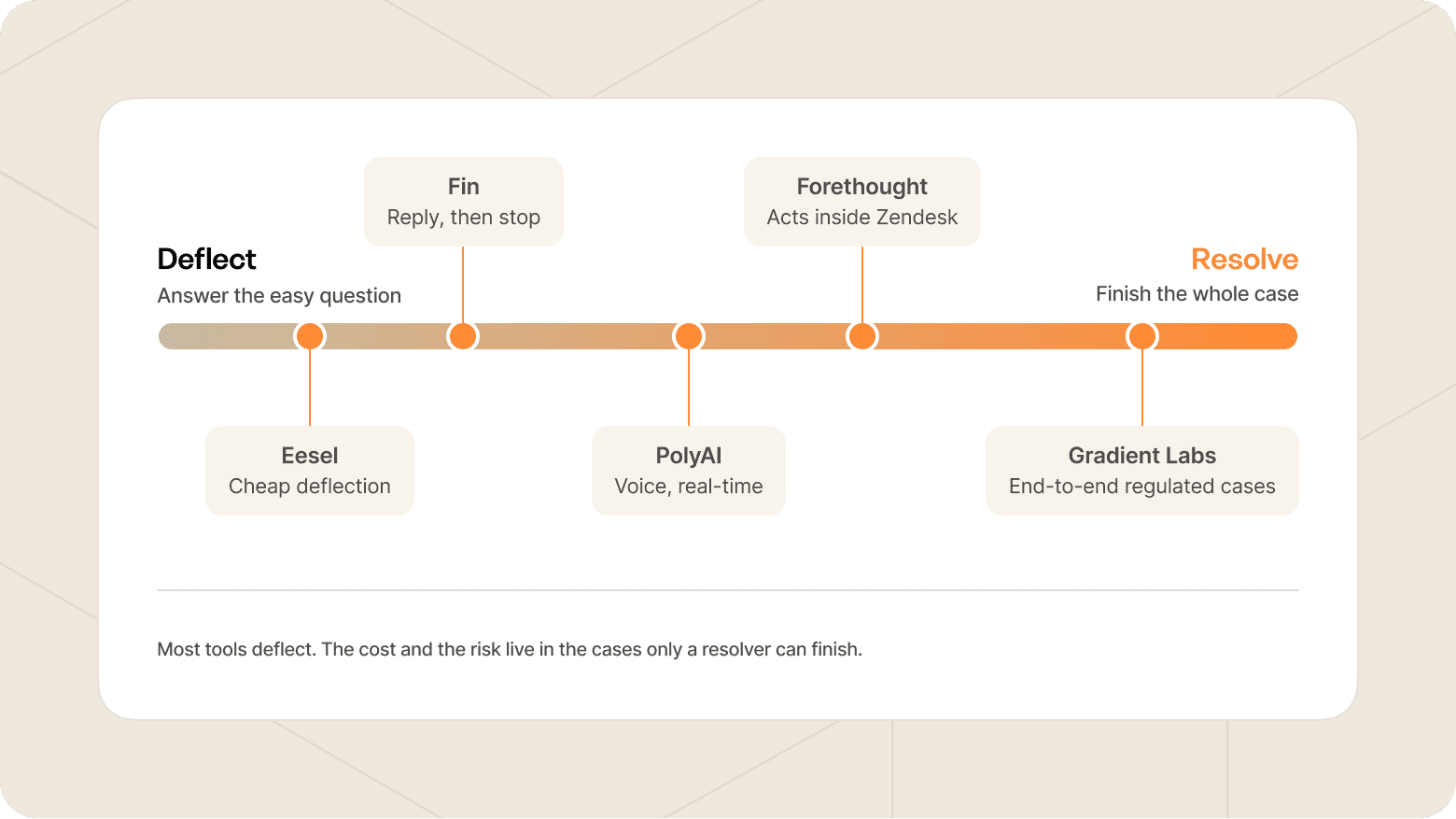
If selecting an alternative vendor, the right choice follows directly from what Fin is failing to do for you:
You want cheap, light deflection and you are keeping your helpdesk: eesel AI.
High-volume, low-touch phone calls are your primary channel, with little fear of regulation performance: PolyAI.
You want agentic actions and you live in Zendesk, with no penetration to deeper-layer back office tasks: Forethought.
Strong CSAT levels and the ability to handle your hardest, most regulated 20% where the highest cost and risk sit: Gradient Labs.
Fin is a genuinely capable product, and for high-volume customer support automation with clean docs and mostly simple queries, it earns its place. But financial services work is rarely simple at the bottom of the queue, and that is where a retrieval-and-deflect model runs out of road. If you are running disputes, collections, KYC, or any case that has to be investigated, decided, and audited, deflection speed is the wrong test. What matters is whether the agent can resolve the whole thing, safely, in a regulated environment.
That is the work Gradient Labs was built for. If you want help mapping your own queue against these options, book a demo, read how to choose an AI agent for financial services, or see how this plays out for AI in banking.


Elizabeth Shew leads Brand and Advocacy at Gradient Labs, where AI agents handle customer support and back-office work for banks, lenders, and fintechs. Before that, she led customer marketing at Mastercard and built Dynamic Yield's customer marketing programme from the ground up, a decade spent turning customer results into industry-shaping stories. She writes about how support and operations teams actually put AI and technology to work. Before tech, she was a professional dancer in NYC.