
What counts as AI customer support for regulated industries?
For regulated industries, the best AI customer support comes down to one test: would every action the agent takes survive an audit? Ticket volume and deflection rate, the numbers most vendors lead with, say nothing about that. A bank, lender or insurer answering customers with AI has to satisfy the same regulators and rules that govern its human agents, on every interaction.
That raises the bar in three places. The agent has to apply financial regulation in real time, from the UK's FCA Consumer Duty to the US Fair Debt Collection Practices Act, rather than rely on a generic security certificate. It has to log every decision, data point and guardrail check so a compliance team can reconstruct what happened. And it has to resolve the customer's problem end to end, because a firm that contains a vulnerability disclosure or a complaint without solving it has created a regulatory problem rather than closing one.
This is why a SOC 2 badge, on its own, tells a regulated buyer very little. SOC 2 attests to how a vendor handles data internally. It says nothing about whether the agent talking to your customers understands forbearance, tipping-off or a Section 75 claim. The EU AI Act classifies AI used to assess creditworthiness as high-risk, with documentation and human-oversight duties attached, so the regulatory surface is widening rather than narrowing. The eight platforms below all clear the data-security bar. They separate on regulatory depth and on whether they can show the work in production.
The 8 best AI customer support platforms for regulated industries at a glance
Platform | FS regulatory coverage | Certifications | FS compliance guardrails | Deployment | Best for |
|---|---|---|---|---|---|
Gradient Labs | FCA Consumer Duty, CONC, FDCPA, Reg E, Reg F, TCPA, UDAAP, Breathing Space, EU AI Act | SOC 2 Type II, GDPR, signed DPA, zero-data-retention | 20+ FS guardrails on every turn | AI delivery supports at every step | FS firms running frontline and back-office on one platform |
Fin (formerly Intercom Fin) | None FS-specific published | SOC 2 Type II, ISO 27001, ISO 42001, AIUC-1, HIPAA, GDPR | General AI guardrails | Self-serve on Intercom | Ecommerce and SaaS teams already on Intercom |
Ada | None FS-specific published | SOC 2 Type II, SOC 3, HIPAA, PCI DSS, GDPR | General | Self-serve or managed | High-volume ecommerce, travel and hospitality |
Sierra | None FS-specific published | SOC 2, ISO 27001, ISO 42001, HIPAA, PCI DSS, FedRAMP | General guardrails | Enterprise build with Sierra | Enterprise retail and consumer brands |
Decagon | None FS-specific published | SOC 2 Type II, GDPR, HIPAA (enterprise) | General AI guardrails | Enterprise build (needs engineering) | Enterprise ecommerce teams with engineering resource |
Lorikeet | FCA Consumer Duty, CONC, Reg E, UDAAP | SOC 2, ISO 27001:2022, HIPAA BAA-ready, GDPR-aligned | Dual-sided runtime guardrails, audit trail, PII redaction | Managed onboarding | Complex healthcare and fintech support workflows |
Zendesk | FSQS-registered (supplier qualification) | SOC 2 Type II, ISO 27001/27701, ISO 42001, FedRAMP, PCI DSS, HIPAA add-on | General | Native to Zendesk | Ecommerce, travel and B2C teams on Zendesk |
Fini | None FS-specific published | SOC 2, ISO 27001, GDPR | PII redaction | Self-serve | Fast-deploy ecommerce and SaaS support |
Gradient Labs takes the top position for financial services. Each platform is profiled below on the same criteria, in the same order, starting with us.
How we ranked them: compliance depth over deflection rate
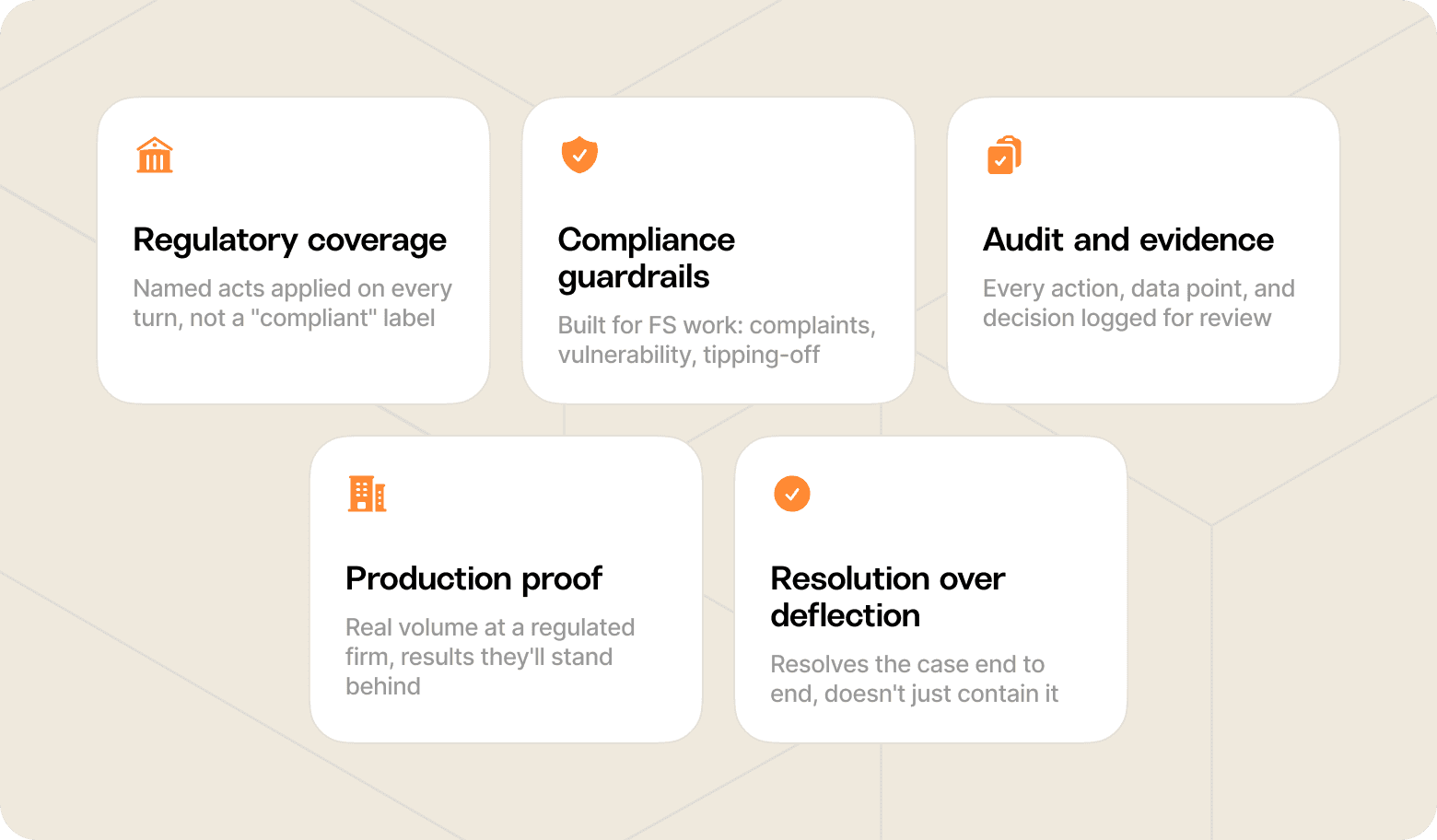
We ranked these platforms on the criteria that decide whether an AI agent is safe in front of regulated customers, in priority order:
Regulatory coverage: Does the platform apply named financial regulation (FCA Consumer Duty, FDCPA, Reg F, the EU AI Act) on every turn, or stop at a general security posture? We looked for specific acts, not "compliant" labels.
Compliance guardrails: Are there controls built for financial work, detecting complaints, vulnerability and financial difficulty, and catching tipping-off or false promises before a message goes out? Or are guardrails generic and left to the customer to configure?
Audit and evidence: Is every action, data point and decision logged in a form a supervisor can review?
Production proof: Has the agent run real volume at a regulated firm, with results that firm will stand behind publicly?
Resolution over deflection: Does the agent resolve the case end to end, or contain it and route it away? A contained complaint is still an open complaint.
Deflection rate sits low on that list by design. It is the figure most vendors lead with, and many AI support deployments plateau at a practical ceiling of 60 to 65% regardless. For a regulated buyer, an agent that resolves 60% of cases correctly and safely beats one that deflects 80% and mishandles a single vulnerable customer.
Which platforms have the strongest compliance posture for regulated industries?
1. Gradient Labs
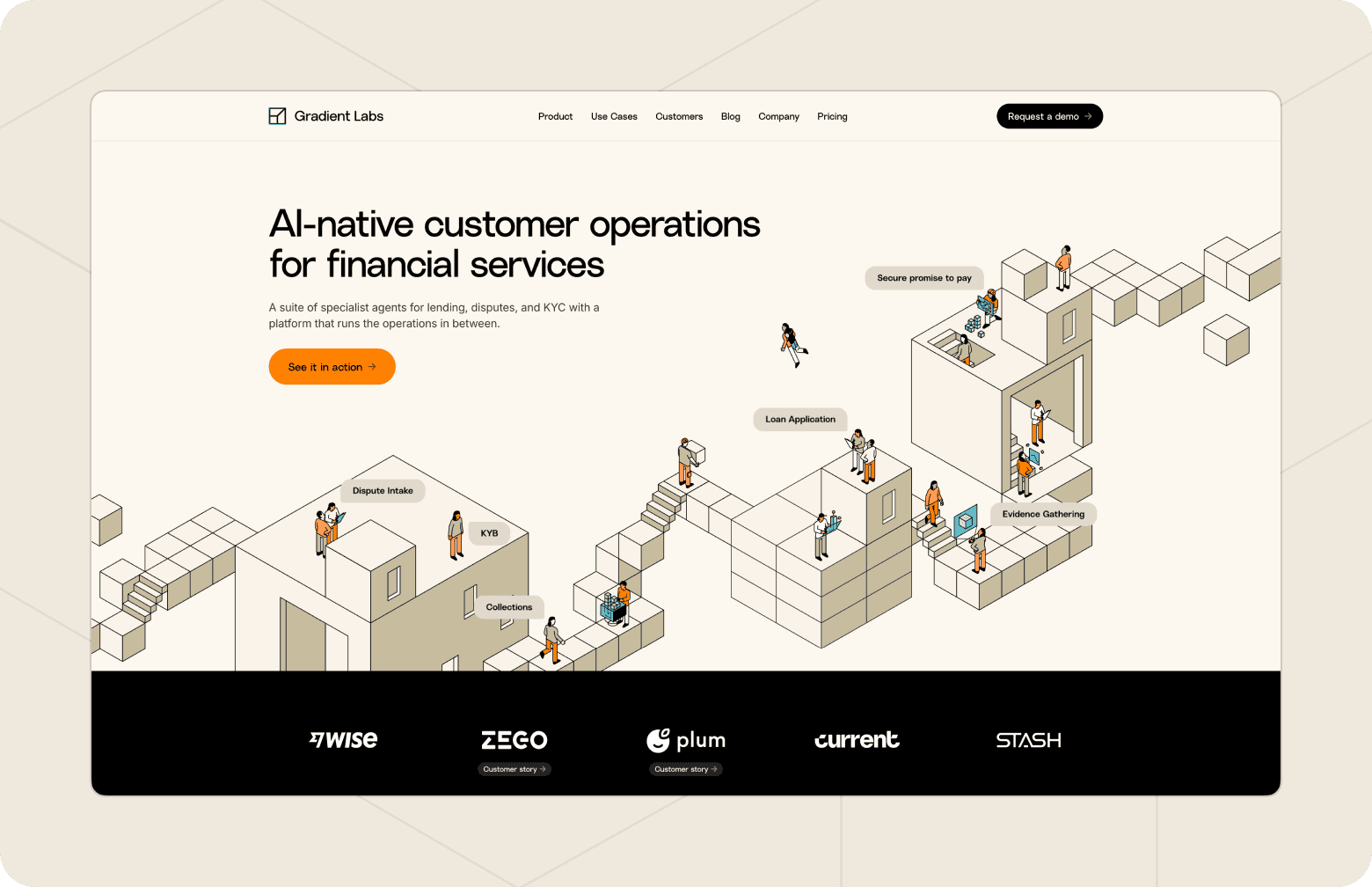
Gradient Labs is an AI-native customer operations platform built for financial services from the ground up. It runs both frontline customer conversations across chat, email and voice and the back-office case work underneath them, disputes, collections and KYC, on one platform with one delivery team. The team behind it comes from financial services: the founders ran Monzo's data organisation under FCA regulation, and the engineering team is almost entirely from FS, so the regulatory knowledge is held in house rather than read off a framework.
Key features: Specialist agents that share memory and context across every stage of the customer lifecycle. The agent asks a follow-up question to find the precise meaning before it acts, instead of guessing the most probable intent. Tone is learned from a company's best human agents, so replies read as native to the brand.
Compliance depth: 20+ financial-services guardrails run on every turn. Customer guardrails detect complaints, vulnerability and financial difficulty and reroute to a human; agent guardrails catch tipping-off, false promises and out-of-bounds advice, editing a draft before it reaches the customer. Coverage is configured by jurisdiction: FCA Consumer Duty, CONC and Breathing Space in the UK; FDCPA, TCPA, Reg F and UDAAP in the US; GDPR and the EU AI Act in the EU. Identity and authentication data is compartmentalised and never fed into general conversation unless you configure it.
Regulatory evidence: Live in production across regulated finance. At SteadyPay, an FCA-authorised lender, the agent runs 33,000 outbound voice calls a month. At Zego, a UK motor insurer, CSAT rose to 77% from 61%. At a consumer neobank, resolution rose by more than 70%. An independent agency penetration-tested the live agent and it passed, and customer security teams have tried to prompt-inject it in production without success. Every action, data point and guardrail check is logged to a full audit trail.
Certifications: SOC 2 Type II certified and GDPR compliant, with a signed DPA and zero-data-retention agreements with every core model provider. Telephony providers retain no audio, only call metadata.
Ideal for: Banks, neobanks, lenders and insurers running customer operations where compliance is non-negotiable, especially teams that want one platform across frontline and back-office rather than a separate tool per use case.
Pricing: Per resolution, with a deployment guarantee: your money back if a scoped use case is not delivered. The AI delivery team runs the migration into production in weeks, and CSV-only collections can start outbound calls in under a day.
"Now we make 33,000 calls a month, converting 60% of engaged customers to committed repayment dates, all within FCA compliance standards." Violeta Filip, Head of Customer Experience, SteadyPay.
2. Fin (formerly Intercom Fin)
Fin is Intercom's horizontal AI support agent, and a different company from Fini, which is profiled later. It resolves common first-line queries inside Intercom's inbox and on other helpdesks.
Key features: Fast first-line automation, per-outcome pricing, tight integration with the Intercom platform.
Compliance depth: A strong general security and AI-governance posture: SOC 2 Type II, ISO 27001, ISO 27701, ISO 42001, AIUC-1 (an AI-agent-specific standard Intercom promotes as a first for AI agents), HIPAA via a business associate agreement on enterprise plans, and GDPR. Guardrails are general-purpose, and no financial-services-specific regulatory controls (FCA, FDCPA) are documented as running on every turn.
Regulatory evidence: Widely deployed for general support automation across industries; no financial-services regulatory deployment proof is published.
Ideal for: Teams already on Intercom that want quick first-line automation, typically in ecommerce, SaaS and HIPAA-covered healthcare support.
3. Ada
Ada is a horizontal AI agent aimed at high-volume consumer support.
Key features: Automated resolution across channels, a no-code builder, broad language coverage.
Compliance depth: SOC 2 Type II, SOC 3, HIPAA, PCI DSS and GDPR, with its security program following the CIS v8 framework. ISO 27001 is not listed, and no financial-services-specific regulatory coverage is documented.
Regulatory evidence: A strong track record in high-volume B2C support; no regulated-finance regulatory proof published.
Ideal for: High-volume consumer support automation in ecommerce, travel and hospitality, and healthcare.
4. Sierra
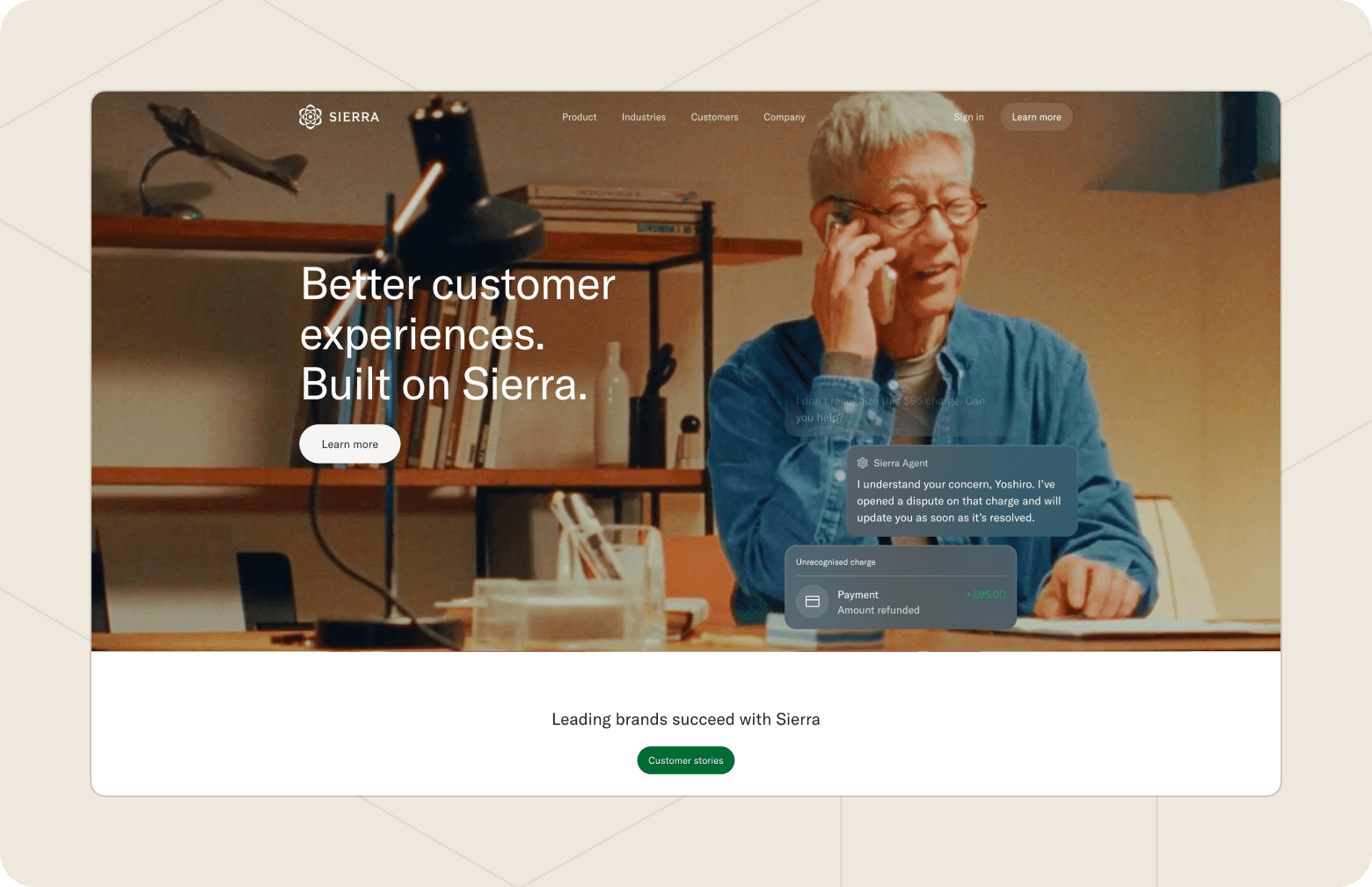
Sierra is an enterprise platform for building branded conversational agents.
Key features: Bespoke agent design, voice and chat, an outcome-based commercial model.
Compliance depth: One of the broader certificate stacks here: SOC 2 Type II, ISO 27001, ISO 42001, HIPAA, GDPR and PCI DSS, plus FedRAMP and CSA STAR. Guardrails are general, no financial-services-specific regulatory set is documented, and building and tuning the agent typically needs engineering involvement.
Regulatory evidence: Used by large consumer brands; no regulated-finance regulatory deployment proof published.
Ideal for: Enterprises building a bespoke branded agent with in-house technical resources, typically in retail, consumer brands and healthcare.
5. Decagon
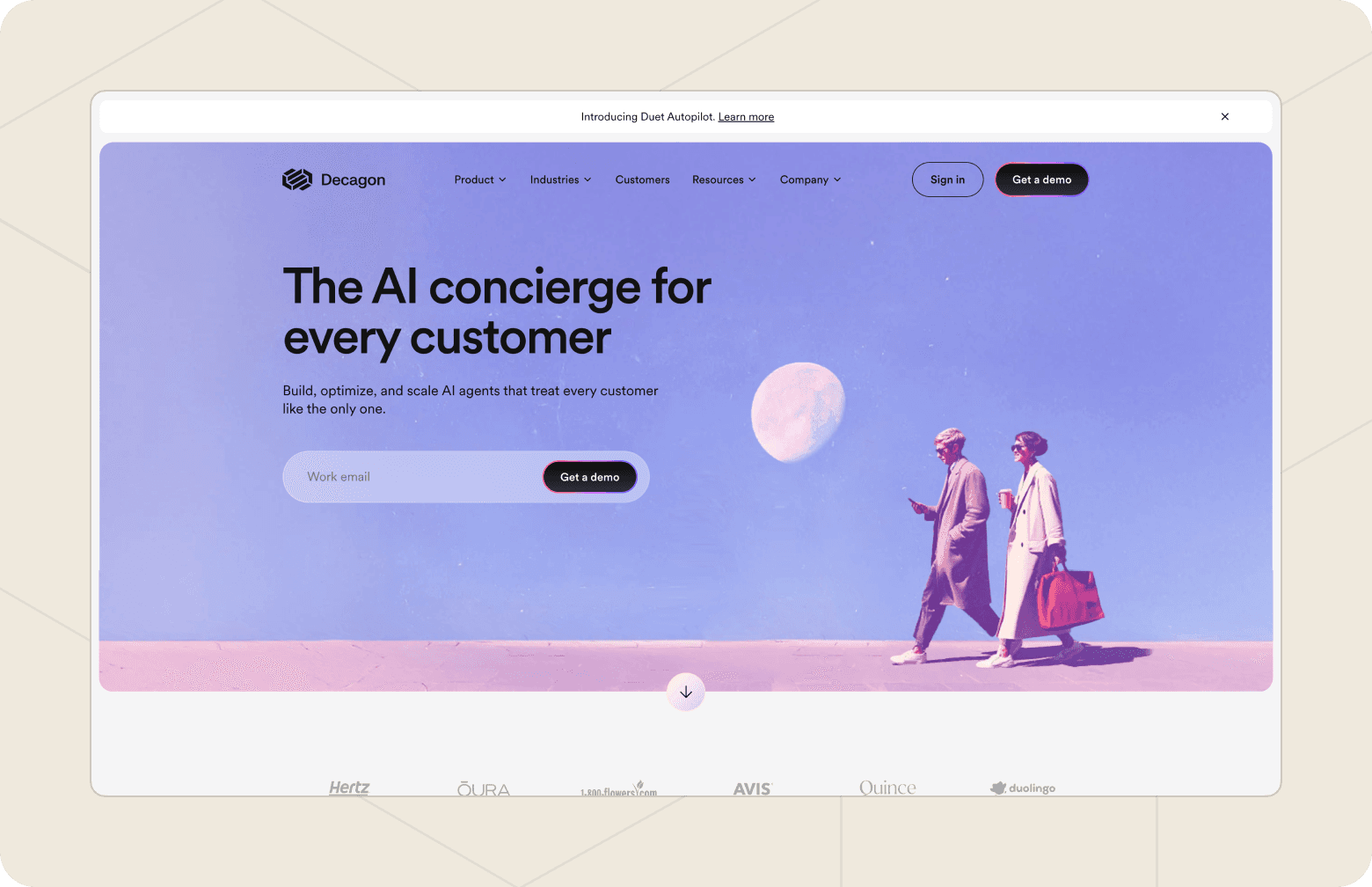
Decagon is a horizontal AI support agent for enterprise teams.
Key features: Conversational automation, analytics, and agent-assist features.
Compliance depth: SOC 2 Type II, GDPR and HIPAA on enterprise contracts, with AES-256 encryption and zero-day retention with model providers. ISO 27001 is not publicly listed, guardrails are general-purpose, and deployment typically needs engineering resource.
Regulatory evidence: Deployed at enterprise support teams; no regulated-finance regulatory proof published.
Ideal for: Enterprise support teams with the engineering capacity to build and maintain the agent, particularly in less regulated industries like ecommerce.
6. Lorikeet
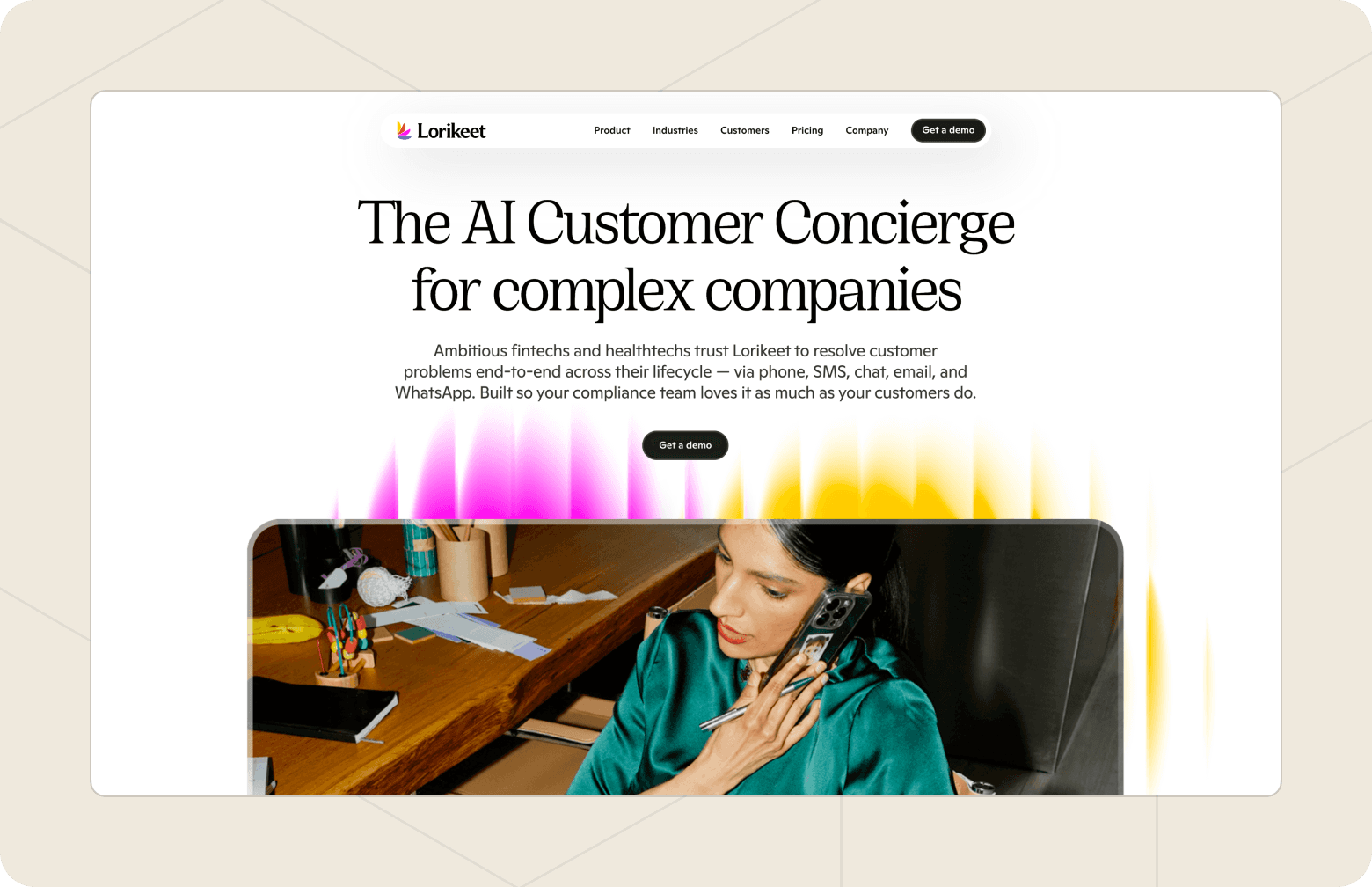
Lorikeet is an AI support agent positioned for complex, workflow-heavy support across healthcare and fintech.
Key features: A graph-based agent design for multi-step workflows, PII redaction, role-based access control, and data residency in the US, UK and Australia.
Compliance depth: SOC 2, ISO 27001:2022, HIPAA BAA-ready and GDPR-aligned, with a strong emphasis on audit trail and data handling. Lorikeet publishes the most FS-specific guardrail guidance of any horizontal vendor here: its articles map dual-sided runtime guardrails to FCA Consumer Duty, CONC, DISP and ICOBS in the UK and Reg E and UDAAP in the US, and describe a replayable, FCA-reviewable audit trail. That mapping lives in published guidance rather than a certified control set, FDCPA, Reg F and TCPA are not covered, and none of it is backed by named production proof.
Regulatory evidence: Reports passing security reviews at major US banks and positions heavily for fintech; no named regulated-finance customer or stand-behind-it results published.
Ideal for: Complex support in healthcare and other regulated industries, where a strong audit trail and configurable guardrails are needed. A good option for some fintechs, with the caveat that their financial-services knowledge comes from published guidance rather than in-house banking and regulatory operators.
7. Zendesk

Zendesk is the incumbent CX platform, now with an AI agent layer.
Key features: A mature ticketing and CX suite, an AI agent built into the same stack, and a large app ecosystem.
Compliance depth: Among the broadest certificate stacks of any vendor here: SOC 2 Type II, ISO 27001, 27017, 27018 and 27701, ISO 42001, FedRAMP, PCI DSS, and HIPAA via an add-on. It is registered on the UK Financial Services Qualification System (FSQS), which qualifies it as a supplier rather than adding agent-level regulatory controls. The AI agent itself carries general guardrails, not financial-services regulation on every turn.
Regulatory evidence: Used across financial services as a CX platform; the AI agent has no published regulated-finance regulatory proof distinct from the platform.
Ideal for: Teams standardised on Zendesk that want AI inside the same stack, across ecommerce, travel and hospitality and general B2C support.
8. Fini
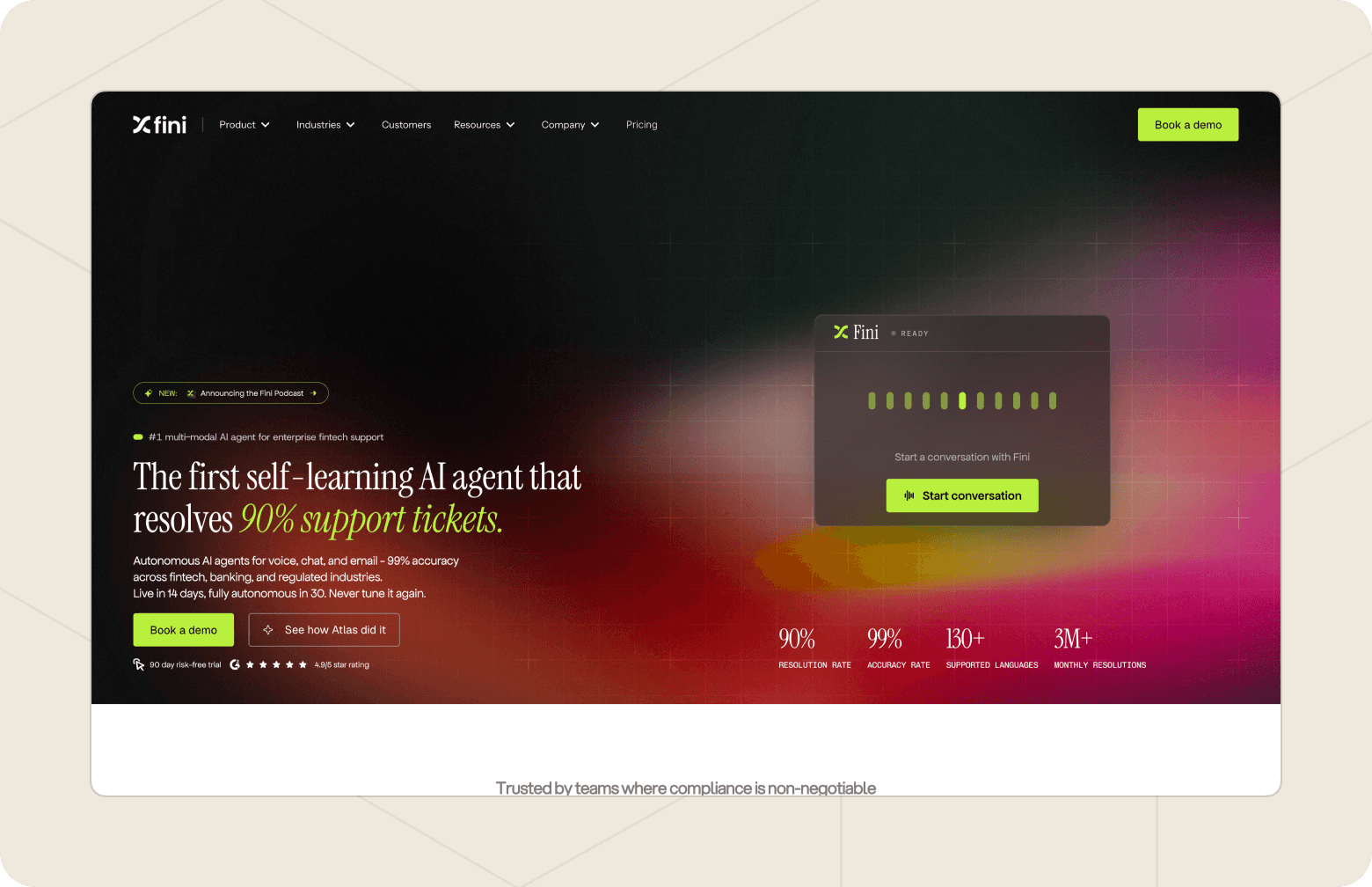
Fini (usefini.com, a separate company from Intercom's Fin above) is a horizontal AI support agent that markets heavily to compliance-critical teams.
Key features: PII redaction marketed as PII Shield, 20+ integrations, and fast deployment of around 48 hours.
Compliance depth: Its published materials list SOC 2 Type II, ISO 27001 and GDPR, with broader coverage marketed too, but financial-services-specific regulatory guardrails (FCA, FDCPA) are not documented as running on every turn.
Regulatory evidence: Positions for fintech, healthtech and insurance; no named regulated-finance regulatory deployment proof published.
Ideal for: Teams that want fast-deploy support automation with strong PII redaction, typically in ecommerce, SaaS and other consumer support.
How do you evaluate AI customer support for compliance?
The profiles above tell you where each platform stands today. Your own evaluation has to go further, because the evidence that matters most never appears on a security questionnaire. Five checks cover it.
Start with named regulations, not certifications
Ask which regulations the agent applies during a live conversation, and in which jurisdictions. A UK lender needs FCA Consumer Duty, CONC and Breathing Space handled in real time; a US collections operation needs FDCPA, Reg F and TCPA. A vendor that answers with a certificate list is telling you it has a security posture, not a compliance capability. The EU AI Act adds documentation and human-oversight duties to high-risk uses like creditworthiness assessment, so coverage has to extend to record-keeping as well as the conversation itself.
Ask how the compliance guardrails run
AI compliance guardrails only protect you if they run on every turn, without a human remembering to switch them on. Ask the vendor to walk a single message through the system end to end: what reads the customer's message, what checks the draft reply, and what gets logged when a check fires. Gradient Labs runs both sides. One layer reads the customer for signs of complaint, vulnerability or financial difficulty and hands off to a human; the other inspects the agent's draft for tipping-off, false promises and out-of-bounds advice before it sends. Firms with their own control frameworks can bring their own guardrails and run them alongside the built-in set. What separates vendors is whether that protection is built in and always on, or a configuration project your team assembles and then maintains as regulation changes.
Demand an audit trail a supervisor can replay
An audit-ready record captures every action the agent took, every data point it referenced, every tool it executed and the reasoning that connected them, on every case. When a regulator asks why the agent said what it said 6 months ago, "the model decided" is not an answer. Test this during the POC: pick a closed conversation and ask the vendor to reconstruct it step by step, including the guardrail checks that fired. If the reconstruction needs an engineer and a week, your compliance team will feel that on every complaint investigation and every audit.
Treat SOC 2 Type II as the entry ticket
Every AI customer service platform in this comparison holds SOC 2, so it cannot be the deciding criterion. It still needs reading properly: Type II attests that controls operated over a review period, usually 6–12 months, where Type I only captures a single day, so ask for the Type II report. Then look underneath it at the data handling that matters for AI specifically: zero-data-retention agreements with every model provider, a signed DPA, encryption at rest and in transit, and clear data-residency terms. Gradient Labs holds SOC 2 Type II, GDPR compliance and zero-data-retention agreements with every core model provider. None of that, from any vendor, tells you the agent behaves within FCA rules in front of a customer. Certification is the floor of the evaluation, not the outcome.
Weight production proof over demo performance
A demo shows the happy path. Ask for a named customer in your industry, with results that customer stands behind publicly, and ask what happened when the agent met vulnerability disclosures or complaints at volume. Independent evidence counts double here: an external penetration test of the live agent, and security teams that have tried to prompt-inject it in production, tell you more than any scripted walkthrough.
6 questions to ask every vendor
Put these to every platform on your shortlist and ask for evidence, not assurances:
Which regulations does the agent apply during a live conversation, and in which jurisdictions?
Are the guardrails always on, or configured and maintained by our team?
Can you replay a past conversation end to end, with every data point, tool call and reasoning step?
What are your data-retention terms with each model provider, and where does our data live?
Which named customer in our industry stands behind your production results?
What happens, step by step, when the agent meets a vulnerable customer or a complaint?
What are the red flags when evaluating an AI support vendor?
Some answers should end an evaluation early, so watch for these signals:
Guardrails that are configured, not built in: if compliance controls are a project your team assembles and maintains, they drift the moment a regulation changes.
An audit trail that is really a transcript: a chat log does not explain why the agent acted. You need every data point, tool call, and reasoning step, replayable months later.
Deflection rate as the headline number: a vendor leading with deflection is counting cases closed, not cases resolved safely.
Accuracy claimed without grounding: an agent that cannot show the source behind an answer, or the guardrail that checked it, sits one hallucination away from a compliance breach.
A certificate list standing in for regulatory coverage: SOC 2 and ISO attest to data handling, not to whether the agent understands forbearance, tipping-off, or a complaint.
No named customer in your industry: a demo shows the happy path, and a vendor that cannot point to a regulated firm publicly standing behind its production results has not proven the hard part.
What does AI customer support cost in a regulated industry?
Price the outcome rather than the seat. Regulated support costs more to run than standard support: every contact carries compliance, quality assurance, and audit overhead on top of the answer, so the real question is what a safely resolved case costs, not what a licence costs. Three pricing models dominate:
Per seat or per agent: predictable, but it rewards headcount over resolution and caps the saving at the number of licences you buy.
Per conversation or per contact: you pay whether or not the issue is solved, so a high deflection rate can flatter the bill while leaving cases open.
Per resolution: you pay when the agent resolves the case, which ties the cost to the outcome a regulated buyer actually cares about.
A per-contact or per-seat deal can look cheap while the agent contains cases it never resolves, which is why this guide weights resolution over deflection. Gradient Labs prices per resolution, with a deployment guarantee: once a use case is scoped, we guarantee the deployment, and if we do not deliver what we promised, you get your money back. Compare on the total cost of a resolved, audit-ready case, including the compliance setup and ongoing guardrail maintenance a generic tool pushes onto your team.
How do you deploy AI customer support in a regulated environment?
A regulated rollout is not a switch you flip, and the vendors that succeed treat it as a staged programme with a compliance sign-off at each gate. Run it in four phases:
Validate before you buy: confirm the named regulations, guardrails, audit trail, and production proof against your own jurisdiction and use case, and get compliance and risk in the room now rather than after signature.
Scope a contained pilot: pick one high-volume, well-understood journey, define what a resolved case looks like, and agree the escalation rules for complaints, vulnerability, and financial difficulty before a customer sees the agent.
Roll out behind guardrails: move that journey into production with guardrails on every turn and a human in the loop on the edge cases, then widen once the audit trail holds up under review.
Monitor and re-audit: review fired guardrails, escalations, and resolution quality on a set cadence, and re-check coverage whenever a regulation changes.
At Gradient Labs this is a managed migration: the delivery team stands up a scoped support or back-office use case in weeks, with an ops lead alongside them rather than an in-house AI team. Coverage then has to be maintained as the rules change, not configured once and forgotten.
Which regulated industries beyond financial services can use AI customer support?
The same test applies wherever a regulator governs the conversation: named rules enforced in real time, a replayable audit trail, and production proof. Only the rulebook changes.
Healthcare and healthtech: patient-data handling under HIPAA in the US, with the same demand for audit-ready records and human escalation on clinical or vulnerability signals.
Insurance: claims, complaints, and vulnerable-customer handling under conduct rules such as the FCA's, close cousins of the duties a bank already meets.
Gambling and gaming: affordability, self-exclusion, and responsible-gambling cues an agent has to detect and act on, not merely log.
Gradient Labs is built for financial services, where the regulatory bar is highest and our team's experience runs deepest. Firms in adjacent regulated industries can run the same evaluation, weighting the checks in this guide against their own regulator's rules.
Choosing an AI customer support platform for a regulated environment
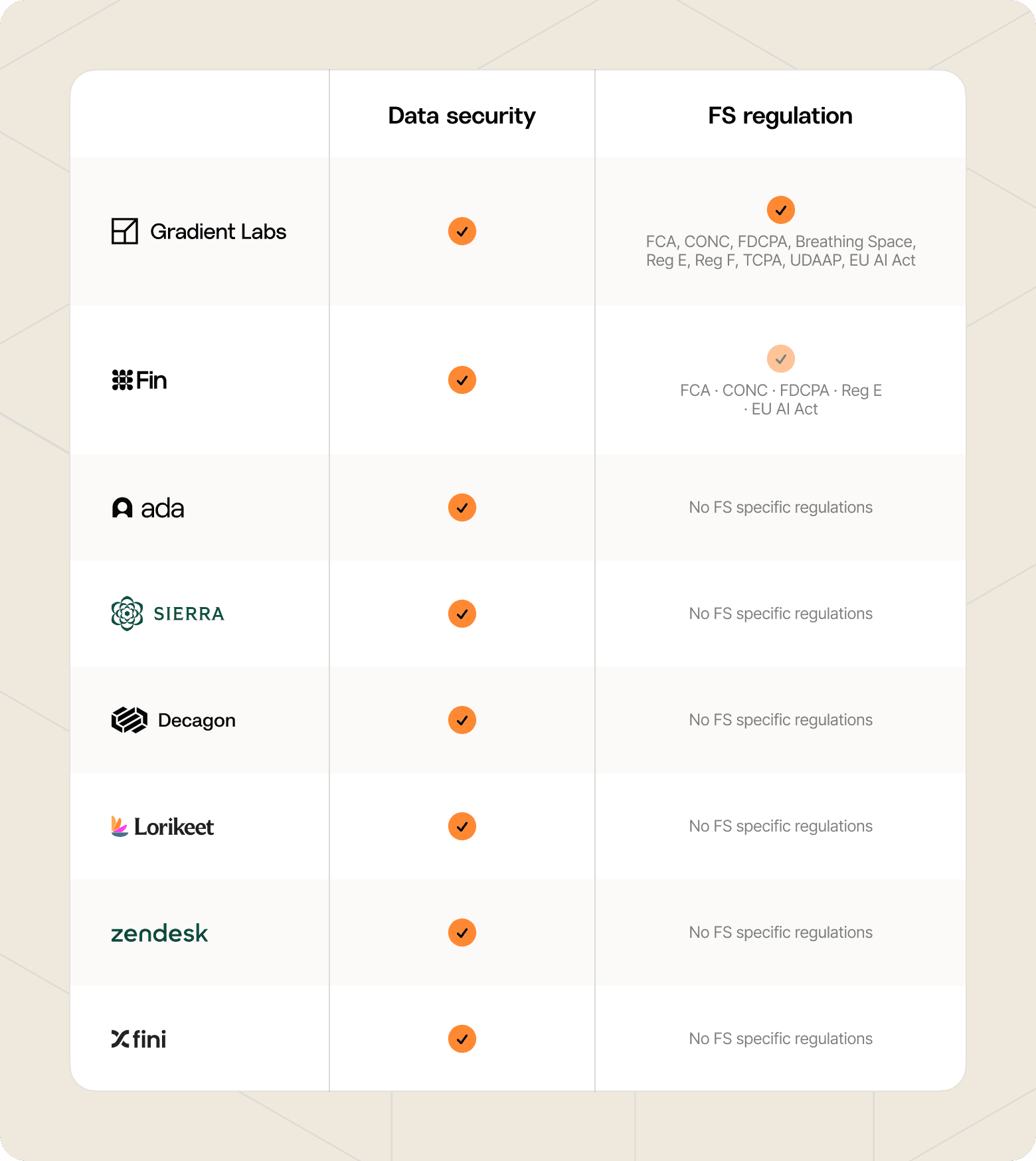
The pattern across this field is consistent. The horizontal agents and incumbents all clear the data-security bar, several with broader certificate stacks than a buyer strictly needs. What none of them can show is financial-services regulation enforced on every turn and backed by named production proof at a regulated firm. Where one describes FS-aware guardrails in its published guidance, it still has no named regulated customer standing behind the results. For a bank, lender or insurer, that gap is the whole decision.
If your operation is non-financial, or you mainly want fast first-line automation inside an existing helpdesk, a horizontal agent may fit you better, and this guide profiles the strongest ones fairly. If compliance depth, audit-ready evidence and regulated-finance proof are non-negotiable, start with the platform built for it. For a structured way to run that evaluation, see our guide on how to choose an AI agent vendor for financial services.
Book a demo to see the guardrails and the audit trail running on your own use case.


Emma Martin is the Head of Marketing at Gradient Labs. Prior to Gradient Labs, she held global marketing leadership roles at Bluecore (acquired by Insider One), Mastercard, and startups on the fronteir of conversational AI. She writes about the intersection of AI, automation and customer experience in financial services.