

If you’re looking for an AI agent for customer support, Sierra is probably already on your shortlist. It is one of the best-funded AI agent companies in the world. Meanwhile, Gradient Labs runs customer operations for financial services companies like Wise, Current, and Pockit, and resolves 80–90% of conversations in mature deployments.
If you’re selecting an AI agent for a regulated customer operation, like banking, there are factors to consider that don’t apply in unregulated industries. In this guide, we outline how each of those factors influences a Gradient Labs vs. Sierra comparison. It covers what each platform does, where each one wins, and the five tests that will help settle the question in your own bake-off.
What do Gradient Labs and Sierra actually do?
Both platforms deliver AI for customer support, both take real actions in your systems, and both price on outcomes rather than seats. The overlap ends there.
Sierra is the horizontal platform of the two: enterprise brands use it to build a branded conversational agent that answers customers across chat, SMS, WhatsApp, email, voice, and ChatGPT. Its Ghostwriter tool builds the agent from SOPs, call transcripts, and plain-English goals, and its analytics suite monitors how conversations perform. The same underlying machinery serves airlines, retailers, media companies, and banks. Sierra's own material is candid about that breadth. The question for a regulated buyer is whether general-purpose machinery clears a financial-grade bar.
Gradient Labs is an AI-native customer operations platform for financial services, built for finserv from the ground up. The agent answers frontline conversations on chat, email, and voice, and runs the back-office work underneath them: disputes, collections, and KYC cases that span days, gather evidence, and stay within regulatory lines. One platform runs the case end to end.
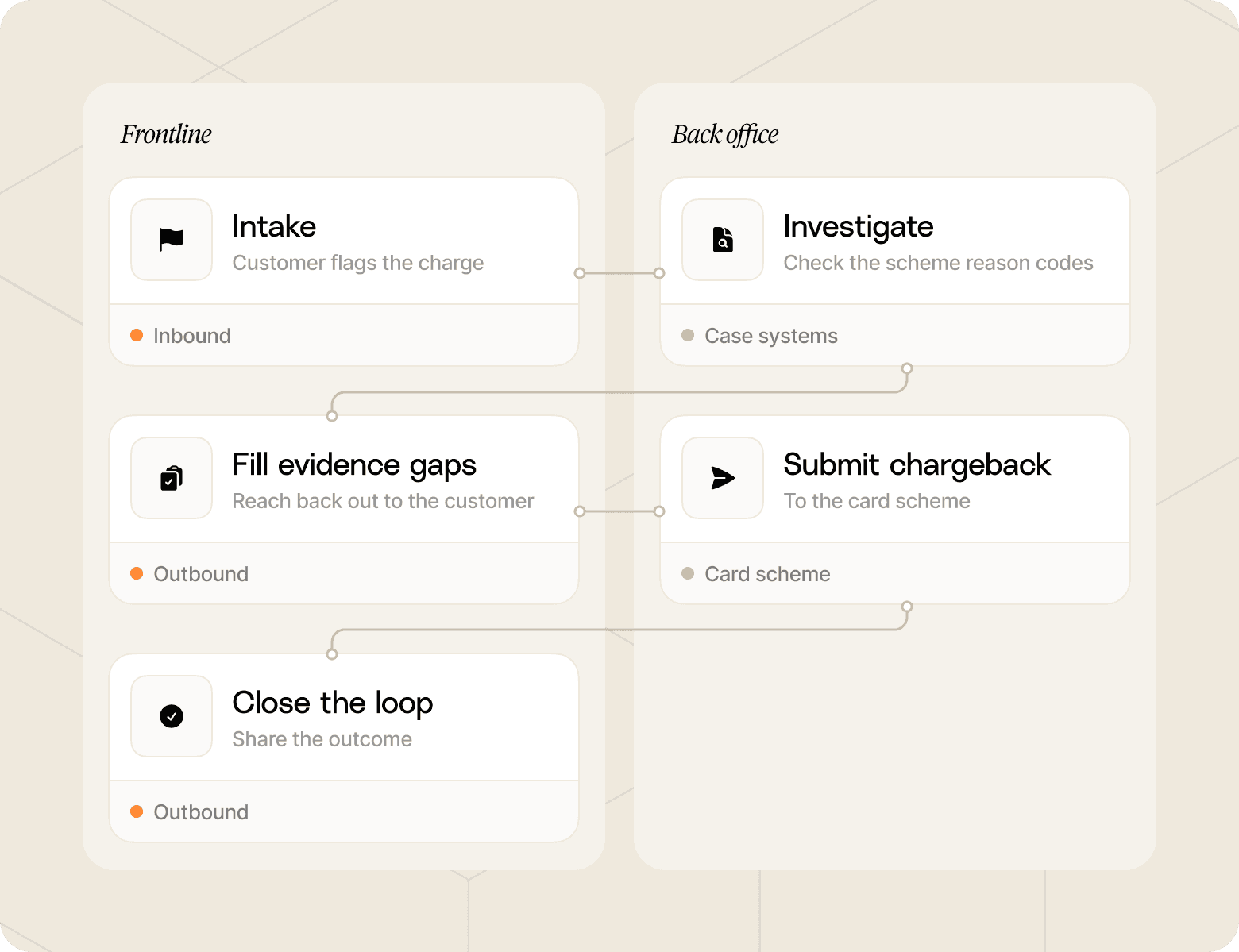
The distinction matters because so much financial services work runs longer than a single conversation. A disputed transaction starts on the frontline when a customer flags a charge, runs through investigation and chargeback work in the back office, and closes back on the frontline with the outcome. An agent that only handles the conversation leaves the rest of the case in your ops queue.
Gradient Labs vs. Sierra at a glance
Platform | Resolution rate | Compliance posture | Deployment | Pricing model | Best for |
|---|---|---|---|---|---|
Gradient Labs | 60% from day one, 80–90% in mature deployments | SOC 2 Type II, GDPR, signed DPAs, zero-day retention with core model providers, independently pen-tested; 20+ FS guardrails covering FCA Consumer Duty, Reg F, and the EU AI Act | Live in 4–6 weeks with an FS-native delivery team | Per resolution, with a deployment guarantee | Banks, lenders, and fintechs running frontline and back-office work on one platform |
Sierra | Customer-reported: 70–90% in published case studies, predominantly non-finance | SOC 2 Type II, ISO 27001, ISO 42001, HIPAA, PCI DSS, GDPR, EU AI Act | Agent built with Sierra's team; timelines not published | Outcome-based; custom quotes, no published rate card | Consumer enterprise brands building one branded agent across every channel |
Why are teams comparing Gradient Labs and Sierra?
Because the first generation of AI customer service deployments hit a ceiling. Teams that bought customer support automation typically stall at 60–65% on a complex financial services operation, because the remaining work runs across days and systems rather than inside a single chat. The pains surface in discovery calls with striking consistency: endless guardrail tweaking to keep the agent inside policy, escalation queues that never shrink, verification flows that still need a human to check an image or a document, and the expensive work (disputes investigation, arrears handling, KYC review) sitting exactly where it was.
Buyers weighing the two platforms are usually asking one underlying question: will this agent resolve the whole case, or reply to the first message of it? In a regulated operation the stakes run higher, because every conversation has to stay inside lines set by regulators, from FCA Consumer Duty in the UK to Reg F in the US. The comparison below is built around that question.
Why trust Gradient Labs?
Gradient Labs was founded by the team that built UK neobank Monzo's data organisation under FCA regulation, and it runs customer operations for Wise, Current, Stash, Pockit, SteadyPay, Zego, Plum, and Morse. The published numbers hold up in production: a 70% resolution rate at Pockit, a 98.6% quality assurance score at Plum, 84% CSAT at a digital bank at scale, and 33,000 AI voice calls a month at SteadyPay.
Yoan Yedrowiak, Head of Customer Success at Plum, puts it in bake-off terms: "Gradient's AI solution delivered impressive results with minimal effort on our part. The proof of concept made the decision clear, and the rollout was seamless. Seeing such a high CSAT and resolution rate validated our choice."
Resolution is the operative word. Plenty of agents deflect: they contain a ticket, keep it away from the human queue, and count that as a win. Gradient Labs counts a conversation only when the customer's problem is solved end to end. Before launch, the platform extracts how your best human agents handle tone, edge cases, and compliance from past conversations, which is why customers start at 60% resolution from day one rather than after months of learning through escalations, and reach 80–90% as the deployment matures.
What is Sierra and how does it work?
Bret Taylor and Clay Bavor founded Sierra in 2023, Taylor arriving from co-running Salesforce (he now chairs OpenAI) and Bavor from nearly two decades at Google, where he ran Google Labs. The platform raised $950M in May 2026, led by Tiger Global and GV, and TechCrunch reported the round at a $15.8B post-money valuation, with roughly $1.6B raised in total.
The product centres on one branded agent deployed everywhere. Ghostwriter builds the agent from your SOPs, transcripts, and plain-English instructions, and the agent then answers customers across chat, SMS, WhatsApp, email, voice, and ChatGPT. An Agent Data Platform underneath integrates customer data and keeps the agent's memory, so responses draw on who the customer is rather than the knowledge base alone. Monitoring tools flag problem conversations, and an experimentation layer runs multivariate tests on agent behaviour. Sierra publishes an outcome-based pricing model: you pay when the agent achieves an agreed outcome, with custom quotes rather than a published rate card.
The certification list is broad: Sierra’s own trust centre lists SOC 2 Type II, ISO 27001, ISO 42001, HIPAA, PCI DSS, GDPR, EU AI Act, and FedRAMP High.
Where does Sierra fall short for financial services?
Three gaps show up when the evaluation gets specific, and none of them shows up in a scripted demo.
The work underneath the ticket. Sierra's agent resolves conversations. It does not run the multi-day case work that sits behind them in a financial services operation: the dispute investigation, the KYC review, the arrears plan. When the conversation ends, that work lands back in your ops queue, and your automation ceiling lands with it.
Who owns the iteration work. G2 reviewers note that clients cannot easily edit agent logic or prompts themselves, and that changes often require contacting Sierra's team. An ops team tuning procedures weekly, which is the reality of a regulated operation, either waits on that loop or staffs engineers to own the agent. Gradient Labs takes the opposite approach: an ops lead configures the agent directly, working with a delivery team that stays through the automation journey. Ian Kershaw, VP of Customer Service, Claims and Fraud at Zego, describes that model: "They work like an extension of our team that knows our pain points and shares our goals."
Depth on regulated conversations. Sierra's guardrails are horizontal by design, built to serve an airline and a bank with the same machinery. Financial services conversations carry specific failure modes (vulnerable customers, complaints, potential fraud, tipping-off risk) that need purpose-built detection and handling on every turn. The sharpest failure mode is an agent that tells a customer it has taken an action it cannot take, like filing a dispute; Gradient Labs runs a hard guardrail that stops the agent claiming an action it has not performed, because in a regulated operation one confident false promise can end in a formal complaint. G2 reviewers also note that Sierra’s AI agent can lose context in longer conversations, and long-running cases are precisely the shape of financial services work, making it better suited for Gradient Labs’ architecture.
None of this makes Sierra a weak product. It is a strong product built for a different job, and the way to see the difference is to test both against the job you actually have.
What should you test in your own bake-off?
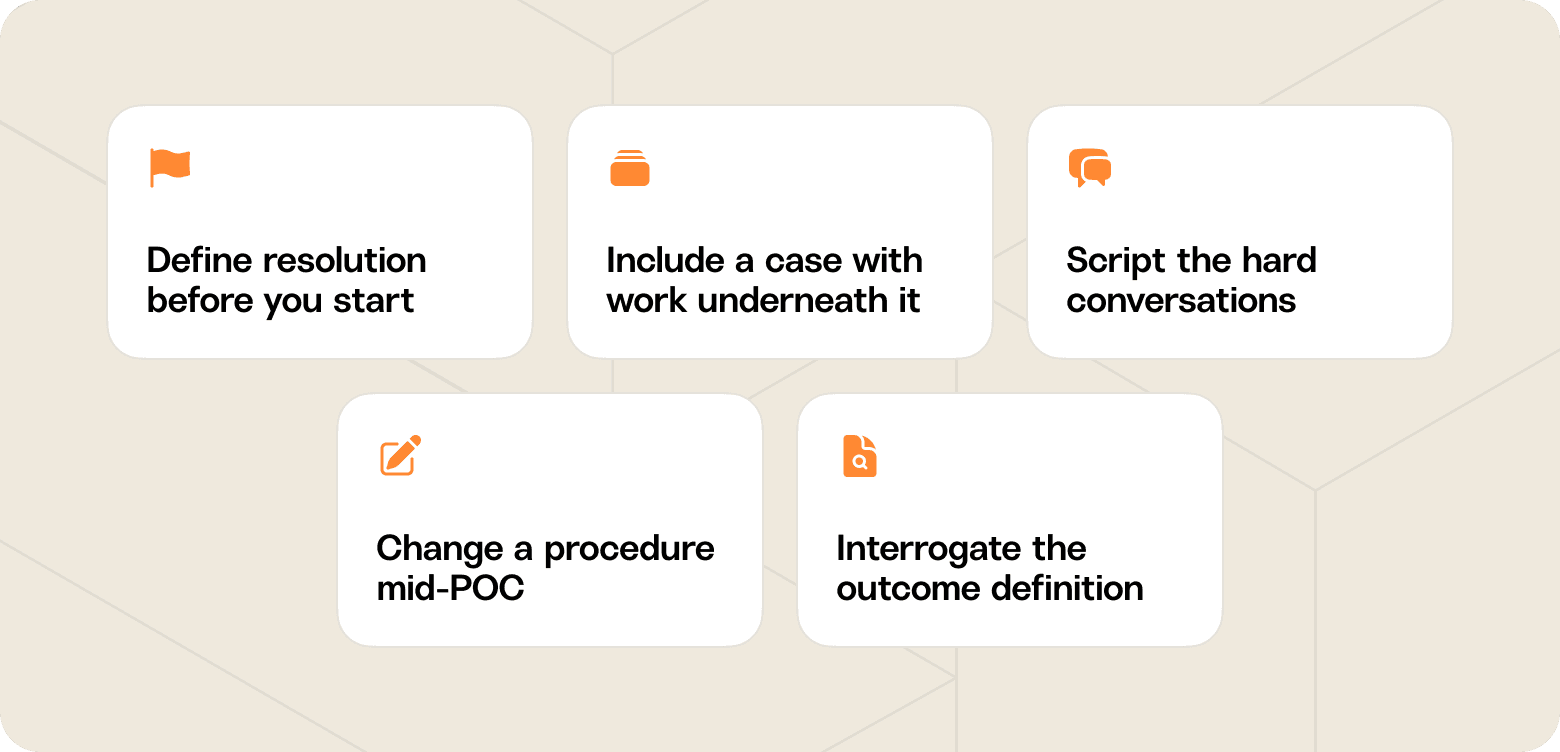
A bake-off is a side-by-side evaluation on your own case types, and it settles a vendor comparison faster than any published number, ours included. The honest way to compare vendors is to make both prove their claims on your cases. Five tests separate these two platforms:
Define resolution before you start: agree that a conversation counts only when the customer's problem is solved end to end, then measure both agents against that definition. Deflection and containment metrics flatter an agent that stops at the first reply.
Include a case with work underneath it: give both platforms a real dispute or collections case and watch what happens after the first conversation ends. One agent should run the investigation steps; the other will hand you a well-written reply.
Script the hard conversations: send in a vulnerable customer, a complaint, and a suspected fraud report. Check what each agent detects, how it reroutes or edits its own replies, and whether the audit trail records every data point referenced and every tool executed. Check whether either agent ever claims to have taken an action it didn’t take.
Change a procedure mid-POC: update an SOP in week two, then measure how long the change takes to reach production and who had to make it. This test predicts your operating cost for the next three years better than any demo.
Interrogate the outcome definition: both vendors price on outcomes, so ask each what counts as billable and read the definition closely. A reply that deflects a ticket and a resolution that closes a case are very different outcomes at the same price point.
Gradient Labs has never lost a head-to-head bake-off on resolution rate or CSAT. We run POCs on your own case types and back the result with a deployment guarantee: once a use case is scoped, deployment is guaranteed, and if the agent doesn’t deliver, you get your money back. Our guide on how to choose an AI agent vendor for financial services covers the longer evaluation checklist, and digital-first teams can follow how to deploy AI agents for neobanks for the rollout stages.
Gradient Labs vs. Sierra: which should you choose?
Choose Sierra if you are a consumer enterprise brand outside regulated industries and the job is one branded agent answering customers on every channel. That is what the platform was built for.
Choose Gradient Labs if you are a bank, lender, or fintech and the job is running a customer operation: frontline support plus the back-office work like disputes, collections, and KYC underneath it, inside regulatory lines, with a secure AI agent for banking that has already cleared compliance review at regulated institutions. Weighing other vendors too? We have published the same head-to-head for Intercom Fin vs Gradient Labs, and our guide to the best Sierra AI alternatives maps the wider field for financial services.
The bake-off will tell you the same thing faster than this page can, and Gradient Labs has never lost one on resolution rate or CSAT. Book a demo and run one on your own cases.

Elizabeth Shew leads Brand and Advocacy at Gradient Labs, where AI agents handle customer support and back-office work for banks, lenders, and fintechs. Before that, she led customer marketing at Mastercard and built Dynamic Yield's customer marketing programme from the ground up, a decade spent turning customer results into industry-shaping stories. She writes about how support and operations teams actually put AI and technology to work. Before tech, she was a professional dancer in NYC.