

If you run customer operations at a bank, lender, insurer, or fintech, Decagon and Gradient Labs sit near the top of most customer service AI shortlists. Buyers tend to bucket them together: both replace the scripted chatbot generation, both publish strong resolution numbers, and both sell to teams drowning in support volume. However, the Decagon vs Gradient Labs decision is a layer deeper than frontline support. Decagon automates frontline conversations; Gradient Labs not only runs the frontline, but can operationalise the case work behind it, with compliance built into the architecture to guarantee security at every step. This guide compares the two head to head: what each does, where each wins, and how to choose with your risk team in the room.
What do Decagon and Gradient Labs each do?
Decagon is a horizontal AI agent platform for enterprise customer support, self-described as "the AI concierge for every customer". Teams define agent behaviour through Agent Operating Procedures: natural-language workflows that describe how the agent should handle each situation. The agent deploys across chat, email, and voice, with testing, A/B experiments, and analytics alongside. Decagon serves customers across technology, travel, retail, and consumer apps, and has raised heavily on that momentum, most recently a $250M Series D at a $4.5B valuation, taking total funding past $480M, according to CMSWire.
Gradient Labs is the AI-native customer operations platform for financial services. Most AI agent companies stop at the conversation layer; Gradient Labs runs frontline support, proactive outreach, and back-office work like disputes, collections, and KYC through a suite of specialist agents that share context and memory across every stage of a case. The platform was built for finserv from the ground up: more than 20 financial services guardrails run on every turn, and every agent action lands in a full audit trail. Customers include Wise, Pockit, Zego, and some of the largest, most regulated financial institutions in Europe.
The overlap is real: both platforms resolve frontline conversations well. The difference is scope and posture, and for a regulated operation that difference decides the evaluation.
Decagon vs Gradient Labs at a glance
The verdict: for financial services, Gradient Labs wins. It runs the whole case rather than the conversation alone, its compliance controls are the architecture rather than a configuration project, and its delivery team removes the engineering burden that Decagon's model assumes you can absorb. Decagon remains a capable choice for high-volume enterprise support outside regulated industries.
Platform | Resolution rate | Compliance posture | Deployment time | Pricing model | Best for |
|---|---|---|---|---|---|
Gradient Labs | 60% from day one, 80–90% in mature deployments | 20+ FS-native guardrails on every turn; SOC 2 Type II | 4–6 weeks; AI delivery team runs the migration | Per resolution, with a deployment guarantee | FS firms running frontline and back-office work on one platform |
Decagon | Decagon-published: 90%+ autonomous resolution at Flashfood, a grocery marketplace | Trust centre published; generic controls, not FS-specific | Weeks to months; needs a dedicated agent engineer | Custom pricing; no published rate card | Enterprise support teams with engineering resource |
Why trust Gradient Labs with a regulated operation?
Gradient Labs runs customer operations for regulated financial services companies including Wise, Plum, Morse, and SteadyPay. The founders ran Monzo's data organisation, growing it past 120 people under FCA supervision, and most of the engineering team arrived from financial services companies. That background shows in the product's assumptions: intent-first reasoning that asks before it acts, guardrails that detect vulnerability and complaints, and an audit trail designed for the person who has to defend it.
Their customer proof points are also strong across the board. At one UK card fintech, Gradient Labs' frontline and back-office agents run across chat and email, outbound collections calls, and dispute investigations, sharing full case context so that when evidence is missing the customer hears about it in the same conversation.
The deployment carries a guarantee, too: once a use case is scoped, if Gradient Labs doesn't deliver what it said it would, you get your money back.
Where does Decagon fit best?
Decagon is a genuinely strong platform, and its published numbers earn the attention they get. Decagon's own site reports a 90%+ autonomous resolution rate at Flashfood, a grocery marketplace, an 80% deflection rate at the language-learning app Duolingo, and a 95% cost reduction at the fitness membership platform ClassPass. Reviewers on G2 consistently praise the responsiveness of its team and the quality of its integrations, and its customer list spans some of the fastest-growing consumer brands in the US.
Decagon fits best where three conditions hold:
High volumes, lighter regulation. Its strongest published results come from consumer apps, travel, and technology, where a wrong answer costs a bad experience rather than a regulatory breach.
Engineering resource to spend. Decagon's customers describe a dedicated "agent engineer" who builds Agent Operating Procedures, integrates systems, and tunes behaviour. G2 reviewers describe implementations spanning weeks to months. If your organisation has that capacity, the platform rewards it with fine-grained control.
The conversation is the case. Decagon automates frontline interactions well, and its voice numbers are growing: the company reports consumer brands like the retailer Hunter Douglas generating more than $1M in revenue from fully AI-handled conversations. Password resets, subscription changes, and order status resolve inside a single conversation, which is precisely the shape of work a horizontal agent handles.
For a financial services operation, the same reviews flag the gaps that matter. G2 reviewers describe user roles that are still basic and audit logs without the depth compliance teams need, "which can cause issues when tracing activity or ensuring compliance," and note that guardrail controls are still being built out. For a platform serving every industry at once, those are forgivable growing pains. For a bank whose regulator asks for the audit trail as evidence, they decide the evaluation.
Where does Gradient Labs fit best?
Gradient Labs was built for the work a financial services operation actually runs, and the difference shows up in three places.
The frontline layer holds its own. During onboarding, the agent ingests your help centre and reviews thousands of historic human conversations, capturing the institutional knowledge that never makes it into a knowledge base, then matches your team's tone of voice. Yonder's inbound AI customer service agent consistently scores an 80–90% CSAT rating while handling genuine account matters: promotion eligibility, credit limit increases, plan adjustments, and account suspensions, each involving identity checks and policy judgement rather than FAQ lookups.
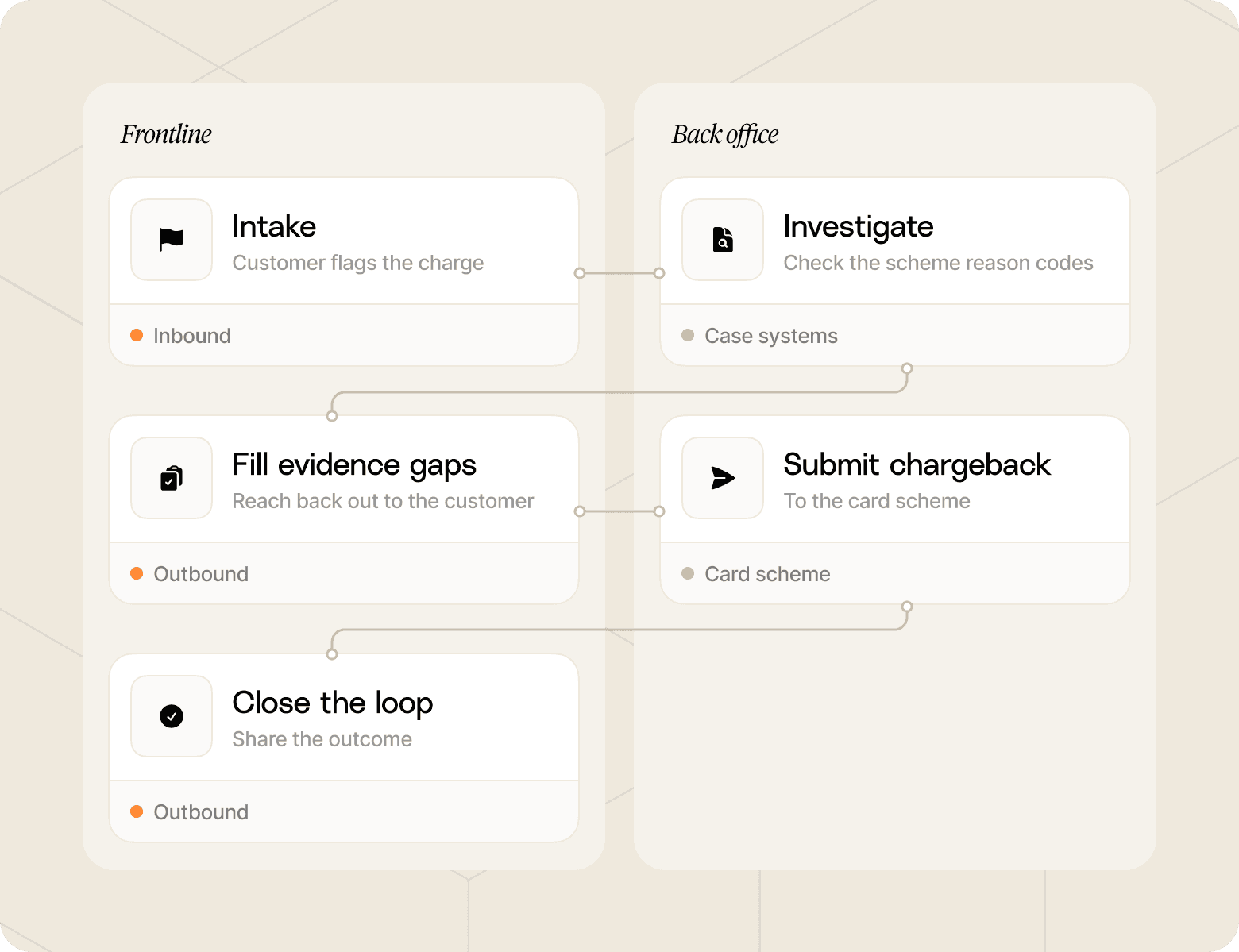
It runs the case behind the conversation. Consider a disputed transaction. A customer flags a charge they don't recognise on the frontline. The case then needs investigation, evidence gathering, a decision against scheme rules, a chargeback submission, and a closing message to the customer, sometimes weeks later. A horizontal agent stops at the first reply; Gradient Labs' specialist disputes agents run the whole lifecycle, passing context between frontline and back office without a human stitching the gap. If evidence is missing, the frontline agent asks the customer for it in the same conversation and the investigation resumes the moment they reply. At one UK card fintech, that connected workflow made the disputes cycle dramatically faster, closing cases in a fraction of the time while keeping customer satisfaction high and most cases arriving fully evidenced.
The delivery team absorbs the engineering. Where Decagon's model assumes an agent engineer on your side, Gradient Labs pairs you with a finserv-native AI delivery team that owns the migration from whatever you run today into production, typically a few weeks or less. Your ops lead configures the agent and nobody on your team writes code. That matters because the buyer running an FS support operation is rarely an engineering team with spare capacity, and our guide to choosing an AI agent vendor for financial services covers how to weigh that delivery question across a shortlist.
Compliance is the architecture. More than 20 pre-built financial services guardrails run on every turn: customer guardrails detect complaints, vulnerability, and financial difficulty, while agent guardrails catch tipping-off, false promises, and out-of-bounds advice before a reply reaches the customer. Regulatory coverage spans FCA Consumer Duty, CONC, and Breathing Space in the UK, FDCPA, TCPA, Reg F, and UDAAP in the US, and GDPR and the EU AI Act. Gradient Labs is SOC 2 Type II certified, with zero-day data retention agreements across all LLM sub-processors, AES-256 encryption at rest, TLS 1.2+ in transit, 24/7 security monitoring, and a full audit trail of every agent action, data point referenced, and decision made. That is what a secure AI agent for banking looks like in practice, and our guide to the best secure AI agents for banking maps the security stack that sits around it.
Voice runs at the same depth: Gradient Labs agents make more than 100,000 outbound voice calls a month across customers, and at one UK card fintech the Lending Agent reaches much of the collections book each week, verifying identity, securing promises to pay, and handing sensitive conversations to a human specialist when a case needs one.
How do Decagon and Gradient Labs price?
Neither platform publishes a rate card, but the models differ in what you pay for and who carries the risk. Decagon quotes custom pricing per deployment, so budgeting starts with a sales conversation and scales with usage. Gradient Labs prices per resolution, with a deployment guarantee attached: once a use case is scoped, if the deployment doesn't deliver what was agreed, you get your money back.

The practical question to ask both vendors is what counts as the billable outcome. A conversation that gets deflected, contained, or handed to a human is not the same as a case that gets resolved, and the gap between those definitions is where an AI contract quietly gets expensive. Anchor the commercial conversation on resolved cases and the comparison gets much clearer.
Which platform breaks the automation ceiling?
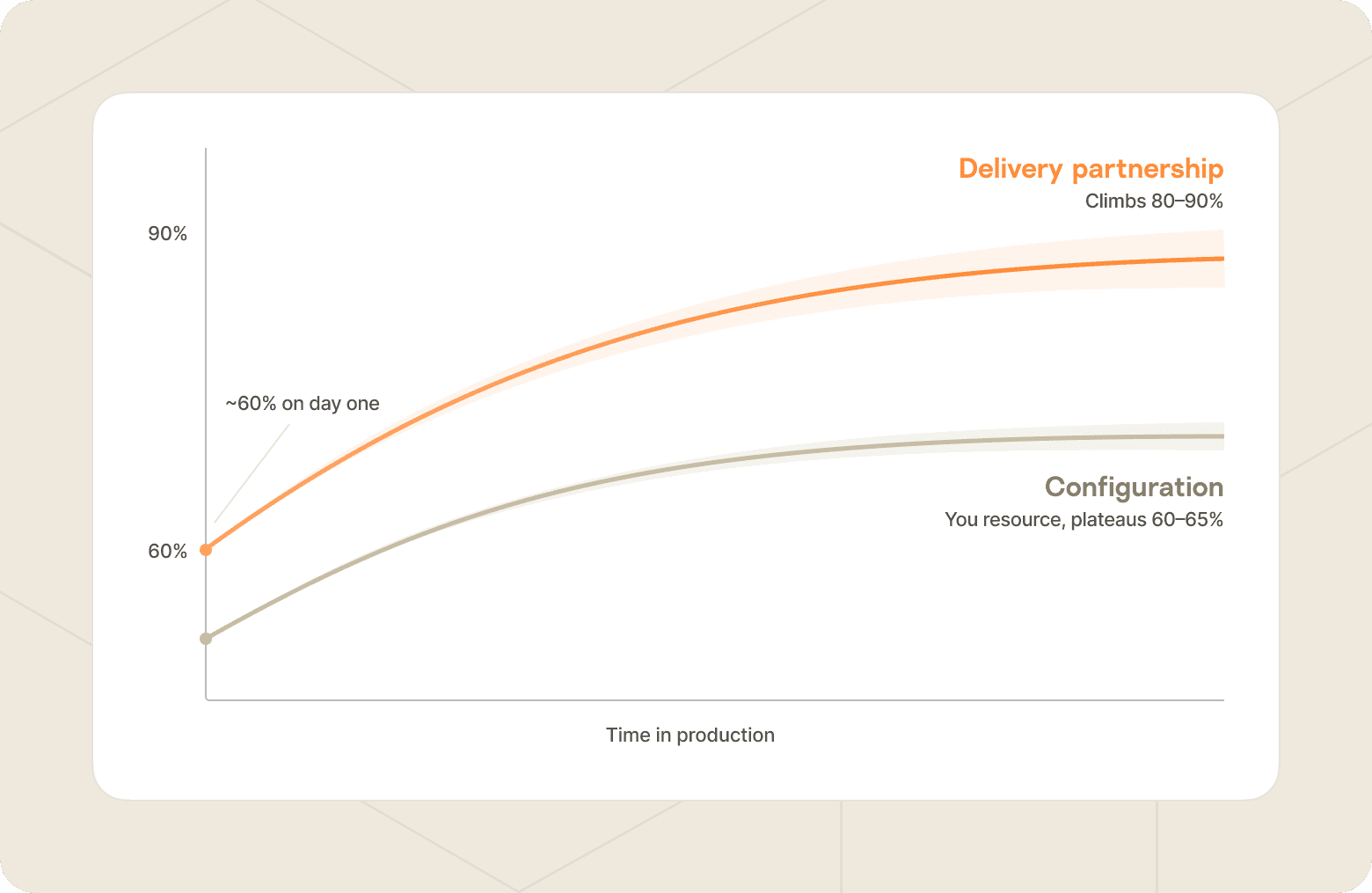
Most deployments of AI for customer support plateau at 60–65% resolution. Customer support automation programmes hit that ceiling for a structural reason: the remaining work crosses into back-office systems, the disputes, KYC reviews, and collections cases that a frontline-only agent cannot reach, however well it handles chat. Operations teams frame it the same way: the biggest savings sit past the plateau, in the 40% of work that stays manual because it digs into systems a frontline agent never touches.
The two platforms answer the ceiling differently. Decagon's answer is configuration: more Agent Operating Procedures, more integrations, more tuning, each requiring engineering time on your side. Gradient Labs' answer is a delivery partnership. Deployments start around 60% resolution, and a post-launch supercharging cycle takes mature deployments to 80–90%: the delivery team analyses every unresolved case, quantifies the impact of each fix, and adds integrations, procedures, and use cases in production. Pockit lifted resolution by 70% and CSAT by 80% within six months of going live, and our guide to deploying AI agents in banking maps the same rollout step by step.
Ask every vendor on your shortlist who does the work that gets you past the plateau, and whether their commercial model assumes you'll do it yourself. The answer separates the two platforms faster than any feature list.
Decagon vs Gradient Labs: which should you choose?
Choose Decagon if you run a high-volume support operation outside regulated industries, with engineering resource to invest and work that resolves inside single conversations. It is a capable platform with momentum and strong published results on that terrain. If the horizontal you're weighing is Fin rather than Decagon, our Intercom Fin comparison runs the same head-to-head.
Choose Gradient Labs if you run a financial services operation or work in a highly regulated industry, such as insurance. The cases that define your cost base run deeper than the first reply, your risk team needs evidence rather than assurances, and your ops leaders need a partner that absorbs the engineering rather than adding to it. Your helpdesk stays, the deployment is guaranteed, and the resolution rate keeps climbing after launch.
Book a demo to see what your operation looks like with the case work automated too.

Elizabeth Shew leads Brand and Advocacy at Gradient Labs, where AI agents handle customer support and back-office work for banks, lenders, and fintechs. Before that, she led customer marketing at Mastercard and built Dynamic Yield's customer marketing programme from the ground up, a decade spent turning customer results into industry-shaping stories. She writes about how support and operations teams actually put AI and technology to work. Before tech, she was a professional dancer in NYC.