
Community banks win on customer relationships. That means a lean team must carry disputes, onboarding, frontline support, and more, while operating to the same standard customers expect from the largest banks that can outspend you on every digital channel. Most sit under $10bn in assets, which keeps you outside direct CFPB supervision while every other obligation still applies. AI in banking is the obvious lever, but most pilots stall. An MIT report found that 95% of enterprise AI pilots deliver no measurable return, and the gap usually traces back to deployment rather than the model.
This guide breaks down how to deploy AI agents in community banks into six steps, in the order a lean team actually works through them, so your first deployment reaches production and pays for itself before you widen it.
1. Choose an AI agent built for community bank operations
A generic AI agent answers a question and closes the conversation. It copes with "what's my debit card limit?" or "how do I reorder checks?" well enough, but on a real banking operation it stalls at around 60% automation, because most of the manual work in a community bank doesn't fit the one question, one answer shape.
The work that fills your team's day runs deeper. A disputed transaction is a case, not a reply: the customer flags a charge, the claim opens under scheme and regulatory timelines, evidence gets gathered, a decision gets made, the chargeback gets filed, and someone closes the loop weeks later. Collections on your loan book, overdraft and error resolution, and KYC on a new account run the same way: long processes, not quick answers.
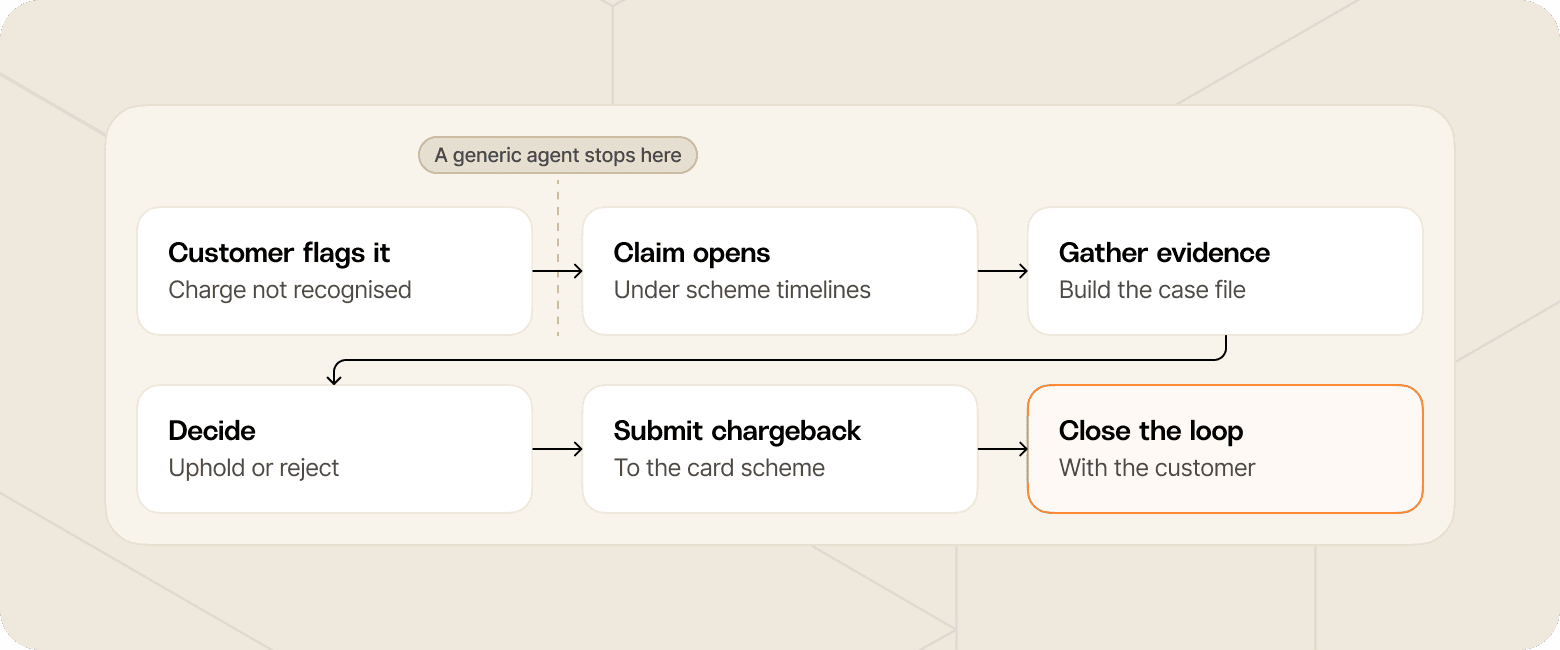
A specialist AI agent like Gradient Labs fits community bank operations on three fronts:
It runs the long process, not just the reply: Disputes, collections, onboarding, and complaints need intake, investigation, decision, follow-up, and close. A specialist agent shares memory and context across every stage. A generic agent stops at the first response.
Compliance is built in: In banking, a wrong answer can be a regulatory breach. You need an agent that runs financial services guardrails on every turn with a full audit trail, rather than a configuration layer your one compliance officer maintains by hand.
It acts inside your systems: Freezing a card, checking account status, posting a payment. A specialist agent connects to your core and case management to do the work, not just describe it.
There's a point-tool trap worth dodging too. You've likely been pitched a disputes tool, then a collections tool, then one for onboarding, each fixing a single case and leaving the rest of the customer relationship untouched. Every one adds a contract, an integration, and another system your team has to learn and keep running. At this point, you're not overhauling your tech stack, but for the sake of the customer experience, AI shouldn't follow the same buying pattern.
For a lean team, one AI partner across your customer operations, from disputes and collections to onboarding and frontline support, is far less to manage than a separate AI vendor for each. Our guide to AI use cases in banking maps the options by effort and impact. These same use cases look different at a community bank's scale; see our guide to AI for community banks for the specifics.
2. Internal buy-in is the first step to deploying AI agents in community banks
In a community bank, the AI agent has to pass your own people before it reaches a customer. The approving team might be on the smaller side, which could make buy-in faster, but the stakes around your regulator relationship are just as high. Three gates tend to decide it:
Security and vendor review: Your team assesses data handling, retention, encryption, and sub-processors. Come with answers: SOC 2 Type II, GDPR-grade data handling with full DSAR support, AES-256 at rest, and zero-day data retention agreements with every model sub-processor.
Compliance review: Your compliance lead checks the agent against the rules you answer to, whether that's Reg E and FDCPA in the US, FCA Consumer Duty and CONC in the UK, or GDPR and the EU AI Act in Europe, plus the AML and KYC checks every region expects on onboarding. The audit trail matters here as much as the model. Your examiner will ask the same questions at your next exam, whether they come from the FDIC, the OCC, or your state regulator. Document who reviewed the agent, what it handles without a person, and how you evidence a complaint was resolved correctly, so that evidence is ready rather than assembled under pressure.
Prioritisation: Pick the first use case by impact, not by ease. Which procedures and data connections unlock the most manual hours? That answer sets the order of everything after.
Then scope the pilot around one concrete question: can the agent find the customer, read the account, and respond correctly under your guardrails? Once we've scoped a use case, we guarantee the deployment. If we don't deliver what we said we would, you get your money back, which puts a floor under the decision for a budget-conscious board.
3. Capture what your longest-serving people know
An AI agent only knows what you tell it, and a knowledge base alone is never enough. Your most tenured staff carry years of judgement that never made it into a document: the edge cases, the workarounds, the way a sensitive account gets handled. At a community bank that knowledge often sits with a handful of long-serving people, which makes capturing it urgent. At Gradient Labs, three sources feed the AI agent:
Knowledge base: Your help articles and policies, the documented baseline.
Facts: The structured details that change often, like fee schedules, eligibility rules, and cut-off times. Kept separate because they're precise.
Notes: Your team's working knowledge, the judgement nobody wrote down. Gradient Labs generates this for you: the agent analyses thousands of conversations your team has already handled and extracts how your best people work, from recurring edge cases to the tone they use with a worried customer. Your team reviews what it surfaces, and it becomes guidance the agent applies from day one.
On top of knowledge sit procedures: your SOPs written as natural-language steps the agent executes, with branching for the cases that don't follow the script. Because the agent learns from your real conversation history, it starts near your team's standard instead of climbing there over months. Treat an early gap the way you would a new hire: a poor response signals missing context, not a dead end.
4. Make sure your AI agent understands the regulations you operate under
In most industries, a wrong answer means a poor customer experience. In banking it can be a regulatory breach, and your regulators will want to see how you control it.
That makes guardrails the platform's job, not a configuration layer your team builds and maintains. At Gradient Labs, two kinds do the work:
Customer guardrails read the conversation and act on it: detecting a complaint, spotting signs of financial difficulty or vulnerability, and handing off to a person when one is needed.
Agent guardrails check what the agent is about to say or do: blocking unlicensed advice, preventing tipping-off on a financial crime case, and keeping sensitive data inside the bank. They edit the draft before it reaches the customer.
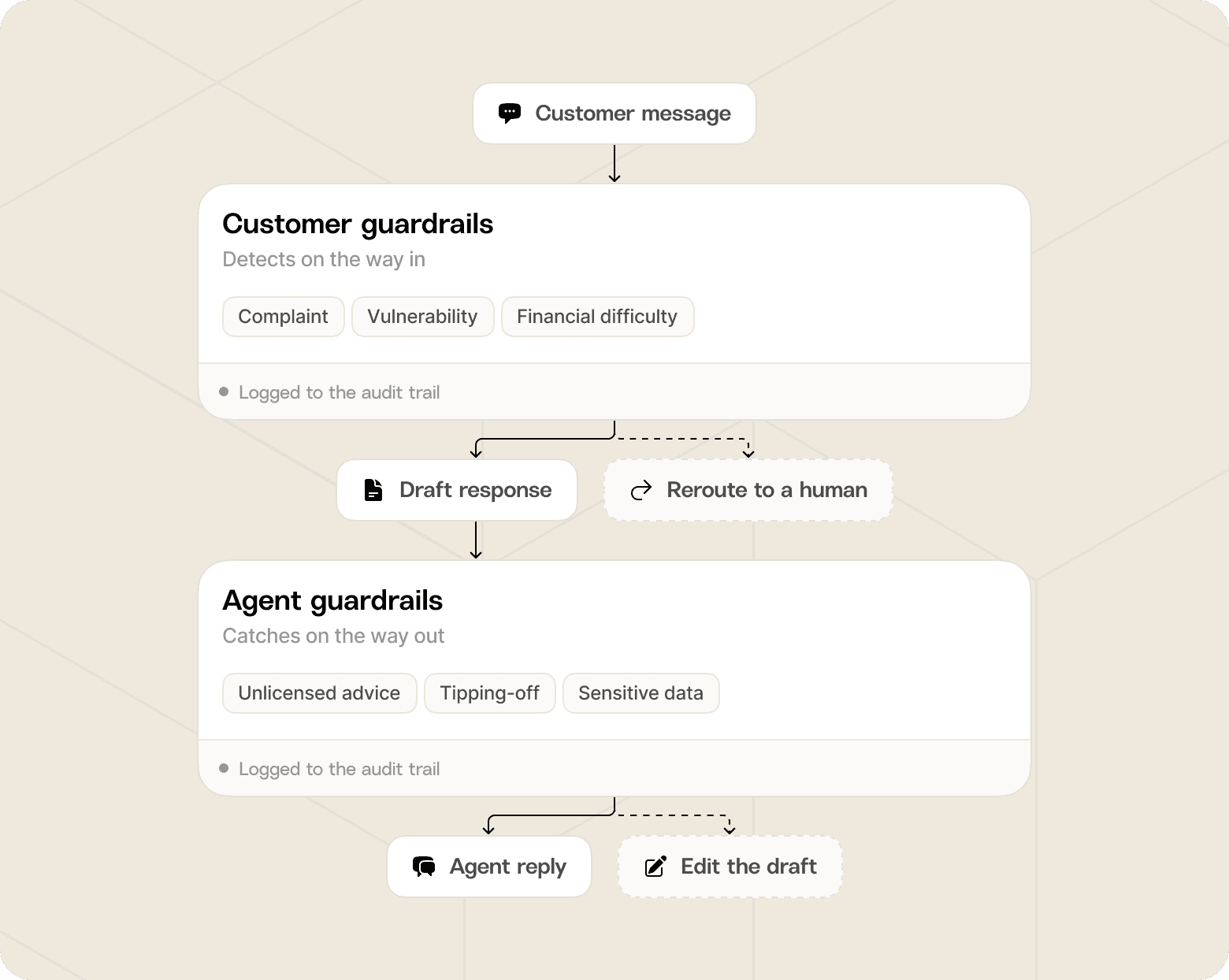
Gradient Labs runs 20+ pre-built financial services guardrails on every turn, with coverage across the regimes you operate in: the US (Regulation E and Reg Z, plus FDCPA and TCPA on collections), the UK (FCA Consumer Duty and CONC), and the EU (GDPR and the EU AI Act), with AML and KYC checks on new-account verification wherever you operate. The audit trail records every action, data point, and decision for your compliance team and your regulators to review. Horizontal tools treat this as your homework. For a community bank with a lean compliance function, that homework is the hard part, and it shouldn't be yours. Our ranking of the best AI customer support for regulated industries scores vendors on exactly this posture.
5. Connect to your core banking system methodically
Resolving a case asks more of an agent than answering a question. The agent earns its return when it can act, such as posting a payment, checking an account, filing a claim, etc. That means connecting to the systems that run the bank: your core banking platform, whether that is Fiserv, Jack Henry, FIS, or COCC, plus your CRM and your case management.
Community banks don't need full core banking integration on day one to see results. A spreadsheet export is enough to begin. For example, the Gradient Labs agent can run CSV-only incomplete application follow-up in under a day, with no integration, so you prove the value before IT commits to a core connection. After that, sequence the integrations the way you sequenced the use cases, connecting what unblocks your highest-priority case first.
This is also where the economics turn. The economics improve sharply past 80% automation, and integration depth carries most of the climb from 60% to 80%: each system you connect turns more cases into ones the agent closes end to end. Start with the spreadsheet, widen to the core when you're ready, and reuse the same connections and guardrails for each new case.
6. Deploy AI agents in your community bank on low-risk volume, then ramp
With a small team watching it, trust is best earned in increments. Start the agent on a low-risk, high-volume use case with full human review, then widen as the numbers hold. One Gradient Labs customer began at just 50 tickets a day with 100% human QA, moved to 25%, 50%, and 100% of volume as quality held, and never rolled back.
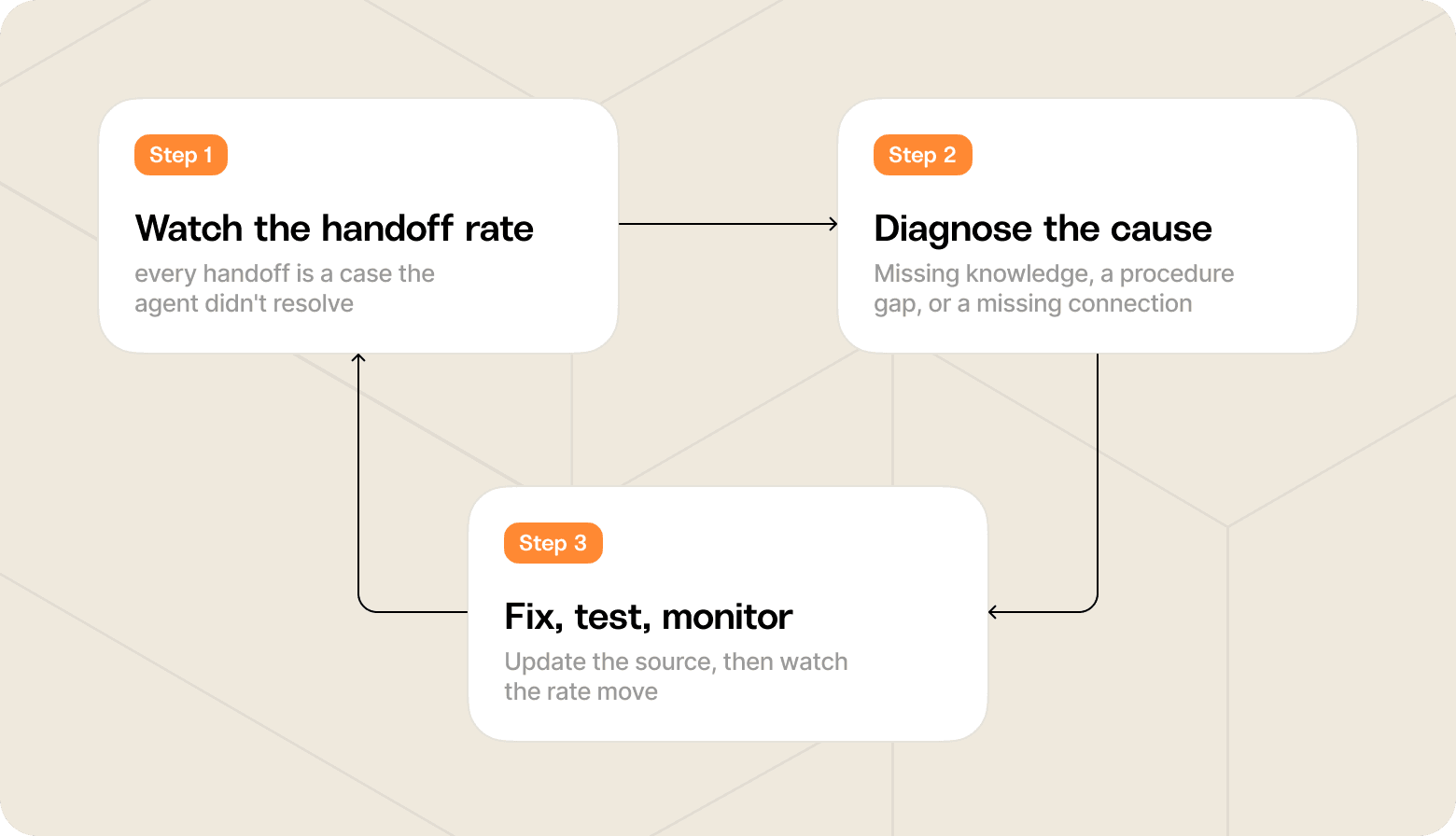
Going live opens the improvement work rather than ending it: a mature deployment reaches 80–90% resolution, but day one usually lands around 60%, and the gap closes through a loop you run after launch:
Watch the handoff rate: each handoff marks a case the agent couldn't close on its own.
Diagnose the root cause: a knowledge gap, an incomplete procedure, or a connection the agent doesn't have yet.
Fix the source, then test: update the knowledge, procedure, or tool, validate it, and watch the rate move.
You don't run that loop alone. Our delivery team works the improvement cycle with your ops lead like an extension of your staff, which is how deployments climb toward 80–90% in mature use. Pockit shows what that looks like: working with our team, they took their AI agent to a 70% resolution rate in under six months, with an 80% CSAT. As their Head of Operations, Michiel Smet, put it, they now have "an AI agent that's actually resolving problems, boosting our CSAT rating, and absorbing growth." Done well, deploying AI agents in community banks improves service quality and cost at the same time.
Deployment is the hard part, and it's the part Gradient Labs is built to carry: a finance-native platform, a delivery team that absorbs the technical work so you don't need an AI team, and a guarantee on every use case we scope. For the wider view across all bank sizes, see our guide to how to deploy AI agents in banking, compare vendors through the same small-institution lens in our ranking of the best AI agents for credit unions, or book a demo and we'll plan your first deployment with you.


Elizabeth Shew leads Brand and Advocacy at Gradient Labs, where AI agents handle customer support and back-office work for banks, lenders, and fintechs. Before that, she led customer marketing at Mastercard and built Dynamic Yield's customer marketing programme from the ground up, a decade spent turning customer results into industry-shaping stories. She writes about how support and operations teams actually put AI and technology to work. Before tech, she was a professional dancer in NYC.