
Borrower stress is climbing on both sides of the Atlantic. US credit card delinquency stands at its highest rate in 16 years, according to New York Fed data, and 13.1 million UK adults had low financial resilience in May 2024, according to the FCA's Financial Lives survey. Most collections teams, meanwhile, still reach only a fraction of the accounts that need a conversation, because headcount and dialler capacity decide which segments get worked at all. For the person who owns those numbers, the real question is which AI use cases for lenders pay back first without putting compliance at risk, whether the rulebook is Consumer Duty in the UK or Regulation F in the US. This guide walks through ten proven use cases across the borrower journey, from application to arrears, and the controls that hold each one inside policy.@eli
What are the best AI use cases for lenders?
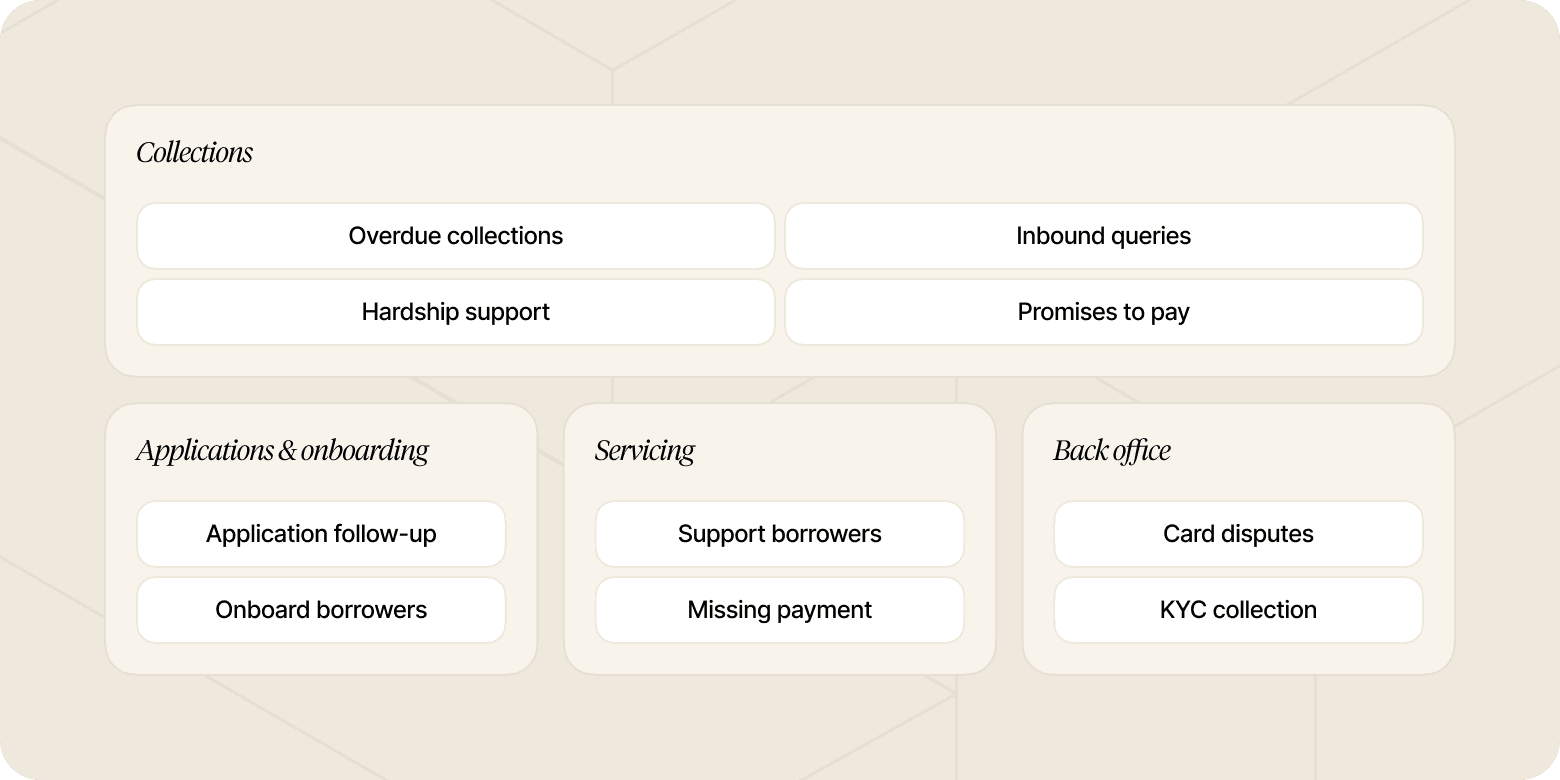
Arrears is where the pressure shows first, but it builds across the entire lending cycle. Applicants stall halfway through and never come back, new borrowers miss a first payment because nobody walked them through the schedule, servicing queues lengthen as the book grows, and disputes and KYC cases wait on stretched back-office teams. AI relieves pressure at every one of those stages, which is why this guide covers the full cycle rather than collections alone.
A use case earns its place on this list when an AI agent can work real borrower accounts without ever stepping outside policy. Four properties make that true in practice:
Guardrails on every conversational turn: the agent's calls, chats, and emails are checked live, so a false promise or a missed vulnerability signal never reaches a borrower.
Human approval gates where you want them: you choose which consequential actions wait for a person's sign-off, whether that's a forbearance outcome or a chargeback going to the scheme.
An audit trail your compliance team can stand behind: every disclosure, consent, and decision lands in the CRM with a timestamp. That record is what evidencing FCA Consumer Duty in the UK, or Regulation F in the US, actually requires.
Certified infrastructure underneath: SOC 2 Type II, GDPR compliance, and zero-day data retention agreements with every LLM provider, so no model provider holds borrower data.
The use cases below follow the borrower journey rather than an org chart: collections first, then applications and onboarding, servicing, and the back-office work behind them. Judge each stage on its own metric. Collections lives on promise-to-pay rates and recovery against your human benchmark, servicing on resolution rate and CSAT, and the back office on SLA compression and decision accuracy. If you sit inside a bank rather than a lender, our AI in banking use case guide walks the same evaluation from a bank's seat.
Use case | Stage | What the agent takes on |
|---|---|---|
Overdue payment collections | Collections | Arrears outreach that ends in an agreed payment plan |
Secure promises to pay | Collections | Commitments captured, confirmed, and chased to the payment date |
Handle inbound collections queries | Collections | Callbacks picked up with full account history |
Hardship assessment and forbearance | Collections | I&E assessments run against your forbearance policy |
Incomplete application follow-up | Applications | Stalled applicants brought back before intent goes cold |
Welcome and onboard new borrowers | Onboarding | Repayment schedules explained, direct debit set up live |
Support active borrowers | Servicing | Balances, settlement figures, and payment-date changes resolved in the conversation |
Investigate a missing payment | Servicing | Repayments traced and explained before they become complaints |
Card disputes | Back office | Dispute cases worked from intake to chargeback submission |
KYC document collection | Back office | Documents chased, validated, and cases kept moving |
Collections: where AI pays back first
Banks tend to start with frontline support. Lenders start with collections, because that is where the loan book bleeds and where headcount caps how many accounts get worked. An account left uncontacted in early arrears (1–30 days) is harder to cure a month later, and the low-ticket segment often never gets chased at all. The four use cases below run as two-way conversations on voice, SMS, and email, carrying some of the heaviest compliance loads in lending, which is exactly why they run behind pre-built guardrails. To see how the vendors stack up, our ranking of the best AI agents for lending covers the field.
Overdue payment collections
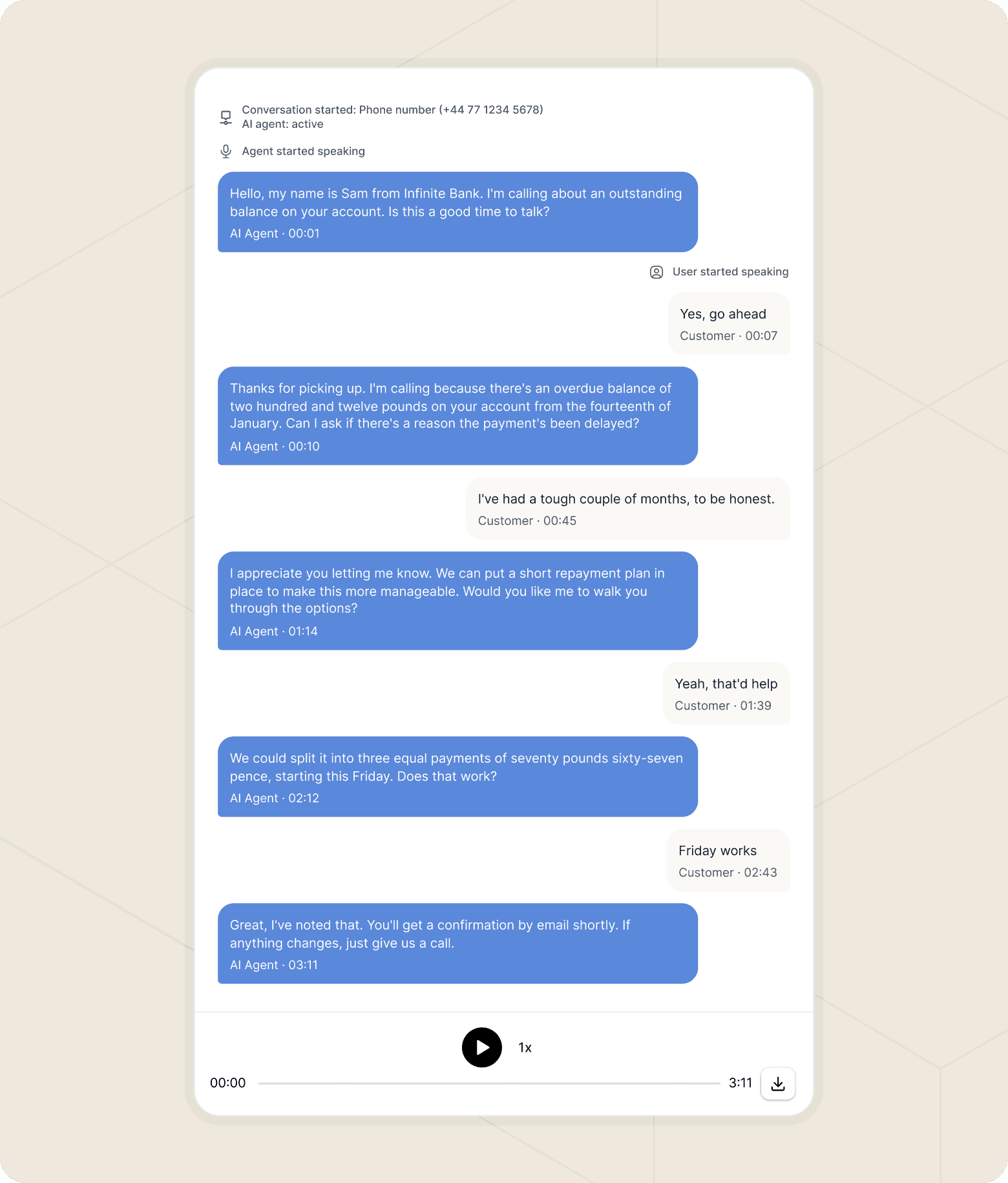
The Lending Agent works overdue payment collections from first contact to agreed plan. It times each call for when the borrower is most likely to pick up, runs identity verification, walks through the balance and what happens next, and agrees a payment plan inside your workout rules. Because it loads the borrower's balance, payment history, and eligible repayment options before dialling, no conversation starts with "let me look that up", and any sign of hardship or vulnerability moves the call to a human specialist straight away.
The scale is proven: 100,000+ calls a month run through the agent across customers, recovery holds at 1:1 against human collectors, and the agent runs 30x more compliant than human teams on the guardrail checks that cover FDCPA, TCPA, and Reg F in the US and FCA Consumer Duty, CONC, and Breathing Space in the UK. SteadyPay, an FCA-authorised lender, moved its outbound voice collections for income advance recoveries onto the agent. Violeta Filip, its Head of Customer Experience, describes what changed:
"Before Gradient Labs, we needed to find a way to reach our growing number of customers effectively. Now we make 33,000 calls a month, converting 60% of engaged customers to committed repayment dates, all within FCA compliance standards. It has fundamentally changed how we manage the collections layer of our lending infrastructure."
Secure promises to pay
A promise to pay is the metric early-arrears teams live by, and most promises die between the call and the payment date. The agent secures promises to pay and then keeps them alive: it captures the commitment, sends confirmation by SMS or email with the mandate link, and follows up before the date so the payment actually lands. Commitments carry across the borrower's history, so a follow-up call picks up where the last one left off rather than renegotiating from zero. It also makes low-ticket debts, the balances under £200 that were never profitable to chase manually, economical to work for the first time.
Handle inbound collections queries
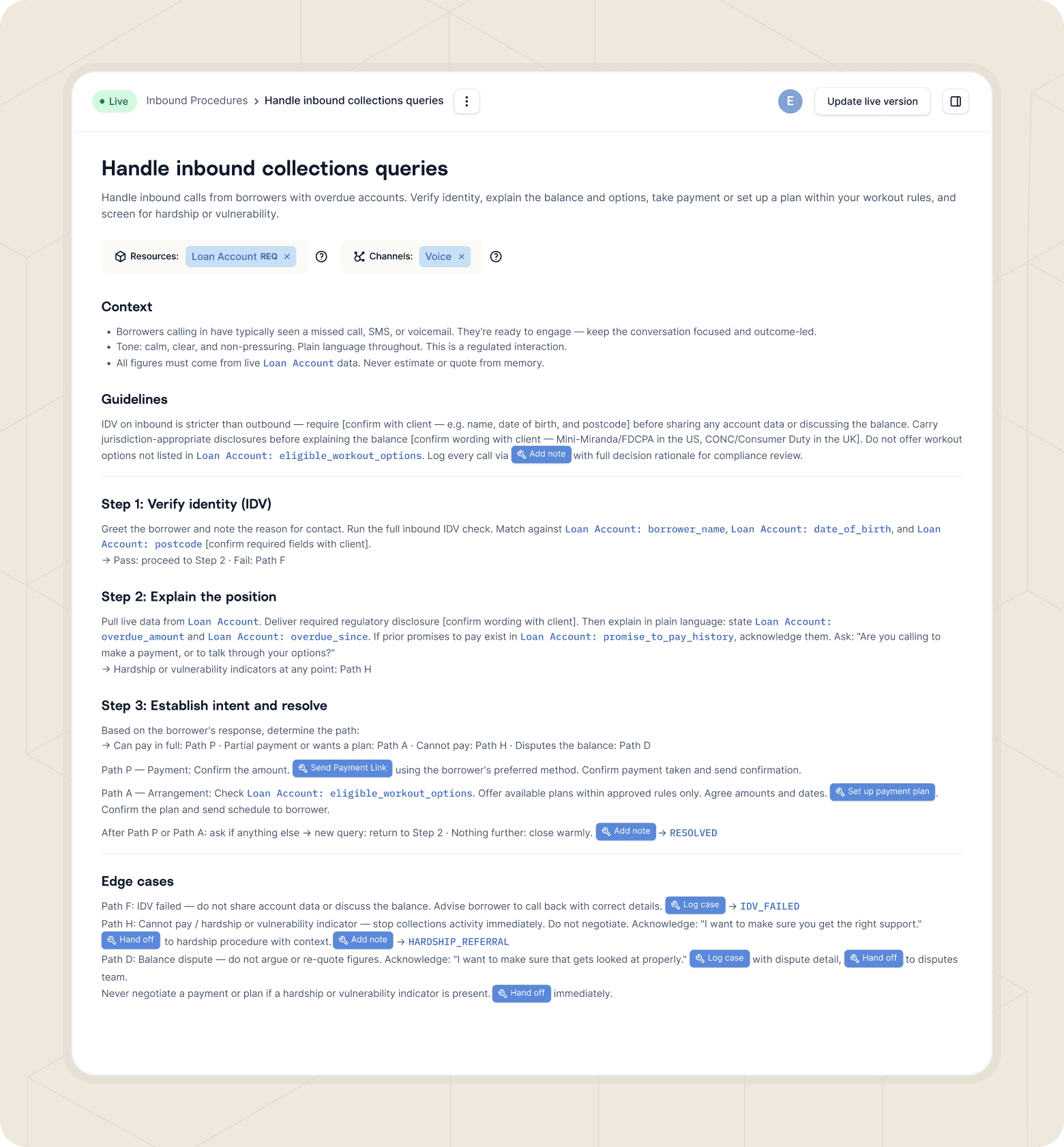
Outbound creates inbound. Every campaign generates callbacks, and a borrower who rings back ready to pay should never queue behind general support. The agent handles inbound collections queries with everything it knows about the account already loaded: prior calls, promises made, and plans offered. Identity checks run stricter on inbound than outbound, the same workout rules apply, and hardship or vulnerability goes to a specialist whichever channel it arrives on.
Hardship assessment and forbearance
When a borrower says they're struggling, regulation prescribes what happens next, and regulators watch how consistently it happens. The agent walks the income and expenditure (I&E) assessment conversationally, runs the back-office review against your forbearance policy, and maps the result to the right forbearance option or escalates the case. Any vulnerability indicator sends the conversation to a human specialist straight away, whatever the channel. For UK lenders this is Consumer Duty demonstrated in practice rather than in a policy document: every borrower assessed the same way, every assessment on record, nobody stuck in a queue.
Applications and onboarding: stop the funnel leaking
Collections is where the pain is loudest, but the borrower journey starts leaking long before an account reaches arrears. Lending ops leaders describe the failure mode as being easy to push money out the door and hard to recover it, and the fix starts at the application. Two use cases work the front of the funnel, and both use the same guardrails and audit trail as the collections work above.
Incomplete application follow-up
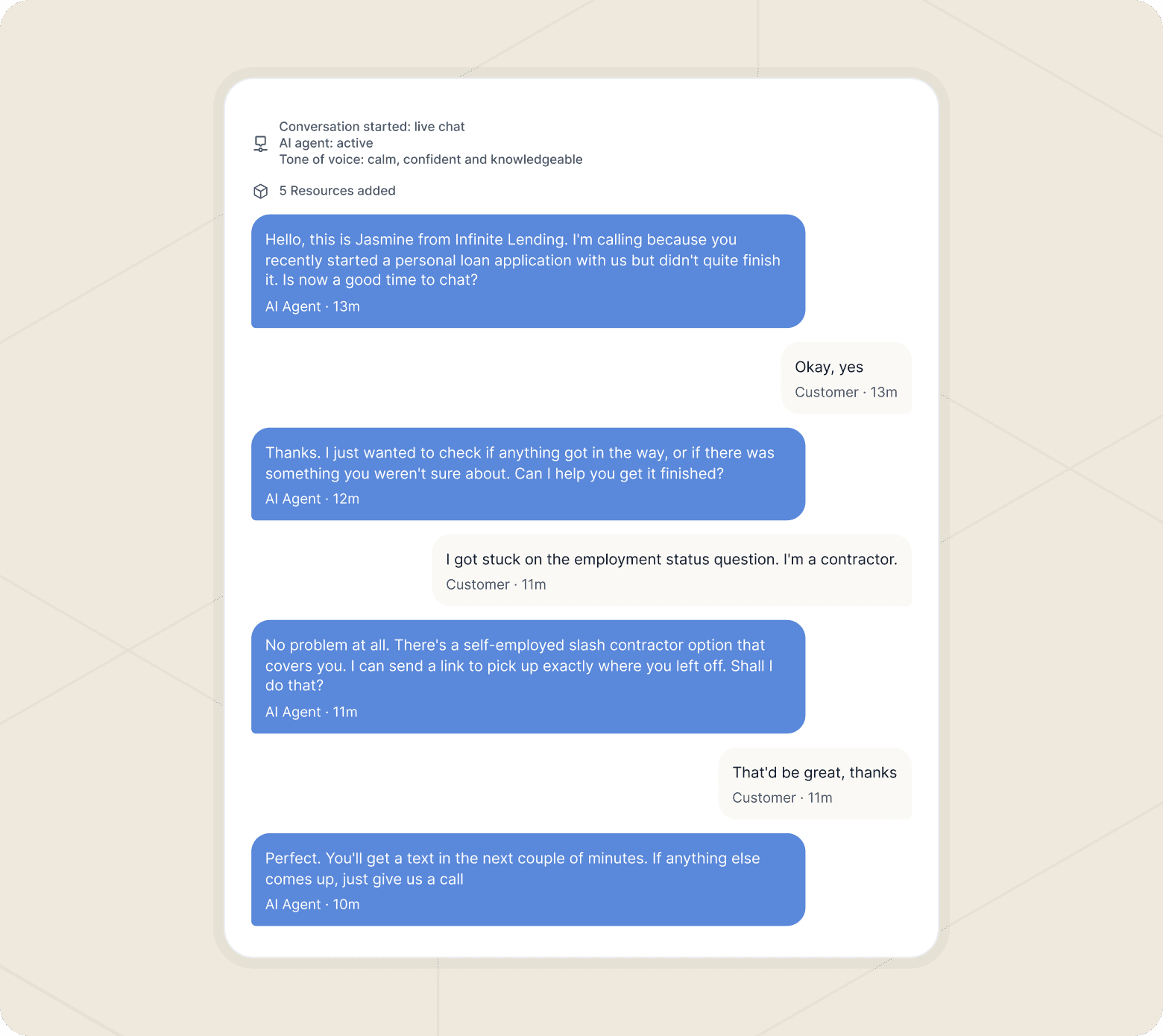
Most lenders spend heavily to acquire an applicant and nothing to recover one who stalls. The agent runs incomplete application follow-up by phone or message within hours of a stall: it answers eligibility, document, and status questions, clears whatever blocked the application, and guides the applicant through to completion. Funded loans that would have gone to a competitor's faster funnel come back at the cost of a conversation.
Welcome and onboard new borrowers
The riskiest payment on any loan is the first one. In the hours after a loan funds, the agent welcomes and onboards the new borrower over voice or SMS: it walks through the repayment schedule, sets up direct debit or autopay live on the call, answers questions about the terms, and screens for vulnerability from day one. Missed first payments fall, and so does inbound servicing volume across the life of the loan, because the borrower already knows the answers.
Servicing: absorb the day-to-day without growing the team
Balances, statements, settlement figures, payment-date changes, direct-debit updates: servicing volume grows with every cohort you originate, and hiring against it erodes the margin on the book. This is where an AI customer service agent earns its keep for a lender, provided the agent resolves cases rather than deflecting them.
Support active borrowers
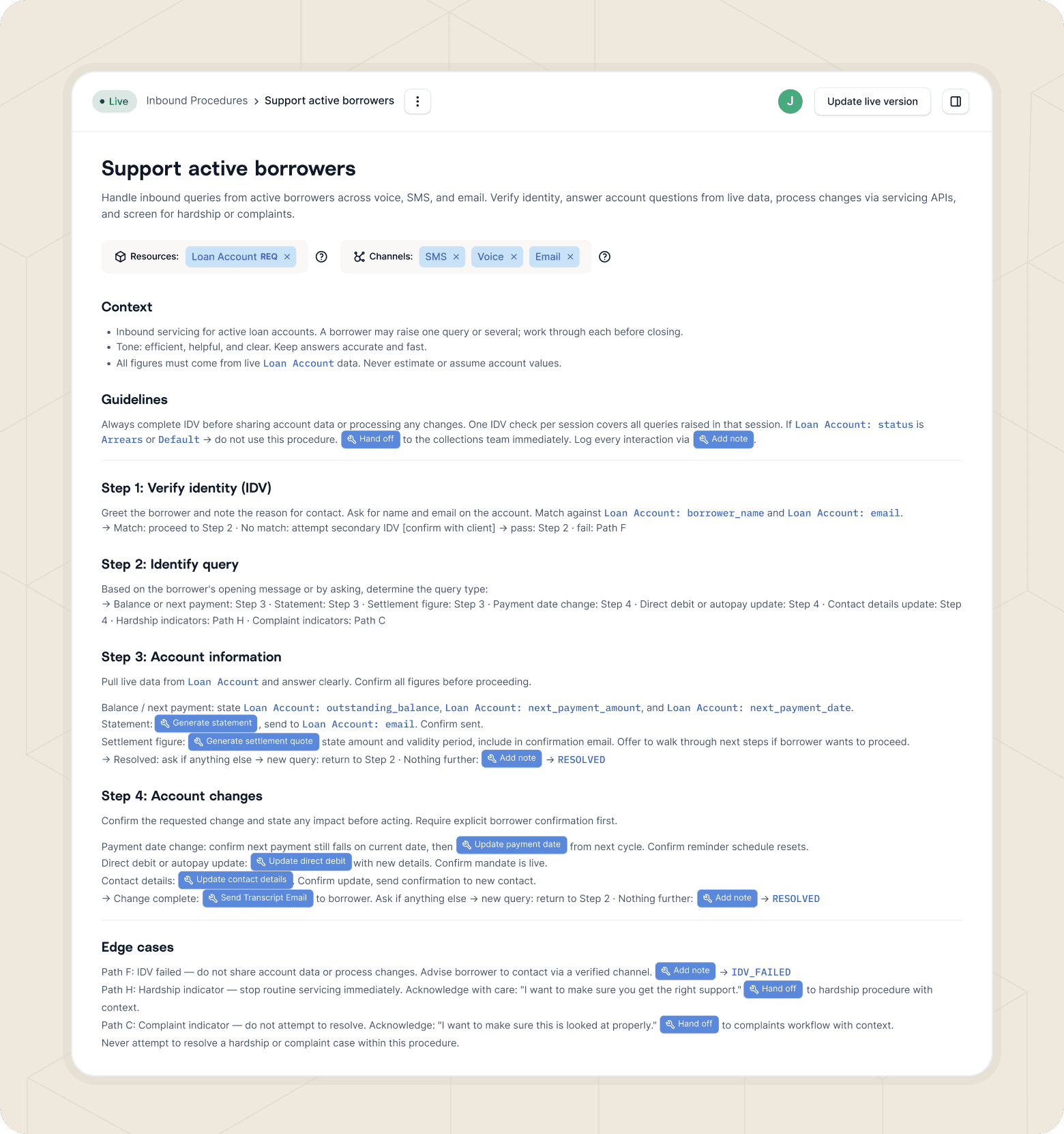
The agent supports active borrowers across voice, SMS, email, and chat. It verifies the borrower, pulls live data from your servicing system, and completes the request in the conversation: a settlement figure quoted, a payment date moved, a direct debit updated. Hardship and complaint indicators route to humans the moment they appear. Customer support automation built this way protects the relationship instead of straining it. Yonder, the UK credit card, runs Gradient Labs' agent across its customer support. MC Glover, its VP of Strategy & Operations, puts it simply:
"With a 98% CSAT, it delivers superb customer experiences. We especially value how closely the AI agent matches our tone of voice."
Investigate a missing payment
A repayment leaves the borrower's bank account and doesn't show against the balance, and suddenly you have an anxious borrower and a manual trace. The agent investigates missing payments directly against transaction data and gives the borrower a plain-language answer. It asks clarifying questions first, so a delayed payment gets an explanation while an unrecognised charge goes where it belongs, to disputes or fraud, rather than being guessed at.
Back-office work for lenders: disputes and KYC
Most lending operations automated the frontline long before the back office, yet the back office is where an AI agent clears the compliance bar most easily, because a human approval gate can sit in front of anything consequential. CSAT has no meaning here; success is shorter SLAs, decisions that hold up on review, and a case record with nothing missing.
Card disputes
Credit card and BNPL lenders carry the same dispute load as any card issuer: fiddly intake, slow evidence gathering, and scheme deadlines that don't wait. The Disputes Agent takes a case from the first customer message to the chargeback. Intake happens on any channel with the right questions asked up front, classification runs against Mastercard and Visa reason codes, missing evidence triggers outreach to the customer, and once the outcome is determined the chargeback goes to the scheme directly, with a human approving the submission if you choose to keep that gate. The production numbers: 95% accuracy on classification and decisioning, resolution time down 25%, and £30+ saved per case by cutting out intermediary processors. Reg E and Reg Z coverage comes pre-configured in the US, Section 75 and FOS timelines in the UK.
KYC document collection
Ask a KYC analyst where their day goes and the answer is chasing, not reviewing. The agent takes over the chase: it requests outstanding documents by email or SMS, checks each submission against policy as soon as it arrives, tells the customer in plain language why a document was rejected, and keeps every case moving until it verifies or lands with compliance. The remediation backlog stops compounding, and the same pattern carries into lending onboarding, where the agent resolves stuck verification steps while the applicant still wants the loan.
How to sequence AI use cases for lenders
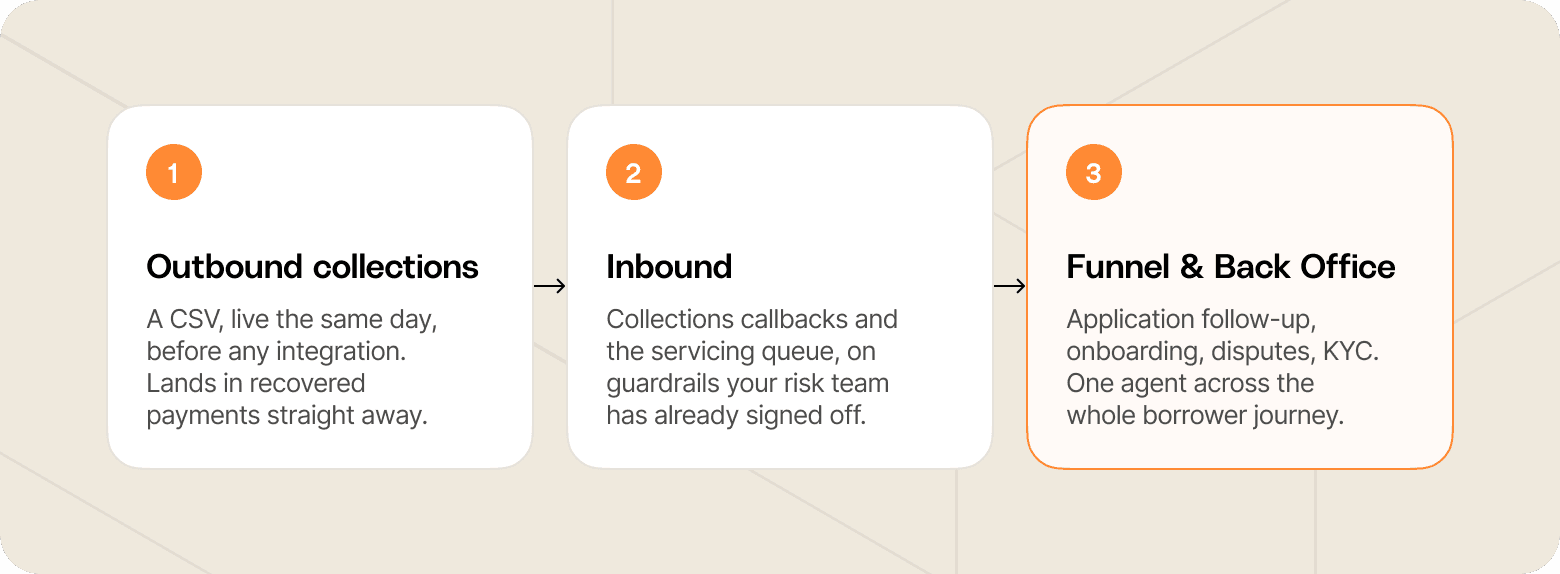
A first use case works best as the opening move of a sequence. In production, most lenders sequence the work this way:
Start with outbound collections. Nothing in financial services goes live faster: hand the agent a CSV and calls can begin the same day, before any integration work. Results land directly in recovered payments, and your risk team gets a working compliance evidence trail to inspect instead of a promise.
Add the inbound side. Collections callbacks and the servicing queue, where most of your customer operations volume sits, run on guardrails and an audit trail your risk team has already signed off, so each approval comes faster than the last.
Then work the funnel and the back office. Application follow-up, borrower onboarding, disputes, and KYC extend the same agent across the whole borrower journey. Because specialist agents share memory and context across every stage, a borrower who moves from a servicing chat into arrears never starts from zero.
For the full rollout behind that sequence, our guide on how to deploy AI agents in lending walks through it step by step.
The order is a pattern rather than a rule: some lenders start in the back office, where a human approval gate makes the first sign-off simplest, and extend toward the frontline from there. Wherever you start, two things decide whether the first deployment leads anywhere. Bring the teams who hold a veto (risk, compliance, information security) into designing the evaluation before testing starts, and write the acceptance criteria down up front, so the go-live decision runs on evidence rather than being renegotiated after every test cycle.
Pick the first process by where the pain shows up in numbers: accounts going uncontacted, SLAs breached, segments written off unworked. Then hold any vendor to production evidence from a lender rather than a demo. Gradient Labs puts a guarantee behind that standard: once we've scoped a use case, we guarantee the deployment, and if we don't deliver what we said we would, you get your money back.
Ready to see an AI agent work your own book? Book a demo.


Elizabeth Shew leads Brand and Advocacy at Gradient Labs, where AI agents handle customer support and back-office work for banks, lenders, and fintechs. Before that, she led customer marketing at Mastercard and built Dynamic Yield's customer marketing programme from the ground up, a decade spent turning customer results into industry-shaping stories. She writes about how support and operations teams actually put AI and technology to work. Before tech, she was a professional dancer in NYC.