

Most banking chatbots still just deflect. The best AI chatbots for banks in 2026 resolve the request end to end inside a regulated environment, and Gradient Labs leads that shortlist for financial services. This guide ranks four AI chatbots built for banking on the three criteria that decide a deployment: resolution quality, compliance posture, and time to production. Kasisto, Cognigy, and Kore.ai each own a clear slot, and we close with live results from banks and lenders already running Gradient Labs in production.
What counts as an AI chatbot for a bank?
A banking chatbot is any conversational interface, on the app, the website, or the phone, that answers customer questions and carries out account actions. AI in banking has moved fast here, and the category now splits on one line: does the chatbot deflect, or does it resolve?
Older chatbots deflect. They match a question to a help article, surface a link, and pass anything hard to a human queue. The best AI chatbots for banks in 2026 work as agents. They read the customer's account, apply the bank's policy, take the action, and close the case. Freezing a lost card, chasing an incomplete application, handling a dispute, or answering an inbound collections query all happen inside the conversation rather than after it.
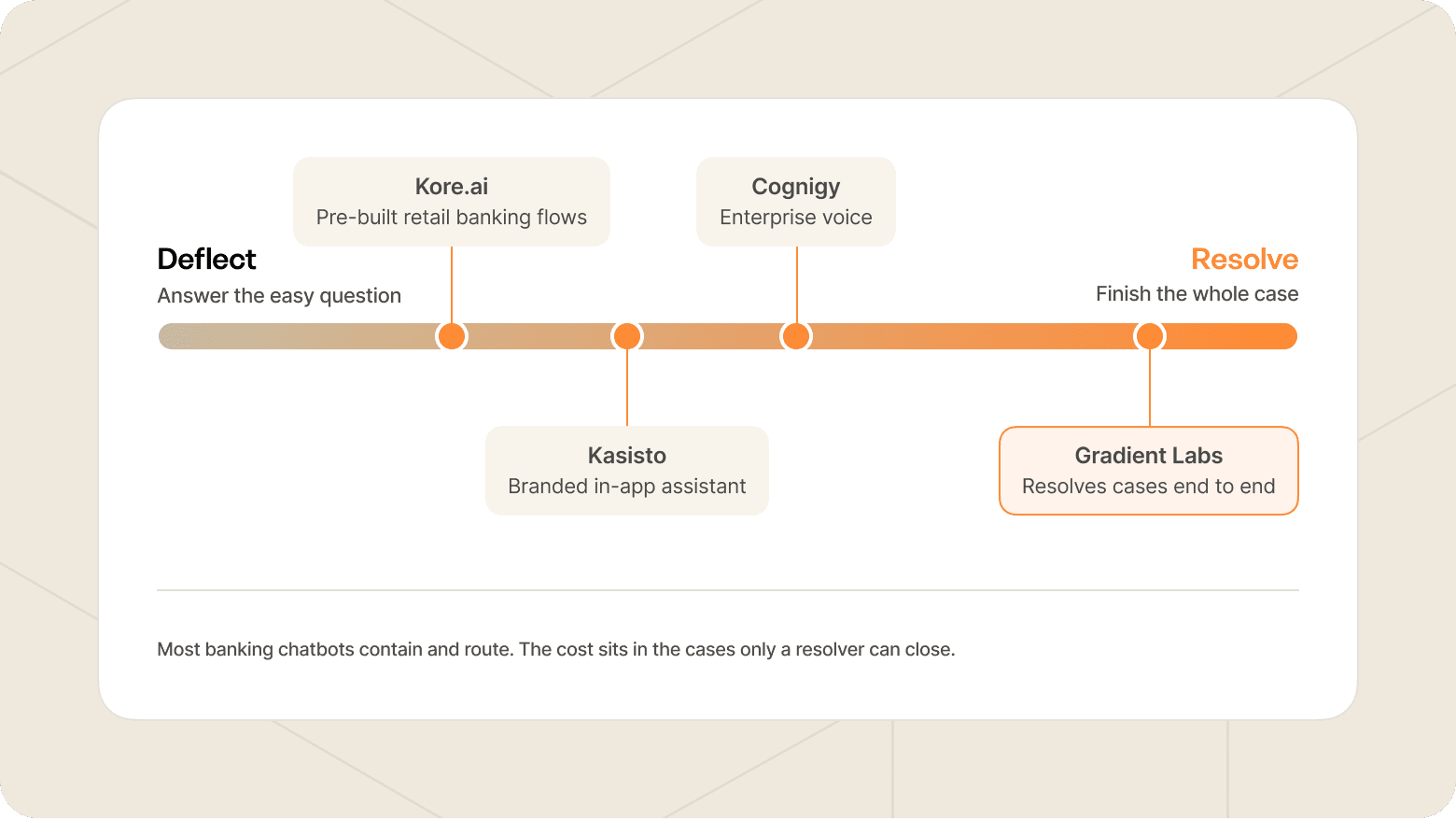
For a bank, one more thing separates a demo from a deployment: whether the chatbot holds up under FCA Consumer Duty, keeps a full audit trail, and behaves safely when a customer is in a vulnerable moment. Good AI customer service in banking is judged on that lens, not just on headline deflection.
The best AI chatbots for banks at a glance
Gradient Labs takes the top slot for financial services because it resolves rather than deflects, and runs both frontline chat and back-office work on one platform. The rest of the field is strong where a bank's need is narrower: a branded in-app assistant, a voice-heavy contact centre, or a library of ready-made retail flows.
Platform | Resolves or deflects | Compliance posture | Deployment | Pricing model | Best for |
|---|---|---|---|---|---|
Gradient Labs | Resolves: 60% day one, 80–90% in mature deployments | FS-native guardrails on every turn; SOC 2 Type II, GDPR, US/UK/EU coverage | Delivery team runs the migration to production | Per resolution, with a deployment guarantee | Banks and fintechs running frontline and back-office work on one platform |
Kasisto (KAI) | Containment-focused in-app self-service | Bank-grade governance; tier-1 bank deployments | Embedded in the bank's own app; enterprise rollout | Enterprise / custom | Large banks wanting a branded in-app virtual assistant |
Cognigy | Deflection plus agent assist across voice and chat | Enterprise-grade; regulated-industry deployments | Enterprise platform; longer integration cycle | Enterprise / custom | Enterprise contact centres, voice-heavy operations |
Kore.ai (BankAssist) | High containment on pre-built banking flows | Enterprise-grade; Global 2000 deployments | 250+ pre-built retail-banking use cases speed setup | Enterprise / custom | Banks wanting ready-made retail-banking flows fast |
How we picked the best AI chatbots for banks
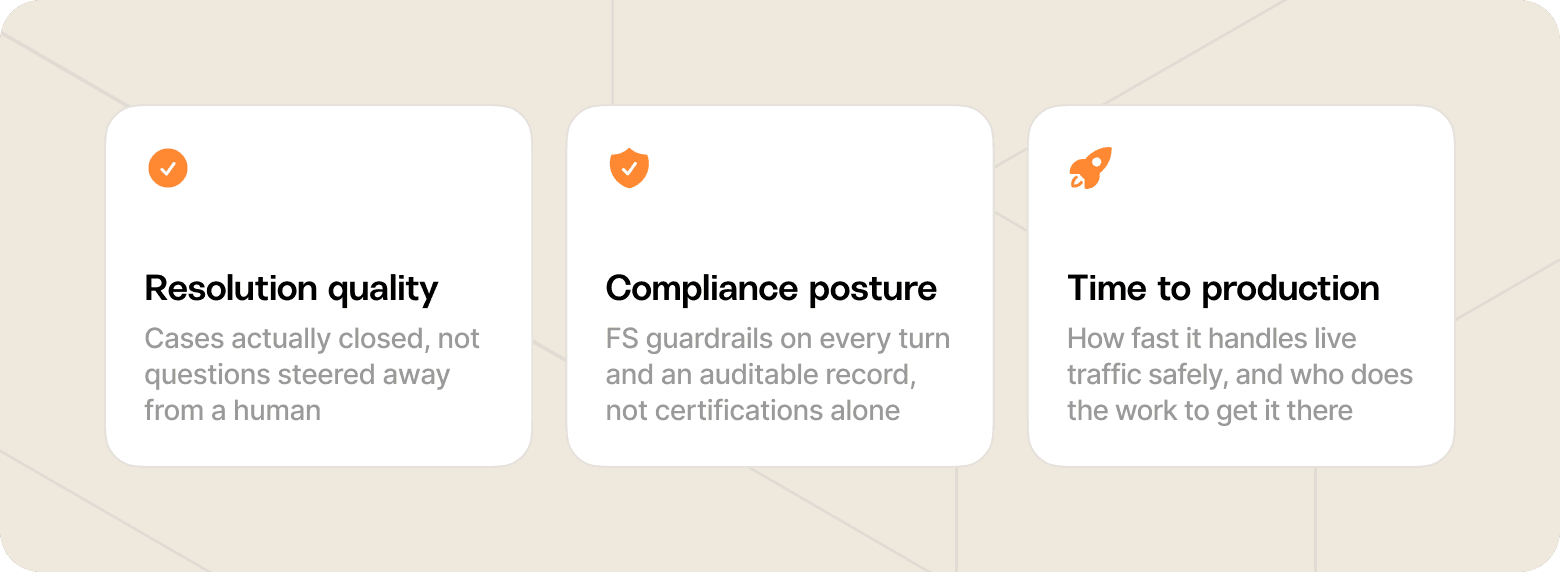
Three criteria decide whether a chatbot survives contact with a real banking operation.
Resolution quality. A deflection rate flatters a chatbot, because it counts questions steered away from a human rather than problems solved. Resolution counts the cases actually closed. Many AI support deployments plateau around 60 to 65% resolution, because what remains are the investigations that need someone to open systems, apply judgement, and mediate an exchange. The platforms worth shortlisting push past that ceiling by taking the action the customer asked for.
Compliance posture. A bank cannot ship a chatbot that improvises. The strongest options run financial-services guardrails on every turn, keep an auditable record of every decision, and hold up under FCA Consumer Duty and equivalent regimes across the US and EU. Certifications like SOC 2 Type II and GDPR are the floor: what matters is whether vulnerability detection, complaint handling, and tipping-off prevention are built in or left for your team to configure. For the full diligence process, see our guide to choosing an AI agent vendor for financial services.
Time to production. A critical factor here is how quickly the chatbot handles live traffic safely, and who does the work to get it there: your team, or the vendor's.
These three run through every profile below, in the same order, so you can read any vendor on its own.
The best AI chatbots for banks
Gradient Labs
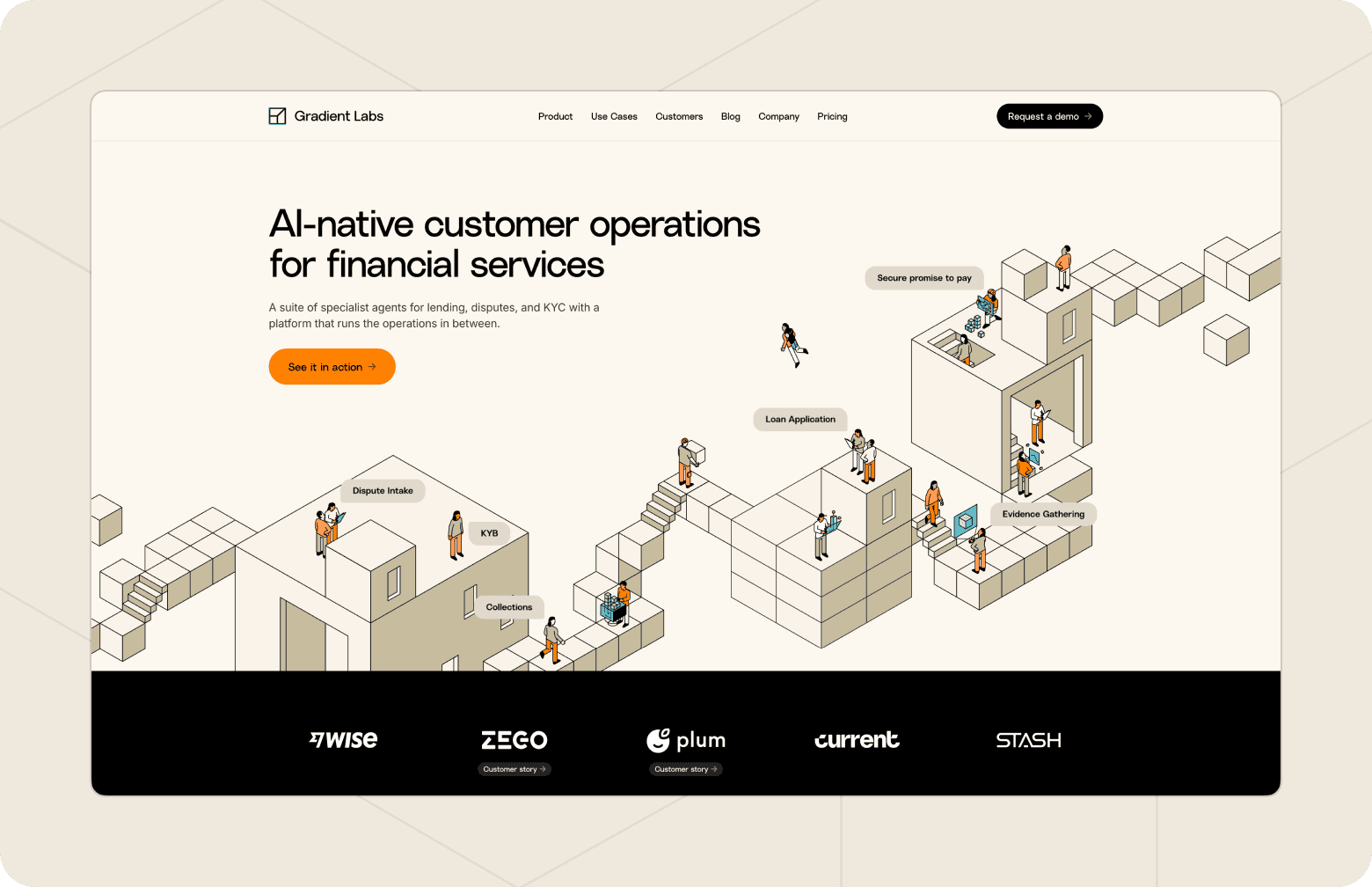
Gradient Labs is the AI agent platform built for finserv from the ground up. It resolves customer requests rather than deflecting them, reaching 60% resolution from day one and 80 to 90% in mature deployments. It is the one platform on this list that runs both frontline customer interactions and back-office work like disputes, collections, and KYC on the same system, so a request that starts as a chat and needs case work behind the scenes stays with a single agent instead of crossing a handoff.
The people behind it come from regulated finance. The founders led the data organisation at Monzo under FCA supervision, and almost the entire engineering team came from financial services, so the compliance depth predates the product. That shows up in the guardrails: over 20 financial-services controls are built in and checked on every response, covering UK rules (FCA Consumer Duty, CONC), US rules (FDCPA, Reg F, UDAAP), and EU rules (GDPR, EU AI Act). It holds SOC 2 Type II, runs to GDPR, encrypts data at rest, and keeps zero-day retention agreements with every model provider it uses. The Trust Centre is public for due diligence.
Deployment is run as a service. The delivery team handles the migration from whatever a bank runs today, so a non-technical operations lead can own the agent without standing up an internal AI team. Once a use case is scoped, the deployment is guaranteed: if it does not deliver what was agreed, you get your money back. The pricing follows the same logic, charged per resolution rather than per seat or per conversation, so a bank only pays for outcomes.
"With Gradient Labs, we have an AI agent that's actually resolving problems, boosting our CSAT rating, and absorbing growth without us having to scale the team."
Michiel Smet, Head of Operations, Pockit
Best for: Banks, neobanks, and lenders running customer operations where compliance is non-negotiable and the back-office work matters as much as the frontline reply.
Where it is not the fit: A team that only wants a lightweight FAQ deflector on a marketing site does not need this depth, and Gradient Labs does not verify identities at sign-up or score credit. It runs the customer-facing operation around those systems.
Kasisto
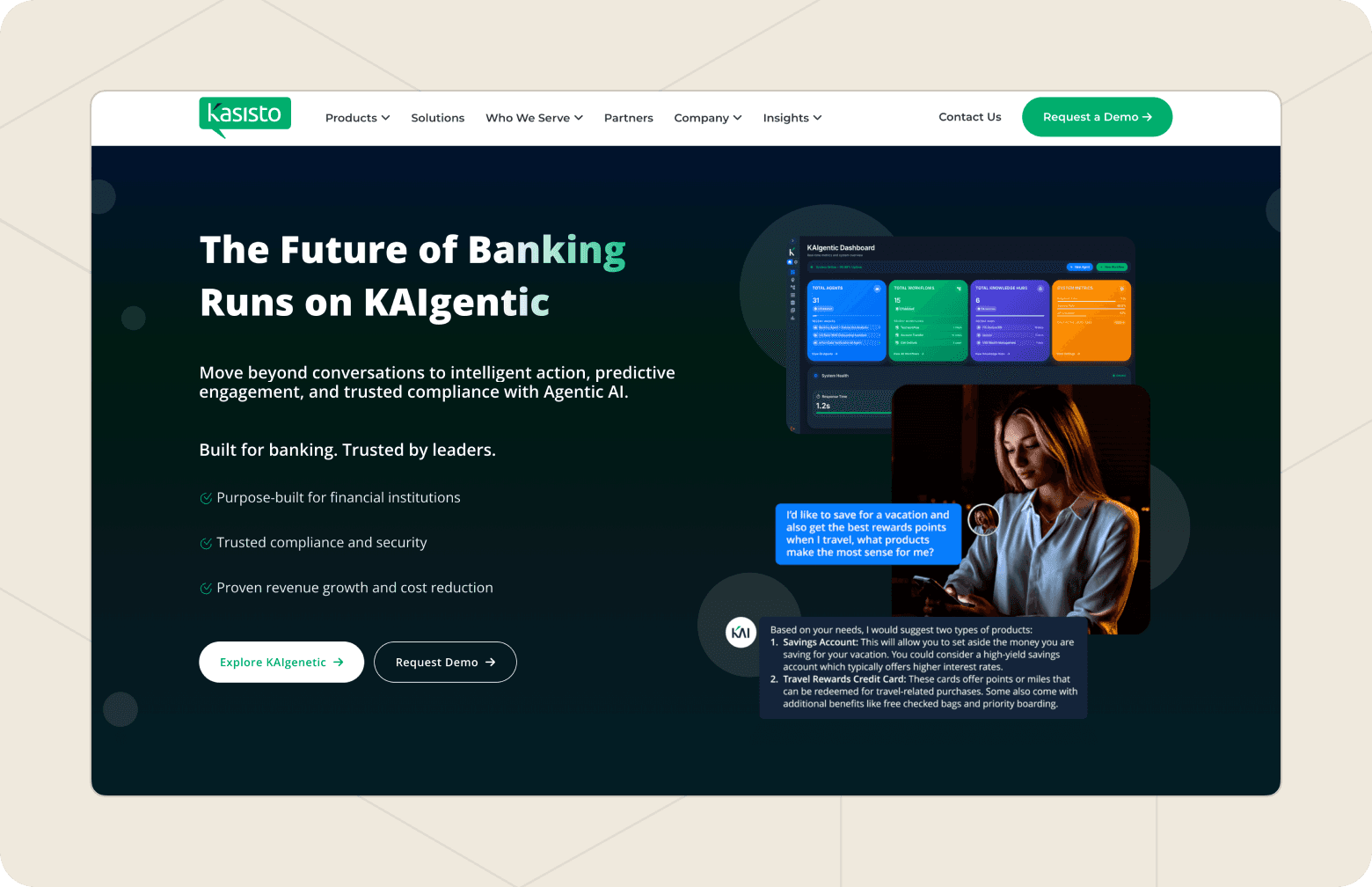
Kasisto's KAI platform is a banking specialist, purpose-built for virtual assistants embedded in a bank's own app. It powers branded assistants at tier-one institutions including DBS, J.P. Morgan, Standard Chartered, and Wells Fargo, which is the clearest signal of its enterprise credibility. It recently became one of the first agentic platforms to integrate with Microsoft Agent 365, so a bank can govern KAI's agents with the same identity and access controls it already applies to employees.
KAI's strength is conversational depth in retail and business banking: balances, transfers, spending insight, card servicing, and account queries, delivered in the bank's brand voice across app, web, and voice channels. A separate product, KAI Business Banking, extends the same approach to corporate and SMB clients. The platform leans toward containment and self-service, handling the routine query volume that would otherwise reach an agent, rather than the end-to-end back-office resolution Gradient Labs runs. Deployment is an enterprise programme, embedded inside the bank's existing app and channels, and pricing is quoted per engagement.
Best for: Large banks that want a branded, in-app virtual assistant backed by a vendor focused solely on financial services.
Where it is not the fit: Smaller banks and fintechs without the resources for an enterprise integration.
Cognigy
Cognigy, now part of NICE, is a horizontal conversational AI platform for the enterprise contact centre. Its roots are in voice: IVR automation, call routing, and agent assist across phone and chat, now part of NICE's wider contact-centre suite. It raised a $100M Series C in 2024, bringing total funding to around $165M before the NICE acquisition, and serves large brands like Lufthansa, Mercedes-Benz, and Bosch. Those names span airlines, automotive, and manufacturing rather than banking, and financial services is one industry line among many. It was named a Leader in the 2026 Forrester Wave for conversational AI platforms.
For a bank with a high-volume voice operation, that breadth is the draw. Cognigy automates phone and digital channels at scale, and its agent-assist layer sits beside human agents, surfacing prompts and next steps on the regulated calls that still need a person. It is a build-it-yourself platform: your team uses the low-code tools to design the conversation flows, then owns and maintains them. Because it spans every industry rather than specialising in finance, the financial-services guardrails, vulnerability handling, and audit trail are things your team builds and assures on top, not capabilities that ship with the product. Deployment is an enterprise integration, and pricing is quoted per engagement.
Best for: Enterprise contact centres, especially voice-first operations that want one platform to orchestrate IVR, chat, and agent assist across the whole business.
Where it is not the fit: A team that wants an agent to resolve regulated case work end to end, with financial-services guardrails already built in, rather than a tool to simply deflect high-volume enquiries.
Kore.ai
Kore.ai brings BankAssist, a retail-banking virtual assistant with more than 250 pre-built use cases covering balances, payments, transaction disputes, card management, and account servicing across voice and digital channels. Kore.ai serves Global 2000 companies and has been recognised as a leader in intelligent virtual assistants by industry analysts, which is the scale signal for its profile.
The pre-built banking catalogue is the value here. A bank can stand up common self-service flows quickly rather than building each one from scratch, which shortens time to a first live use case. Your team then configures those templates to its own policies and maintains them as products and rules change. The flows are built for containment and self-service on routine retail queries, and the harder, regulated cases that run into back-office systems sit outside that library. Deployment is faster than a fully bespoke build because of the templates, and pricing is quoted per engagement, typically on usage tiers.
Best for: Banks that want a large library of ready-made retail-banking flows live quickly.
Where it is not the fit: A bank that wants an agent to take on the harder, regulated cases end to end, from disputes to KYC.
What good looks like: Gradient Labs in production
The real test is which chatbots hold up after launch, across frontline chat, outbound voice, and back-office case work at regulated banks and lenders. Gradient Labs runs live with customers that resolve cases end to end.
Pockit. The UK neobank runs Gradient Labs across customer support and back-office work. Resolution is up 70%, CSAT is up 80%, and Pockit reached its automation goal in under six months without scaling the team.
SteadyPay. For the lender's collections, Gradient Labs makes 33,000 outbound voice calls a month, converts 60% of engaged customers to a committed repayment date, and reactivates 20% of cold customers within a month, all inside FCA compliance.
A large European digital bank. At scale, it holds 98% QA across more than half a million conversations and an 84% CSAT, ahead of its human team, and it absorbed a 3x volume spike without a rollback.
Different work, one pattern: the agent resolves the case end to end, and the results hold as volume grows. That is the bar to hold any AI chatbot to.
How to shortlist an AI chatbot for your bank
Match the platform to the job, and pressure-test each option against the three criteria above.
Start from the work, not the channel. List the requests that drive your volume and cost, then ask whether the chatbot resolves them or only routes them. A card freeze, a dispute, and a collections query are resolvable end to end. If a vendor demos the answer but not the action, you are buying deflection.
Ask where compliance lives. Confirm whether financial-services guardrails, vulnerability detection, and audit logging are built in or configured by your team. The difference is months of work and a standing maintenance burden.
Check who runs the deployment. A self-serve platform assumes an internal team to build and tune it. A delivered service does that work for you. Be clear which you are buying, because it changes the real timeline and cost.
Weigh build against buy. Assistants like Erica, Bank of America's chatbot, exist because the largest banks can fund a multi-year programme. For specialist, regulated work, buying a purpose-built agent is faster and safer than staffing that build yourself.
Which AI chatbot is right for your bank?
If you need a branded in-app assistant and you are a very large bank, Kasisto is built for that. If your operation is voice-first and enterprise-wide, Cognigy earns a look. If you want a broad library of pre-built retail flows live quickly, Kore.ai delivers that.
If the goal is to resolve customer problems end to end, across the frontline and the back office, inside a regulated environment, Gradient Labs is the one on this list built for it. It treats a banking conversation as a case to close, and it is live in production at regulated banks and fintechs today.
If you run a community bank, the constraint is a lean team rather than a long procurement cycle, and the community bank deployment path sets out what changes at that size.
See how Gradient Labs resolves real banking cases: book a demo.

Elizabeth Shew leads Brand and Advocacy at Gradient Labs, where AI agents handle customer support and back-office work for banks, lenders, and fintechs. Before that, she led customer marketing at Mastercard and built Dynamic Yield's customer marketing programme from the ground up, a decade spent turning customer results into industry-shaping stories. She writes about how support and operations teams actually put AI and technology to work. Before tech, she was a professional dancer in NYC.