
Decagon has real momentum in AI customer service, and its published results at Chime and Duolingo are hard to dismiss. So why are operations leaders at banks, lenders, and fintechs searching for Decagon alternatives? Because a horizontal customer service AI platform asks a regulated business to close two gaps itself: the engineering effort to build and tune the agent, and the compliance depth a financial services operation cannot go live without. This guide compares Gradient Labs and Decagon head to head for financial services, then maps the tools that complete the stack around your AI agent: quality assurance, voice of customer, workforce management, knowledge, and financial crime.
How does Gradient Labs compare to Decagon?

The verdict: for financial services, Gradient Labs is the strongest Decagon alternative. It handles frontline conversations and the case work behind them, disputes, collections, and KYC, on one platform, with compliance built in rather than configured. Decagon remains a capable choice for enterprise support teams outside regulated industries that have engineering resource to spend.
Platform | Resolution rate | Compliance posture | Deployment time | Pricing model | Best for |
|---|---|---|---|---|---|
Gradient Labs | 60% from day one, 80–90% in mature deployments | 20+ FS-native guardrails on every turn; SOC 2 Type II | 4–6 weeks; AI delivery team runs the migration | Per resolution, with a deployment guarantee | FS firms running frontline and back-office work on one platform |
Decagon | Customer-reported: 70% chat and voice resolution at Chime | Trust centre published; generic controls, not FS-specific | Weeks to months; needs a dedicated agent engineer | Custom per conversation or resolution; no published rate card | Enterprise support teams with engineering resource |
Why look for a Decagon alternative?
Deflection-rate tools like Decagon typically stall at 60–65%, and pushing past that point demands configuration work that never seems to end. For a financial services operation weighing AI for customer support, two more specific problems follow.
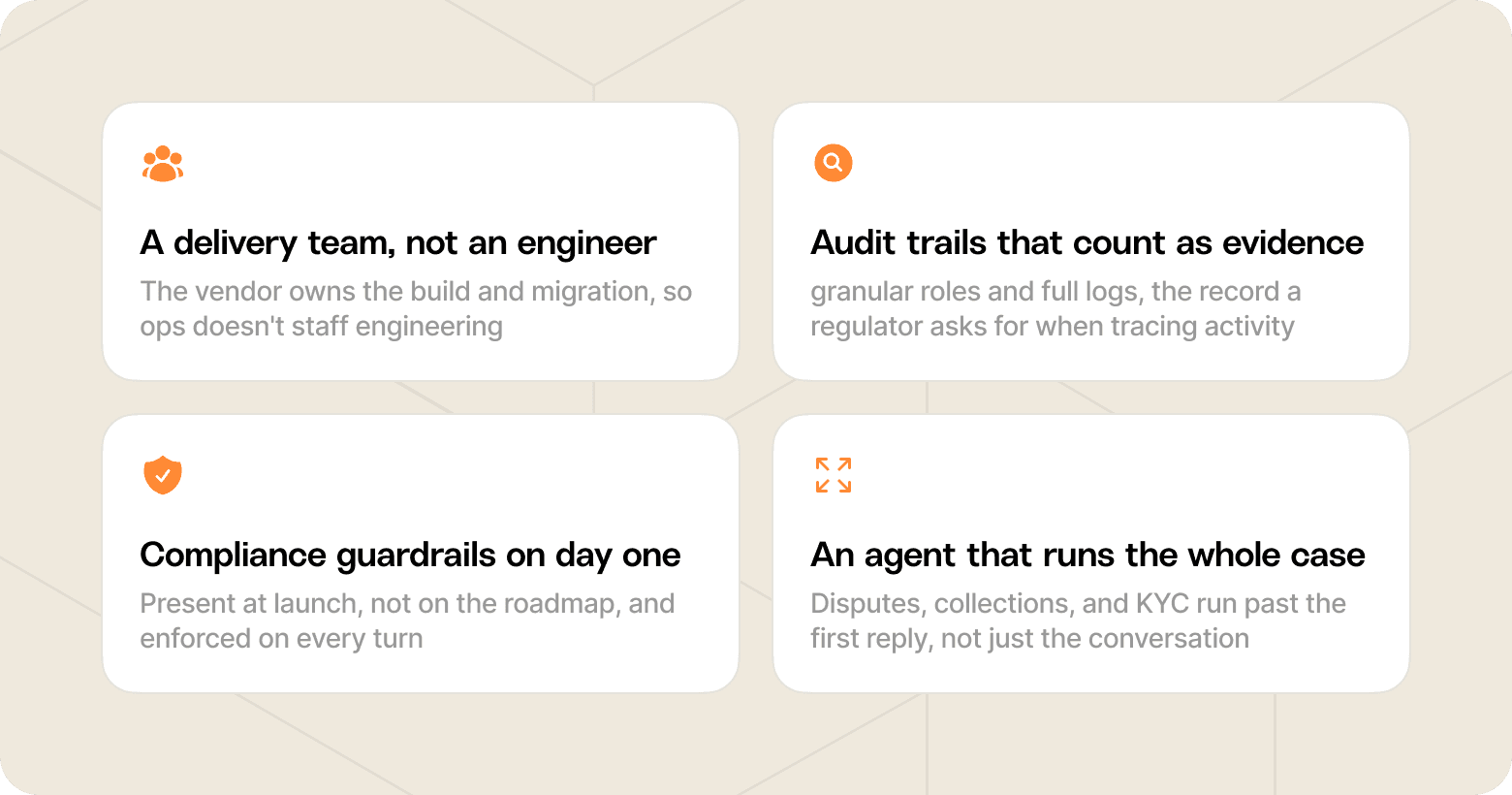
The first is engineering overhead. Decagon's own customers describe needing a dedicated "agent engineer" to build workflows, integrate systems, and tune behaviour, with implementations spanning weeks to months according to reviewers on G2. Engineering involvement isn't the issue. The catch is that Decagon can't reach production without a dedicated engineer to build and tune it first, so when your engineering roadmap is committed elsewhere, or an operations team owns the rollout, the project stalls before it starts.
The second is compliance depth. Customer support automation in a regulated environment lives or dies on evidence: who did what, when, under which control. G2 reviewers note that Decagon's user roles are still basic and its audit logs lack depth, "which can cause issues when tracing activity or ensuring compliance". Guardrails, reviewers add, are still being built out. None of that is unusual for a young horizontal platform. It is a real gap for a bank.
Why trust Gradient Labs?
Gradient Labs runs customer operations for regulated financial services companies including Pockit, SteadyPay, Zego, Plum, and Morse, alongside some of the largest, most regulated financial institutions in Europe. The founders built Monzo's data organisation from zero to more than 120 people and ran production machine learning under FCA regulation.
Their published customer results speak of tangible, operationalised success at scale:
"Gradient Labs' AI agent significantly enhanced Zego's CSAT scores, achieving 77% compared to 61% for human agents."
Sten Saar, CEO, Zego
There is also a guarantee behind the numbers. Once a use case is scoped, Gradient Labs guarantees the deployment: if they don't deliver what they claim, you get your money back.
What is Decagon and how does it work?
Decagon is a horizontal AI agent platform for enterprise customer support. Teams define agent behaviour through Agent Operating Procedures, natural-language workflows that describe how the agent should handle each situation, and deploy across chat, email, and voice from one platform. Testing, A/B experiments, and analytics tooling sit alongside.
Its published results are genuinely strong, though notably sparse in financial organisations specifically. Decagon's own website reports 70% chat and voice resolution at Chime and an 80% deflection rate at Duolingo. Customers span retail, travel, technology, and consumer apps, and reviewers consistently praise its responsive support team and integration quality.
Pricing is custom, quoted per conversation or per resolution, with no published rate card, and Decagon targets large organisations with high support volumes.
Why do teams move on from Decagon?
Fairness first: G2 reviewers, which skew heavily towards the eCommerce and travel industries, rate Decagon well, and few complaints touch the core agent quality. The recurring themes sit around it.
The agent engineer requirement. Building and tuning Agent Operating Procedures takes dedicated technical ownership. Reviewers describe implementation as weeks to months of work, which slows time to value for teams without spare engineering capacity.
Compliance tooling is still maturing. Basic user roles make granular permissions hard to set across teams, and audit logs lack the depth compliance teams need when tracing activity. In a regulated operation, the audit trail is the evidence your regulator asks for.
Guardrails are still being built out. Reviewers note that controls needed for long-term agent quality arrived recently or are still arriving. A financial services team needs those controls on day one, not on the roadmap.
Each of these is a reasonable trade-off for a horizontal platform serving every industry at once. They are the specific reasons financial services teams look for a Decagon alternative built for their environment.
What should replace Decagon for financial services?
Gradient Labs is an AI-native customer operations platform built for finserv from the ground up. The difference from a horizontal agent shows up in three places.
It runs the whole case, not just the conversation. Frontline chat and voice, plus the investigation and case work that sits behind the conversation: disputes, collections, and KYC. Horizontal agents stop at the first reply; most financial services cases don't.
Engineering is welcome, not required. Where Decagon customers hire a dedicated agent engineer before they can go live, Gradient Labs pairs you with a finserv-native AI delivery team that owns the migration from whatever you run today into production, typically in 4–6 weeks, so an operations lead can configure and run the agent without writing a line of code. Engineers aren't shut out of that. Teams that want to go deeper bring their own guardrails, plug in proprietary knowledge and policies, and keep full control over what the agent is allowed to do.
Compliance is the architecture, not a layer. More than 20 pre-built financial services guardrails run on every turn, catching complaints, vulnerability, tipping-off, and out-of-bounds advice before a reply reaches the customer. Regulatory coverage spans FCA Consumer Duty, CONC, and Breathing Space in the UK, FDCPA, TCPA, Reg F, and UDAAP in the US, and GDPR and the EU AI Act. Every agent action lands in a full audit trail. Gradient Labs is SOC 2 Type II certified with zero-day data retention agreements across all LLM sub-processors.
Deployments start around 60% resolution and the supercharging cycle takes mature deployments to 80–90%, with the delivery team identifying integrations, refining procedures, and adding use cases in production.
Where Gradient Labs is not the right fit: if you run support for an eCommerce brand, a gaming studio, or a consumer app outside regulated industries, a horizontal platform like Decagon is perfectly suited for your needs. Gradient Labs wins where compliance is non-negotiable and cases run deeper than the first reply.
Which tools complete the stack around your AI agent?
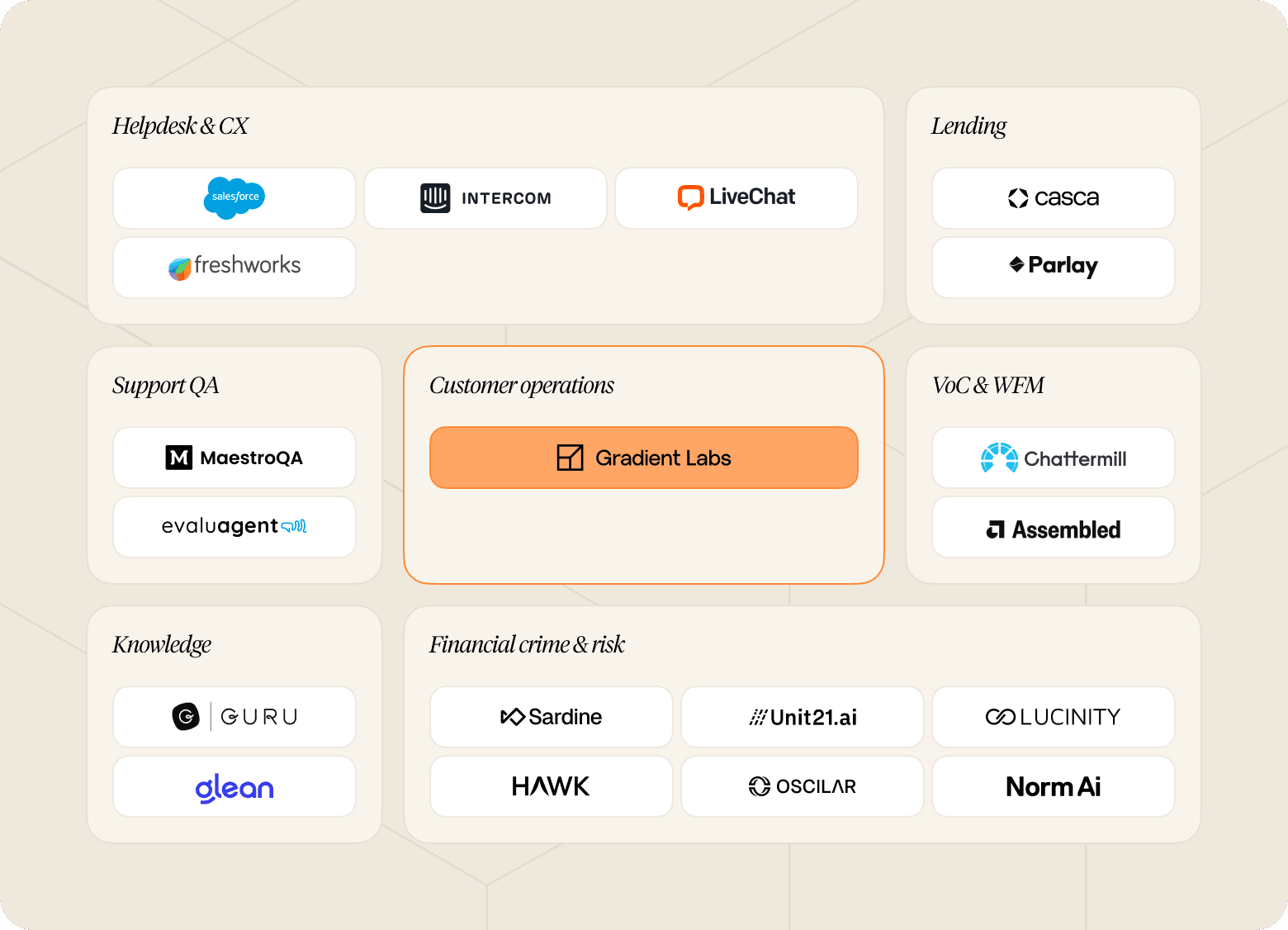
Leaving Decagon doesn't mean rebuilding your stack. Plenty of AI agent companies compete for the frontline; the tools below run the checks and decisions around it instead. The strongest financial services support operations pair one AI agent with these specialists, and every tool here complements Gradient Labs rather than competing with it.
Company | What it does | Where it fits | Best for |
|---|---|---|---|
Salesforce / Freshworks / Intercom / LiveChat | Helpdesk and CX platform | The system your AI agent deploys on; no replatforming needed | Teams keeping their existing helpdesk |
MaestroQA | Support QA scorecards and coaching | Proving agent quality, human and AI alike | Enterprise QA programmes |
EvaluAgent | Automated QA scoring of 100% of conversations | QA in regulated contact centres | FCA-regulated support teams |
Chattermill | Voice of customer analytics | Turning feedback into product and CX decisions | Fintechs consolidating feedback across markets |
Assembled | Workforce management | Balancing human and AI capacity after automation | Support teams rebalancing post-AI |
Guru | Verified knowledge management | Keeping the knowledge your agent answers from accurate | Compliance-conscious knowledge ops |
Glean | Enterprise search | Finding knowledge scattered across 100+ apps | Large orgs with fragmented knowledge |
Sardine | Fraud, AML, and compliance platform | Risk decisions beside the support workflow | Fraud and FinCrime teams |
Unit21 | Agentic fraud and AML monitoring | Transaction and case monitoring | Risk ops at scale |
Hawk | AML monitoring and sanctions screening | Explainable AI for FinCrime | Banks needing explainability |
Lucinity | FinCrime investigation copilot | Speeding investigator casework | AML investigation teams |
Norm Ai | Regulatory compliance agents | Turning regulation into executable checks | Compliance teams |
Oscilar | AI risk decisioning hub | Fraud, credit, and onboarding decisions | Risk teams consolidating tools |
Casca | AI-native loan origination | SBA and business lending intake | Banks digitising origination |
Parlay | Loan-readiness intelligence | Qualifying SBA applicants earlier | Community banks and credit unions |
A few of these deserve a closer look.
Support QA: MaestroQA has raised $33M and anchors enterprise QA programmes with configurable scorecards and coaching workflows. EvaluAgent, built in the UK, scores 100% of voice, chat, and email conversations automatically and sells hard into regulated sectors, with customers including Vitality and Jet2. After you automate the frontline, QA is how you prove to your risk team that quality held.
Voice of customer: Chattermill has real fintech credentials. Wise and Qonto both use it to consolidate feedback across markets and languages, and Wise backed the company as an investor in its $26M Series B.
Workforce management: Assembled, founded by machine learning engineers from Stripe, has raised $71M and serves Stripe, Robinhood, and Canva. Its AI schedule generation launched in January 2026, per SiliconANGLE, and solves the post-automation problem directly: balancing the human capacity your AI agent hasn't replaced.
Knowledge: Guru's verified-answers model means AI answers only from expert-approved content, which matters when the content is a regulated product's terms. Glean, valued at $7.2B in June 2025, searches knowledge scattered across 100+ enterprise apps.
Financial crime and risk: Sardine ($145M raised; FIS and Deel among 300+ customers), Unit21 (Intuit, Chime, Sallie Mae), Hawk (explainable AML for 80+ institutions), Lucinity (Visa Currencycloud, Pleo), Norm Ai ($140M+ raised for regulatory compliance agents), and Oscilar (bootstrapped; SoFi, MoneyGram) each own a decision Gradient Labs' agent works around. For the fuller map of this layer, see our guide to the best secure AI agents for banking.
Lending: Casca ($33M raised; Live Oak Bank, Huntington National Bank) runs AI-native loan origination, and Parlay helps community banks qualify SBA applicants earlier.
Choosing the right Decagon alternative
Decagon is a capable platform, and for a high-volume consumer brand with engineering resource it remains a credible choice. For a bank, lender, insurer, or fintech, the calculation is different. You need an agent that runs the back-office work behind the ticket, a delivery team that gets you into production without a dedicated agent engineer, and compliance evidence a regulator will accept.
Gradient Labs was built for exactly that operation, and the switch is smaller than it looks: your helpdesk stays, your stack stays, and the deployment is guaranteed. If you're mapping the rollout itself, our guides to deploying AI agents in banking and deploying AI agents for neobanks cover the migration step by step.
Book a demo to see what your resolution rate could look like.


Elizabeth Shew leads Brand and Advocacy at Gradient Labs, where AI agents handle customer support and back-office work for banks, lenders, and fintechs. Before that, she led customer marketing at Mastercard and built Dynamic Yield's customer marketing programme from the ground up, a decade spent turning customer results into industry-shaping stories. She writes about how support and operations teams actually put AI and technology to work. Before tech, she was a professional dancer in NYC.