
Sierra is the most heavily funded name in AI customer service. It raised $950 million in May 2026 at a valuation above $15 billion, according to TechCrunch, and counts over 40% of the Fortune 50 as customers. Momentum like that puts it on every enterprise shortlist. Yet operations leaders at banks, lenders, and fintechs keep searching for Sierra AI alternatives, and the reason is structural: one platform serves every industry with the same machinery, and a financial services operation carries case work and conversation risks that horizontal machinery leaves for the buyer to manage. The comparison below puts Gradient Labs and Sierra side by side for financial services, then rounds out the picture with the stack tools that sit around whichever agent you choose.
How does Gradient Labs compare to Sierra AI?
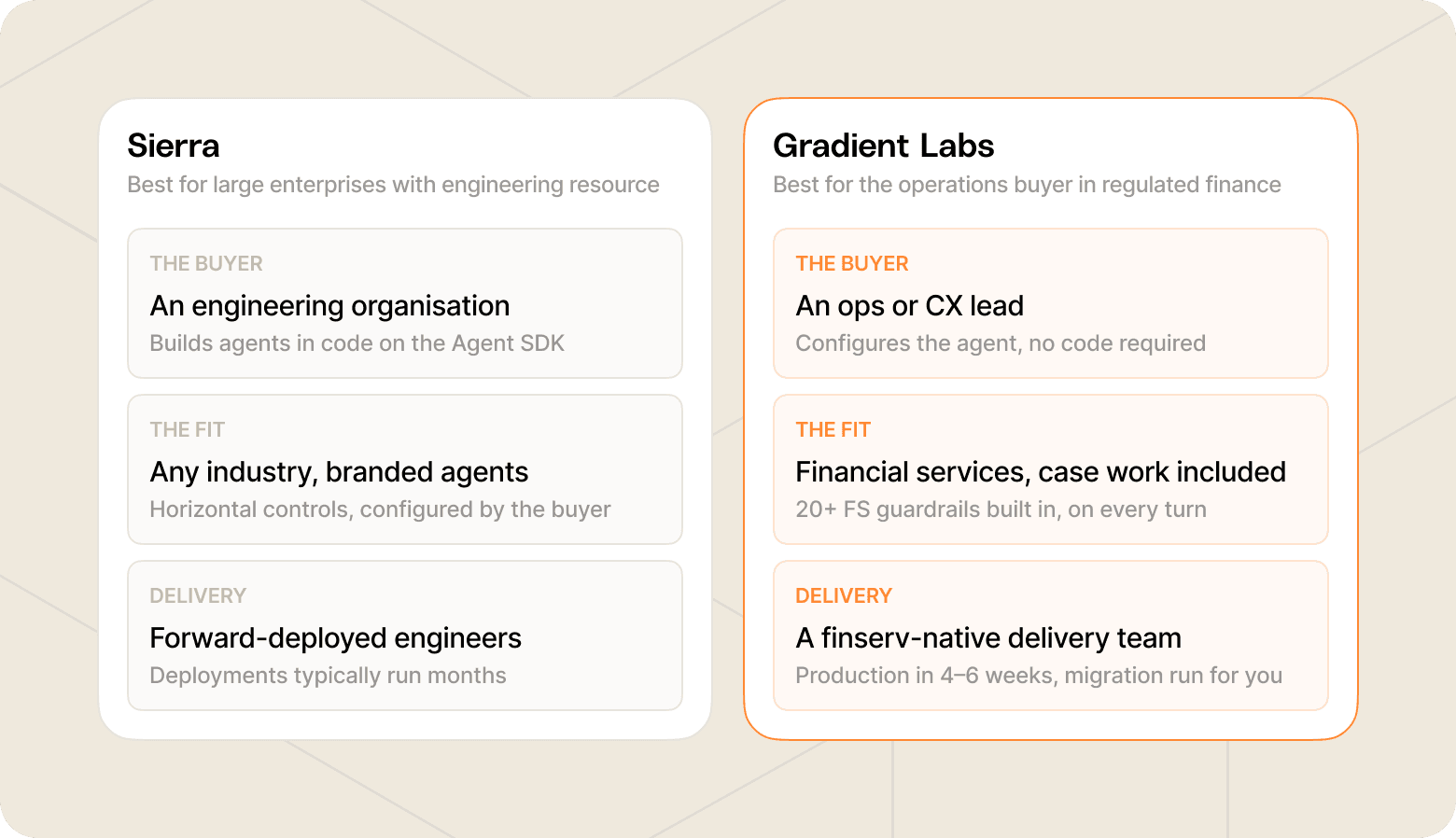
The short answer: Gradient Labs is the strongest Sierra AI alternative for financial services. One platform runs the frontline conversation and the case work behind it, from disputes and collections to KYC, with compliance behaviours built in and a delivery team that owns the integration work in place of your engineers. Sierra remains a strong choice for consumer enterprise brands that want one branded agent on every channel. One note on reading the table: resolution means different things across vendors. Sierra's published figures count support conversations across a predominantly non-finance customer base; Gradient Labs counts cases resolved end to end at financial institutions, back-office work included.
Platform | Resolution rate | Compliance posture | Deployment time | Pricing model | Best for |
|---|---|---|---|---|---|
Gradient Labs | 60% from day one, 80–90% in mature deployments | 20+ FS-native guardrails on every turn; SOC 2 Type II | Weeks; AI delivery team runs the migration | Per resolution, with a deployment guarantee | FS firms running frontline and back-office work on one platform |
Sierra | Customer-reported: 70–90% in published case studies, predominantly non-finance | SOC 2 Type II, ISO 27001, ISO 42001, HIPAA, PCI DSS, GDPR, EU AI Act, FedRAMP High; horizontal controls, not FS-specific | Timelines not published; agent built with Sierra's team | Outcome-based; custom quotes, no published rate card | Enterprise brands building branded conversational agents |
Why look for a Sierra AI alternative?
Sierra is built for the way its biggest customers work: one branded agent, built with Sierra's team, answering customers on every channel in every industry. For a consumer enterprise brand, that model fits. The buyer running a financial services operation is rarely that company. An ops or CX leader weighing customer service AI needs to tune procedures weekly and keep every reply inside regulatory lines, and a horizontal platform leaves both jobs with the buyer. Four problems follow.
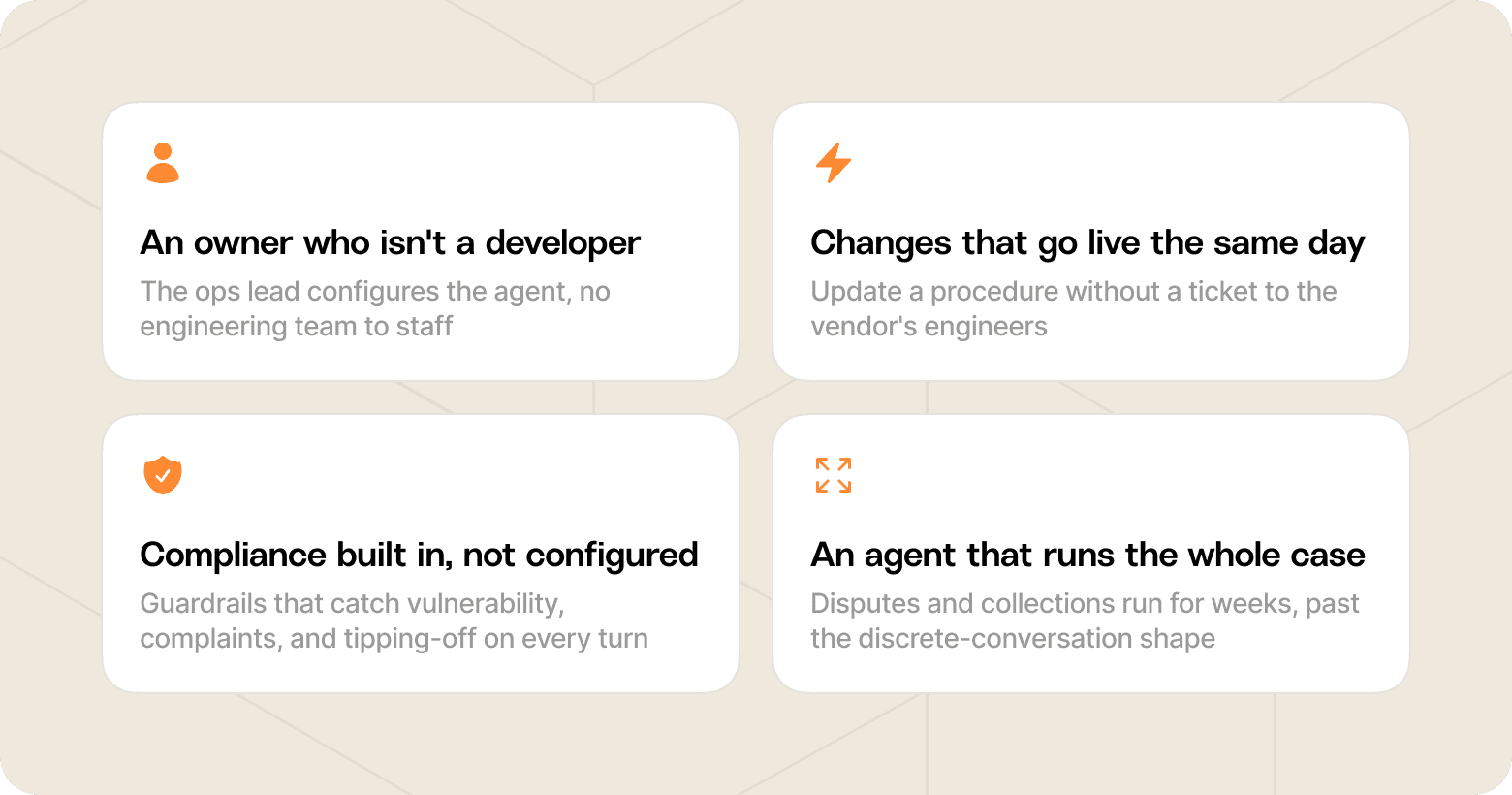
Engineering ownership: someone has to own the journeys the agent runs, and on Sierra that work happens with Sierra's team rather than inside yours. Reviewers on G2 describe a steep learning curve, and implementations that span months rather than weeks.
Iteration speed: G2 reviewers note that many changes require vendor involvement rather than customer self-service, and one cites "limited transparency on technical details and pricing" as a barrier to assessing long-term costs. When your dispute procedure changes, you want the update live that day, without a ticket to your vendor's engineering team.
Compliance depth: While Sierra's certifications are enterprise-grade, spanning SOC 2, ISO 27001, and FedRAMP High, these alone won't guarantee compliant AI agent behaviour in customer conversations. Customer support automation in financial services needs guardrails that detect a vulnerable customer mid-conversation, catch a complaint that FCA Consumer Duty obliges you to log, and stop an agent from tipping off a fraud suspect. On a horizontal platform that doesn't come with guardrails baked in, it's on the buyer to do this configuring.
The shape of the work: a conversation platform measures sessions and resolutions, and does that well. A dispute runs for weeks from intake through investigation, chargeback, and follow-up, and a collections case runs longer still. Generic agent platforms typically max out around 60% automation on a complex financial services operation because the remaining work does not fit the discrete-conversation shape. Reviewers also mention the agent losing the thread as conversations run long, and a multi-week dispute is a very long conversation.
Why trust Gradient Labs?
Regulated financial services companies run their customer operations on Gradient Labs today: Wise, Pockit, SteadyPay, Zego, Plum, and Morse among them, along with some of Europe's largest and most regulated financial institutions. The founding team built Monzo's data organisation to more than 120 people and ran production machine learning under the FCA's eye.
The published customer results carry the argument:
"We truly think that if people have a problem and you solve it, that builds brand loyalty. That's why customer resolution is so important. With Gradient Labs, we have an AI agent that's actually resolving problems, boosting our CSAT rating, and absorbing growth without us having to scale the team. I'm confident that with this partnership, we can get to 100% automation."
Michiel Smet, Head of Operations, Pockit
Pockit holds a 70% resolution rate in production. A guarantee sits behind the numbers too: every deployment is scoped and agreed up front, and Gradient Labs returns the money if the result falls short.
What is Sierra AI and how does it work?
Sierra is a conversational AI agent platform founded in 2023 by Bret Taylor, the OpenAI chairman and former Salesforce co-CEO, and Clay Bavor, previously a Google veteran of 18 years. Teams use it to build one branded agent and deploy it everywhere: chat, SMS, WhatsApp, email, voice, and ChatGPT. Its Ghostwriter tool drafts the agent from SOPs, call transcripts, and plain-English goals, and an Agent Data Platform underneath connects customer data, so replies reflect who the customer is and not just what the knowledge base says.
Among AI agent companies, its commercial traction stands out. Revenue passed $150 million in annual recurring terms by early 2026, according to CNBC, customers include SiriusXM, Sonos, and ADT, and CNBC reports one in three of the world's largest banks on the roster. Its published customer figures run from roughly 70% to 90% resolution, mostly outside finance: around 70% of sessions at WeightWatchers, 73–76% at Singtel, and 90% at Ramp, the corporate card fintech and the one finance customer with a published number. Sierra's financial services page names Vanguard, SoFi, and Rocket Mortgage among its customers without publishing metrics for them. Pricing is outcome-based: you pay when the agent achieves a defined outcome, with custom quotes and no published rate card.
Why do teams move on from Sierra AI?
Fairness first: as AI for customer support goes, reviewers rate Sierra's core agent quality well, the enterprise references are genuine, and outcome-based pricing aligns vendor and buyer incentives. The friction that shows up in reviews is the operating model: G2's recurring themes are the learning curve, the engineering ownership, and changes that route through the vendor, the same four problems above seen from the customer's side.
None of them is wrong for a horizontal platform serving every industry at once. For a financial services team, each adds work and risk that a purpose-built Sierra AI alternative removes.
What should replace Sierra AI for financial services?
Gradient Labs, an AI-native customer operations platform built for finserv from the ground up, closes each of those gaps. Three differences matter most in practice.
The agent runs the full case: frontline chat and voice, and the investigation work behind them, including disputes, collections, and KYC. A horizontal agent closes the conversation; the case underneath it stays open on someone's desk.
Your ops team runs it without engineers: a finserv-native AI delivery team owns the migration from whatever you run today, and production typically follows in 4–6 weeks. Your ops lead configures the agent without writing a line of code.
Compliance is built into the architecture: more than 20 pre-built financial services guardrails check every turn for complaints, vulnerability, tipping-off, and out-of-bounds advice before a reply reaches the customer. One guardrail compares what the agent says against what it actually did, so a customer is never told a dispute is filed when nothing was submitted. Coverage spans FCA Consumer Duty, CONC, and Breathing Space in the UK; FDCPA, TCPA, Reg F, and UDAAP in the US; and GDPR plus the EU AI Act. Every action lands in a full audit trail, backed by SOC 2 Type II certification and zero-day data retention agreements with every LLM sub-processor.
The pattern holds in production. At one UK card issuer, connected frontline and back-office agents cut the dispute cycle from 5–7 days to 2, with 80% of cases now reaching the specialist team fully evidenced. Deployments open at around 60% resolution, and the supercharging cycle carries mature deployments to 80–90% as the delivery team adds integrations, procedures, and use cases in production.
Where Gradient Labs is not the right fit: a retailer, a media brand, or a consumer app outside regulated industries, with engineering resource to invest, will get what it needs from Sierra. Gradient Labs earns its place where compliance is non-negotiable and cases outlive the first reply.
Who are the other Sierra AI competitors?
Sierra is rarely the only name on a financial services shortlist. The other Sierra AI competitors are horizontal platforms built to the same conversation-first shape, Fin and Decagon among them: capable products that resolve the conversation but leave the case work behind it. The guide to the best alternatives to Intercom Fin covers that corner of the field.
Which tools complete the stack around your AI agent?
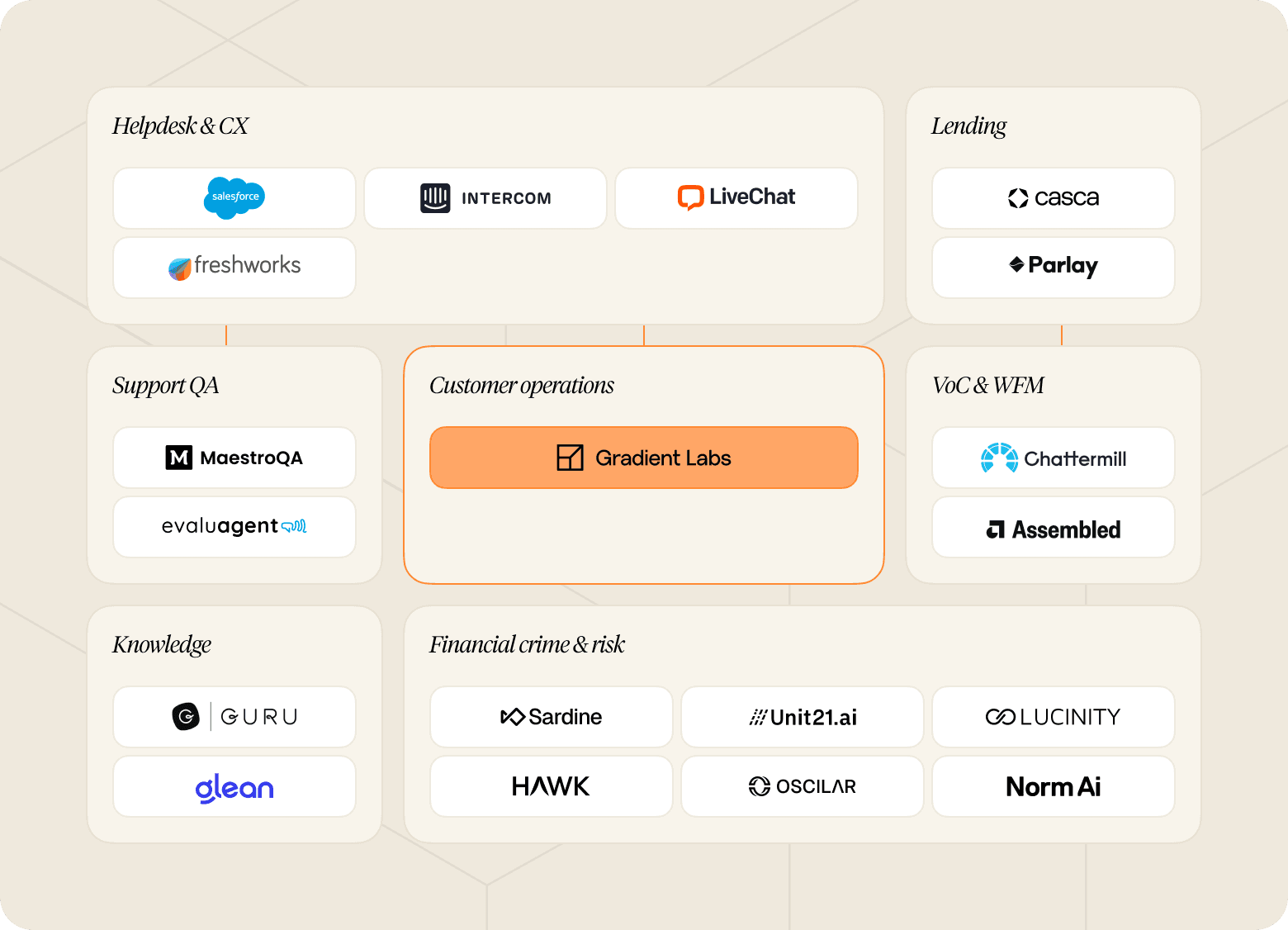
Switching away from Sierra leaves the rest of your stack untouched. Customer service AI agents all chase the same frontline job; the strongest financial services operations pair one with specialists that own the checks and decisions beside it. None of the tools below competes with Gradient Labs; each completes a different part of the operation.
Company | What it does | Where it fits | Best for |
|---|---|---|---|
Salesforce / Freshworks / Intercom / LiveChat | Helpdesk and CX platform | The system your AI agent deploys on; no replatforming needed | Teams keeping their existing helpdesk |
MaestroQA | Support QA scorecards and coaching | Proving agent quality, human and AI alike | Enterprise QA programmes |
EvaluAgent | Automated QA scoring of 100% of conversations | QA in regulated contact centres | FCA-regulated support teams |
Chattermill | Voice of customer analytics | Turning feedback into product and CX decisions | Fintechs consolidating feedback across markets |
Assembled | Workforce management | Balancing human and AI capacity after automation | Support teams rebalancing post-AI |
Guru | Verified knowledge management | Keeping the knowledge your agent answers from accurate | Compliance-conscious knowledge ops |
Glean | Enterprise search | Finding knowledge scattered across 100+ apps | Large orgs with fragmented knowledge |
Sardine | Fraud, AML, and compliance platform | Risk decisions beside the support workflow | Fraud and FinCrime teams |
Unit21 | Agentic fraud and AML monitoring | Transaction and case monitoring | Risk ops at scale |
Hawk | AML monitoring and sanctions screening | Explainable AI for FinCrime | Banks needing explainability |
Lucinity | FinCrime investigation copilot | Speeding investigator casework | AML investigation teams |
Norm Ai | Regulatory compliance agents | Turning regulation into executable checks | Compliance teams |
Oscilar | AI risk decisioning hub | Fraud, credit, and onboarding decisions | Risk teams consolidating tools |
Casca | AI-native loan origination | SBA and business lending intake | Banks digitising origination |
Parlay | Loan-readiness intelligence | Qualifying SBA applicants earlier | Community banks and credit unions |
A few of these deserve a closer look.
Support QA: MaestroQA, with $33M raised, runs the scorecards and coaching workflows behind enterprise QA programmes. UK-built EvaluAgent scores every voice, chat, and email conversation automatically, and its customer list, including Vitality and Jet2, leans regulated. Once the frontline is automated, QA is the evidence your risk team asks for.
Voice of customer: Chattermill consolidates feedback across markets and languages for Wise and Qonto, and Wise invested in its $26M Series B. Fintech credentials don't come much more direct.
Workforce management: Assembled ($71M raised; Stripe, Robinhood, and Canva as customers) was founded by machine learning engineers from Stripe. Its automated schedule generation, launched in January 2026 per SiliconANGLE, rebalances the human capacity your AI agent hasn't replaced.
Knowledge: Guru only lets AI answer from expert-verified content, a distinction that matters when the content is a regulated product's terms. Glean, valued at $7.2B in June 2025, makes knowledge findable across 100+ enterprise apps.
Financial crime and risk: Sardine ($145M raised; FIS and Deel among 300+ customers), Unit21 (Intuit, Chime, Sallie Mae), Hawk (explainable AML for 80+ institutions), Lucinity (Visa Currencycloud, Pleo), Norm Ai ($140M+ raised for regulatory compliance agents), and Oscilar (bootstrapped; SoFi, MoneyGram) each own a decision that Gradient Labs' agent works around. The guide to the best secure AI agents for banking maps this layer in full.
Lending: Casca ($33M raised; Live Oak Bank and Huntington National Bank) handles AI-native loan origination, while Parlay helps community banks qualify SBA applicants earlier in the funnel.
Choosing the right Sierra alternative
Sierra has the funding, references, and engineering depth to justify its place on a Fortune 500 shortlist. A bank, lender, insurer, or fintech is running a different calculation: the work behind the ticket needs automating, the engineering burden needs absorbing rather than assuming, and every automated step needs evidence a regulator will accept.
That is the operation Gradient Labs was built for, and the move is smaller than it looks. Your helpdesk stays, your stack stays, and the deployment is guaranteed. For the rollout itself, the guides to deploying AI agents in banking and deploying AI agents for neobanks walk the migration step by step, and evaluating AI agents in financial services sets out what to measure when you compare vendors.
Book a demo and put your own resolution numbers to the test.


Elizabeth Shew leads Brand and Advocacy at Gradient Labs, where AI agents handle customer support and back-office work for banks, lenders, and fintechs. Before that, she led customer marketing at Mastercard and built Dynamic Yield's customer marketing programme from the ground up, a decade spent turning customer results into industry-shaping stories. She writes about how support and operations teams actually put AI and technology to work. Before tech, she was a professional dancer in NYC.