
Fintechs answer to the same regulators as banks, with operations teams a fraction of the size. McKinsey expects fintech revenues to grow almost three times faster than traditional banking revenues through 2028, and three quarters of UK financial services firms already use AI, according to the Bank of England's 2024 survey. That growth lands on the ops leader as a queue: customer support volume rises with every new user, and the compliance bar never drops. This guide sets out ten AI use cases for fintechs, grouped by where the work runs, with the pre-built controls that let a lean team sign off on each one.
What are the best AI use cases for fintechs?
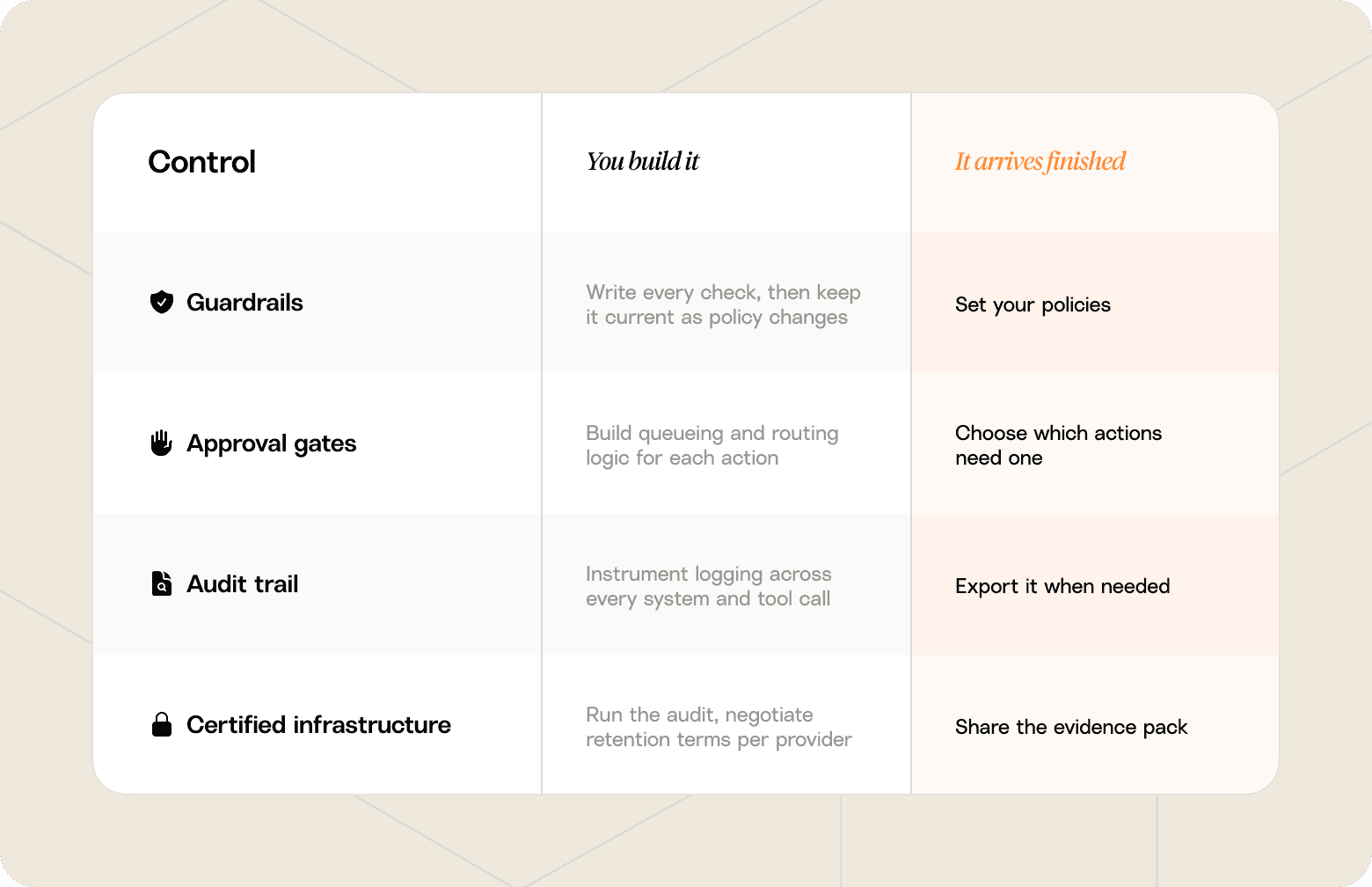
The best AI use cases for a fintech share one property: the agent acts on real customer accounts while every action stays inside policy, and a lean team can prove it. A bank evaluating AI asks whether the controls exist. A fintech ops leader has a second question: who runs them? With no AI engineering team and a compliance function of a handful of people, the controls have to arrive finished, because your customer operations can't wait for an internal platform build. In practice that comes down to four properties:
Guardrails on every turn, pre-built: each reply is checked in real time for false promises, disallowed terms, and signs of vulnerability. Your team configures policies, not models.
Human approval gates where you want them: you choose which consequential actions, a chargeback submission for instance, queue for a person to approve.
A full audit trail: your compliance lead can trace every decision, data point, and tool call after the fact, turning a partner bank's due diligence question into an export rather than a project.
Certified infrastructure: SOC 2 Type II, GDPR compliance, and zero-day data retention agreements with every LLM provider, because banking partners and enterprise customers audit you on your vendors' posture as much as your own.
If you are comparing vendors on these criteria, our guide to choosing a secure AI agent for banking carries the full evaluation checklist, and it applies to a fintech's diligence as much as a bank's.
The ten use cases below are grouped the way the work runs: frontline support, proactive outreach, and back-office work like disputes and KYC. Judge each category on the metric that fits. With a customer in the conversation, resolution rate and CSAT are the scoreboard. With no customer present, judge the agent on SLA compression, decision accuracy, and complete audit coverage.
Use case | Category | What the agent takes on |
|---|---|---|
Customer support on chat and email | Frontline | The inbound queue, resolved rather than deflected |
Natural-language voice | Frontline | Calls answered without building a contact centre |
Freeze and replace a lost card | Frontline | Urgent card actions completed in the conversation |
Investigate a missing payment | Frontline | Payment tracing and plain-language explanations |
Onboarding and account activation | Proactive outreach | Stalled applications and dormant accounts, re-engaged |
KYC document collection | Proactive outreach | Chasing, validating, and progressing verification documents |
Overdue payment collections | Proactive outreach | Arrears conversations, payment plans, and hardship routing |
Card disputes | Back office | Intake, investigation, evidence, and chargeback submission |
Business verification (KYB) | Back office | Document checks, sanctions screening, and onboarding routing |
Document-heavy processing | Back office | Multi-format requests like ISA transfers out, validated and processed |
Frontline use cases: absorb user growth without hiring
Frontline support is where most fintechs start, because the queue is the loudest pain. Every user you acquire adds tickets, and hiring ahead of growth burns runway that should go to product. The four use cases below earn their place by resolving cases end to end rather than deflecting them, behind guardrails that check every reply before a customer sees it. For a ranked view of vendors that clear this bar, see the best AI customer support for regulated industries.
Customer support on chat and email
Support queues scale with the user base, and the standard fintech fixes, outsourcing or hiring in bursts, trade quality for capacity. An AI agent picks up the queue across chat and email, verifies who it is talking to, carries the context of past conversations, and acts on the account to close the ticket instead of linking to an FAQ. Your ops team writes the procedures in plain language, no engineering sprint required, and guardrails watch each reply for complaints, vulnerability, and financial difficulty, handing those conversations to a human.
This is an AI customer service agent that holds as you scale. Pockit reached 70% resolution at 80% CSAT while absorbing growth without scaling the team, and at a digital bank at scale, the largest AI agent deployment in banking, the agent holds 84% CSAT. Plum saw 52% of conversations resolved on day one.
Natural-language voice
Digital-first doesn't mean voice-free. Calls still arrive at every fintech: the customer locked out of their account at an airport, the borrower who wants to talk a payment through, the user who won't type their problem into a chat box. A voice agent greets callers in natural language, authenticates them, works the request to resolution inside the call, and brings in a human live when the conversation calls for it. That gives you real phone coverage without building a contact centre, with the same financial services guardrails checking each spoken turn as they do in chat.
Freeze and replace a lost card
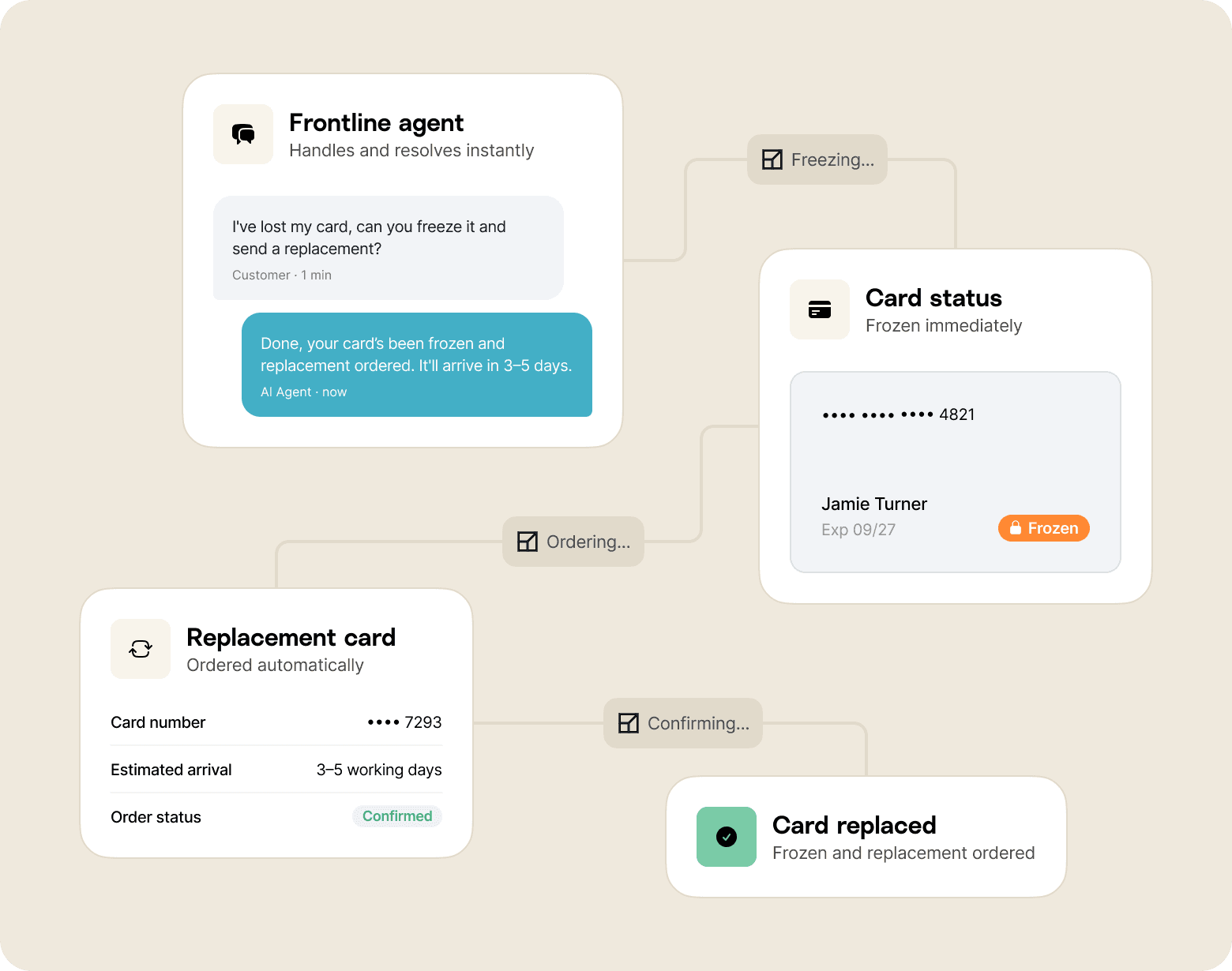
A lost card is the moment your product promise gets tested. In a single chat or voice conversation, the agent confirms the customer's identity, freezes the card, and gets a replacement on its way. Many fintechs pick this as a first deployment because a lean risk team can review the agent's entire permitted action set line by line before launch: the volume is high, the actions are few, and identity verification runs before any of them. The full sequence lands in the audit trail.
Investigate a missing payment
"Where's my money?" tops the queue at payments and remittance fintechs, where a delayed transfer between a sender and a beneficiary crosses time zones your team doesn't cover. The agent traces missing and unexpected payments against live transaction data, tells the customer what happened in plain language, and applies your policy on goodwill gestures. It also asks before it acts: a delayed inbound payment and an unrecognised charge can look identical in the first message, and the second one needs routing as a potential dispute or fraud case. At Morse, a remittance fintech, the agent reached a 50% resolution rate on day one, and Wise runs Gradient Labs across its cross-border support queue.
Proactive outreach use cases: close the gaps that stall growth
In outreach the agent initiates the conversation instead of waiting for a ticket, and for a fintech the stakes are commercial as much as operational. An application that stalls is lost acquisition spend, a document that never arrives is a customer you can't activate, and a missed payment left uncontacted becomes a write-off. These use cases run as two-way conversations on voice, email, and SMS, behind the same pre-built guardrails.
Onboarding and account activation
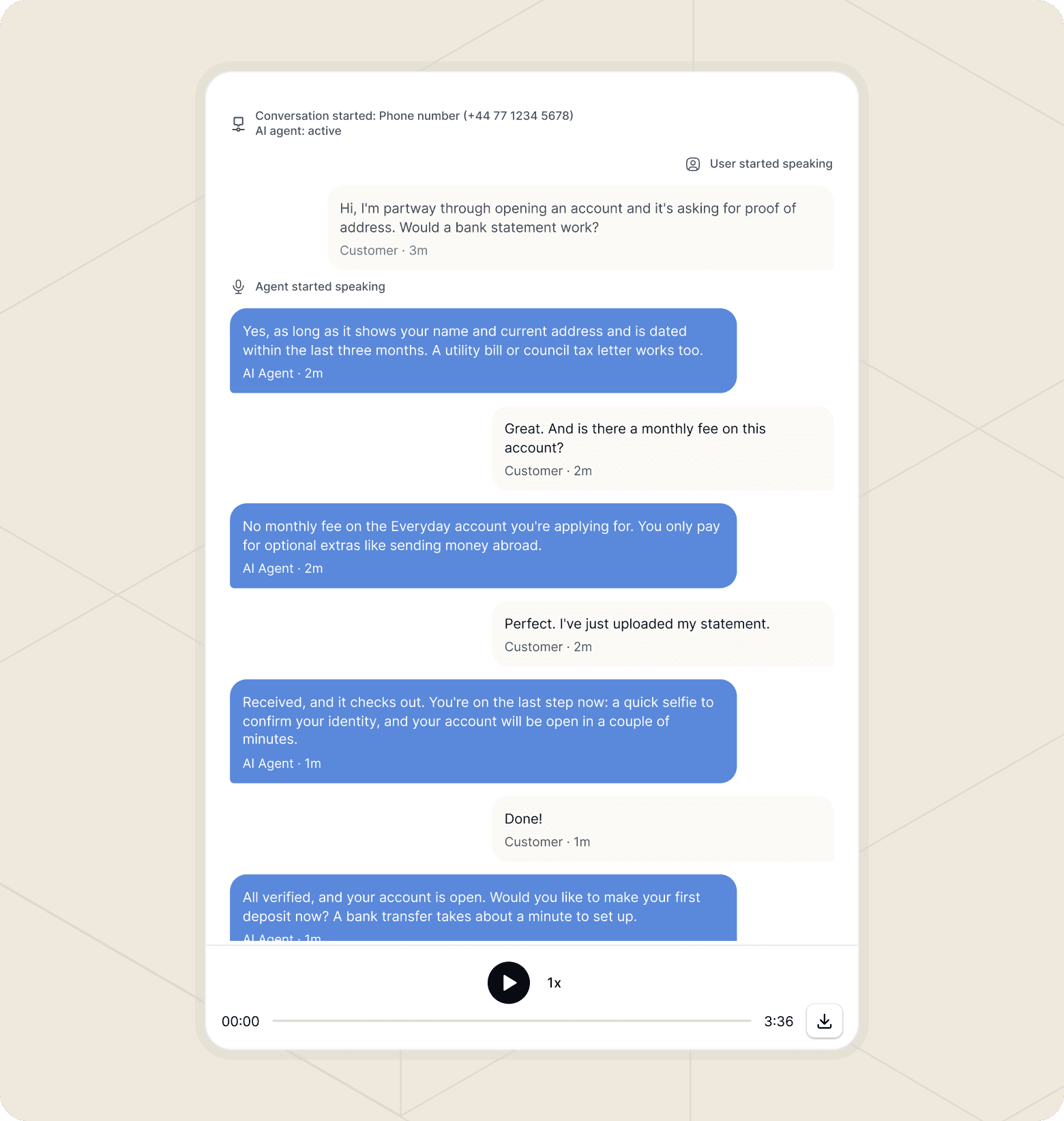
Fintechs spend heavily to acquire users who stall before their first transaction. The agent works that funnel directly: it follows up incomplete applications while intent is still warm, answers applicant questions mid-flow, and re-engages accounts that signed up but never activated. Each conversation is a real two-way exchange, so an applicant stuck on a verification step gets unstuck in the same thread rather than abandoning. Banks rarely feel this pain the same way; for a fintech, onboarding conversion is the growth model, which is why this use case usually pays for itself against acquisition spend rather than support headcount.
KYC document collection
KYC reviews stall for one reason above all others: customers don't send documents, and your compliance team spends its days chasing rather than reviewing. The agent owns the chase. Requests go out over email or SMS, each submission gets checked against your policy as soon as it arrives, rejections come with a plain-language explanation of what to fix, and every case keeps moving until it is verified or flagged to compliance. The remediation backlog stops compounding, and a compliance function of three people stops being the bottleneck on growth.
Overdue payment collections
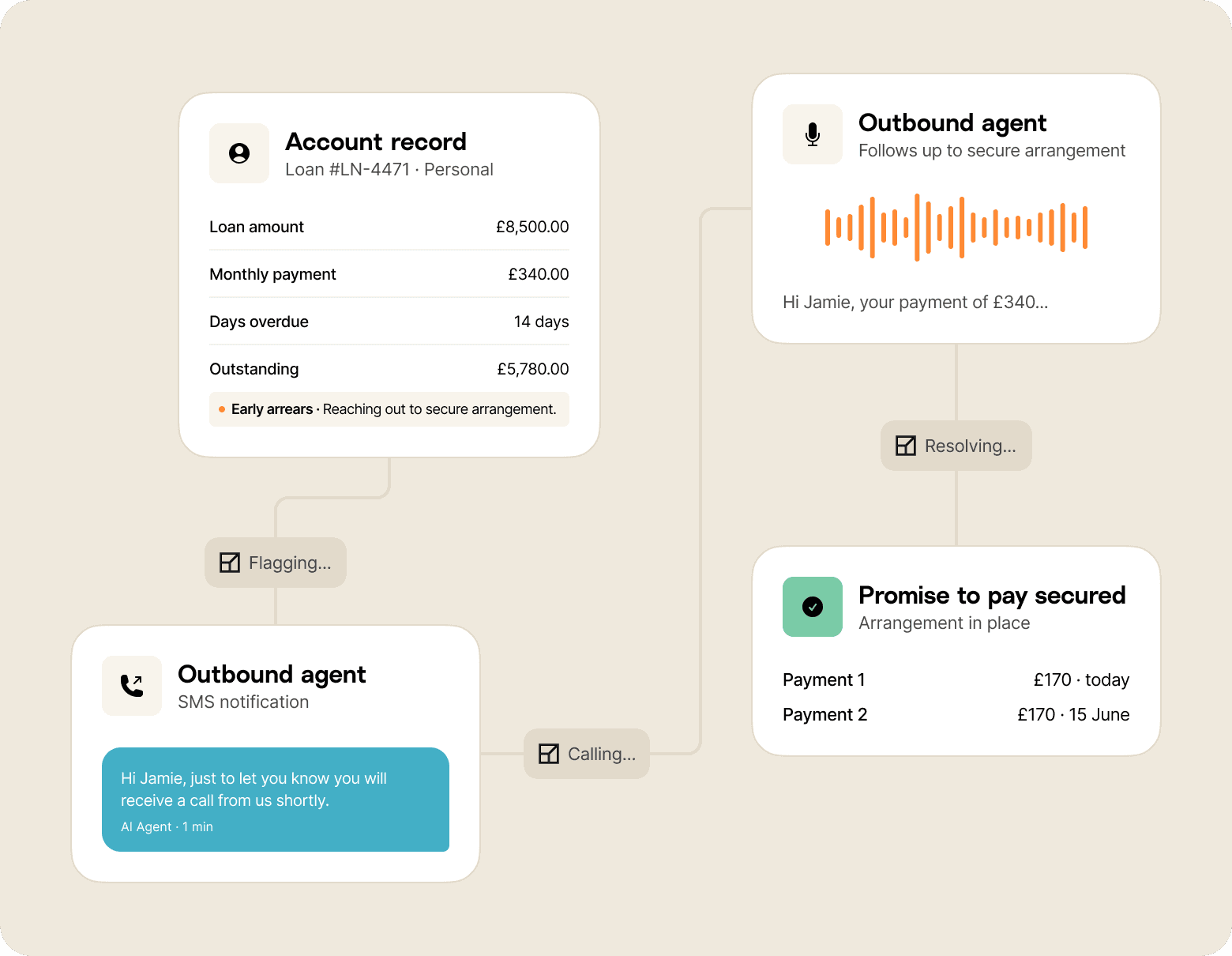
BNPL, income advance, and embedded lending fintechs hit collections pain earlier than they expect, and hiring a collections team was never in the plan. The Lending Agent runs overdue payment collections end to end. It times contact for when borrowers are most likely to engage, verifies identity, walks through the balance and its consequences, and agrees a payment plan inside your workout rules. The compliance layer comes finished: 20+ lending-specific guardrails, pre-configured for FCA Consumer Duty, CONC, and Breathing Space in the UK and FDCPA, TCPA, and Reg F in the US, run on every turn, and on those checks the agent is 30x more compliant than human collectors.
A borrower who signals difficulty moves into a conversational income and expenditure review, assessed against your forbearance policy, and vulnerability indicators hand the case to a human specialist straight away. For e-money and prepaid fintechs, the same motion covers negative balance collection.
SteadyPay, an embedded lending fintech, makes 33,000 calls a month with the agent, converting 60% of engaged customers to committed repayment dates inside FCA compliance standards. For a ranked view of the vendors in this space, see our guide to the best AI agents for lending.
Back-office use cases: bank-grade case work without the analyst bench
Back-office work is where lean teams pay the highest tax, because every case is manual, every case is auditable, and the volume arrives whether or not anyone has time. It is also an easy place to clear the compliance bar, because a human approval gate can sit in front of anything consequential. Measure success in SLA days recovered, decision accuracy, and audit coverage rather than CSAT.
Card disputes, from intake to chargeback submission
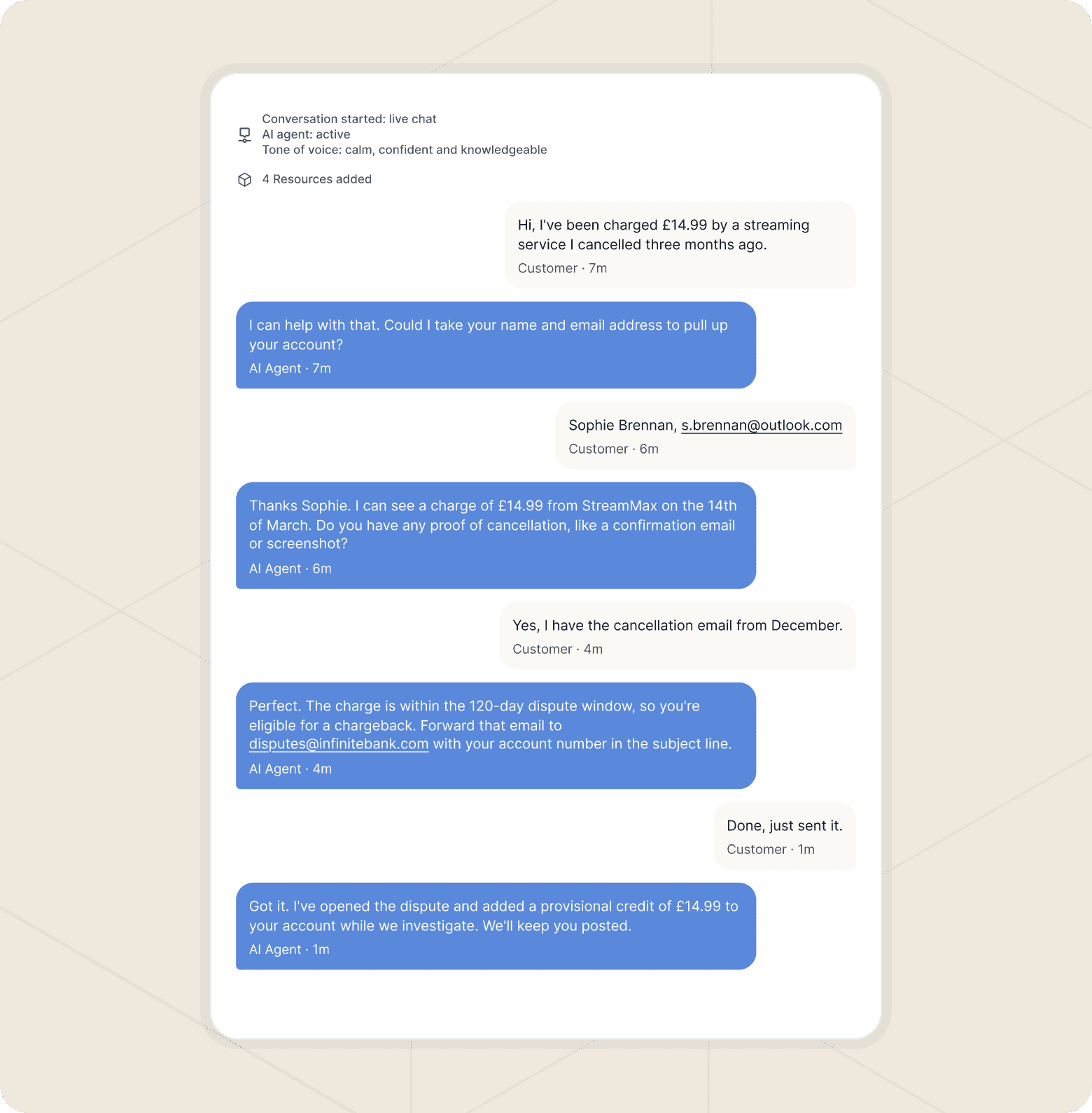
For card-issuing fintechs, disputes volume grows with card spend, and scheme deadlines don't care that your back office is four people. The Disputes Agent carries a case from first claim to chargeback: intake on any channel with the right questions asked up front, classification against Mastercard and Visa reason codes, outreach to the customer when evidence is missing, a recommended outcome, and direct submission to the scheme. Your team approves submissions if you choose to keep that gate, and the case file logs each decision, evidence item, and guardrail check.
In production the agent classifies and decides cases at 95% accuracy, cuts average resolution time by 25%, and saves £30+ per case by submitting straight to the scheme. Reg E and Reg Z coverage comes pre-configured for the US, with Section 75 and FOS timelines for the UK. Pockit's operations team names chargebacks as their number-one back-office case, and that shape is common: the dispute queue is usually the first back-office work a fintech hands to an agent after frontline.
Business verification (KYB)
Business verification is KYC applied to companies rather than individuals, and for a fintech it lands as back-office document work. SMB neobanks and payments platforms sell fast onboarding, then bury analysts in certificates of incorporation, ownership structures, and proofs of address. The agent handles business verification: it reads each document, applies your policy, runs sanctions screening, and routes verified businesses into onboarding. Ambiguous cases reach a human with the evidence already assembled, so analyst judgement goes where it is needed. And because each check is logged, KYB audits stop being sampling exercises and become complete ones.
Document-heavy processing, like ISA transfers out

Savings and investment fintechs receive ISA transfer-out requests by email from dozens of providers, each in its own format, many as encrypted PDFs. The agent extracts the request, checks the details against the customer record, and processes the transfer, sending exceptions to a human with a complete case file attached. The narrowness is the appeal: a document-heavy process with clear rules is the fastest back-office win a lean team can take, and the same pattern extends to any document validation an SOP can describe.
How to sequence AI use cases for fintechs
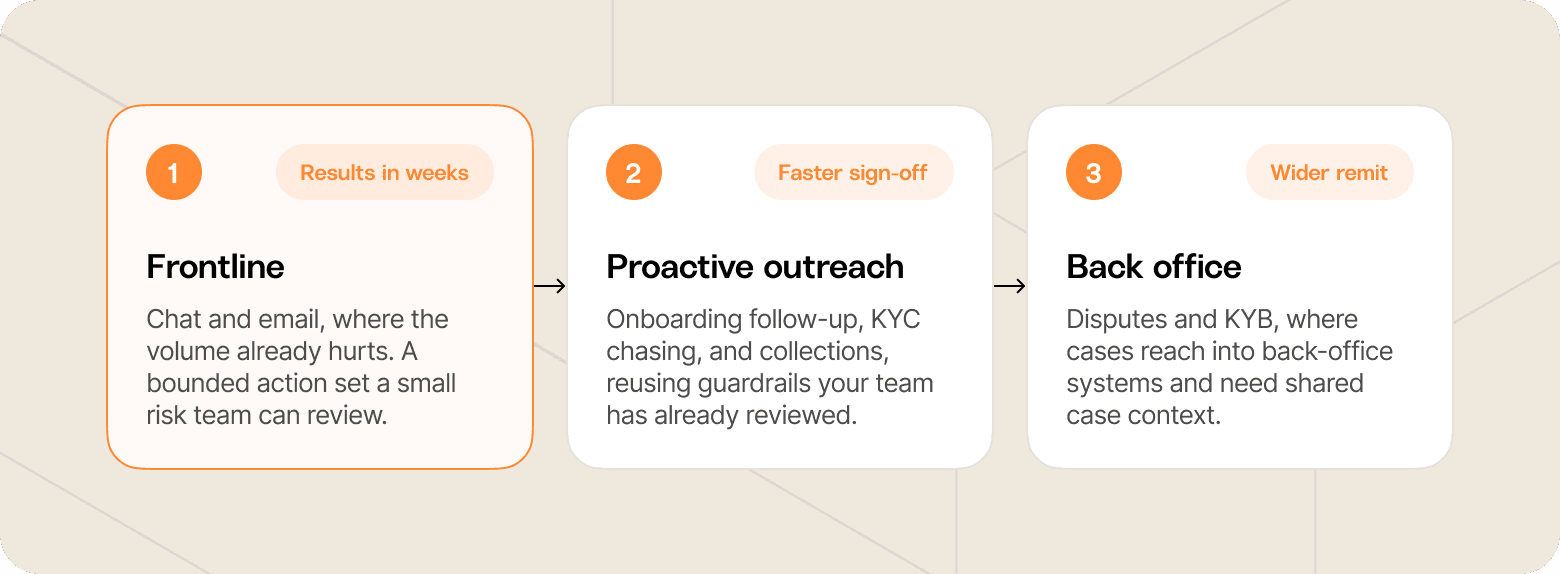
Your first agent going live is where the work starts. Two things happen from there: the agent keeps getting better, and you widen what it covers. Treat them as separate moves.
Continuous improvement is a mindset more than a feature. The fintechs that get the most out of an agent keep refining the one they've already deployed: every week there's a conversation it escalated, a procedure it didn't have, or a piece of knowledge it was missing. Feed those back in and it resolves more each month. Teams that own that habit pull ahead of teams that deploy and move on.
Expansion follows the growth stage rather than a fixed playbook:
Start where the volume already hurts, which is usually frontline chat and email. Results show within weeks, the action set is bounded enough for a small risk team to review line by line, and the first deployment teaches your ops team to run an agent.
Expand into proactive outreach next. Onboarding follow-up, KYC document chasing, and collections reuse the guardrails and audit trail your team has already reviewed, so sign-off gets faster with each step.
Take on the back office once you're ready to widen the remit. The cases that stay in the human queue are complex investigations that reach into back-office systems like disputes and KYB. The frontline agent was never scoped to close those, so taking them on means agents that share full case context across the frontline and the back office.
Some fintechs run the sequence in reverse and start in the back office, where a compounding dispute backlog is the sharpest pain and an approval gate makes the first sign-off simplest. Wherever you start, bring the teams who hold a veto (risk, compliance, and your partner bank where one is involved) into designing the evaluation before testing starts, and write the acceptance criteria down up front so the go-live decision runs on evidence.
The partnership matters as much as the sequence, because a lean team is not staffing an AI org to run this. Ian Kershaw, VP of Customer Service, Claims and Fraud at Zego, puts it directly:
"When we partnered with Gradient Labs, we weren't just looking for another automation tool, we were looking to redefine how Zego serves our customers. What sets Gradient Labs apart is their way of working - they understand fintechs. They work like an extension of our team that knows our pain points and shares our goals."
A first use case typically goes live in weeks, resolution starts around 60% on day one, and mature deployments run at 80–90% as procedures and integrations deepen. Gradient Labs backs that path with a guarantee: once we've scoped a use case, we guarantee the deployment, and if we don't deliver what we said we would, you get your money back. If you run a bank-sized operation, our AI in banking use case guide walks the same categories with a bank's regulatory obligations in the foreground.
Ready to see an AI agent run one of your own processes? Book a demo.


Elizabeth Shew leads Brand and Advocacy at Gradient Labs, where AI agents handle customer support and back-office work for banks, lenders, and fintechs. Before that, she led customer marketing at Mastercard and built Dynamic Yield's customer marketing programme from the ground up, a decade spent turning customer results into industry-shaping stories. She writes about how support and operations teams actually put AI and technology to work. Before tech, she was a professional dancer in NYC.