
For scaling fintechs, support volumes climb faster than any team can hire for. A neobank doubles its user base in a year, a lender's collections queue swells at month-end, and the same lean operations team is expected to absorb all of it without dropping compliance. That is the job an AI chatbot has to do at a fintech, and it is why the best AI chatbots for fintechs now resolve the request end to end rather than deflecting it to a human queue. This guide ranks four AI chatbots on the criteria that decide a fintech deployment: resolution quality, compliance posture, and time to production. Gradient Labs leads for fintechs, and we close with live results from neobanks and lenders already running it.
What is an AI chatbot for a fintech?
An AI chatbot for a fintech runs wherever your customers reach you, in the app, over web chat, or on the phone, fielding their questions and acting on their accounts. What used to be one category has pulled apart into two, and the line between them is simple: does the bot hand the problem on, or does it finish it?
The deflection generation matches a question to a help article, offers a link, and passes anything awkward to a human. Agents are the step change. A modern fintech chatbot reads the account, applies your policy, does what the customer asked, and closes the case in the same conversation, whether that is freezing a lost card, chasing an incomplete application, settling a dispute, or fielding an inbound collections query.
There is a further test a fintech cannot skip. Most fintechs are regulated yet run lean, so the bot has to hold its own under FCA Consumer Duty, leave a full audit trail, and stay safe when a customer is having a hard time, all without a big team supervising every turn.
What should a fintech look for in an AI chatbot?
A fintech chatbot is only as good as the share of the operation it can actually run. Score any option against four things, in this order.
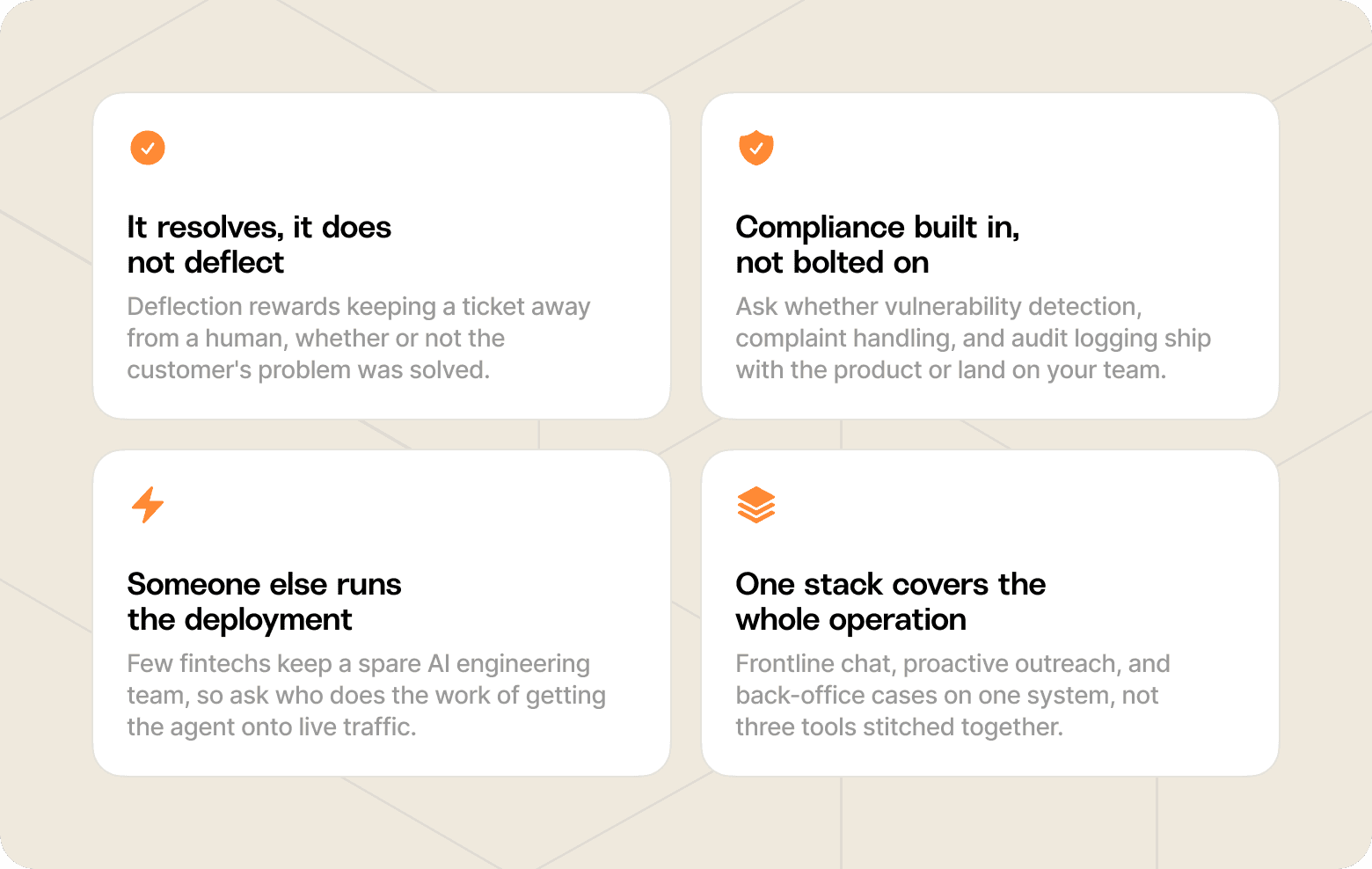
It resolves, and it covers the whole stack. Deflection is a flattering metric. It rewards a bot for keeping a ticket away from a human, whether or not the customer's problem was ever solved. Real fintech work is wider than the chat window anyway: proactive outreach, and back-office case work like disputes, collections, and KYC. The options worth your time close the request and run that entire stack on one system, so a case that opens in chat and needs investigation behind the scenes never stalls at a handoff.
Compliance is built in, not bolted on. A regulated fintech cannot put a bot live that makes things up. The strongest options carry financial-services guardrails on every turn, log every decision for audit, and stand up to FCA Consumer Duty in the UK, the FDCPA and Reg F in the US, and the EU AI Act. Treat SOC 2 Type II and GDPR as table stakes. The real question is whether vulnerability detection, complaint handling, and tipping-off prevention come built into the product, or land on your team to configure and maintain.
It reaches production in days. Fintechs move quickly and seldom keep a spare AI engineering team on the bench. So the timeline comes down to one question: who actually does the work of getting the bot safely onto live traffic, you or the vendor?
One vendor runs the operation, not a rack of point tools. A complete stack means you are not stitching a deflection bot to a disputes tool to a collections dialler. Every seam is a handoff, an integration to maintain, and a place a regulated case can slip through. For the full diligence process, see our guide to choosing an AI agent vendor for financial services.
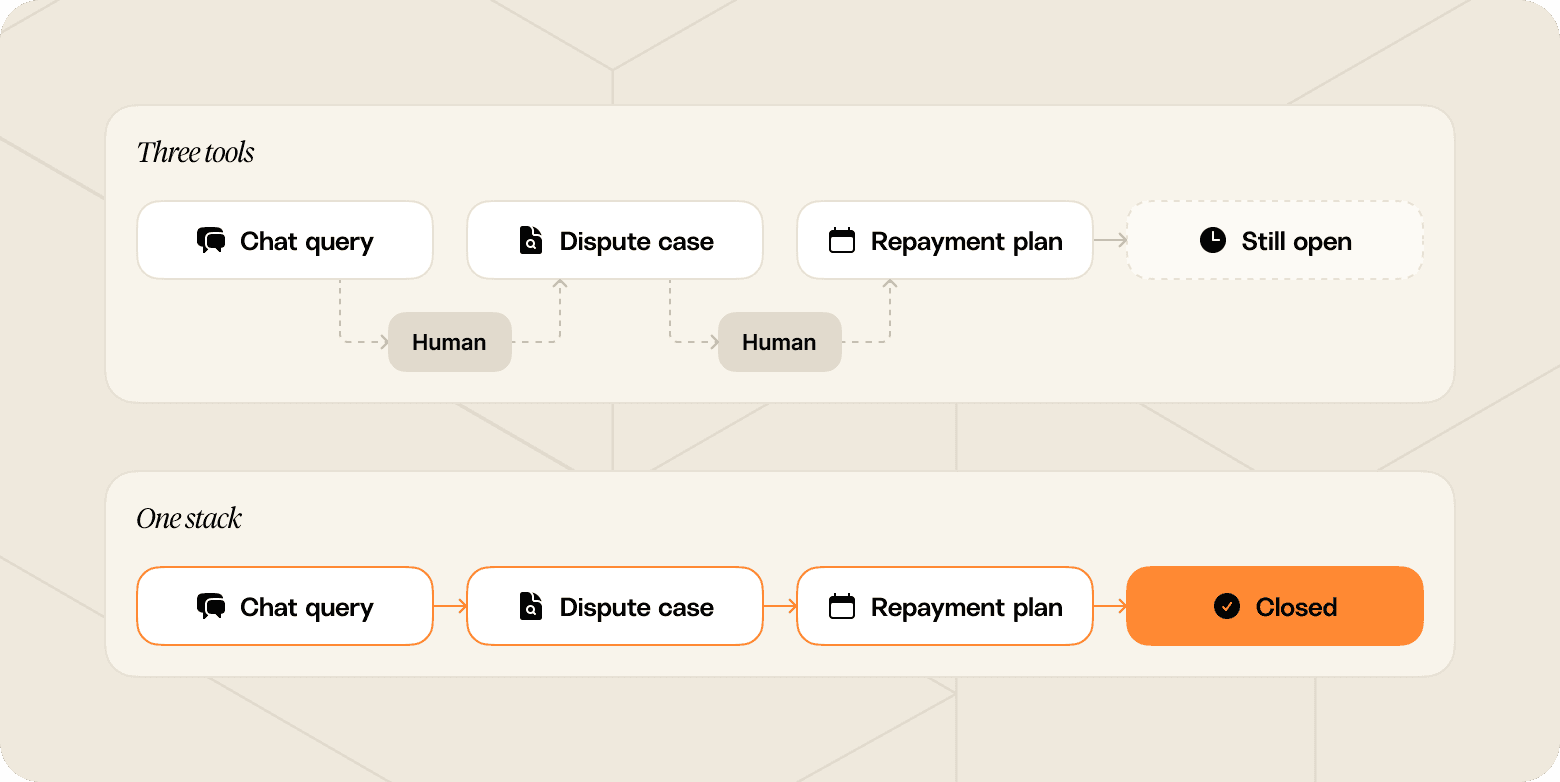
These four run through every profile below, in the same order, so you can read any vendor on its own.
The best AI chatbots for fintechs at a glance
Gradient Labs leads the table because it does the whole job: it resolves rather than deflects, and runs frontline and back office as one stack. The other three each earn their place on a narrower need, a voice-heavy contact centre, a ready-made flow library, or the helpdesk your team is already signed into.
Platform | Resolves or deflects | Compliance posture | Deployment | Pricing model | Best for |
|---|---|---|---|---|---|
Gradient Labs | Resolves: 60% day one, 80–90% in mature deployments | FS-native guardrails on every turn; SOC 2 Type II, GDPR, US/UK/EU coverage | Delivery team runs the migration to production, typically 2-4 weeks | Per resolution, with a deployment guarantee | Fintechs running frontline and back-office work on one platform |
Cognigy | Deflection plus agent assist across voice and chat | Enterprise-grade; FS guardrails built by your team | Enterprise platform; longer integration cycle | Enterprise / custom | Fintechs with voice-heavy or high-volume contact centres and engineering talent to spare on guardrail creation |
Kore.ai | High containment on pre-built flows | Enterprise-grade; compliance configured by your team | Weeks; pre-built flow library speeds setup | Enterprise / custom | Fintechs wanting ready-made flows live fast |
Freshworks (Freshchat) | Deflection-focused self-service on the helpdesk | Enterprise-grade security; general-purpose, not FS-specific | Native to the Freshworks helpdesk; fast to switch on | Subscription, per agent | Early-stage fintechs already on Freshworks |
The best AI chatbots for fintechs
Gradient Labs
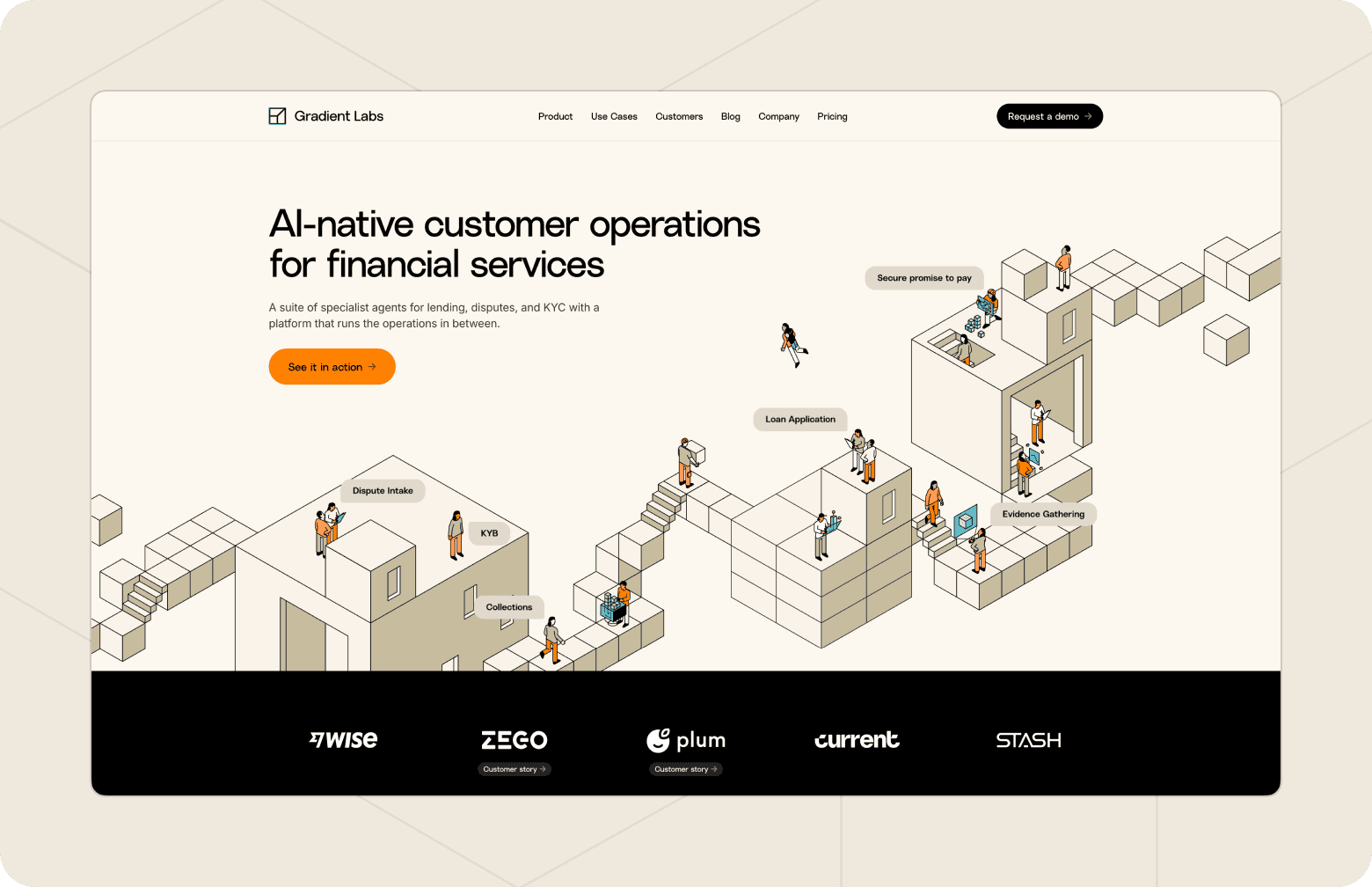
Gradient Labs is the AI agent platform built for financial services from the first line of code, and it is the only option here that runs a fintech's entire customer operation as one stack. Instead of deflecting, it resolves: 60% of requests on day one, climbing to 80 to 90% in mature deployments. Because frontline chat, proactive outreach, and back-office work like disputes, collections, and KYC all sit on the same system, a request that begins in chat and turns into case work stays within a single workflow, with no handoff and no second tool.
The compliance depth predates the product, because the people building it came out of regulated finance. Its founders ran the data organisation at Monzo under FCA supervision, and nearly all of its engineers arrived from financial services. You see it in the guardrails: more than 20 financial-services controls sit on every response, spanning UK rules (FCA Consumer Duty, CONC), US rules (FDCPA, Reg F, UDAAP), and EU rules (GDPR, EU AI Act). The platform is SOC 2 Type II certified, runs to GDPR, encrypts data at rest, and holds zero-day retention agreements with every model provider it touches.
Deployment runs as a service, which is exactly what a fintech with no AI team to spare needs. Gradient Labs' own delivery team handles the migration off whatever you run today, so an operations lead who has never written a line of code can own the agent. Every scoped use case carries a guarantee: if the deployment does not do what was agreed, you get your money back. Pricing tracks the same principle, charged per resolution rather than per seat or per conversation, so you pay for outcomes, not access.
"What sets Gradient Labs apart is their way of working: they understand fintechs. They work like an extension of our team that knows our pain points and shares our goals. The AI agent now fully automates some complex workflows that previously wouldn't have been possible."
Ian Kershaw, VP of Customer Service, Claims and Fraud, Zego
Best for: Fintechs whose customer operations live or die on compliance, and where the back-office work counts as much as the frontline reply.
Where it is not the fit: If all you want is a lightweight FAQ deflector on a marketing page or in a non-regulated industry, this is more than you need. Gradient Labs also does not run identity checks at sign-up or score credit, so it operates the customer-facing work around those systems rather than replacing them.
Cognigy
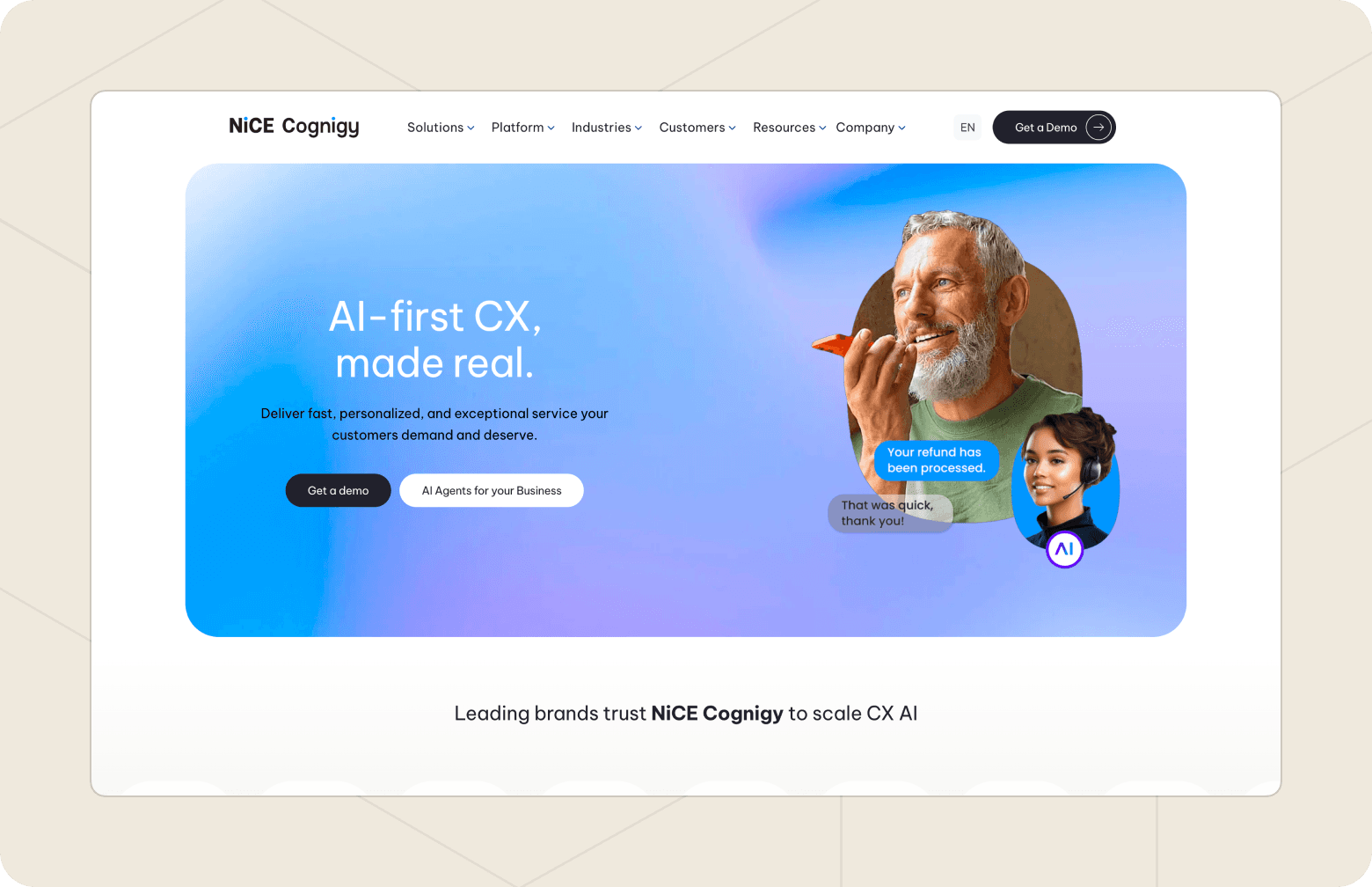
Cognigy, now part of NICE, is a conversational AI platform aimed at the enterprise contact centre, and its heritage is in voice: IVR automation, call routing, and agent assist across phone and chat. Its logo wall of Lufthansa, Mercedes-Benz, and Bosch spans airlines, carmakers, and manufacturers, and it was named a Leader in the 2026 Forrester Wave for conversational AI platforms. Unlike Gradient Labs, financial services is one vertical Cognigy serves, not the one it was built around.
For a fintech running serious phone volume, that voice pedigree is the appeal. Cognigy automates phone and digital channels at scale and drops an agent-assist layer next to human agents on the regulated calls that still need one. It is also a platform you build on: your team designs the flows in its low-code tooling, then owns them and keeps them current. One critical call out: because the product spans every industry, the financial-services guardrails, vulnerability handling, and audit trail are things you assemble on top, not features that arrive switched on.
Best for: Fintechs with a voice-heavy or high-volume contact centre that want one platform across IVR, chat, and agent assist.
Where it is not the fit: A lean fintech that wants regulated case work resolved end to end, with FS guardrails already in place, rather than a platform to build and maintain.
Kore.ai
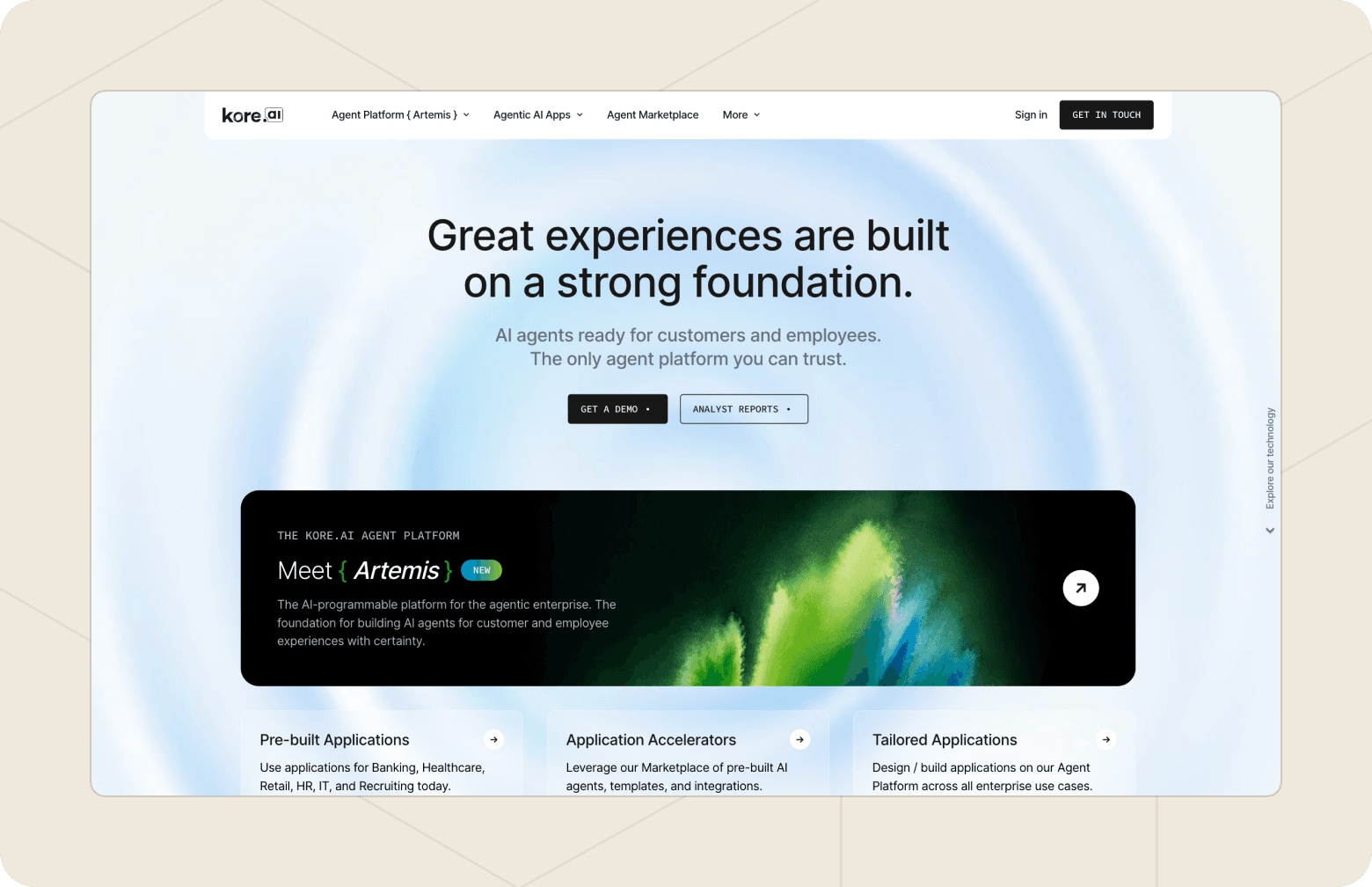
Kore.ai is an enterprise conversational AI platform whose calling card is breadth of pre-built content, including BankAssist, a retail-banking assistant covering balances, payments, card management, and account servicing across voice and digital. It sells into Global 2000 companies and has been named a leader in intelligent virtual assistants by industry analysts.
For a fintech, the ready-made catalogue is the draw: common self-service journeys go live without building each from zero. From there the work is yours, shaping the templates to your policies and keeping them aligned as products and rules move. The library is tuned for containment on routine queries, so the harder regulated cases that reach into back-office systems fall outside it. The templates still beat a bespoke build on speed.
Best for: Fintechs that want a broad library of ready-made flows in production quickly.
Where it is not the fit: A fintech that needs an agent to own the harder regulated cases end to end, from disputes to KYC.
Freshworks (Freshchat)
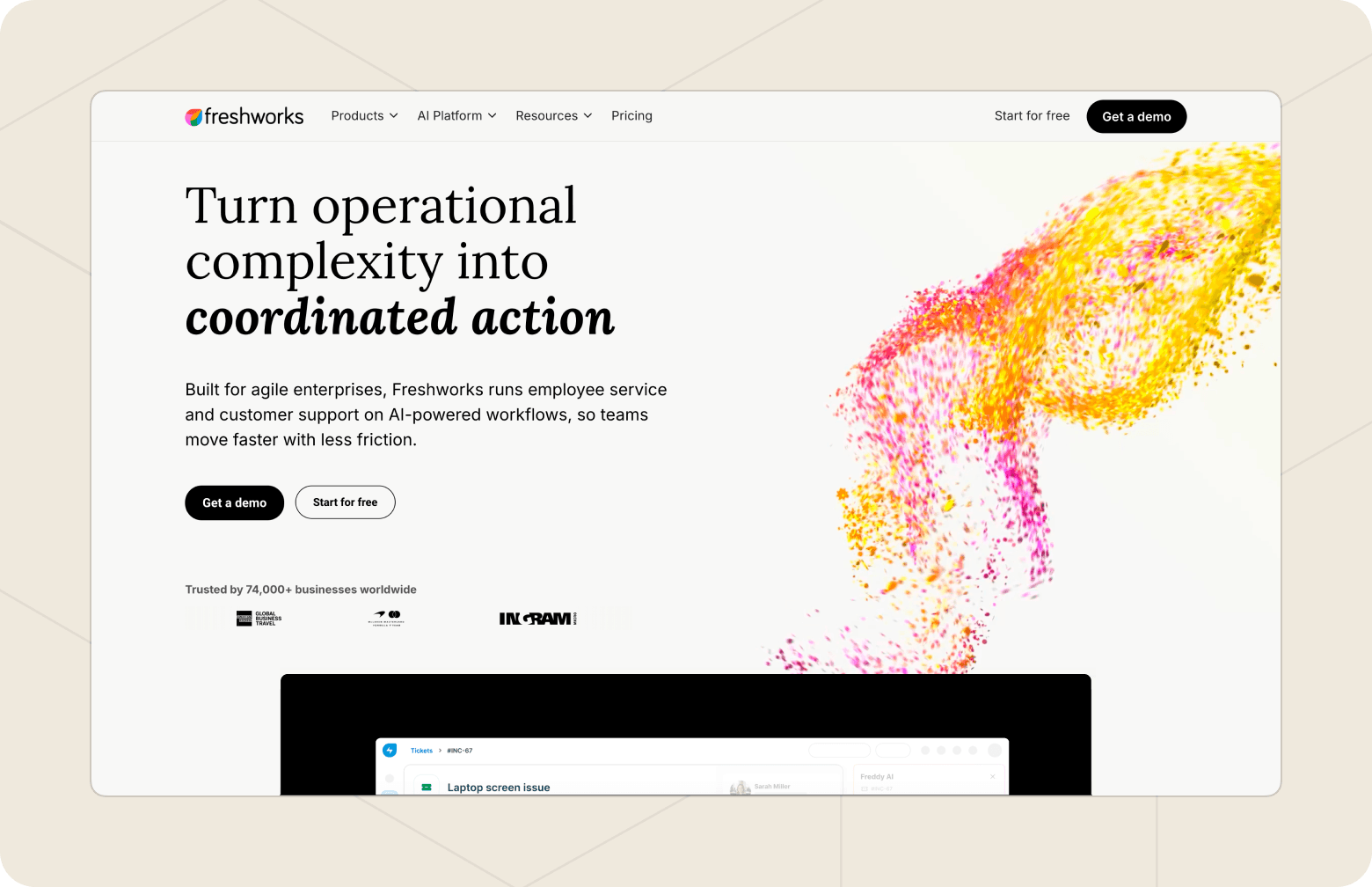
Freshworks is the incumbent helpdesk many early-stage fintechs already run, and its Freddy AI layer adds self-service on top of a support desk the team already knows. Freshchat handles live chat and bot-led deflection across web, app, and messaging, while the wider suite covers ticketing, email, and phone. It is publicly listed, widely adopted, and quick to switch on, which is why it turns up so often in a scaling fintech's first support stack.
The strength is time to value on frontline self-service: a fintech already on Freshworks can turn on bot deflection without a new vendor or a heavy integration. The trade-off is scope. Freddy is a general-purpose assistant built for horizontal support, so the financial-services guardrails, vulnerability handling, and back-office case work sit outside it, and a fintech usually pairs it with other tools as regulated work grows.
Best for: Early-stage fintechs already on Freshworks that want fast frontline deflection.
Where it is not the fit: A regulated fintech that needs end-to-end resolution and financial-services guardrails on every turn, rather than general-purpose deflection.
What a complete fintech support stack looks like in production
The honest test of any chatbot is what happens after launch, measured across frontline chat, outbound voice, and back-office case work at regulated fintechs. These are Gradient Labs deployments that close cases end to end.
Pockit. The UK neobank puts Gradient Labs across both customer support and back-office work. Resolution has climbed 70%, CSAT 80%, and Pockit hit its automation target in under six months without adding to the team.
SteadyPay. On the lender's collections, Gradient Labs places 33,000 outbound voice calls a month, turns 60% of engaged customers into a committed repayment date, and brings 20% of cold customers back within a month, all inside FCA compliance.
A large European digital bank. Running at scale, it sustains 98% QA over more than half a million conversations and an 84% CSAT that beats its human team, and it soaked up a 3x volume spike without a rollback.
Plum. The savings and investing app hit a 52% resolution rate on day one, before the supercharging cycle that carries deployments toward 80 to 90%.
Four different operations, one pattern: the agent takes the case all the way to closed, and the numbers hold as volume climbs. That is the bar to measure any AI chatbots for fintechs against.
How to choose an AI chatbot for your fintech
Fit the platform to the work in front of you, and hold every option against the four tests above.
Start from the work, not the channel. Write down the requests that actually drive your volume and your cost, then ask of each: does the bot resolve it, or just route it? A card freeze, a dispute, a KYB check, and a collections query can all run to a close. When a vendor demos the answer but never the action, deflection is what is on sale.
Ask where compliance lives. Get a straight answer on whether FS guardrails, vulnerability detection, and audit logging come built in or get configured by your team. For a lean fintech, that gap is months of work plus a maintenance load that never ends.
Check who runs the deployment. A self-serve platform assumes you have an internal team to build and tune it; a delivered service does that for you. Know which one you are buying, because it moves both the timeline and the cost. Our guide to deploying AI agents in fintech walks through what that work involves.
Weigh build against buy. A fintech can fund an in-house chatbot, but the agent platform underneath, from orchestration and evals to guardrails, telephony, and audit trails, takes quarters to build and never stops needing maintenance. For regulated work, buying a purpose-built agent is faster and safer than staffing that build yourself.
Which AI chatbot is right for your fintech?
A voice-first operation should look hard at Cognigy. A fintech that wants a broad library of ready-made flows live in a hurry will get there fastest with Kore.ai. And if you are early and already inside Freshworks, its Freddy AI layer is the quickest way to switch frontline deflection on.
But if the goal is to resolve customer problems end to end, across the frontline and the back office, inside a regulated environment, Gradient Labs is the one on this list built for exactly that. It treats a fintech conversation as a case to close and runs the whole operation as a single stack, live in production at neobanks and lenders now. It is the same reason it topped our companion guide to the best AI chatbots for banks: in regulated work, resolution beats deflection.
See how Gradient Labs resolves real fintech cases: book a demo.


Elizabeth Shew leads Brand and Advocacy at Gradient Labs, where AI agents handle customer support and back-office work for banks, lenders, and fintechs. Before that, she led customer marketing at Mastercard and built Dynamic Yield's customer marketing programme from the ground up, a decade spent turning customer results into industry-shaping stories. She writes about how support and operations teams actually put AI and technology to work. Before tech, she was a professional dancer in NYC.