
Your bank competes on something the big banks and neobanks can't buy: people who know their customers by name. That relationship is also expensive to staff, and it is getting harder to protect. Community banks originate 44% of America's small-business loans and 70% of its agricultural loans, yet the smallest banks now spend 11 to 15.5% of payroll on compliance, against 6 to 10% at the largest. AI for community banks offers a way out of that squeeze, as long as you pick use cases that resolve real work without putting compliance or the customer relationship at risk. This guide walks through the secure ones, grouped by where the work runs: the frontline, proactive outreach, and the back office.
What secure AI for community banks looks like
A secure AI use case is one where an agent acts on real customer accounts while every action stays inside policy, and where your examiner can see exactly what happened. For a community bank running lean, five properties separate a deployment your risk committee will sign off on from an AI flight of fancy:
Guardrails on every turn: every message is screened as it is written, catching false promises, disallowed terminology, and signs of financial difficulty or vulnerability before anything reaches the customer.
Human sign-off where it counts: for consequential actions, like submitting a Reg E chargeback or agreeing a payment plan, a person approves before the agent acts.
An examiner-ready audit trail: every decision, data point, and tool call lands somewhere your compliance officer can pull in full, which turns a sampled exam into a complete record.
Infrastructure your vendor-risk process accepts: the platform underneath holds what third-party risk management expects under FFIEC guidance: SOC 2 Type II certification, GLBA-aligned data handling, and zero-day data retention agreements with every model provider.
No AI team required: you do not have the engineers to build or run this, and you should not need them. The vendor absorbs the technical work, an ops lead configures the agent in plain language, and it stays maintainable by people who know your bank, not the model.
If you are weighing vendors against these five, our guide to choosing a secure AI agent for banking carries the full evaluation checklist. This is the community-bank companion to our broader guide on secure AI use cases for banks, and the use cases below sit inside the three groups every bank's work falls into.
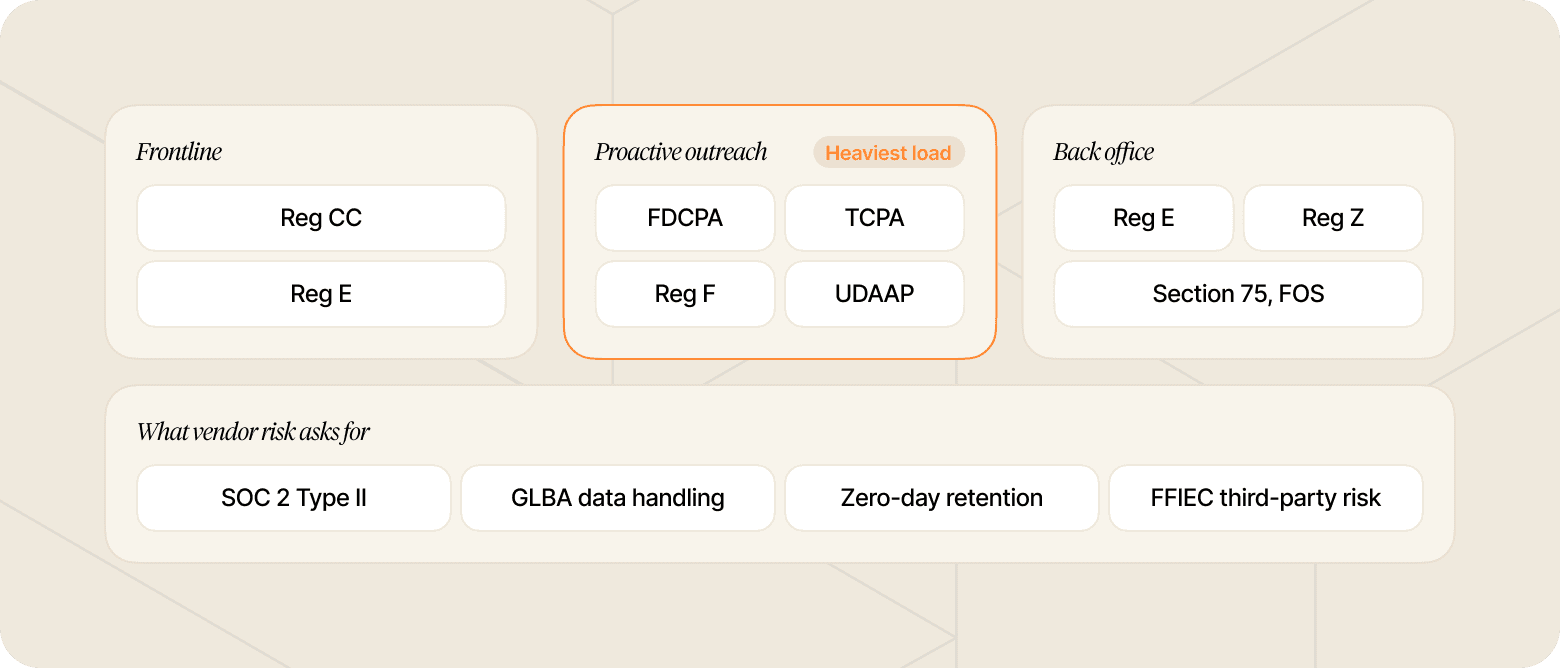
Which metric proves it depends on the group. With a customer in the conversation, CSAT and resolution rate are what to watch. On cases the agent works with no customer present, the honest measures are turnaround against your SLA, decision accuracy, and whether every case leaves a complete audit trail.
Use case | Where it runs | What the agent takes on |
|---|---|---|
Customer support on chat and email | Frontline | The inbound queue, resolved rather than deflected |
Natural-language voice | Frontline | Calls that would otherwise wait on hold or in the phone tree |
Freeze and replace a lost card | Frontline | Urgent card actions, verified and completed in the conversation |
Investigate a missing payment | Frontline | Payment tracing and plain-language answers, Reg E claims routed correctly |
Overdue payment collections | Proactive outreach | Arrears calls, payment plans, and promises to pay inside Reg F and FDCPA |
Loan and KYC document collection | Proactive outreach | Chasing, validating, and progressing outstanding documents |
Hardship assessment | Proactive outreach | Income and expenditure reviews against your workout policy |
Card disputes | Back office | Intake, investigation, evidence, and chargeback submission |
Business verification (KYB) | Back office | Document checks, sanctions screening, and onboarding routing |
Account and loan document processing | Back office | Multi-format document requests, validated and processed |
Frontline AI that protects the customer relationship
Frontline work is where community banks feel the staffing squeeze first, and it is where the wrong tool does the most visible damage. A chatbot that deflects customers to an FAQ chips away at the exact thing you compete on. A resolution-first agent does the opposite: it takes the inbound queue, verifies the customer, remembers past conversations, and acts to close the issue rather than pointing at a help page. Every reply passes through guardrails that detect complaints, vulnerability, and financial difficulty and route those conversations to a person.
The fear that AI customer service flattens the experience into a call-centre script does not survive contact with the numbers. At Zego, the agent scored higher CSAT than the humans it worked alongside, 77% against 61%. Ease of rollout matters just as much to a lean team, and Plum speaks to that. Its Head of Customer Success, Yoan Yedrowiak, put it this way:
"Gradient's AI solution delivered impressive results with minimal effort on our part. The proof of concept made the decision clear, and the rollout was seamless. Seeing such a high CSAT and resolution rate validated our choice."
Customer support on chat and email
Support volume grows faster than a community bank can hire, and the usual approach to customer support automation, a deflection bot, trades the relationship for capacity. The agent takes the inbound queue on chat and email, verifies the customer, and resolves the issue: a debit-card question, a statement query, an address change. Ops staff write the procedures in plain language with no code, and guardrails hand off anything that needs a human. For a bank whose brand is service, resolution rate and CSAT are the numbers that matter, and both hold up at scale.
Frontline support on voice
Your customers still call, and the phone tree is the part of the experience they like least. A voice agent answers in natural language, authenticates the caller, resolves the request on the call, and hands off live to a person when the conversation needs one. It is IVR replacement that sounds like your best teller rather than a menu of options. Financial services guardrails run on every turn, so false promises and mishandling of a vulnerable caller get caught in real time.
Freeze and replace a lost card
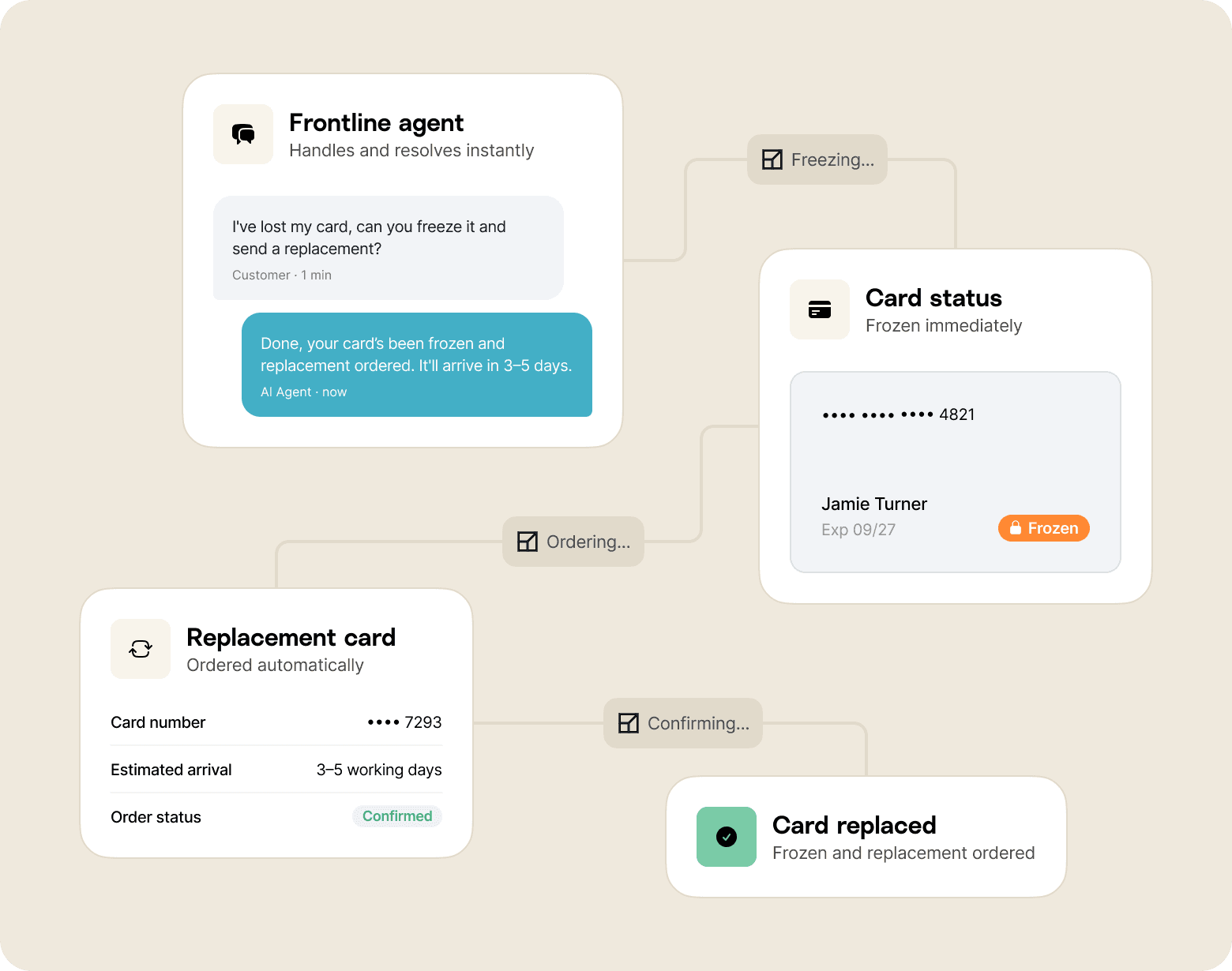
Losing a card is the moment a customer most wants their bank to act, and the one most likely to strand them on hold. The agent verifies the customer, freezes the card instantly, and orders a replacement inside a single conversation on chat or voice. It earns its place as a first project on three counts: high volume, a narrow set of permitted actions, and a sequence your risk team can sign off step by step before launch.
Investigate a missing payment
Few questions arrive more often, or more anxiously, than "where's my money?" The agent investigates missing or unexpected payments, works with transaction data to find what happened, and explains it in plain language, applying Reg CC funds-availability rules and your goodwill policy. Because it asks before it acts, it tells a delayed inbound deposit apart from an unrecognised charge, and routes the second as a potential Reg E error or fraud case instead of guessing.
Proactive outreach, handled inside your compliance rules
Outreach is where a small team runs out of hours first. Collections calls, document chases, and hardship reviews all need making, and every early contact a community bank misses makes the later conversation harder. These run as two-way conversations on voice, SMS, and email, and they carry the heaviest compliance load on this list, which is the case for automating them behind guardrails built for the rules rather than configured by hand.
Overdue payment collections
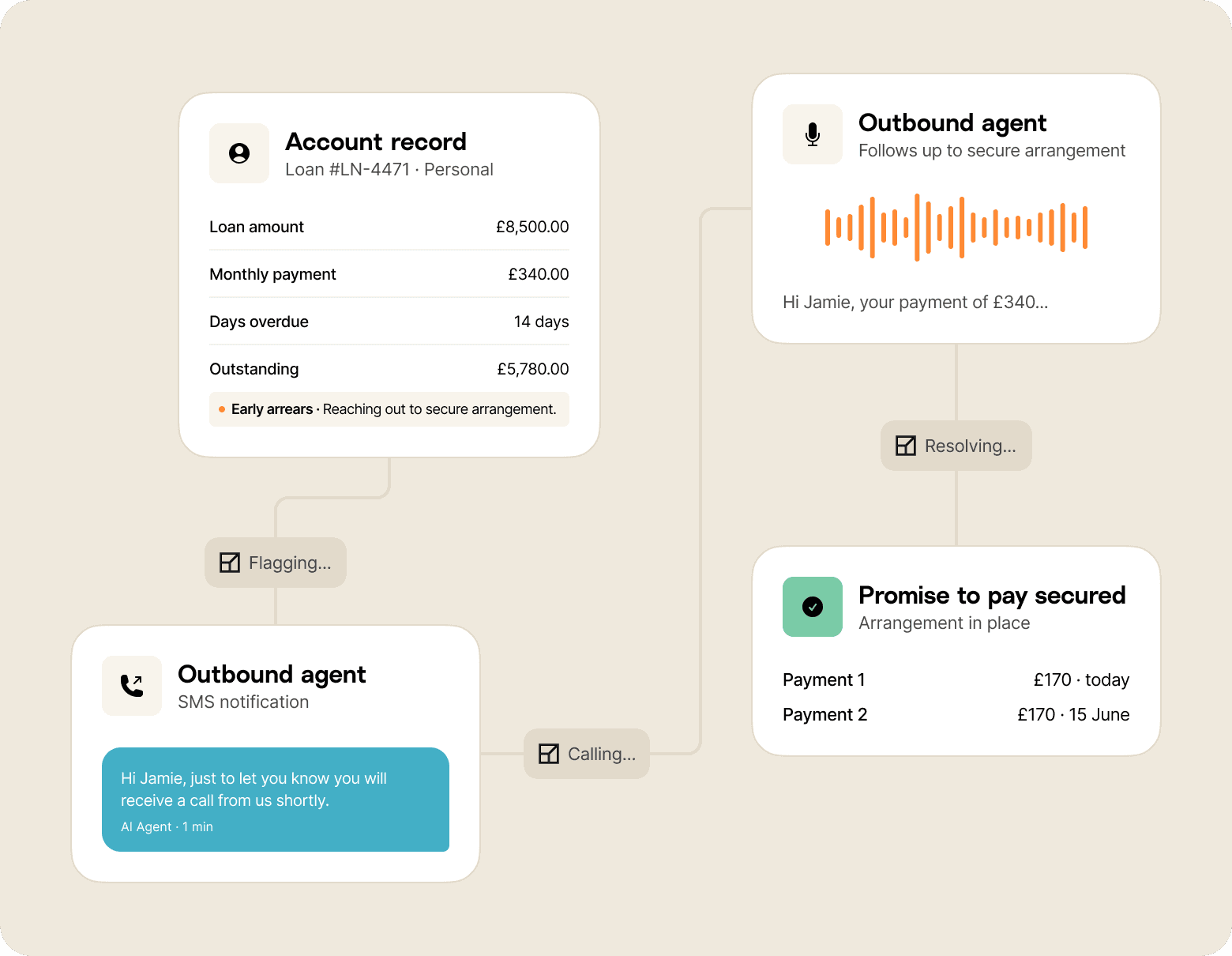
Most collections teams work only a slice of the accounts on their list, and the small balances almost never get a call. The Lending Agent runs overdue payment collections end to end: it contacts customers in arrears when they are most likely to answer, verifies identity, explains the balance and its consequences, and negotiates a payment plan inside your workout rules. Every disclosure and consent lands in the system of record with a timestamp, alongside the guardrail checks that ran on the call, so your compliance officer can trace which rules applied to any conversation. Compliance is pre-built, not configured: guardrails cover FDCPA, TCPA, and Reg F in the US, plus FCA rules for any UK operations, and the agent runs 30x more compliant than human agents on those checks. Across customers the agent makes 100,000+ calls a month at a recovery rate matching human collectors, and the same procedures answer inbound collections queries with full account history loaded. For a ranked view of vendors in this space, see our guide to the best AI agents for lending.
Loan and KYC document collection
Verification reviews and loan files stall for one reason above all: customers do not send documents, and staff spend their days chasing rather than reviewing. The agent runs the chase end to end. It requests the outstanding document over email or SMS, validates it against your policy the moment it lands, explains rejections in plain language, and keeps each case moving until it is complete or flagged to compliance. Nothing sits unworked, and the backlog stops compounding.
Hardship assessment
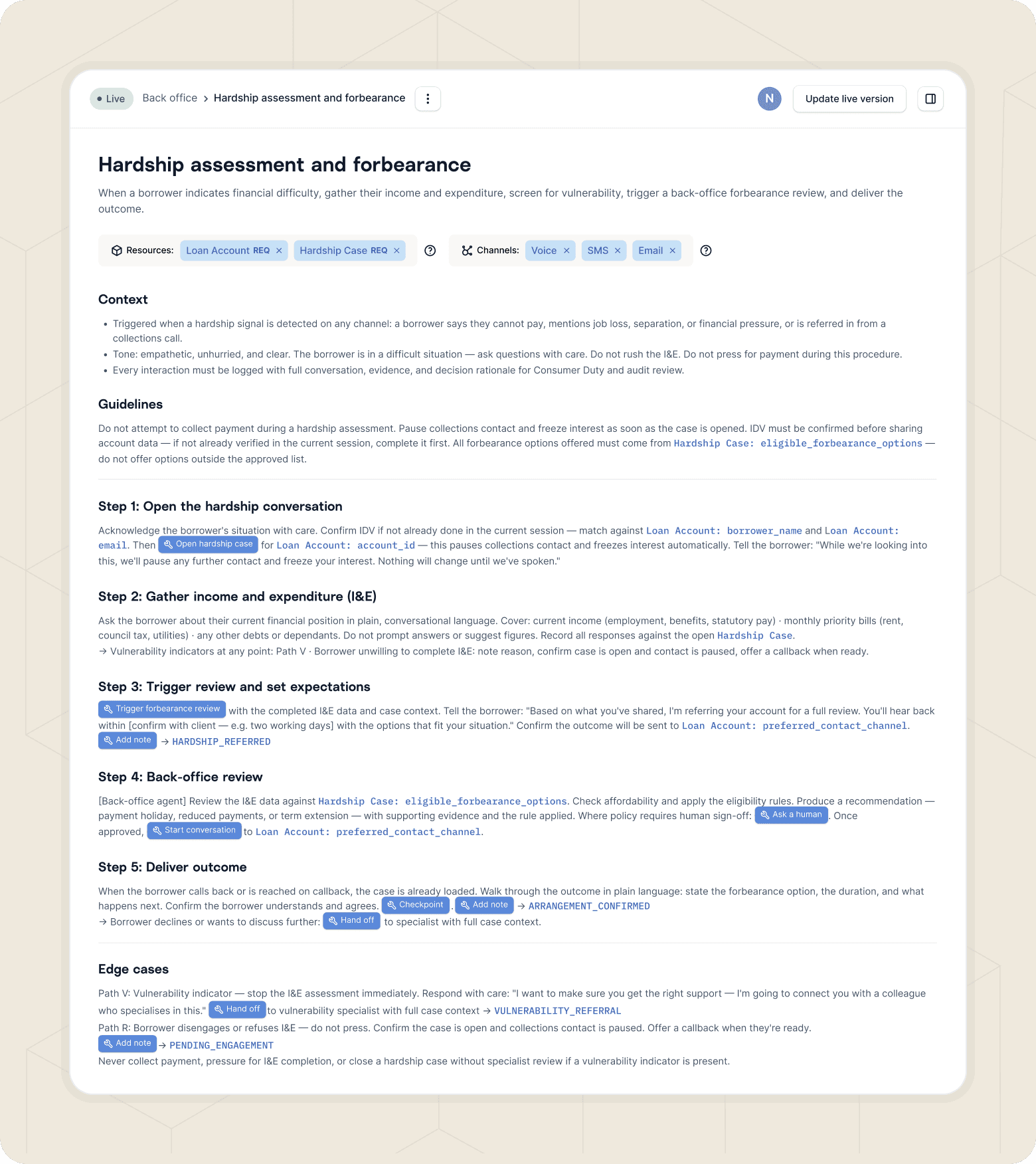
When a borrower says they are struggling, the next steps are prescribed and closely watched. The agent gathers the income and expenditure picture conversationally, runs the back-office review against your workout policy, and resolves or routes the case. Vulnerability indicators escalate to a person immediately, on every channel. Handled consistently and documented case by case, it is how a lean team meets UDAAP fair-treatment expectations without leaving customers waiting because the queue was long.
Back-office work that clears the examiner bar
Back-office work is the least automated part of most community banks and, counterintuitively, the easiest to clear a security review, because a human approval gate can sit in front of any consequential action. Success looks like shorter turnaround, accurate decisions, and an audit trail with nothing missing. CSAT is not the headline metric here, though faster cases tend to lift it anyway.
Card disputes, from intake to chargeback submission
Disputes are the number-one back-office case for any bank that issues cards, and Reg E puts a clock on them. The Disputes Agent carries the whole case: it captures the claim on any channel with the right intake questions, maps it to the correct Mastercard or Visa reason code, chases the customer for any missing evidence, decides the outcome, and files the chargeback with the scheme directly. Nothing is submitted without the sign-off you require, and the case file logs every decision, piece of evidence, and guardrail check behind it. It is pre-configured for Reg E and Reg Z in the US, plus Section 75 and FOS timelines for any UK operations, holds 95% accuracy on classification and decisioning, cuts average resolution time by 25%, and saves $30+ on every case through direct scheme submission.
Business verification (KYB)
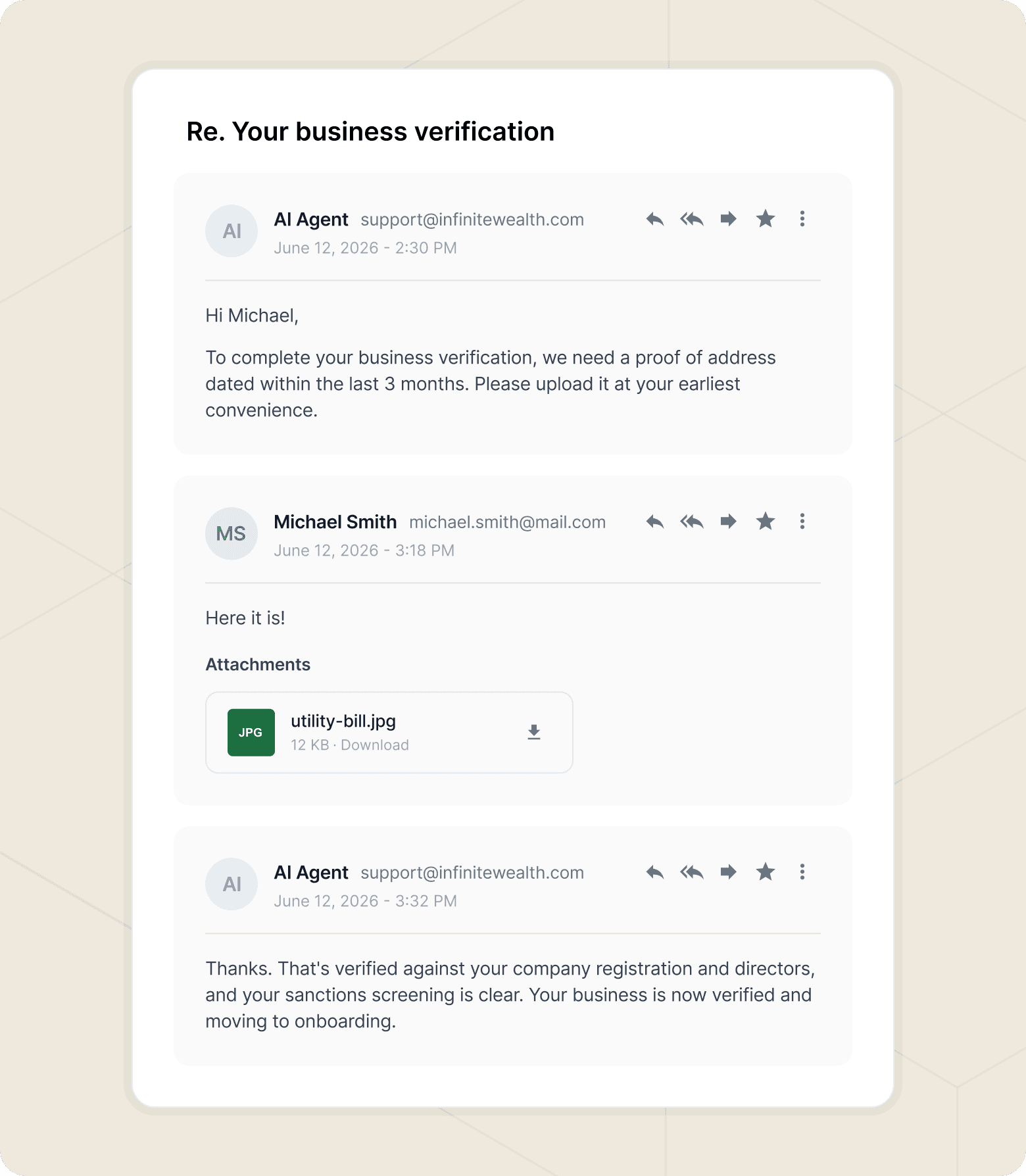
The small businesses on your high street are core customers, and onboarding each one means a stack of documents: articles of incorporation, ownership structures, proofs of address, all checked against policy and run through sanctions screening. The agent reads every business document, checks it against your policy, and screens for sanctions before verifying the business and routing it to onboarding. Anything ambiguous goes to a person with the evidence already assembled, so your team spends its judgement on the cases that need it. Every check is logged, which turns KYB from a sampled audit into a complete one.
Account and loan document processing
Payoff letters, lien releases, and account maintenance requests arrive by email and fax in a dozen formats. The agent reads each request, validates the details against customer records, processes it, and escalates the exceptions with a complete case file. It is a narrow use case, and that is the point: document-heavy work with clear rules and painful manual overhead is the fastest back-office win a community bank can get, and the same shape covers any document check against an internal policy.
How AI for community banks fits your first project
There is no single right entry point. Most community banks start on the frontline, where volumes are high and results show within weeks, but plenty start in the back office, on the disputes or verification backlog where the manual pain is sharpest. Wherever you start, four things separate the deployments that expand from the pilots that stall:
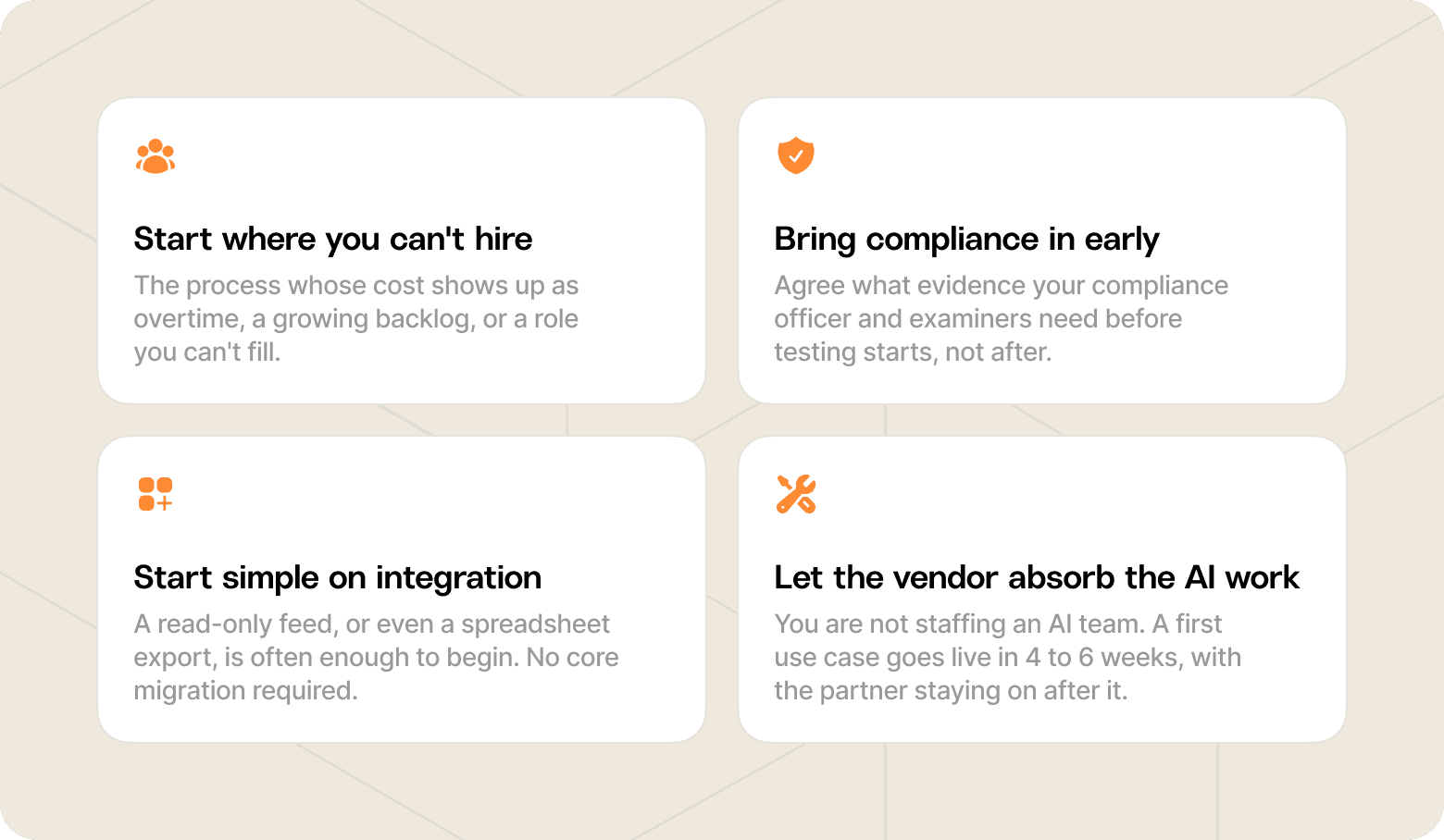
Start where you can't hire. Pick the process whose cost shows up as overtime, a growing backlog, or a role you can't fill, not the one where AI would be a nice-to-have.
Bring compliance in before testing starts. Your compliance officer and your examiners will ask how the agent stays inside Reg E, Reg F, and GLBA. Agree the evidence each one needs up front, so sign-off becomes a review of results rather than a negotiation over requirements.
Expect to start simple on integration. You do not need an API-first core migration to begin. A read-only feed, or even a spreadsheet export, is often enough for a first use case, and the deeper integrations come once the agent has earned them.
Lean on the vendor to absorb the AI work. You are not staffing an AI team, and you should not have to. The right partner takes a first use case live in 4 to 6 weeks and stays on to move resolution up from there, working like an extension of your own team.
For the full sequence, from examiner sign-off to integrating a legacy core and ramping safely, our step-by-step guide on how to deploy AI agents in community banks walks through it.
The banks that get the most from this do not stop at one use case. One card issuer began with frontline support, expanded into outbound collections, then into fully automated dispute investigations, each deployment building the confidence for the next and pulling more of its customer operations onto agents that share context across the customer's whole journey. Browse the full use case library to see each one in detail, or the broader AI in banking use case guide for where the results are landing across the industry.
Whichever process you pick, hold the vendor to production evidence in a bank-like setting, not a demo. Gradient Labs backs that standard with a guarantee: once we have scoped a use case, we guarantee the deployment, and if we don't deliver what we said we would, you get your money back. Ready to see a secure AI agent run one of your own processes? Book a demo.


Elizabeth Shew leads Brand and Advocacy at Gradient Labs, where AI agents handle customer support and back-office work for banks, lenders, and fintechs. Before that, she led customer marketing at Mastercard and built Dynamic Yield's customer marketing programme from the ground up, a decade spent turning customer results into industry-shaping stories. She writes about how support and operations teams actually put AI and technology to work. Before tech, she was a professional dancer in NYC.