
Every credit union is being asked to do more for members without adding headcount. More than 140 million Americans belong to a credit union, according to the NCUA, and they expect the instant, always-on service the megabanks and neobanks spend millions to automate. McKinsey estimates generative AI could add $200–340 billion a year to global banking, yet a lean member services team rarely has the room to chase it. This guide sets out ten AI use cases for credit unions, grouped by where the work runs: frontline, proactive outreach, and back office. Each one names the controls that keep it inside your obligations and inside the member promise your credit union is built on.
What are AI use cases for credit unions?
An AI use case for a credit union is one where an AI agent acts on real member accounts while every action stays inside policy. Four properties separate a deployment you can trust from a chatbot that puts the member relationship at risk:
Guardrails on every turn: each member conversation is checked live, flagging anything from a false promise to an early sign of financial hardship.
Optional human sign-off: a person on your team can approve consequential actions, such as a chargeback or a repayment plan, before the agent commits them.
A complete audit trail: every decision, data point, and tool call is recorded where your risk and compliance team can review it.
Certified infrastructure: the underlying platform clears what credit union vendor due diligence expects under NCUA third-party guidance: SOC 2 Type II, GDPR compliance, and zero-day data retention agreements with every LLM provider.
If you are weighing vendors on these criteria, our guide to the best AI customer support for regulated industries covers the evaluation in depth.
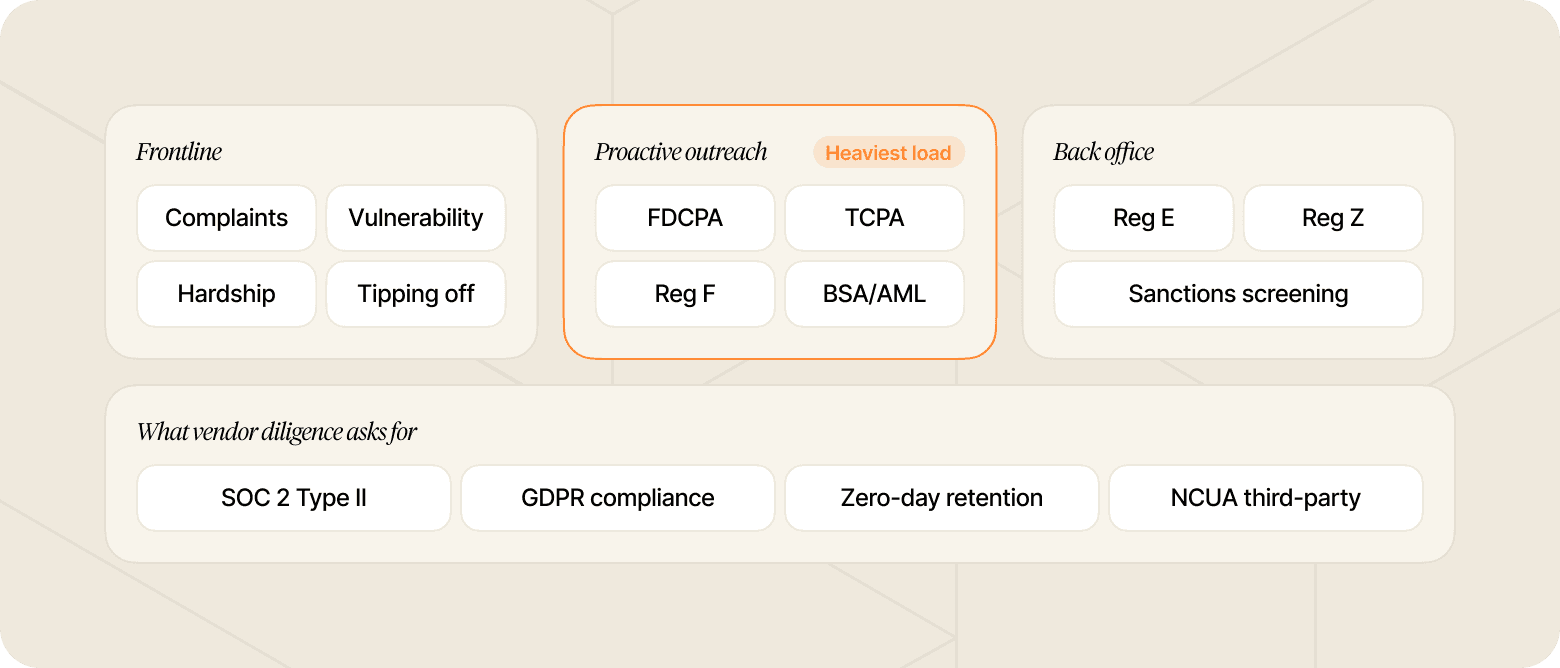
The use cases below are grouped the way the work actually runs in a credit union: frontline member support, proactive outreach, and back-office work like verification, disputes, and collections. The right proof metric changes with the category. Where a member is in the conversation, CSAT and resolution rate tell you whether it is working. Where the agent works a case with no member present, judge it on how far the service level compresses, how accurate its decisions are, and whether the audit trail covers every case.
Use case | Category | What the agent takes on |
|---|---|---|
Member support on chat and email | Frontline | The inbound queue, resolved rather than deflected |
Natural-language voice | Frontline | Calls that would otherwise wait on hold |
Freeze and replace a lost card | Frontline | Urgent card actions, verified and completed in the conversation |
Investigate a missing payment | Frontline | Payment tracing and plain-language explanations |
Overdue loan collections | Proactive outreach | Arrears calls, repayment plans, and promises to pay |
Member onboarding and verification | Proactive outreach | Chasing, validating, and progressing onboarding documents |
Hardship assessment and financial wellness | Proactive outreach | Income and expenditure reviews against your hardship policy |
Business membership verification (KYB) | Back office | Document checks, sanctions screening, and onboarding routing |
Card disputes | Back office | Intake, investigation, evidence, and chargeback submission |
Loan payoff and lien release | Back office | Multi-format payoff requests, validated and processed |
Frontline use cases: member service that feels personal at scale
Frontline work is where most credit unions start, because the volumes are largest and the results show fastest. It is also where the wrong tool does the most visible damage to a relationship members chose you for. The four use cases below hold up because the agent resolves cases rather than deflecting them, and because guardrails screen every reply before it reaches a member.
Member support on chat and email
Support queues grow faster than a credit union can hire, and the usual fixes trade service quality for capacity. The agent takes the inbound queue on chat and email, verifies the member, remembers past conversations, and takes the actions that resolve the issue rather than pointing at an FAQ. Your team defines procedures in plain language, with no code, and every reply passes through guardrails that detect complaints, vulnerability, and financial difficulty and route those conversations to a person.
The results hold at scale. The largest AI agent deployment in banking, at a digital bank at scale, runs at 84% CSAT, and Pockit reached 70% resolution at 80% CSAT. Its Head of Operations, Michiel Smet, makes the case for resolution-first service directly:
"We truly think that if people have a problem and you solve it, that builds brand loyalty. That's why customer resolution is so important. With Gradient Labs, we have an AI agent that's actually resolving problems, boosting our CSAT rating, and absorbing growth without us having to scale the team. I'm confident that with this partnership, we can get to 100% automation."
Member support on voice
Members still call, and a credit union's membership often skews towards people who prefer to. When they call, they want a fast answer, not a touch-tone maze. A voice agent answers in natural language, authenticates the caller, resolves the request on the call, and hands off live to a person when the conversation needs one. Voice raises the stakes, so financial services guardrails run on every turn, preventing false promises, tipping off, and the mishandling of a vulnerable member in real time. For a credit union taking thousands of calls a month on a small contact centre, this is the difference between modernising the phone line and merely re-recording the hold message.
Freeze and replace a lost card
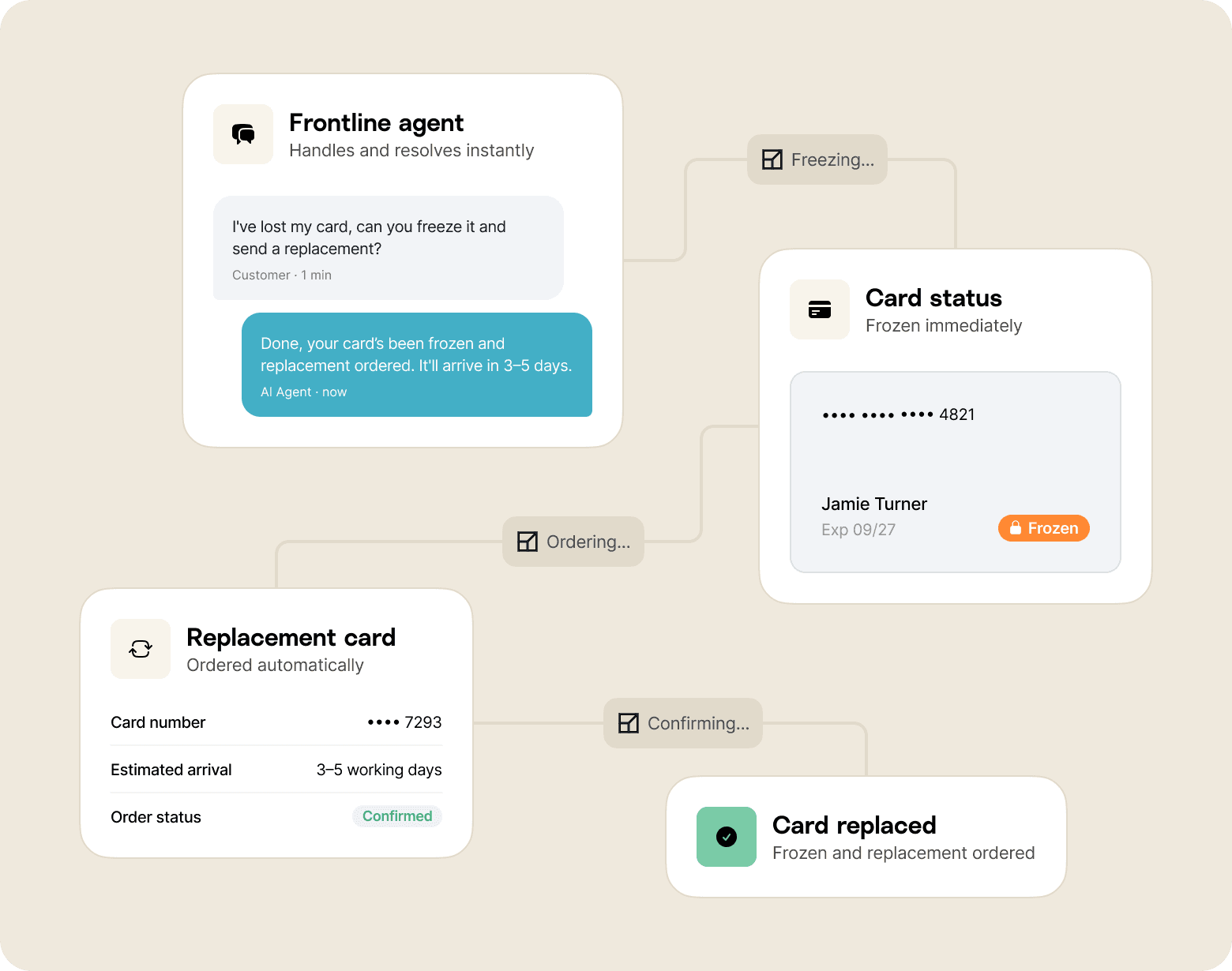
Losing a card is exactly when a member wants their credit union to move fast, and exactly when they tend to get stuck on hold. In a single chat or voice conversation, the agent verifies the member, freezes the lost card instantly, and orders a replacement. It makes a strong first deployment for three reasons: the volume is high, the actions are few and well defined, and your risk team can approve every permitted step before launch. Identity verification always runs first, and every step is written to the audit trail.
Investigate a missing payment
Few questions come in more often, or carry more worry, than "where's my money?". The agent investigates missing or unexpected payments, digs through the transaction data to work out what happened, explains it in plain language, and applies your own rules on whether a goodwill gesture fits. It clarifies before it acts, so a delayed direct deposit and an unrecognised charge don't get treated the same way, which matters when the second could be fraud or a dispute that needs routing elsewhere.
Proactive outreach use cases: reaching members before problems grow
Outreach is where an AI agent stops waiting for a member to get in touch and starts closing loops first. These use cases run as two-way conversations on voice, email, and SMS, not one-way notifications, and they carry some of the heaviest compliance loads in the list, which is exactly why credit unions automate them behind pre-built guardrails.
Overdue loan collections
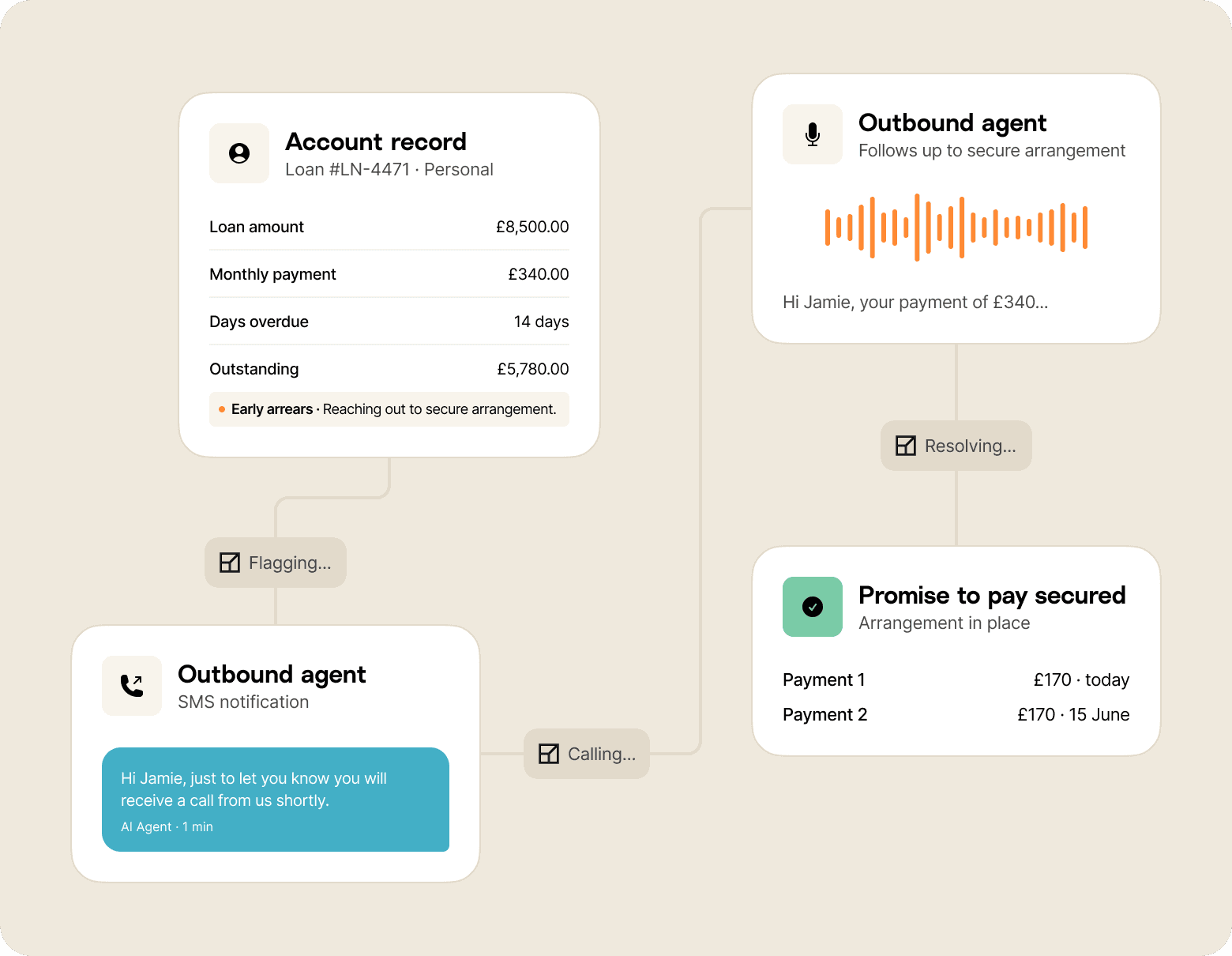
Collections teams at a credit union reach a fraction of the accounts they should, and every missed early contact makes the eventual conversation harder for a member who is often a neighbour. The Lending Agent runs overdue loan collections end to end: it contacts members in arrears at the moment they are most likely to respond, verifies identity, explains the balance and its consequences, and negotiates a repayment plan within your workout rules.
Each disclosure, decision, and consent is timestamped into your system of record next to the guardrail checks that fired on the call, which lets compliance see exactly which rules governed any given conversation instead of trusting a summary. Compliance is pre-built rather than configured: financial services guardrails cover FDCPA, TCPA, and Reg F, and the agent runs 30x more compliant than human agents on those checks.
The proof runs at scale: across customers the agent makes 100,000+ calls a month with a 1:1 recovery rate matching human collectors. The same procedures answer inbound collections queries with full account history loaded, so a member who calls back never starts from zero. For a ranked view of the vendors in this space, see our guide to the best AI agents for lending.
Member onboarding and identity verification
New-member growth stalls for one reason above all others: people don't finish sending documents, and your team spends its days chasing rather than welcoming. The agent runs the chase end to end. It requests the outstanding document over email or SMS, validates the submission against your policy and BSA/AML requirements the moment it lands, explains rejections in plain language, and keeps each case moving until the member is verified or flagged to compliance. Nothing sits unworked, and a new member reaches a funded account faster. The same pattern extends to periodic reviews, where identity and eligibility documents fall out of date and someone has to ask for them again.
Hardship assessment and financial wellness
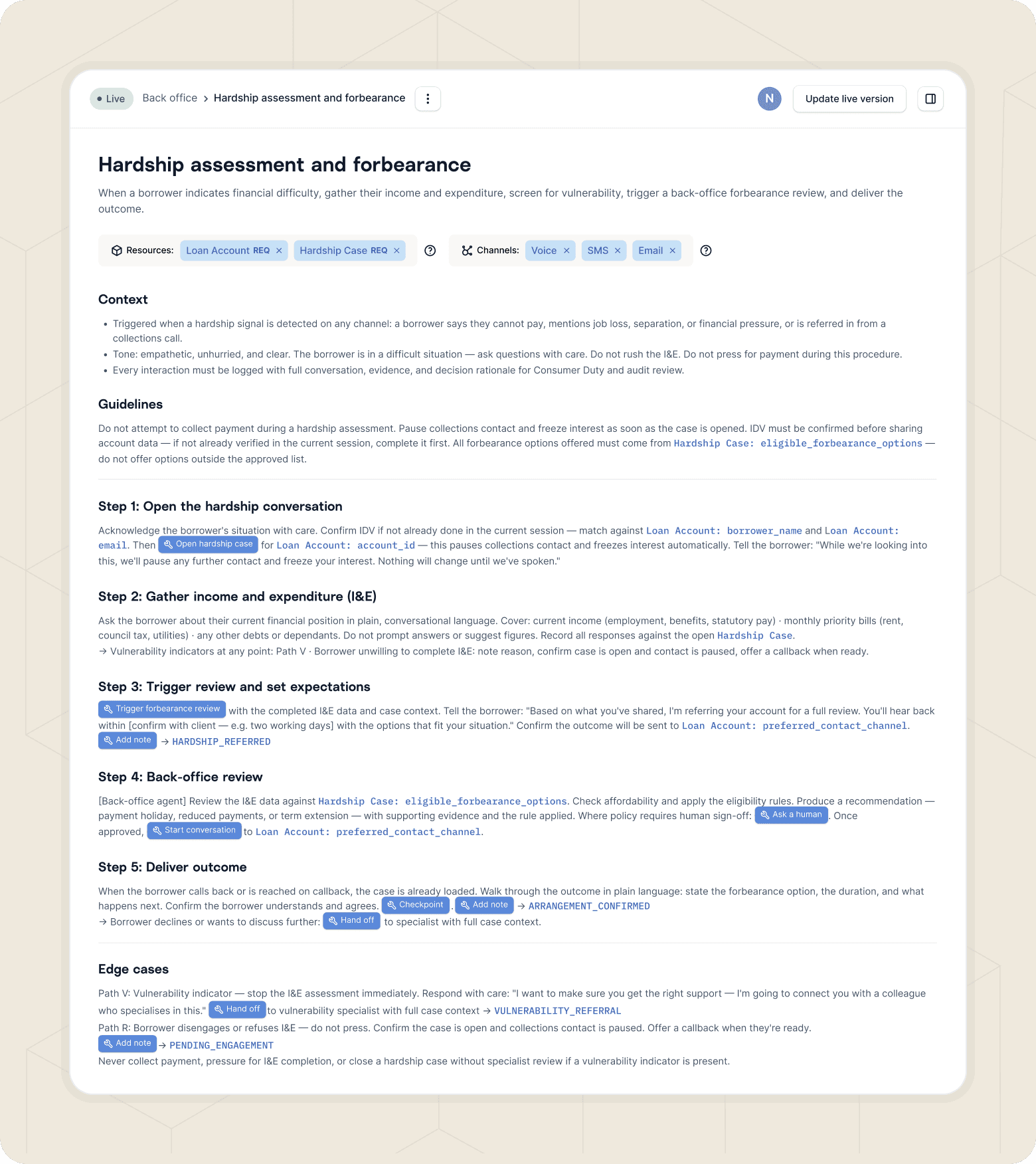
When a member says they are struggling, the next steps are prescribed and closely scrutinised, and they sit at the heart of the "people helping people" promise a credit union is built on. The agent gathers the income and expenditure picture conversationally, runs the assessment against your hardship policy, and resolves or routes the case. Signs of vulnerability escalate to a human specialist immediately, on every channel. This is the use case that turns a financial wellness commitment into something members feel rather than read on your website: consistent treatment, documented assessments, and no member left waiting because the queue was long.
Back-office use cases: clearing the work members never see
Back-office automation is the least crowded lane in most credit unions, and the part where AI clears the security bar most comfortably, because a human approval gate can sit in front of any consequential action. Success looks like shorter service levels, accurate decisions, and an audit trail with nothing missing. Member satisfaction is not the primary metric here, but faster processing usually lifts it anyway.
Business membership verification (KYB)
More credit unions serve small-business members every year, and business onboarding is where a small team feels the strain first. A credit union rarely has a dedicated business-onboarding desk: one or two people fit it around everything else, working through certificates of incorporation, ownership structures, and proofs of address, each checked against policy and screened for sanctions. The agent reads every business document, checks it against your policy, and screens for sanctions before verifying the business and routing it to onboarding.
Anything ambiguous goes to a person with the evidence already assembled, so your team spends its judgement on the cases that need it rather than the paperwork that doesn't. Two things happen at once: the business member is approved in a fraction of the time, and the people who used to chase documents are freed for work only they can do. Every check is logged, which turns verification from a sampling-based audit into a complete one.
Card disputes
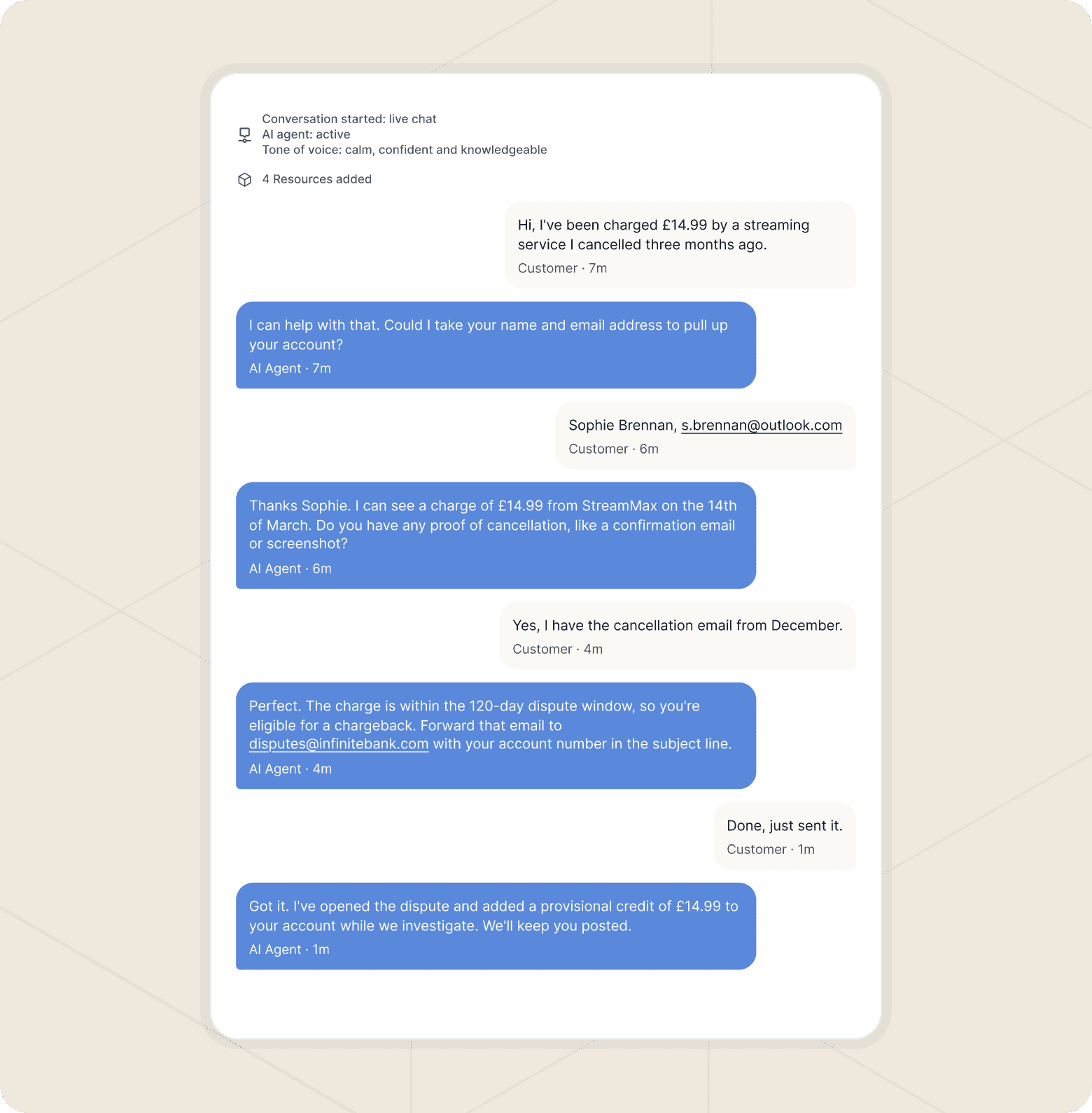
For any card-issuing credit union, disputes are among the heaviest back-office cases going: intake is fiddly, evidence takes chasing, and the card networks set deadlines that don't move. The Disputes Agent runs the lifecycle end to end. It takes the claim on any channel with the right questions asked up front, classifies it against Mastercard and Visa reason codes, reaches back out when evidence is missing, determines the outcome, and submits the chargeback directly to the network.
You can require a person to approve every submission before it goes, and the case file records each decision, evidence item, and guardrail check along the way. The case context travels with the agent from stage to stage, so the member who raised the charge in week one isn't met with a blank slate when the answer comes weeks later. The production numbers hold up under scrutiny: 95% accuracy on classification and decisioning, average resolution time down 25%, and $30+ saved on every case through direct network submission. It is pre-configured for Reg E and Reg Z, the rules that govern electronic transfers and cardholder disputes in the US.
Loan payoff and lien release processing
Auto and personal loans are the core of most credit union balance sheets, and every payoff generates a document-heavy request that lands in an inbox. Payoff and lien release requests arrive from dealers, other lenders, and members, each in a different format, many as scanned attachments or faxes. The agent reads each request, validates the details against member records, and processes the payoff or lien release, escalating exceptions with a complete case file. Its narrowness is the whole appeal: a document-heavy process with clear rules and a lot of manual grind is about the fastest back-office win a credit union can pick up. Any document check against an internal policy follows the same pattern.
How to prioritise AI use cases for credit unions
There is no single right entry point. Frontline chat, email, and voice is the most common first deployment because the volumes are high and results show within weeks, but plenty of credit unions start in the back office instead, taking on the verification or disputes backlog where the manual pain is sharpest. Wherever you start, three things separate the deployments that expand from the pilots that stall:
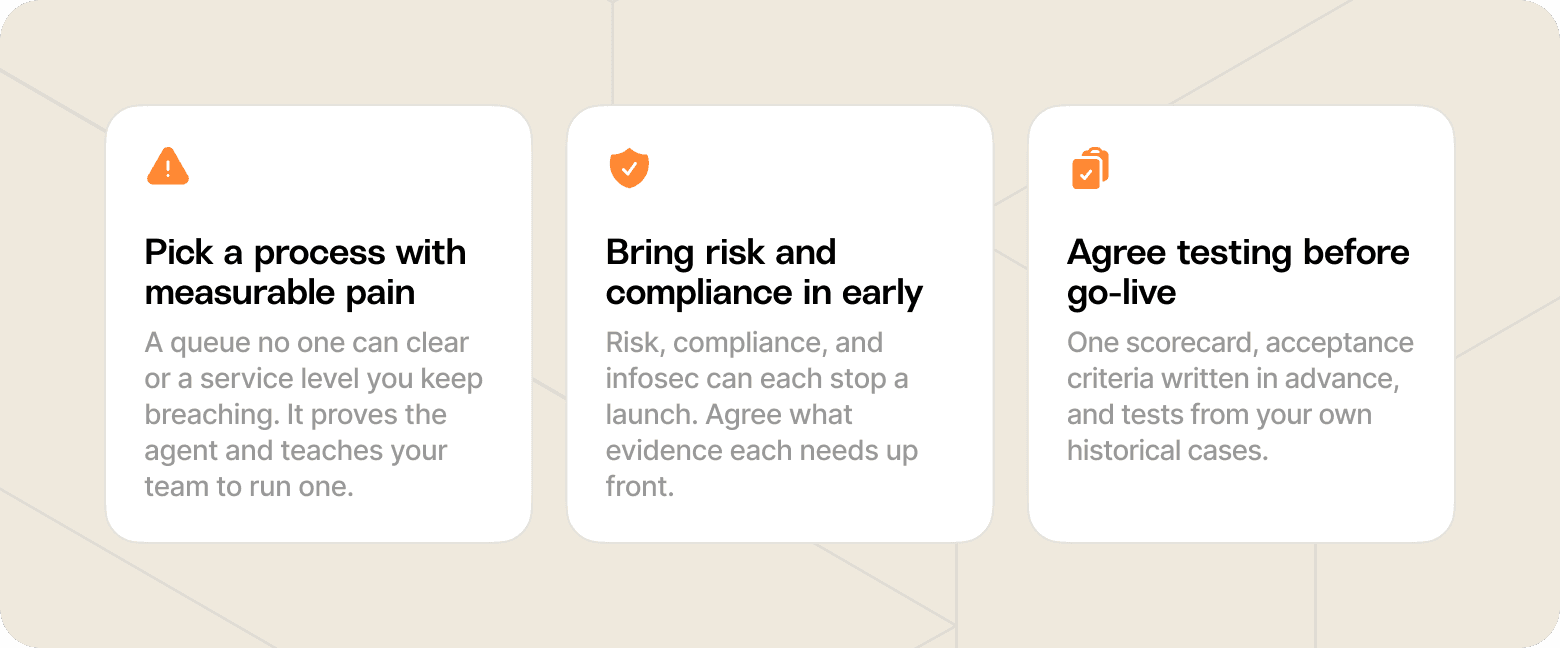
Pick a process with measurable pain. Choose one where the cost shows up as a queue no one can clear or a service level you keep breaching, not one where AI would be a nice-to-have. On a lean team the first deployment does double duty: it proves the agent, and it teaches your people to run one.
Bring risk and compliance in early. Your risk, compliance, and information security reviewers can each stop a launch. Involve them in shaping the evaluation and agree the evidence each one needs up front, so sign-off becomes a review of results rather than a negotiation over requirements.
Agree a testing framework before go-live. One scorecard for grading the agent's conversations, acceptance criteria written down in advance, and tests built from your own historical cases. The guardrails and audit trail the first use case proves carry over to the next, so each expansion is faster to sign off than the last.
Resolution rates at most programmes stall somewhere around 60–65%, because what is left needs back-office systems the frontline can't reach, and that is exactly where the largest savings hide. Reaching them takes agents that share full case context between the frontline and the back office, so a member never has to repeat themselves and a case never restarts at a handoff. Credit unions and banks run many of the same processes at different scale: for the bank-scale view of these use cases, see our guide to secure AI use cases for banks. Browse the full use case library to see each one in detail.
Few credit unions want to staff an AI engineering team to keep an agent running, which is why the build-versus-buy question for AI for credit unions usually lands on buy: a finished platform your ops lead configures, maintained by the vendor, leaves your people on the work only your credit union can do. Whichever process you pick, hold the vendor to production evidence in a member-like environment rather than a demo. Gradient Labs backs that standard with a guarantee: once we have scoped a use case, we guarantee the deployment, and if we don't deliver what we said we would, you get your money back.
Ready to see a secure AI agent run one of your own processes? Book a demo.


Elizabeth Shew leads Brand and Advocacy at Gradient Labs, where AI agents handle customer support and back-office work for banks, lenders, and fintechs. Before that, she led customer marketing at Mastercard and built Dynamic Yield's customer marketing programme from the ground up, a decade spent turning customer results into industry-shaping stories. She writes about how support and operations teams actually put AI and technology to work. Before tech, she was a professional dancer in NYC.