
For a lender, reputation is won or lost in the conversations customers dread: the missed payment, the arrears call, or the month the money runs out. Automate those conversations badly, and one poorly-judged collections call does damage on three fronts: the borrower complains, the FCA takes notice, and a public review warns off the next customer. But handle it well, and the opposite happens: borrowers in difficulty feel treated fairly, commit to a plan, and recovery climbs alongside trust. This guide is for the collections, operations, and compliance leaders deciding whether to trust AI with these conversations. It shows where AI reputation for lenders is really decided, what a compliant, trust-building deployment requires, how to choose a vendor, and why the collections floor is the place to start.
What AI reputation for lenders really comes down to
AI reputation for lenders is two things at once: the trust borrowers place in you, and the regulatory standing that lets you keep lending. Both are tested hardest in the same place, the moments when a customer cannot pay. That is what makes lending different from a general banking deployment, where a sensitive conversation happens more sporadically. In collections and hardship, the sensitive conversation is the entire job.
AI now runs those conversations at scale. For example, Gradient Labs’ Lending Agent works the full borrower journey, from chasing an unfinished application through onboarding, servicing, and overdue payment collections. Every one of those calls is a moment of truth for the borrower and a compliance event for you. Handle them with care and each interaction earns trust. Handle them badly and the damage lands twice, once with the customer and once with the regulator.
Why a mishandled collections call can cost more than the debt
An automated collections call that gets the tone wrong is the fastest way to turn a recoverable account into a complaint. A bot that keeps pushing a fixed payment date at someone who has just lost their income, misses a hardship cue, or chases a customer who is legally protected from collections, like a borrower in the UK's Breathing Space scheme, does real harm, and in collections that harm is regulated. The FCA's Consumer Duty and CONC hold you to treating customers in difficulty fairly, whether a human or an agent is on the line.
Picture a borrower who messages to say they cannot make this month's payment. A generic bot restates the amount due, sends a payment link, and marks the account as contacted. The customer feels chased rather than helped, files a complaint, and tells other people that your firm sends robots after people who are struggling. That story travels, and it is exactly the reputation a lender cannot afford.
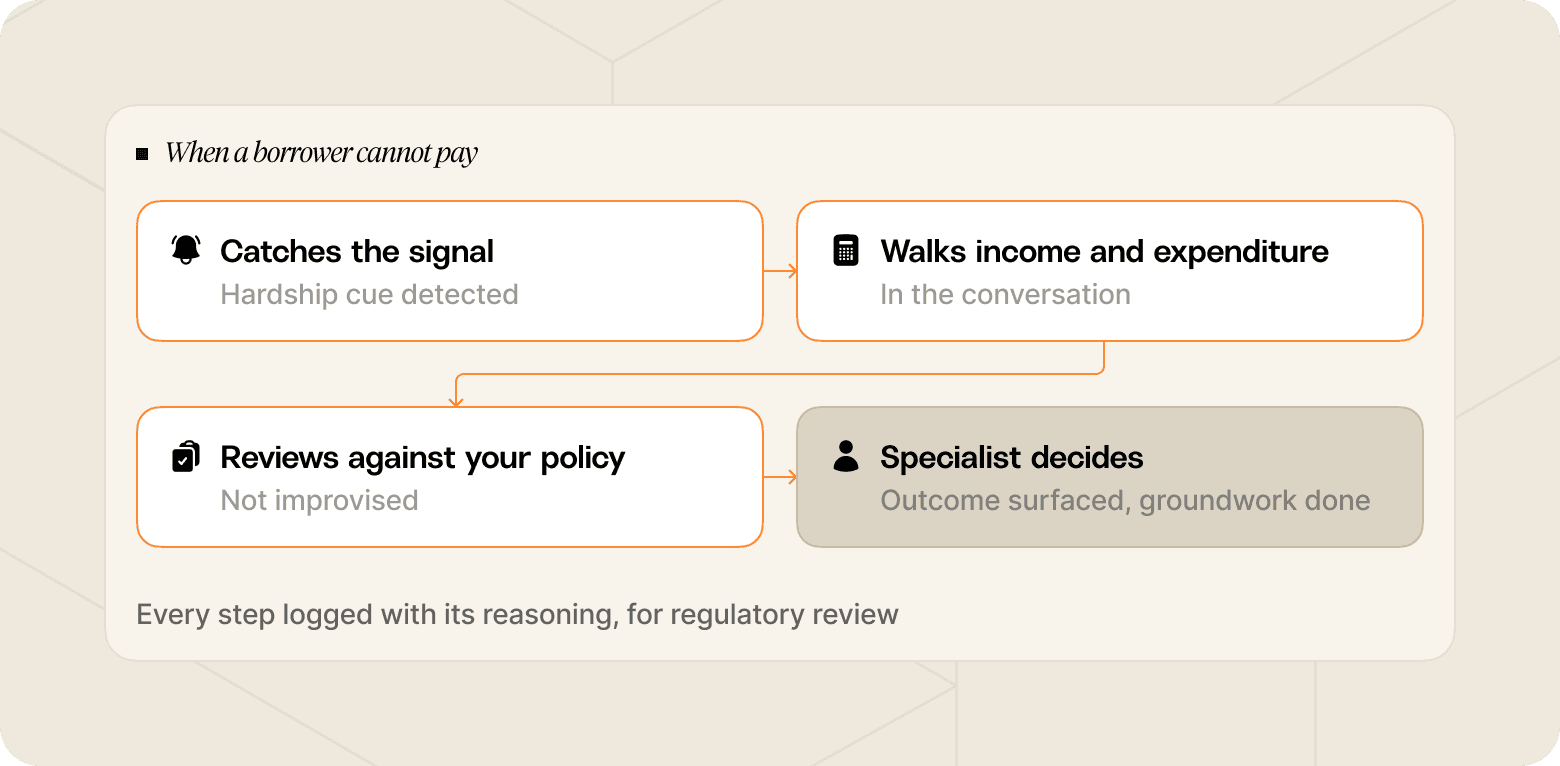
The cost is never just the single account. Frustrated borrowers disengage, stop answering the phone, and become harder to cure, so poor conduct erodes recovery as well as reputation. However, these risks can be addressed, and with the right AI agent, there’s a great reward. The same collections conversations that carry the risk are where improved trust and recovery are actually built.
How compliant AI in collections builds trust and recovery together
When an agent reaches borrowers at the right moment, listens before it acts, and follows the rules on every turn, recovery and reputation rise together. This is the upside most lenders underestimate, because they assume automated collections must mean cruder collections.
Proof against this assumption is in the numbers at SteadyPay, where the Gradient Labs Lending Agent runs outbound collections inside FCA rules:
"Before Gradient Labs, we needed to find a way to reach our growing number of customers effectively. Now we make 33,000 calls a month, converting 60% of engaged customers to committed repayment dates, all within FCA compliance standards. It has fundamentally changed how we manage the collections layer of our lending infrastructure."
Violeta Filip, Head of Customer Experience, SteadyPay
Compliance is where the reputational gap really opens up. A well-built lending agent runs more than 20 lending-specific guardrails on every turn, which makes it far more consistent than a stressed human team working a hard queue: Gradient Labs measures its agent as 30 times more compliant than human agents on the same collections work. Every borrower gets the same careful, rule-following conversation, at any hour, without a bad day.
Timing is the other half of the story. An agent that contacts borrowers when they are most able to engage, on the channel they actually answer, reaches people a fixed call-list never would, and SteadyPay saw a 20% lift in cold customers reactivated within a month. Being reached at a sensible moment, rather than at the same hour as every other creditor, is itself a mark of respect that borrowers notice.
That consistency is what lets recovery and trust climb at once. Borrowers reached at the moment they can actually engage, treated fairly when money is tight, and offered a realistic plan are more likely to commit and less likely to complain. A lender that gets this right turns its collections operation from a reputational liability into a reason customers stay through the hard months.
What a reputation-safe AI lending deployment requires
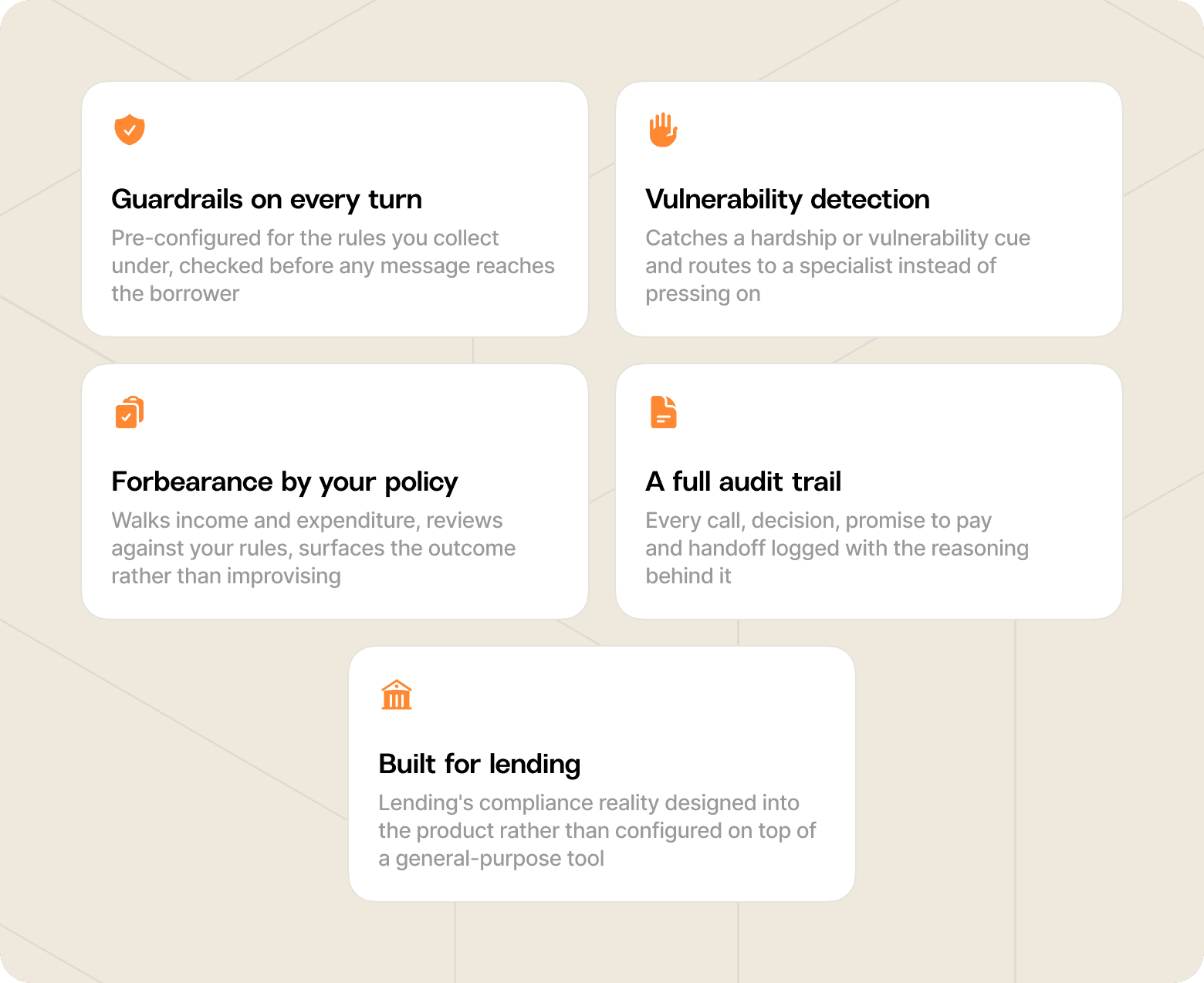
The difference between AI that protects your licence and AI that endangers it comes down to how the agent handles the hardest moments. A deployment built for lending needs all of the following:
Lending-specific guardrails on every turn. The agent should run controls pre-configured for the rules you operate under, FDCPA, TCPA, Reg F, UDAAP, and Mini-Miranda in the US, FCA Consumer Duty, CONC, and Breathing Space in the UK, checking every message before it reaches the borrower.
Vulnerability and hardship detection. When a hardship or vulnerability signal appears on a call or in a message, the agent has to catch it and route the case to a human specialist, not press on with the script.
Forbearance that follows your policy. For a hardship case the agent should walk the income and expenditure questions, trigger a review against your forbearance rules, and surface the outcome, rather than improvising an arrangement.
A full audit trail. Every call, decision, promise to pay, and handoff should be logged with the reasoning behind it, so you can evidence fair treatment to the FCA on demand.
Financial services in the build, not added later. The people who built Gradient Labs ran production machine learning inside a regulated bank and come almost entirely from finance, so lending's compliance reality is designed into the product rather than configured on top.
Security underpins the lot. Confirm SOC 2 Type II certification, GDPR compliance, and zero-day data retention with every model provider, so borrower data never becomes a breach headline of its own.
Protecting AI reputation for lenders starts with the vendor
Brand safety in lending is a procurement decision. When you evaluate a collections or servicing AI vendor, judge them on what decides whether the deployment protects your reputation or spends it:
Lending depth. Does the vendor understand curing, forbearance, promise-to-pay, and how a hardship case is actually worked? Point solutions bolt compliance on afterwards. Ask what was built for lending from the start.
Compliance on every turn. Are the guardrails lending-specific and running on each message, and does the agent escalate hardship and vulnerability to a human with full context?
Proof at a regulated lender. Has the vendor gone live at an FCA-authorised lender at real volume, with recovery, conversion, and complaint numbers you can check? SteadyPay is the kind of reference to ask for.
Compliance and security posture. Confirm regulatory coverage for every market you collect in, plus certifications like SOC 2 Type II. The EU AI Act makes this a baseline, not an extra.
Pressure-test every vendor against the hardship call, not the easy balance query. Any agent can read out a settlement figure, so the real test is what happens when a borrower says they have lost their job. For a fuller breakdown of the criteria, see our guide on evaluating AI agents in financial services. The same trust question sits underneath any AI deployment in finance, and we cover the wider version in our guide to bank AI reputation.
Where lenders should start
Start where the volume and the risk both concentrate but the scope stays contained: outbound collections or inbound collections queries on a defined segment. A CSV-only collections deployment can start making outbound calls in under a day, with no integration required, so you prove fair treatment and recovery before you widen the remit across the borrower lifecycle.
Track the reputation signal from week one. Recovery rate, promise-to-pay conversion, and complaint volume tell you directly whether the agent is treating borrowers well, long before a review is ever posted, and they give you the evidence to expand with confidence. Complaint volume is the number your compliance team and the FCA care about most, so watching it fall as automation scales is the clearest proof that fair treatment and recovery are moving together.
From there, trust compounds. Each arrears conversation the agent handles fairly is proof for the next stage, and a lender that gets collections right earns the standing to automate onboarding, servicing, and application support behind it. Reputation built one fair conversation at a time is how good lenders always earned trust, and it is how the best of them will keep it.
See how the Gradient Labs Lending Agent recovers more while treating every borrower fairly. Book a demo.


Elizabeth Shew leads Brand and Advocacy at Gradient Labs, where AI agents handle customer support and back-office work for banks, lenders, and fintechs. Before that, she led customer marketing at Mastercard and built Dynamic Yield's customer marketing programme from the ground up, a decade spent turning customer results into industry-shaping stories. She writes about how support and operations teams actually put AI and technology to work. Before tech, she was a professional dancer in NYC.