

A customer taps their card, the payment goes wrong, and they raise a dispute. What happens next decides whether they get their money back in two days or two weeks. In most disputes teams, that case lands with an analyst who spends more than 30 minutes classifying it, chasing missing evidence, and copying notes between systems. Multiply that across the queue, and the backlog never clears. You can automate disputes with AI instead, from the first intake question to the final chargeback submission.
This guide shows you how to map each step of a dispute to an AI agent, what to look for in one built for regulated finance, and the results a live deployment delivers.
What it means to automate disputes with AI
Automating disputes with AI means handing the repetitive work of a card dispute to an AI agent that runs the case end to end: intake, classification against card scheme reason codes, evidence review, customer follow-up, a recommended decision, and chargeback submission. A human stays in the loop where it matters, on the final approval, while the agent does the manual work in between. This is what AI dispute management means in practice: an agent that owns the case, not a tool that files a ticket and waits.
Two terms worth separating. A dispute is the work: a customer challenges a transaction and your team investigates it. A chargeback is one outcome of that work: the case is valid, so you raise it with the card scheme (such as Visa or Mastercard) to claw the funds back. You automate the whole dispute, and the chargeback is the step at the end.
One thing to rule out early is that fraudulent payments are not disputes. They sit in a separate fraud and financial-crime workstream, with different rules and different systems, as does transaction monitoring. This guide covers card-network disputes and chargebacks, the number-one back-office case for most card issuers.
Why disputes still get worked by hand
Disputes are the back-office work that resists automation. A frontline chatbot can deflect a simple "where's my refund?" question, but a dispute needs someone to read the evidence, apply scheme rules, and decide. So it stays manual, and it stays slow.
The bottleneck is rarely the decision itself, but everything else around it:
Evidence arrives incomplete, so the case bounces back to the customer for a screenshot, a date, or a receipt.
That back-and-forth runs over days, with the case sitting idle between each reply.
Context is lost between the frontline agent who took the dispute and the back-office analyst who works it, so the customer has to repeat themselves.
Every case is scored by hand against Visa and Mastercard rules, so quality varies from one analyst to the next.
There's a ceiling to what frontline-only tools reach. Many AI customer support deployments plateau at 60–65% resolution, because the work that remains crosses into back-office systems a chat widget never touches. The cost savings that matter sit past that plateau, in exactly the disputes work that stays manual.
How to automate disputes with AI, step by step
Here's how to automate disputes with AI across the full case lifecycle. Each step maps to work an AI agent like Gradient Labs can own, with your team supervising the outcome.
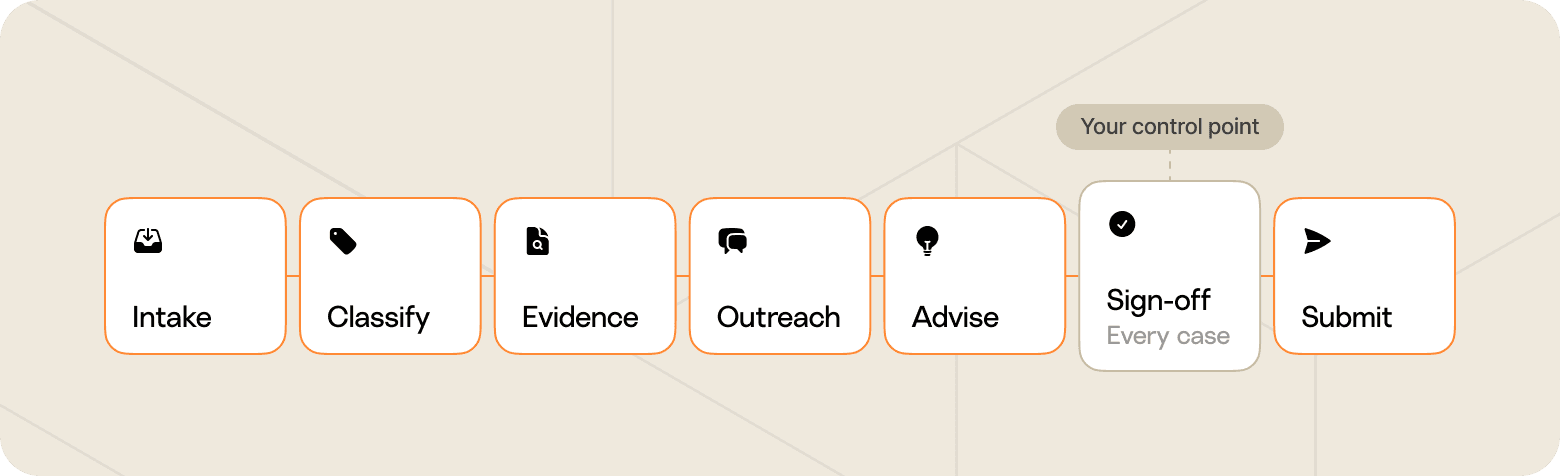
Intake the dispute. The frontline agent takes the dispute over chat, email, or voice, asks the right intake questions, and captures evidence upfront. Or the customer submits a form that routes straight to the disputes agent.
Classify the case. The agent maps the dispute to the correct card scheme reason code and checks the account for prior claims and repeat-claimant patterns.
Review the evidence. It checks every screenshot, receipt, and timestamp against scheme requirements, and flags what's missing.
Reach out to fill gaps. If evidence is missing, the agent contacts the customer in the same conversation, then resumes the investigation the moment they reply. No case sits idle waiting for a handoff.
Recommend an outcome. Once the evidence is complete, the agent applies your decisioning logic and recommends accept or reject, with a full audit trail.
Human sign-off. Your specialist approves or overrides in one action. This is the control point you keep.
Submit and close the loop. On approval, the agent raises the chargeback with the scheme directly, then tells the customer the outcome.
Yonder, a UK fintech offering reward credit and debit cards, rebuilt its disputes process along exactly these lines. Before, a dispute generated a ticket that a specialist worked by hand: copy the transcript into an AI co-pilot, paste the classification back into the ticket, message the customer through the support tool, and repeat the whole cycle every time new evidence arrived. Turnaround averaged five to seven days, stretching to nine during volume spikes.
With Gradient Labs' AI disputes agent working the back-office layer while the frontline agent shares full case context, evidence gaps get flagged at intake and most cases now complete their evidencing in a single day. The human review step that once took five days now takes 24 hours.
"Gradient Labs' frontline and back office agents talk to each other and keep the full context of a case. If evidence is missing, the customer hears about it in the moment... Cases that took us the best part of a week to decide now take a day. Better for our customers, and better for our team."
Antony Atkins, Senior Escalations Manager, Yonder
What to look for in an AI disputes agent
Not every AI tool can handle dispute resolution end to end. Score any agent you're evaluating against these criteria:
Shared context across frontline and back office. The agent working the case needs the full history from the frontline conversation, and the ability to reach back out to the customer without a handoff. This is the gap single-agent tools can't bridge.
Scheme-rule accuracy. Classification and decisioning have to match Visa and Mastercard reason codes consistently, case after case. Look for accuracy scored against those rules, not a generic confidence figure.
Compliance guardrails on every turn. A disputes agent in regulated finance needs controls that run on every action, pre-configured for the rules you operate under: FCA Consumer Duty and Section 75 in the UK, Regulation E and Reg Z in the US.
A complete audit trail. Every decision, every piece of evidence reviewed, and every guardrail check, logged and submission-ready. If you can't show your working to a regulator, the automation isn't worth the risk.
A human approval gate. The agent recommends and your specialist decides. Approve, override, or send back for more evidence, in one action.
Weak-case detection. The agent should flag missing dates, invalid screenshots, and scheme-rule mismatches before a chargeback goes out, so you raise stronger cases and win more of the ones you submit.
These are the same standards that separate secure AI agents for banking from a general-purpose chatbot: compliance depth and auditability come first, headline automation rates second. If you are running a formal evaluation, our scorecard for automated dispute resolution for banks sets out the evidence to demand from every vendor before you sign.
The results to expect
What does automating disputes with AI actually deliver? Yonder's numbers, from a live deployment, set a realistic bar:
150% faster disputes cycle. Cases that took five to seven days now close in two.
80% one-touch rate. Four in five cases reach the specialist team fully evidenced, with no back-and-forth.
90%+ CSAT on disputes, holding steady even through the volume spikes that used to add a third to processing time.
5x faster human review. The decision-and-submit step dropped from five days to 24 hours.
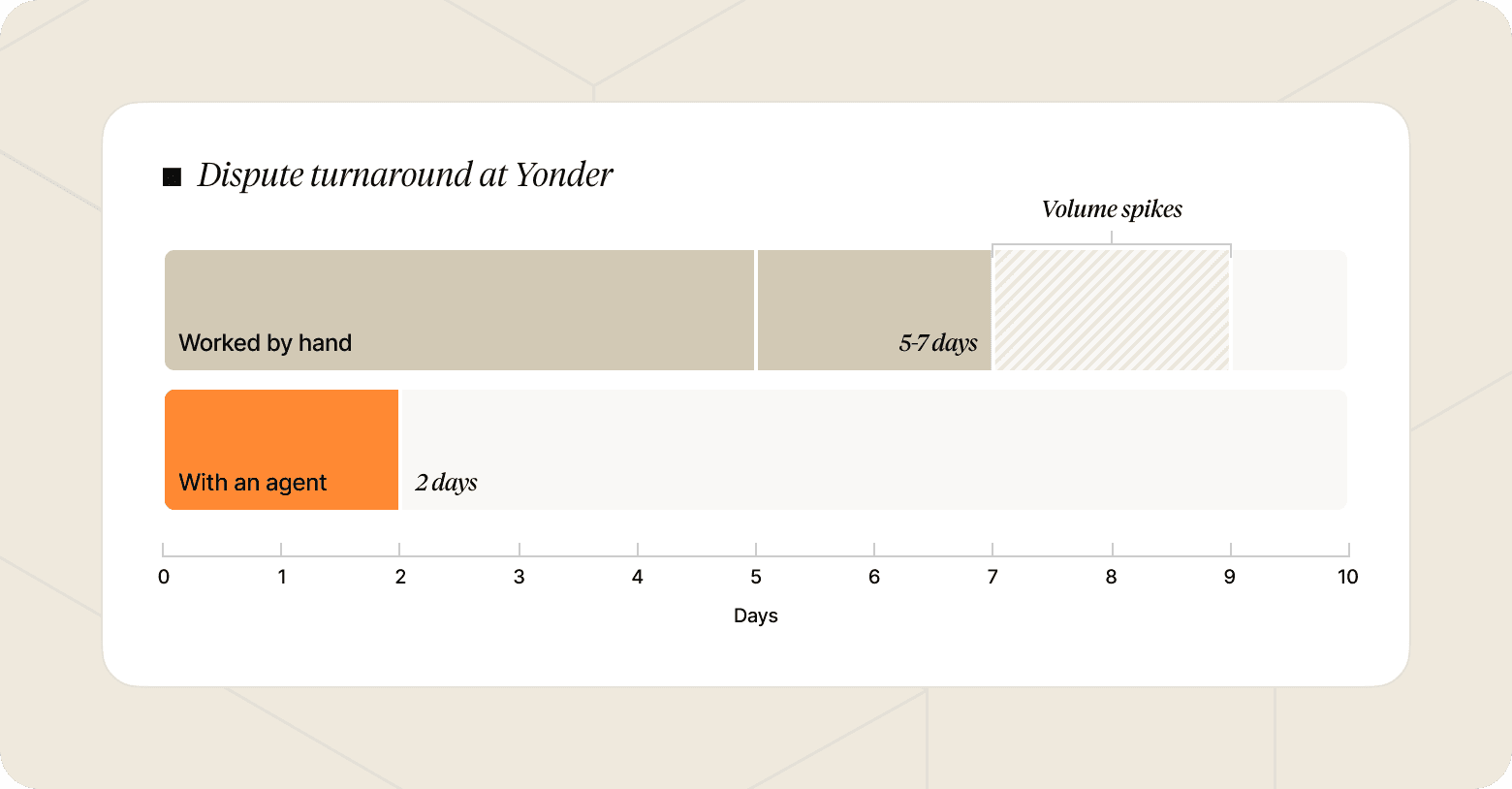
The queue effect matters as much as the per-case numbers. Cases that used to get risk-accepted, because no analyst had the time to work them, now get investigated to the same standard around the clock.
How to get started
You don't automate every dispute type on day one. The teams that succeed start narrow and expand as confidence builds.
Yonder reached disputes automation as part of a wider customer operations programme: first AI on frontline chat and email, then an AI lending agent for collections calls. Each success built the internal trust to hand over more complex, higher-stakes work. A sensible sequence:
Start with one high-volume dispute type, like a subscription cancellation dispute, where the evidence pattern is consistent.
Keep your specialists on approvals and edge cases while the agent works the queue.
Expand to more dispute types, and eventually to direct scheme submission, once the audit trail proves out.
Validate each new dispute type against real historic cases in a sandbox before it handles live volume, the same way Yonder tested the agent against member scenarios ahead of launch. For a large regulated institution, a disputes deployment typically takes four to six weeks to get into production, not the year a build would cost.
Ready to see how to automate disputes with AI on your own case types? Book a demo.

Elizabeth Shew leads Brand and Advocacy at Gradient Labs, where AI agents handle customer support and back-office work for banks, lenders, and fintechs. Before that, she led customer marketing at Mastercard and built Dynamic Yield's customer marketing programme from the ground up, a decade spent turning customer results into industry-shaping stories. She writes about how support and operations teams actually put AI and technology to work. Before tech, she was a professional dancer in NYC.