
AI chatbot vs AI agent: start with the definitions
Choosing customer support automation for a regulated business comes down to one distinction most vendors blur: an AI agent versus an AI chatbot. Both sit in a chat window, but what they do behind that window is vastly different.
An AI chatbot answers questions. It matches a customer's message to a known intent, returns an answer from a knowledge base or a scripted flow, and deflects the ticket once the answer lands. Ask it something outside its script, or anything that needs an ction taken in another system, and it escalates to a human. Its job is to contain volume at the front door.
An AI agent resolves cases. It reasons about what the customer actually wants, asks a follow-up when the request is ambiguous, takes actions across your systems (checking a balance, freezing a card, opening a dispute), and runs the case through to an outcome. When it needs the customer, it reaches back out and picks the case up again the moment they reply. Its job is to finish the work, not just field the question.
For financial services, most of the work that costs your team time is not a question with a single, tidy answer. It is a full case, covering everything from a dispute to a hardship request to an onboarding check or a missed payment. Those are what an AI agent is built to run and an AI chatbot is built to hand off. Put plainly, a chatbot is a front-door filter, while an AI customer service agent is measured on the customer operations it actually completes.
AI agent vs AI chatbot: the differences that matter
Dimension | AI chatbot | AI agent |
|---|---|---|
What it does | Answers questions and deflects tickets | Resolves cases end to end |
How it works | Matches an intent, returns a scripted or knowledge-base answer | Reasons about intent, asks follow-ups, takes actions |
Scope of work | Front-line FAQs | A good AI agent will run the front-line plus the back-office work behind the ticket |
When it's stuck | Escalates to a human | Reaches out to the customer, resumes when they reply |
Success metric | Deflection or containment rate | Resolution rate, SLA compression, audit coverage |
Systems | Reads from a knowledge base | Acts across core systems: payments, cards, CRM |
Compliance | Guardrails added after the fact, if at all | Financial-services guardrails on every turn, full audit trail |
Over time | Plateaus once the questions get complex | Improves as it takes on more of the case |
The pattern in that table reveals the dividing line: a chatbot manages the conversation, but an AI agent runs the work. In a low-stakes retail setting, managing the conversation is often enough. In financial services, where the conversation is usually the start of a regulated case, it rarely is.
Take a disputed transaction. A chatbot recognises the word "dispute", points the customer to a help article or opens a form, and marks the ticket closed, but in reality the case has not progressed at all. An AI agent built for this type of work, on the other hand, verifies the transaction, checks eligibility against the card scheme rules, gathers the evidence it needs, opens the chargeback, and keeps the customer updated until the money is resolved. Same opening query from the customer, two very different endings: one deflects and hands the work to your team, the other finishes it.
Why chatbots stall in financial services
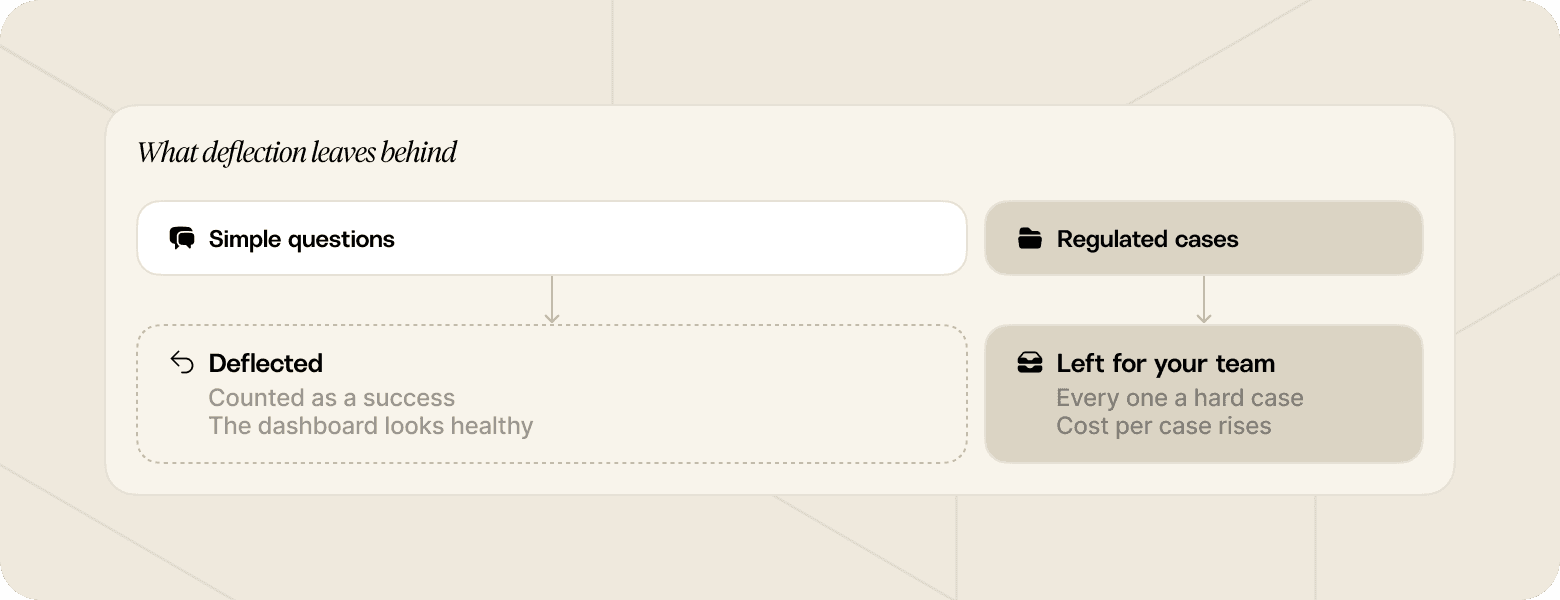
A chatbot's core measure is deflection: how many tickets it keeps out of the human queue. Deflection looks impressive on a dashboard until you count what it leaves behind. The deflected tickets are the simple ones. The residue that reaches your team is the complex, regulated work that actually carries cost and risk.
This is the difference between deflection vs resolution, and it is where most deployments hit a wall. Many AI customer support deployments plateau at 60 to 65% resolution, because a tool built to answer questions cannot carry a case through investigation, action, and follow-up. Past that ceiling sit the disputes, the arrears conversations, and the complaints, exactly the work a scripted bot is designed to escalate rather than finish. The economics follow the same curve: the tickets a chatbot removes are the cheap ones, so your cost per remaining case rises even while the deflection number on the dashboard looks healthy.
Regulation raises the stakes further. A customer in financial difficulty, a vulnerability signal, a complaint that triggers FCA Consumer Duty obligations: these need judgement, the right tone, and a decision that stands up to audit. A chatbot working from a knowledge base has none of that. It either deflects as soon as the conversation turns sensitive, or it answers when it should have handed off, which is the more dangerous failure in a regulated operation. In that setting, an answer with no record of why it was given is a compliance gap, not simply a support miss.
What an AI agent does that a chatbot can't
An AI agent is built to close the gap a chatbot leaves open. Four capabilities separate customer service AI agents from scripted bots.
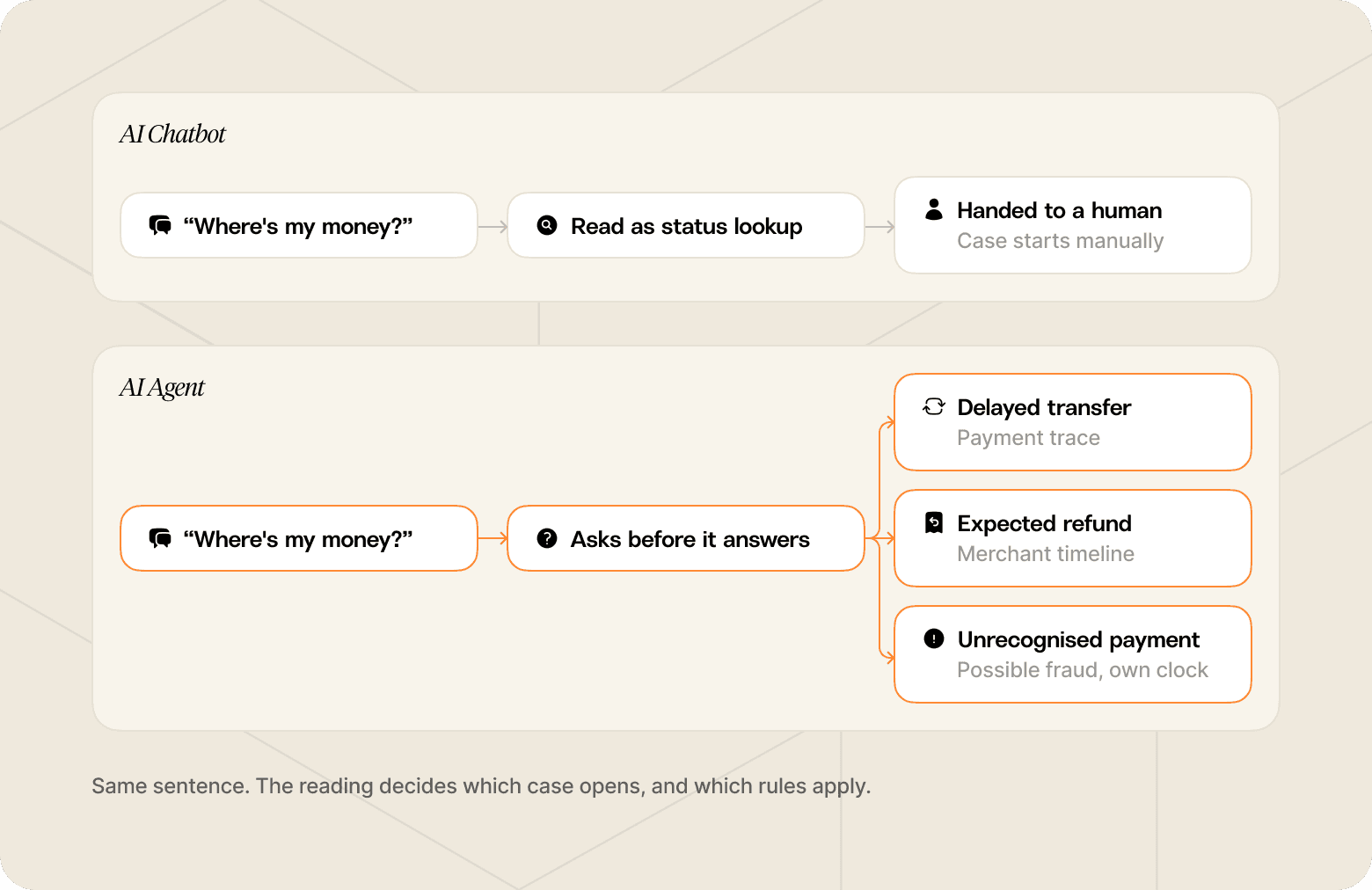
It seeks to understand before it acts. For example, “where's my money?" could mean a sent payment, an expected refund, or a transaction the customer doesn't recognise. An AI agent asks the follow-up that pins down which one, then acts. A chatbot picks the most probable intent and runs with it.
It runs the back-office work behind the ticket. An AI agent takes a dispute at the front door, investigates it, gathers evidence, follows up with the customer, and submits the chargeback. It handles collections and KYC and onboarding checks the same way, as cases to finish rather than questions to route.
It runs financial-services guardrails on every turn. Purpose-built agents carry 20+ pre-built FS guardrails that detect complaints, vulnerability, and financial difficulty and reroute, while agent-side controls catch tipping-off, false promises, and out-of-bounds advice before a reply ever reaches the customer.
It gets better after go-live. Because an agent runs the whole case, its resolution rate compounds as it takes on more work types, moving from around 60% at launch towards 85% and beyond in mature deployments. A chatbot's containment rate flattens once the easy questions are covered.
This is not theory. Gradient Labs runs a Lending Agent in production at SteadyPay, handling outbound voice and back-office hardship work, and a Disputes Agent at Yonder that cut dispute resolution from more than five days to same-day. Both go beyond replying to tickets and write into the system of record, which is the line a chatbot cannot cross.
What to demand from an AI agent in regulated finance
Not every AI agent is built for financial services. The gap between AI agents that are specialised for finance, and those that aren’t, often won’t show up in a demo; but it shows up clearly in the cases your team is still clearing three months after go-live. Use these criteria to separate an agent that can run regulated work from an AI agent that’s barely a step above a chatbot:
Resolution over deflection. Ask the vendor to define resolution and show the rate on work like yours. If they only quote deflection or containment, they are measuring a chatbot. Our guide on evaluating AI agents for financial services sets out how to run that test.
Compliance you inherit rather than build. The agent should arrive with financial-grade guardrails already running on every turn, regulatory coverage for the markets you serve (FCA Consumer Duty, FDCPA, the EU AI Act), SOC 2 Type II certification, and an audit trail that records every action and the reasoning behind it.
A delivery team that knows finance. Customer support automation only sticks when the people configuring it understand a dispute, an arrears case, and a KYC review, not just the model. A non-technical ops lead should be able to run the agent without hiring an AI team.
Evidence it can go past the ceiling. Deployment is the start of the work, not the end. Ask how the vendor takes an agent from launch to a mature resolution rate, and who does that work.
For a deeper checklist, see how to choose an AI agent vendor for financial services and our roundup of the most secure AI agent for banking options.
Choosing between an AI agent and an AI chatbot
The honest answer depends on the work in front of you. An AI chatbot for financial services can still earn its place at the front door, deflecting a high volume of simple, low-risk questions. Once the work becomes a regulated case, a dispute, a collections conversation, an onboarding review, a vulnerable customer, that same chatbot's ceiling turns into your team's backlog. Once you have settled on an agent over a chatbot, the next question is how much it should handle on its own, which we cover in AI copilot vs autonomous agent.
Financial services sits firmly on the case side of that line, which is why Gradient Labs is built for finserv from the ground up. Our specialist AI agents for financial services resolve the full case across the borrower and customer lifecycle, run compliance on every turn, and come delivered by a team that has run production operations under FCA regulation. Compliance is built into the architecture and enforced on every turn, so it holds up to audit rather than depending on a layer switched on after launch.
If you are mapping where an agent would actually sit in your operation, our guide to AI agents for customer service covers the frontline, outbound, and back office, and the five questions to put to a vendor.
If you're weighing an AI agent against your current chatbot, book a demo and we'll show you what full resolution looks like on your own use cases.


Elizabeth Shew leads Brand and Advocacy at Gradient Labs, where AI agents handle customer support and back-office work for banks, lenders, and fintechs. Before that, she led customer marketing at Mastercard and built Dynamic Yield's customer marketing programme from the ground up, a decade spent turning customer results into industry-shaping stories. She writes about how support and operations teams actually put AI and technology to work. Before tech, she was a professional dancer in NYC.