
If you run onboarding or compliance at a bank or fintech, two checks stand between every new applicant and their first transaction: know your customer (KYC) and know your business (KYB). They sound interchangeable, and plenty of teams treat them as one job, but they verify different things and break down in different places. That is the distinction behind KYC vs KYB: KYC verifies an individual, KYB verifies a company and the people who own and control it. Get either wrong and you either let bad actors through or make legitimate applicants wait at the door. Financial crime compliance already costs financial institutions more than $206 billion a year globally, according to LexisNexis Risk Solutions, and Signicat's onboarding research found 68% of European consumers have abandoned a financial application partway through. This guide defines both checks, shows where each one slows a bank or fintech down, and covers how to automate KYC and KYB without losing the human judgement regulators expect.
KYC vs KYB: what each check actually verifies
KYC and KYB are two sides of the same obligation: know who you are doing business with before you take them on, and keep knowing as the relationship runs. Both sit inside the same anti-money-laundering framework, both feed the same FinCrime function, and both carry the same penalty for getting it wrong. What changes is the subject matter and nature of the check.
Know your customer (KYC)
KYC verifies that an individual is who they claim to be, and gauges the risk they carry, before and throughout a relationship. It covers identity verification (IDV), sanctions and politically-exposed-person (PEP) screening, and customer due diligence (CDD): collecting and checking the data that proves identity and source of funds. Higher-risk cases trigger enhanced due diligence (EDD), a deeper investigation into where money comes from and who the customer really is. The global baseline traces to the FATF recommendations, which most national regimes build on.
Know your business (KYB)
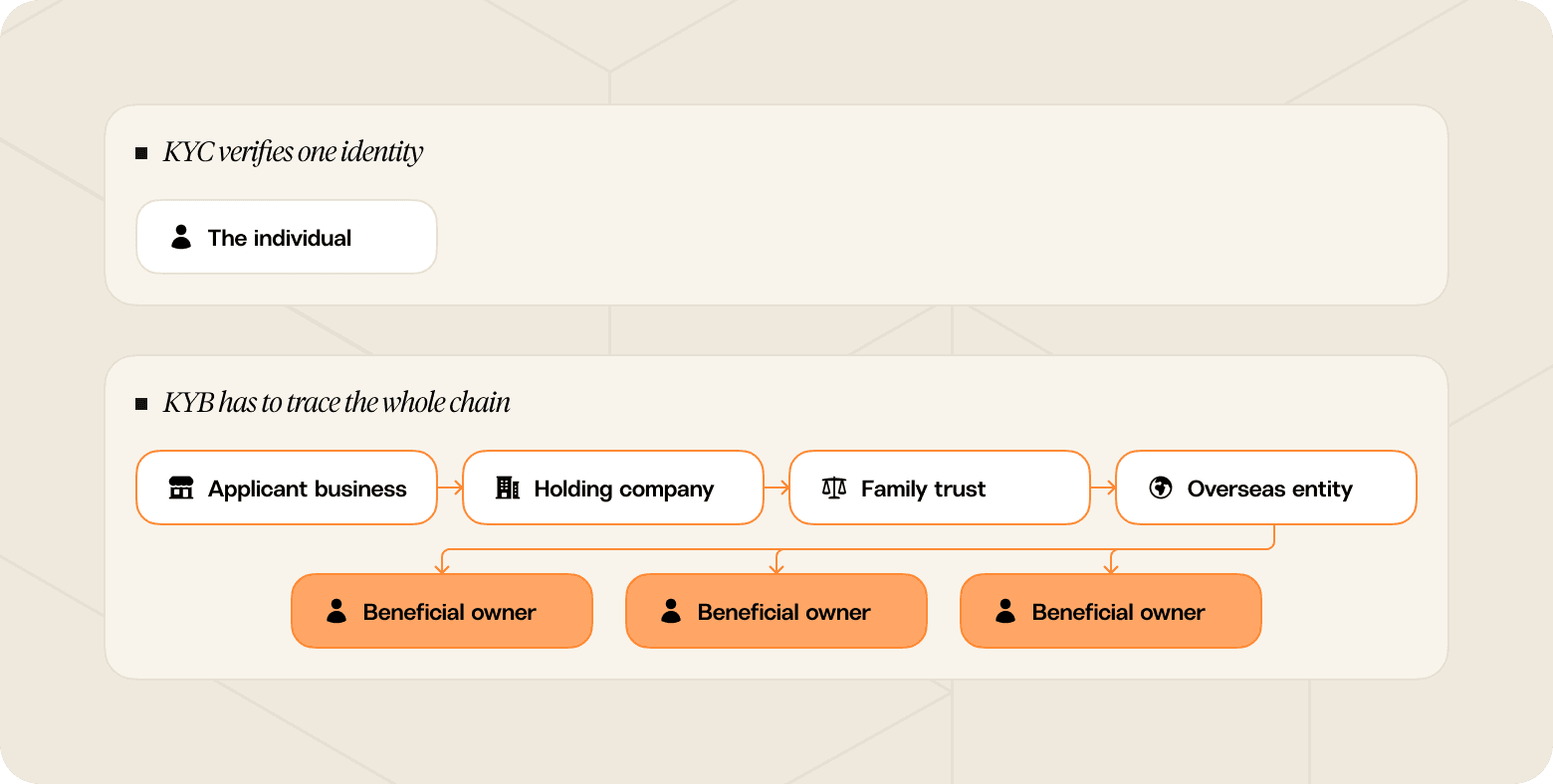
KYB applies the same intent to a company. You verify the legal entity, then trace the people behind it: directors, and the ultimate beneficial owners (UBOs) who own or control the business. That second step is what makes KYB harder than KYC, as ownership can sit behind holding companies, trusts, and cross-border structures. In the US, FinCEN's CDD Rule requires banks to identify and verify the beneficial owners behind every legal entity customer, at a 25% ownership threshold; the EU's incoming anti-money-laundering package applies the same 25% test.
Core differences and where they overlap
The subject differs, but the machinery underneath is shared. Both KYC and KYB checks run against the same sanctions and PEP lists and the same adverse-media sources, both demand ongoing monitoring rather than a one-time pass, and both have to leave an audit trail a regulator can follow. A firm that treats either as a box ticked at onboarding, and never revisited, is carrying risk.
KYC | KYB | |
|---|---|---|
Verifies | An individual | A business and the people behind it |
Core checks | ID verification, sanctions, PEP and adverse-media screening, CDD | Entity verification, ownership graph to 25% UBOs, director and officer screening |
Hardest part | Matching a real person to genuine documents | Calculating effective ownership through corporate layers |
Triggers EDD when | High-risk customer, PEP match, unusual source of funds | Complex ownership, high-risk sector or jurisdiction |
Never truly finished | Re-screening on changes in circumstance | Re-verification as ownership and directors change |
Why KYC vs KYB slows banks and fintechs down
The obligation is clear. The friction comes from how the work gets done, and it lands differently depending on the size of the institution. A large bank carries volume and legacy systems that were never built to share data. A growing fintech carries onboarding demand that outpaces the compliance headcount it can hire. Both hit the same pressure points.
Onboarding drop-off. Every manual step and repeated document request is a moment the applicant can walk away. When verification stalls, the good customers abandon the flow alongside the bad actors you meant to stop, and the abandonment shows up as lost revenue rather than a compliance line.
Manual review queues. FinCrime analysts spend their day rekeying the same case between an IDV tool, a screening system, and a CRM that were never designed to talk to each other. The judgement work they were hired for gets buried under copy-paste.
The depth of EDD. A high-risk case is an investigation, not a checkbox. Someone has to read the documents, follow the money, and write up a defensible decision, and that time competes with the routine reviews stacking up behind it.
KYB ownership complexity. Tracing a UBO means pulling company registries across jurisdictions, reconciling mismatched records, and chasing directors for documents they are slow to send. One layered structure can absorb a day of analyst time before a decision is even in reach.
Ongoing monitoring. KYC and KYB are never one-and-done. Circumstances change, sanctions lists update, and ownership shifts, so every existing customer is a re-screening liability, not a closed file.
Consistency and audit. Two analysts can reach two different calls on the same borderline case. Every decision needs a trail that shows what was checked, what was found, and why the outcome was justified, and hand-built trails are where audits find gaps.
What to weigh before you automate KYC and KYB
Automation is not a switch you flip over a compliance process. Weigh these before you scope a deployment.
Encode your policy, not a generic one. Your risk appetite, your thresholds, and your escalation rules are what make a decision defensible. KYC automation has to run your policy exactly as your compliance team wrote it, not an AI vendor's approximation of it.
Map the data and integrations. Verification touches IDV providers, sanctions and PEP lists, company registries, and your CRM. The value comes from an agent that reads and writes across all of them, so the analyst is not the integration layer between systems.
Insist on guardrails and audit by design. In a regulated flow, compliance cannot be a setting the buyer configures later. Look for financial-services guardrails that run on every step and a full audit trail of every check, data point, and decision, captured automatically rather than reconstructed after the fact.
Cover the regulations you actually operate under. A multi-market bank needs a system that respects FinCEN and OFAC in the US, the Money Laundering Regulations and FCA expectations in the UK, and the EU's AML regime, rather than one built for a single jurisdiction.
Decide where the human stays. The goal is to remove the repetitive work, not the accountable decision. High-risk EDD, final sign-off on a marginal case, and appeals belong with a person, and the automation should hand those cases over with the groundwork already done.
KYC and KYB compliance is also a security question, not only a process one. For the wider bar an FS buyer should hold any agent to on data handling and controls, see our guide to secure AI agents for banking.
What good KYC and KYB automation looks like
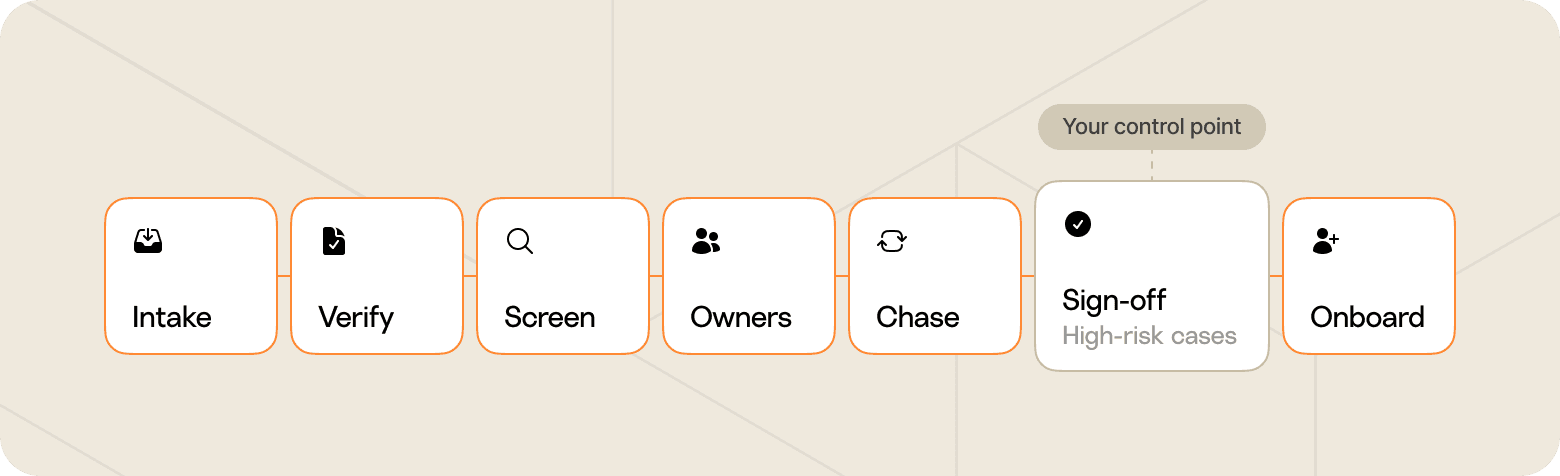
Done well, automation clears the routine cases end to end and gives your analysts the hard ones with the groundwork done. Take business verification, the KYB flow Gradient Labs runs today. The agent starts where analysts lose the most time. It builds the applicant's ownership and control graph, calculates effective ownership through each corporate layer, and identifies every beneficial owner above the 25% threshold, then reconciles what the applicant declared against what the structure actually shows.
The agent screens the entity and its owners against sanctions lists, and a case that fails a hard check stops rather than progresses, a dissolved company being the obvious one. What it does not do is adjudicate a possible match or run the financial crime review behind it. That judgement stays with your analysts, and the agent's job is to reach them with the case complete. Where evidence is missing, it asks the applicant for the specific document it needs, a shareholder register or an updated beneficial-ownership declaration, then reviews what comes back and picks the case up again. Your internal screening, risk, and policy detail never appears in that conversation.
A clean case reaches onboarding without a person involved. Everything else goes to compliance with the case assembled: what the agent checked, what it found, and what is still outstanding. No application is approved or declined on a risk judgement the agent made alone, and that boundary is what makes the flow defensible. That is KYB verification handled as a process, not a form.
The KYC side works the same way. During conversational onboarding, the agent collects and verifies identity documents in the flow of the conversation, screens against sanctions and PEP lists, and resolves the simple mismatches ("your address does not match, can you upload a recent statement?") without an analyst ever touching the ticket. The applicant is verified in minutes, and the cases that need a trained eye are the only ones that reach one.
Humans stay exactly where their judgement earns its keep. An analyst no longer works a queue of routine checks: they handle the escalations the agent flags, make the call on genuinely high-risk cases, and own the final sign-off where accountability has to sit with a person. Because the agent runs the same checks the same way every time, and logs each one, the human starts from a complete, consistent case file instead of rebuilding it by hand. The review moves to the agent while the reviewer keeps the decision.
The payoff: smoother for customers, lighter for your ops team
The end user feels it first. Verification happens in minutes inside the flow they are already in, not across a week of emails and re-requests, so the applicants you want to keep stop dropping out at the compliance step. A legitimate business gets its facility approved while it still cares, and an individual finishes onboarding in one sitting rather than three.
Your operations team feels it next. FinCrime analysts come off the repetitive review queue and spend their time on the investigations that need a human, growth stops meaning a linear increase in headcount, and every decision carries a consistent audit trail your risk and compliance functions can stand behind. This is what automating the manual work of customer operations looks like when the work is verification. Pockit, a consumer fintech, saw its resolution rate climb 70% and CSAT improve 80% while absorbing growth without scaling its team. As Head of Operations Michiel Smet put it: "we have an AI agent that's actually resolving problems, boosting our CSAT rating, and absorbing growth without us having to scale the team."
See how a specialist agent handles verification end to end: book a demo.


Elizabeth Shew leads Brand and Advocacy at Gradient Labs, where AI agents handle customer support and back-office work for banks, lenders, and fintechs. Before that, she led customer marketing at Mastercard and built Dynamic Yield's customer marketing programme from the ground up, a decade spent turning customer results into industry-shaping stories. She writes about how support and operations teams actually put AI and technology to work. Before tech, she was a professional dancer in NYC.