
If you are choosing your first AI agent for a bank, a lender, or a fintech, you have probably been told the same thing: start with an AI copilot, keep a human on every action, and you stay safe. It sounds sensible. It is also where the real debate about AI copilot vs autonomous agent begins. The two terms get used loosely, so this guide defines each in plain language, explains why the market is split on which one is safer, and sets out where our team lands after three years running agents in production in regulated financial services.
AI copilot vs autonomous agent: what's the difference?
Both terms describe AI doing customer operations work. The difference is who takes the action.
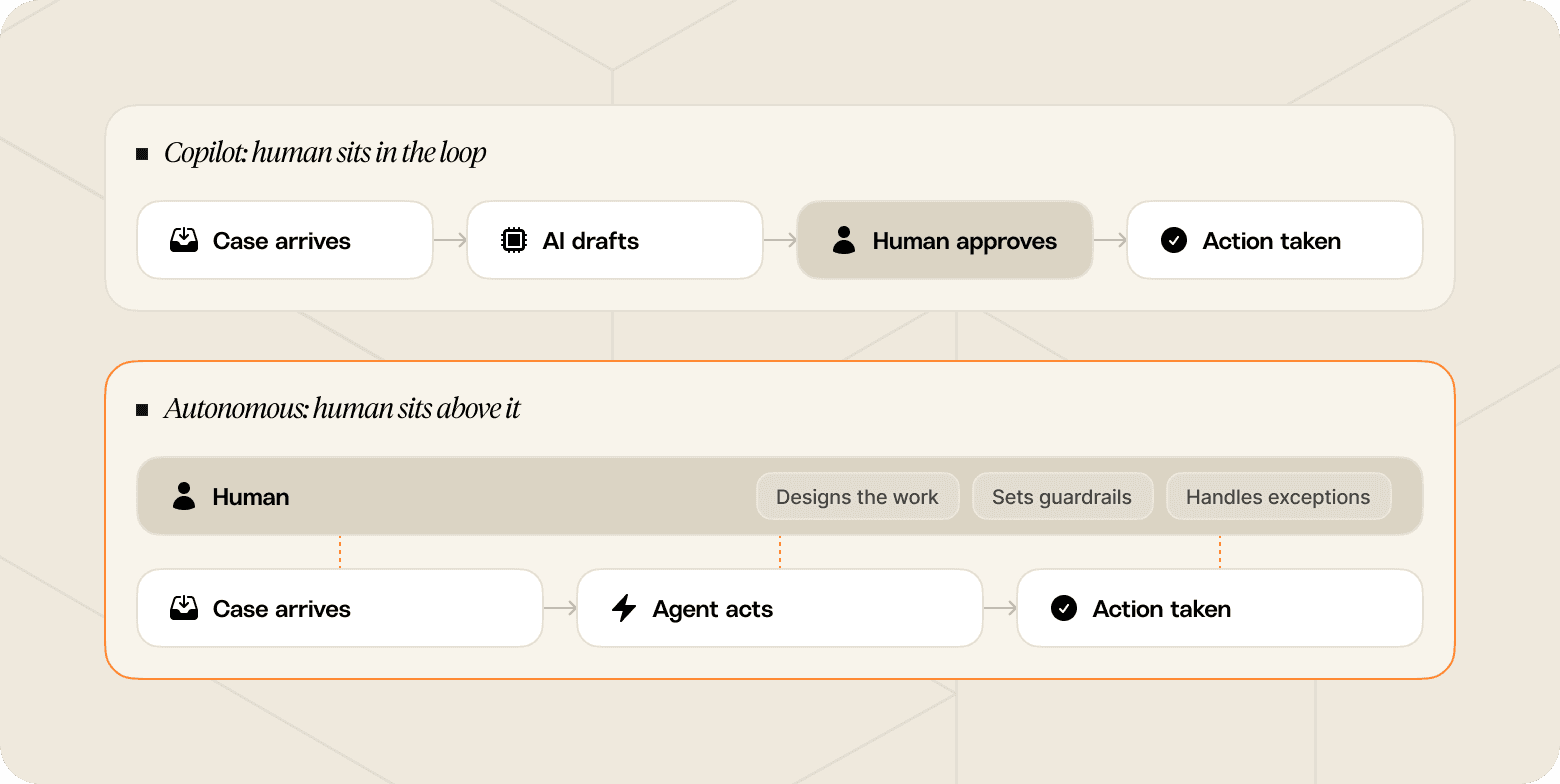
An AI copilot (often called agent assist) works alongside a human. It drafts a reply, suggests the next step, or summarises a case, and a person reviews and approves it before anything reaches the customer or the system of record. The human stays in control of every action. Internal tools that draft an underwriting memo or a support reply for an agent to check are copilots.
An autonomous AI agent handles a case from start to finish. It reads the customer's message, works out what they actually need, takes the action, and replies directly, escalating to a human only when it reaches something it should not decide alone. The human moves from approving every step to designing how the agent works and handling the exceptions it routes to them.
AI copilot (agent assist) | Autonomous AI agent | |
|---|---|---|
Who acts | The human, helped by AI | The agent, within set limits |
Who approves each action | A human, every time | The agent, with humans on exceptions |
Where the human sits | In the loop on every case | Often above the loop, on design and edge cases |
Scalability | Capped by human bandwidth | Scales beyond headcount |
Best fit | Low volume, high ambiguity, early trust-building | High volume, well-scoped, measurable outcomes |
Some deployments run a copilot on sensitive cases and full autonomy on routine ones; for some industries or use cases, the type of AI may not matter much, and both will deliver similar outcomes. But for highly regulated industries like financial services, the question matters much more: where does human judgement actually make the outcome safer?
Why the market is split on which is safer
There are strong safety arguments for both types of AI.
The copilot camp argues that a human on every action is the natural safety net. If the AI gets something wrong, a person catches it before it reaches the customer. For a risk or compliance team meeting AI for the first time, that is intuitive and reassuring, and it maps onto how most regulated processes already work.
The autonomy camp argues that human review does not scale, and that a well-built agent is more consistent than a stretched team. Once volume climbs, a human checking every suggestion becomes the bottleneck, and the quality of that checking degrades. The agent, meanwhile, applies the same policy the same way on every case.
Regulation raises the stakes on both sides. Rules like the UK's FCA Consumer Duty and the EU AI Act hold firms accountable for outcomes and for the systems that produce them, whether the final action came from a person or an agent. That accountability is exactly why the "which is safer" question deserves a real answer rather than a default.
Expert view: a well-built autonomous agent is the safer choice
This is not a view we hold from the sidelines. The team behind Gradient Labs built and ran the AI and data organisation leading UK digital bank Monzo, growing it from zero to more than 120 people while running production machine learning under FCA regulation. Our co-founders have spent their careers on what genuinely makes an agent safe: deep domain expertise, rather than a human signing off every step. Three years of live financial services deployments have proved this repeatedly.
So why is a specialised autonomous agent safer than a copilot? The reasons follow.
The AI copilot ceiling is a human ceiling
An AI copilot makes a person faster, but it doesn't remove work from that person's plate. Every case still needs a human to read the suggestion, decide, and act, so scalability, cost, and coverage stay tied to headcount. You get an efficiency gain, but that’s often not enough to clear backlog. When ticket volume spikes overnight or an outbound collections campaign goes out to thousands of borrowers at once, the copilot model scales the way hiring scales, slowly and expensively.
"Human in the loop" is only as safe as human attention spans
This is the failure we see most often in practice. When an AI's suggestions are right most of the time, the people reviewing them start to trust the output and approve it without truly checking. The better the copilot gets, the stronger the reflex. This pattern, known as automation bias, is well documented in human-factors research, and it means the safety net has holes exactly where it matters: the small share of cases where the AI is wrong and a tired reviewer waves it through.
In financial services, that failure mode is costly. For example: if a human agent accidentally approves an AI-written reply that discloses an account is under fraud investigation, it can amount to tipping-off, which is a criminal offence in the UK. A rushed sign-off on a vulnerable customer or a complaint can breach Consumer Duty. An approver who is nominally in the loop but effectively rubber-stamping is not a meaningful control.
Autonomy done right is engineered to be safer
The autonomy Gradient Labs is built for is not "trust the model and hope". It is a controlled agentic workflow, with safety designed into every step:
It seeks to understand before it acts. Asked "where's my money?", the agent works out whether the customer means a sent payment, an expected refund, or an unrecognised transaction before it does anything, the way a good human agent would.
Guardrails run on every turn. More than 20 pre-built financial services guardrails check each response for complaints, vulnerability, tipping-off, false promises, and out-of-bounds advice, and edit or reroute before anything reaches the customer.
Every action is auditable. Each decision, data point, and tool call is logged, so risk and compliance can review exactly what happened and why, per case.
It asks for help when it should. For genuinely ambiguous or high-stakes moments, the agent uses Ask a Human to hand off to a person, rather than guessing.
Those controls run the same way on every case, at any volume, at 2 AM as reliably as at midday. That consistency is the safety argument, and it is the thing a fatigued reviewer cannot match.
Benchmark against your team, not perfection
The copilot case quietly assumes the human catch is reliable and the human standard is zero errors. Neither is true. Humans make mistakes, get tired, and apply policy unevenly, and no system, human or AI, is right 100% of the time. So the honest test for AI is a practical one: does the agent produce a measurable uplift on what your human team currently does today, with the same or better accuracy? In our deployments the answer has been higher CSAT than human teams on frontline work, and resolution that starts around 60% on day one and climbs to 80–90% in mature deployments. Measured against the real baseline your team sets, a well-built autonomous agent clears it.
Where humans still belong
Autonomy-first does not mean humans out. It moves them up the stack to where their judgement actually adds safety.
Designing the work: People write the procedures, set the policies, and decide what the agent is and is not allowed to do.
Setting the guardrails: Compliance and risk teams shape the checks that run on every turn, and bring their own alongside ours where they want to.
Handling the exceptions: The cases the agent routes out through Ask a Human are the ones that genuinely need a person: novel situations, high-stakes calls, the long tail of real ambiguity.
The question worth asking is where human judgement makes the outcome safer, and where it only adds latency and false confidence. On a high-volume, well-scoped process, a person approving every routine action does the latter.
How to choose between a copilot and an autonomous agent
The right model depends on the work in front of you. A few practical factors:
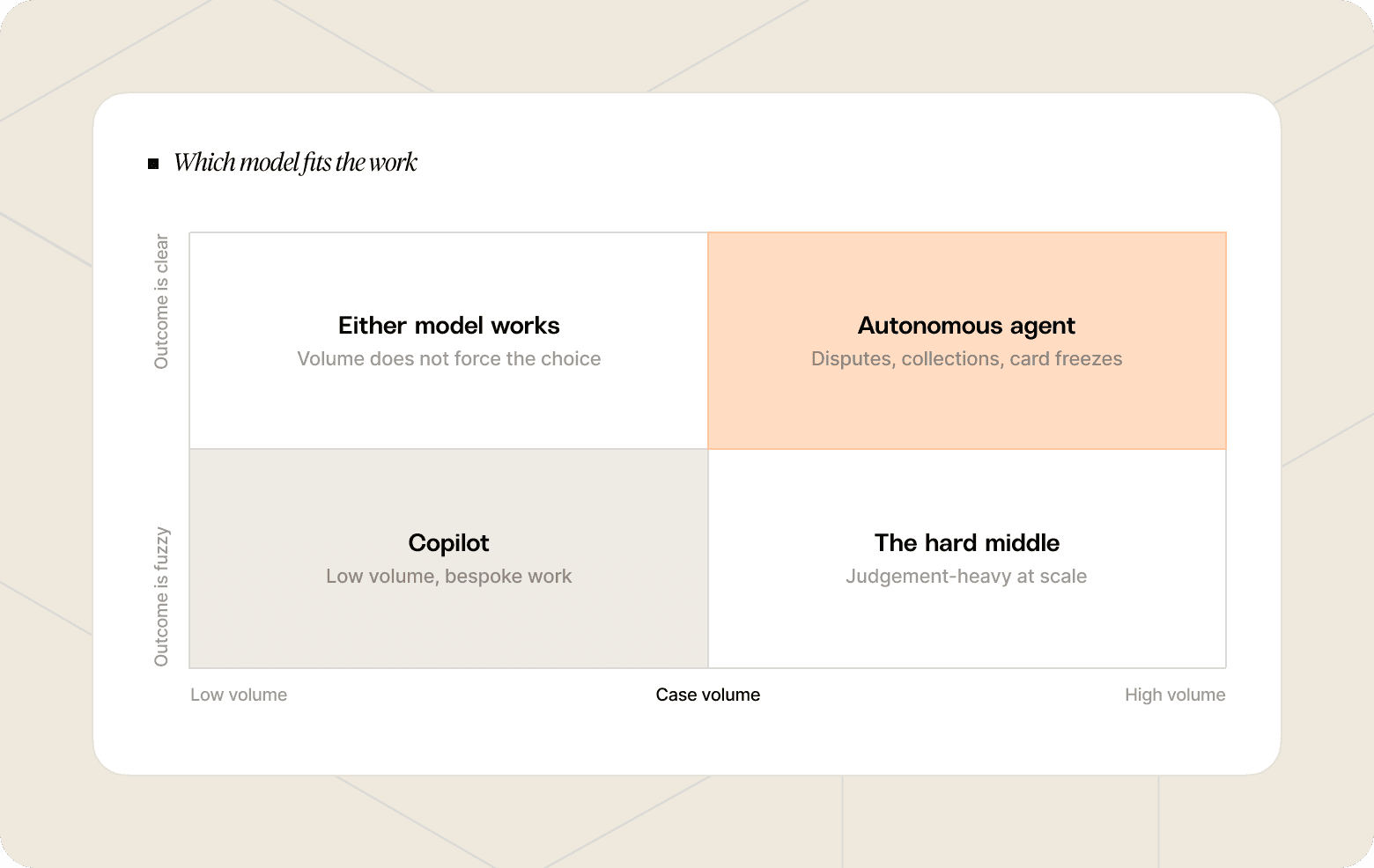
Volume: The higher the case volume, the worse the copilot bottleneck and the stronger the case for autonomy. Low-volume, highly bespoke work is where a copilot earns its place.
How measurable the outcome is: Where success is clear and checkable (a dispute filed correctly, a payment explained, a promise to pay captured), an autonomous agent can be trusted and proven. Fuzzy, judgement-heavy work is harder to hand over fully.
Whether there's a customer in the loop: For live customer conversations, track CSAT and resolution. For back-office work like disputes, collections, and KYC with no customer watching, track SLA, accuracy, and audit coverage instead.
Regulatory exposure: Higher exposure is an argument for more control, but control means guardrails, audit trails, and escalation paths, not a human clicking approve on every action.
If you are weighing this up, it is worth learning how to evaluate any AI agent before you trust it with live cases, and what to look for when choosing an AI agent vendor for a regulated environment. For the compliance and security side specifically, our guide to secure AI agents for banking covers the controls that make autonomy safe to deploy. If you are weighing an agent against a scripted chatbot in the first place, start with AI agent vs AI chatbot.
Gradient Labs is the AI-native customer operations platform for financial services, built to run these processes end to end, autonomously and safely. Want to see what that looks like on your own processes? Book a demo.


Elizabeth Shew leads Brand and Advocacy at Gradient Labs, where AI agents handle customer support and back-office work for banks, lenders, and fintechs. Before that, she led customer marketing at Mastercard and built Dynamic Yield's customer marketing programme from the ground up, a decade spent turning customer results into industry-shaping stories. She writes about how support and operations teams actually put AI and technology to work. Before tech, she was a professional dancer in NYC.