
A customer flags a payment they don't recognise. A general-purpose AI agent answers the question, then hands off the real work to a human: the investigation, the chargeback, and the follow-up. That handoff sits at the heart of the vertical AI vs horizontal AI decision facing every financial services team evaluating AI agents today. Horizontal AI is built to handle any industry's front-line chat. Vertical AI is built for one industry's work, end to end. This guide shows you which one fits your use case, where horizontal tools stall in regulated operations, and how to choose with confidence.
What is vertical AI vs horizontal AI?
Horizontal AI is general-purpose. One platform serves retail, travel, SaaS, and financial services from the same core, and each buyer configures it for their own industry. This is the world of general-purpose AI customer service, and it clears discrete front-line questions well: where's my order, how do I reset my password, or how do I return this?
Vertical AI is built for a single industry's processes, data, and compliance obligations from the ground up. In financial services, that means the system already understands what a dispute is, how a collections case unfolds over weeks, and when a conversation has to hand off because a customer is showing signs of vulnerability. The domain knowledge lives in the product, rather than being assembled by the buyer after purchase.
The difference is not model quality: both approaches run on the same frontier models. What separates them is the quality of the agents, and whether the system understands the work your team actually does, and whether it can run that work end to end or only reply to the ticket at the top of it. For a simple, high-volume support queue, horizontal AI is often enough. For the regulated processes that make up most of a financial services operation, the gap starts to cost you.
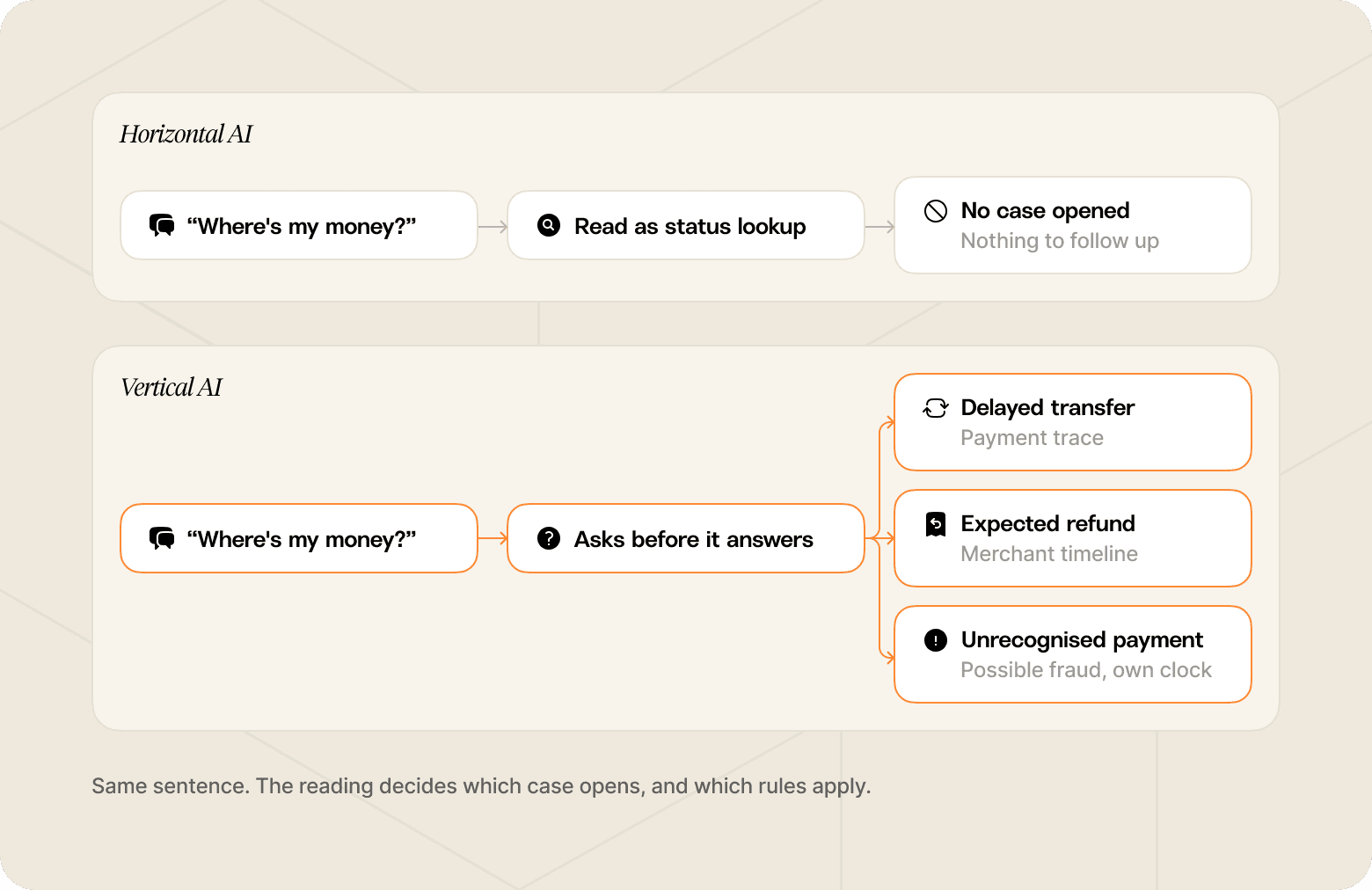
Take a question as ordinary as "where's my money?". A horizontal agent reads it as a status lookup and answers literally. A financial services agent knows it might mean a delayed transfer, an expected refund, or a payment the customer doesn't recognise, so it asks the right follow-up questions before it acts. Getting the case right depends on understanding the question first, and that understanding is exactly what a vertical system is built to carry.
Where horizontal AI stalls in financial services
Horizontal AI agents clear simple, high-volume questions well. On the work that actually runs a regulated operation, four ceilings show up in production, and the teams running these tools report them consistently:
The deflection ceiling. General-purpose agents handle common, high-volume questions well but stall on the rest. Gartner predicts agentic AI will autonomously resolve 80% of common customer service issues by 2029, and the complex, regulated cases that run a financial services operation sit outside that common set. The hardest cases, the ones that cost the most to handle manually, are exactly the ones left behind.
Operational risk. Vulnerability, complaints, and financial-difficulty signals have to be detected and routed correctly every time, not most of the time. Horizontal platforms treat this as guardrail configuration the buyer builds, tunes, and takes responsibility for.
Safety gaps. Sensitive flows like image and document verification for security checks are not yet safely automated on general-purpose tooling, so they fall back to manual review and slow the whole case down.
The manual workflow underneath. The agent answers the customer, but the back-office case behind the ticket stays manual. A case such as a dispute will still get mostly handled by a person, and the headcount you hoped to free stays busy.
These are not settings you can tune away over a longer pilot. They trace back to a product built to serve every industry rather than the specific processes of a regulated one, which is why teams that start on horizontal tools so often end up evaluating a vertical alternative for their hardest work.
What vertical AI means for a regulated operation
Vertical AI for financial services is built for finserv from the ground up across four facets: the product, the people, the platform, and compliance. One example of a vertical AI agent is Gradient Labs, which was designed around financial services from the first whiteboard, not retrofitted afterwards. The founders built and ran production machine learning under FCA regulation at Monzo, and almost all of the engineering team comes from financial services, so the domain knowledge shows up in the architecture rather than in a layer of consultants added later.
The clearest way to see the divide is the difference between discrete interactions and long-running processes. A password reset is one turn: ask, answer, close. A dispute lifecycle runs around 60 days from intake through investigation, decision, chargeback, and customer follow-up. A lending relationship runs across application, onboarding, repayment, and collections over years. These cases need an agent that holds context across turns, channels, and days, applies the right policy at each step, and closes the loop weeks after the first message. A horizontal agent built for discrete chat has nowhere to keep that state.
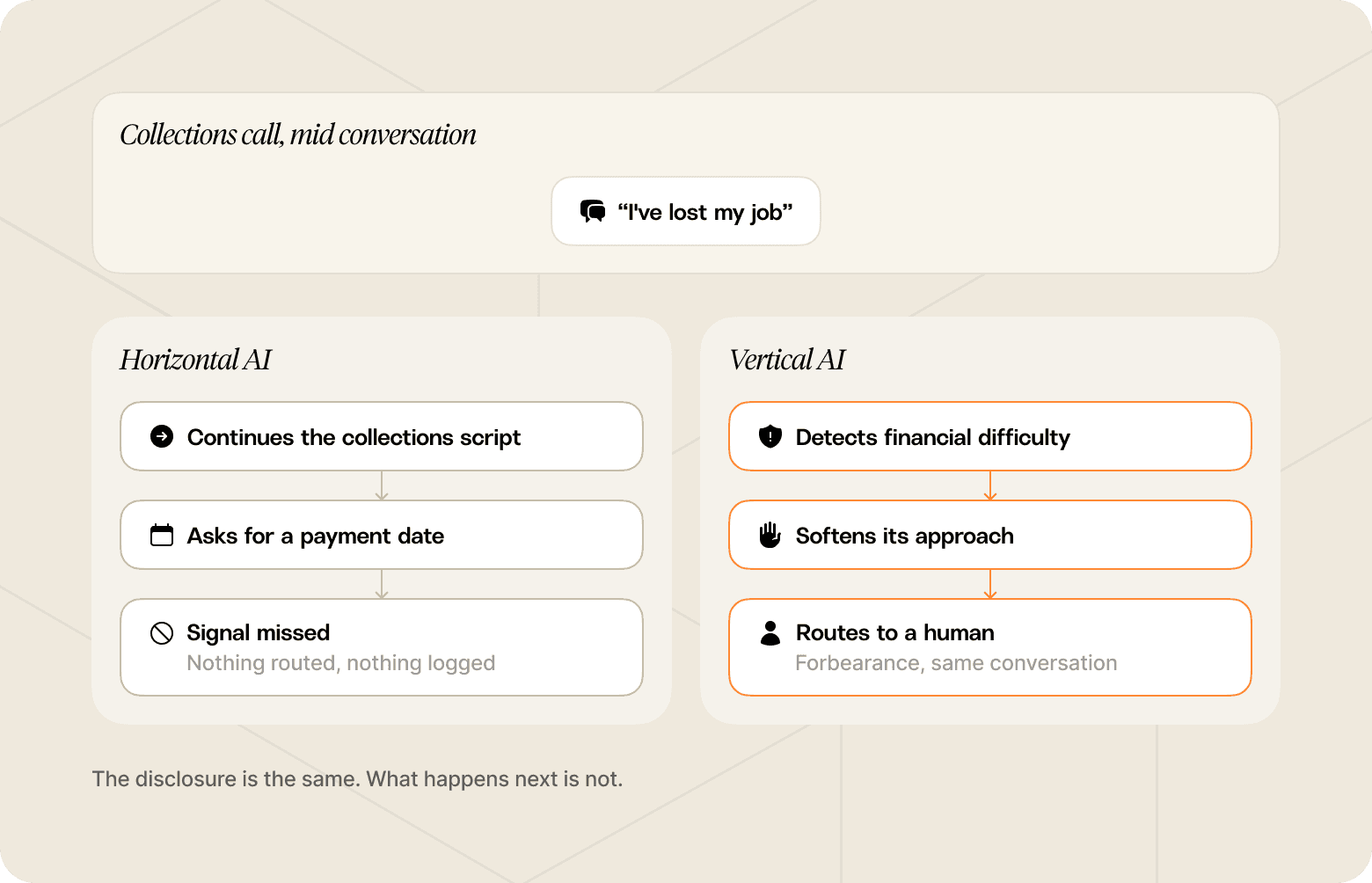
That state is what makes safe handling possible for financial services. When a borrower in a collections call mentions they have lost their job, a vertical agent recognises the financial-difficulty signal, softens its approach, and routes to a human for forbearance where the rules require it, all inside the same conversation. A general-purpose agent, tuned for chat, has no native concept of what that disclosure means or what a regulator expects the operation to do next. Safety measures need to be built on top to achieve the same result.
For financial services, a vertical AI platform ships with compliance already built in, so your team spends its time on the operation, not on assembling and maintaining the controls. In practice for Gradient Labs, for example, that means over 20 pre-built financial services guardrails running on every turn, detecting complaints, vulnerability, and financial difficulty, and catching disallowed advice before it reaches the customer. It means regulatory coverage across the US, UK, and EU, from FDCPA and TCPA to the FCA Consumer Duty and the EU AI Act. And it means a full audit trail of every action, data point, and reasoning step, backed by SOC 2 Type II certification, GDPR compliance, and zero-day data retention agreements with every model provider. Our AI in banking use case guide maps the specific processes where this depth pays off.
Vertical AI vs horizontal AI: how to choose
The right answer depends on the work in front of you, not on which vendor demos best. Four questions to consider in your evaluation:
Regulatory exposure. How much of your work touches vulnerable customers, complaints, FinCrime, or Consumer Duty obligations? The more it does, the less a configuration-layer approach to compliance holds up, and the more a system with financial services built in earns its place.
Case complexity and lifecycle length. Are you mostly answering discrete questions, or running cases that span days, channels, and back-office systems? Discrete questions suit horizontal tools, but multi-day processes like disputes, collections, and KYC need an agent built to carry a case from start to finish.
Build versus buy. Do you have an AI engineering team to configure and maintain a general-purpose platform, or would you rather the integration, the guardrails, and the ongoing tuning were absorbed by a partner who already knows financial services? Most operations underestimate how much platform work sits beneath a working agent.
Proof in your environment. Ask for production evidence in regulated financial services, not retail demos. Run a proof of concept on your own volumes and grade it on the scorecard your QA team already uses. Our guide to evaluating AI agents in financial services sets out how to structure that test.
Score any shortlist against these four questions before you commit.
What vertical AI looks like in production
The payoff of a vertical system is that one agent runs the whole case. It handles the front-line interaction, does the back-office work behind it, reaches back out to fill any evidence gaps, and closes the loop with the customer. Gradient Labs is the AI-native customer operations platform for financial services, and the only one that runs both front-line customer interactions and back-office case work across a single platform and delivery team.
That shows up in named agents doing real work in production. The Lending Agent runs outbound collections end to end, from identity verification and balance explanation to negotiation and hardship handling, and it is live at SteadyPay. The Disputes Agent runs intake, chargeback adjudication, and outbound evidence follow-up inside one procedure, and it is live at Yonder, where disputes now resolve 150% faster with a 90% CSAT. The difference shows up in the numbers that matter to a regulated operation, resolution and CSAT, rather than deflection alone.
With Gradient Labs, we have an AI agent that's actually resolving problems, boosting our CSAT rating, and absorbing growth without us having to scale the team.
Michiel Smet, Head of Operations, Pockit
Teams typically start with one narrow, high-volume manual process where the pain is sharpest, then add more agents over time on the same data, the same guardrails, and the same audit trail. Resolution climbs from launch toward 80–90% in mature use as the delivery team refines procedures and adds integrations. The vertical choice comes down to one question: will the system still be running your hardest cases in two years, or only the easy ones today?
Want to see whether a vertical AI agent fits your operation? Book a demo.


Elizabeth Shew leads Brand and Advocacy at Gradient Labs, where AI agents handle customer support and back-office work for banks, lenders, and fintechs. Before that, she led customer marketing at Mastercard and built Dynamic Yield's customer marketing programme from the ground up, a decade spent turning customer results into industry-shaping stories. She writes about how support and operations teams actually put AI and technology to work. Before tech, she was a professional dancer in NYC.