
Imagine you’re a support leader seeing a 70% deflection rate for cases handled by AI. What may feel like a huge workload removed then takes a scary turn: CSAT plummets as customers report they simply received a canned answer, gave up, and came back angrier. Deflection vs resolution is the distinction that decides whether AI customer service actually cuts your workload or just hides it. A deflected contact simply exited the queue, while a resolved one actually solved the customer's problem. This guide shows you why that gap matters, why real resolution has to reach the back office, and which questions separate a vendor that closes tickets from one that finishes the job.
Deflection vs resolution: what the words really mean
Deflection measures how many contacts never reached a human. Resolution measures how many customers got their problem solved. On a dashboard the two can look almost identical, but in the customer's experience they are worlds apart.
A chatbot that replies "here's our refund policy" and closes the chat has deflected a contact. If the customer still doesn't have their refund, nothing was resolved. The ticket left your queue, but the job didn't get done, and that gap is where re-contacts, complaints, and quiet churn live.
Buyers reach for several words on the deflection side: containment, automation rate, deflection rate. They all describe a contact leaving the queue, not necessarily a problem being solved. Meet your team in whatever word they already use, then look underneath it at what the customer actually walked away with.
Why deflection rates flatter the numbers
Deflection is easy to inflate and hard to argue with, which is exactly what makes it risky as a headline metric. The number gets flattering in a few predictable ways:
Closing isn't solving: a session that ends without a human counts as deflected, even when the customer abandoned it in frustration.
Re-contacts disappear off-report: the same issue comes back as a fresh ticket, a phone call, or a complaint, so one unsolved problem can deflect two or three times.
Easy questions carry the average: "where's my statement?" deflects effortlessly and lifts the rate, while the disputes, arrears, and verification cases that actually cost you money sit untouched.
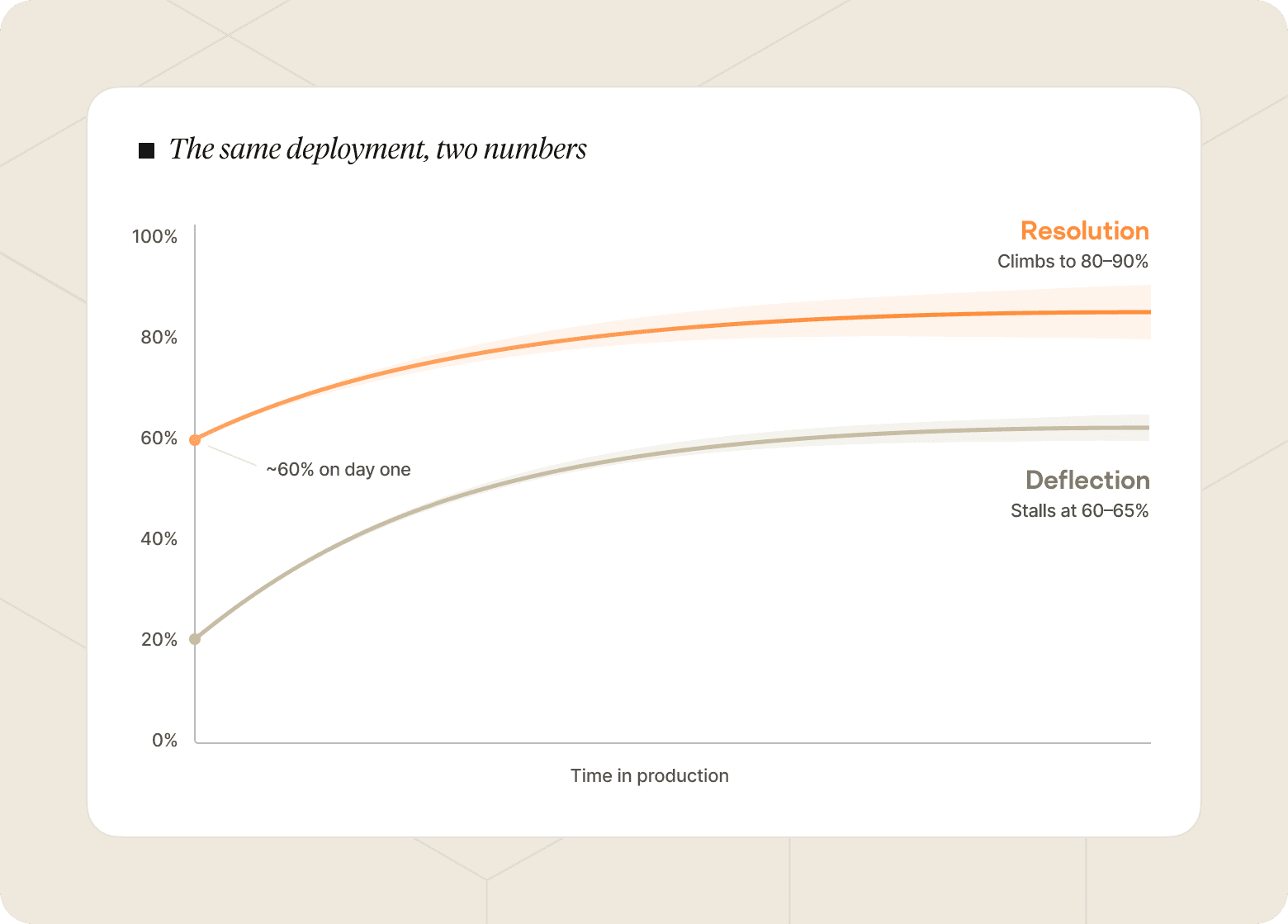
This is why so many teams report deflection stalling around 60–65% once the simple questions are gone. The frontline gets handled, and the number stops climbing because the work underneath the ticket was never in scope. A high deflection rate can sit right next to a rising complaints backlog, and nobody reading the dashboard would notice.
The hidden cost of a deflected contact
A customer who was deflected, without their true problem solved, doesn’t just vanish. The case simply reappears somewhere more expensive.
The customer comes back, so one problem generates two or three contacts and your true cost per resolution climbs while the deflection rate still looks healthy. Some customers don't come back at all and churn quietly instead, taking their balance with them. Others escalate: an unresolved complaint in UK financial services can end up at the Financial Ombudsman Service, where every referred case carries a fee and a paper trail regardless of who was at fault.
There is a regulatory edge to this as well. In the UK, the FCA's Consumer Duty expects firms to deliver good outcomes for customers, not just quick responses. A support operation that optimises for deflection can hit its target while leaving customers without a resolution, which is exactly the outcome the rules are written to catch. The gap between deflection and resolution is a compliance question as much as an efficiency one.
Resolution has to reach the back office
The deflection number stops at the frontline, and most problems that need solving don't. Real resolution usually depends on work that happens away from the chat window.
A disputed card transaction needs the evidence reviewed, the chargeback raised with the card scheme, and the outcome communicated days later. An arrears case needs the borrower's balance explained, a repayment negotiated, and the promise logged for compliance. A verification query needs documents checked against policy before anything can move. None of that fits the discrete, one-and-done shape that deflection rewards, and none of it finishes inside a single chat.
When resolution is measured only on the frontline, its scope shrinks to whatever can be answered in straightforward replies. That is a thin slice of a real customer operation, and automating only that slice is rarely cost-effective: the expensive, repetitive work sits in the back office, and it stays manual. To resolve a customer's issue end to end, an agent has to run the frontline conversation and the back-office work like disputes, collections, and KYC behind it, as one connected case rather than a reply followed by a handoff.
This is the difference between the frontline questions that close in a single turn, like a password reset or "where's my statement?", and the deeper depth cases that run across days, channels, and systems. A dispute, an arrears plan, or a business verification is a long-running process, not a one-off exchange. Generic chat tools handle the first kind well and stall on the second, which is precisely where deflection rates plateau and manual workload stays put. That split maps closely onto the difference between an AI agent and an AI chatbot.
What end-to-end resolution looks like in financial services
Gradient Labs is the AI-native customer operations platform for financial services, built to resolve cases end to end rather than deflect them. Instead of a chatbot that closes the conversation, specialist agents run the whole job: the frontline reply, the investigation, the outreach to fill gaps, and the outcome.
Take disputes, one of the clearest cases where the frontline alone can't finish the job. Yonder, a UK credit and debit card fintech, had hit the ceiling of what a single frontline agent could automate: a disputes process that averaged the best part of a week, because one agent couldn't hold context across the frontline conversation and the back-office investigation.
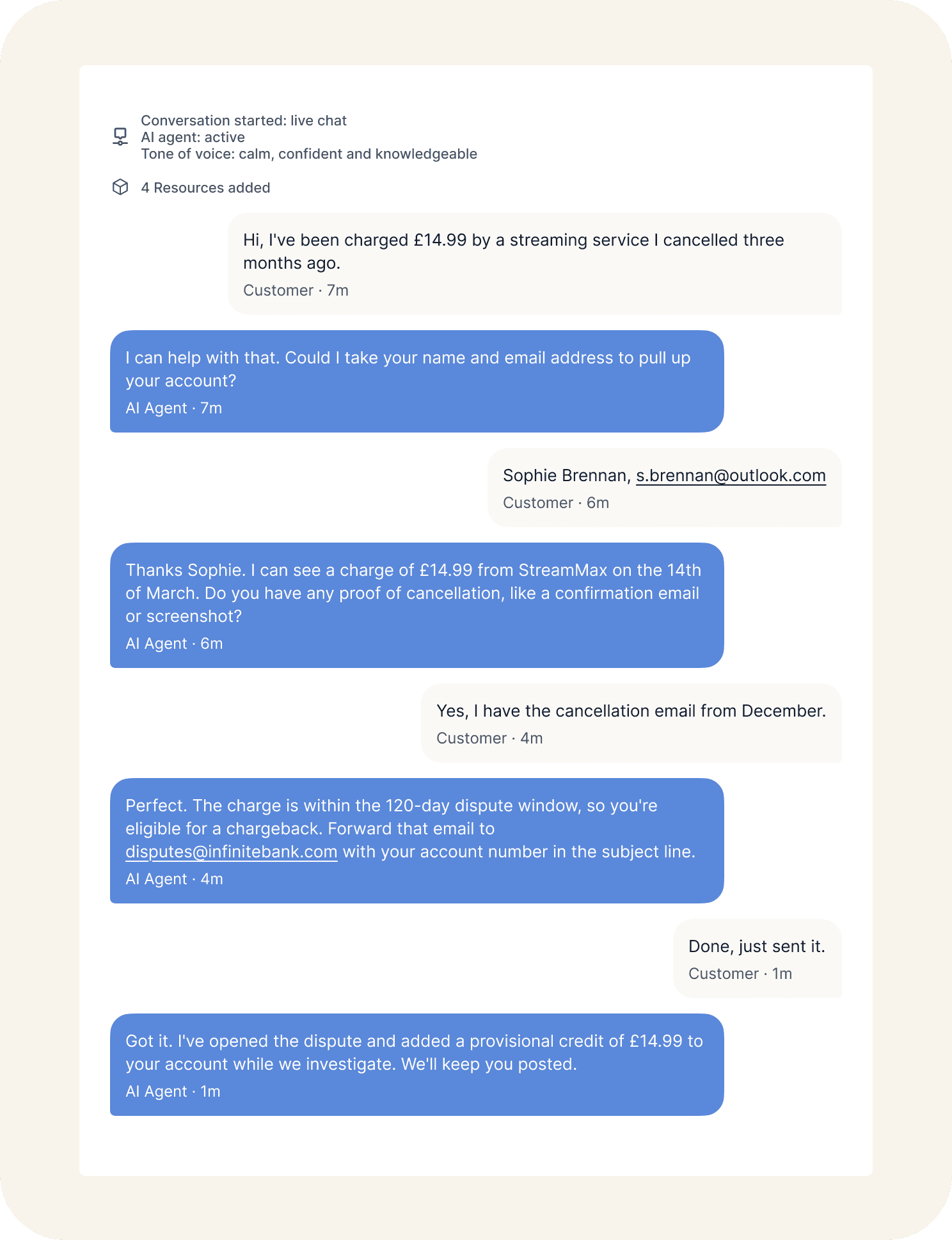
With Gradient Labs' Disputes resolution running the full case, from intake and evidence review to a recommended outcome a human approves, Yonder now resolves disputes 150% faster. Cases that once took five to seven days close in two to three, arrive fully evidenced 80% of the time, and hold a CSAT of 90% or higher even through volume spikes, while the specialist review step dropped from five days to 24 hours.
"The game changer for us is that Gradient Labs' frontline and back office agents talk to each other and keep the full context of a case. If evidence is missing, the customer hears about it in the moment. Cases that took us the best part of a week to decide now take a day."
Antony Atkins, Senior Escalations Manager, Yonder
Collections tells the same story on the outbound side. The agent handles outbound collections calls end to end: it verifies identity, explains the balance, negotiates a repayment, detects hardship, and logs every disclosure and consent for compliance, handing the vulnerable cases to humans. One lender, SteadyPay, makes 33,000 of these calls a month, converting 60% of engaged customers to a committed repayment date, all within FCA compliance standards.
The reason this works is structural, not a matter of a better chatbot. Most financial services problems cross the line between frontline and back office at least once, and every crossing is a point where a frontline-only tool hands off to a human and the case stalls. Running both sides on one platform, with one audit trail and one shared context, is what lets the agent carry a case from the first message to the final outcome without dropping it. Frontline support on text and voice comes with each specialist agent, so the conversation and the casework never sit in two disconnected systems.
This is what moves the resolution number. Gradient Labs lands around 60% resolution on day one and 80–90% in mature deployments, because the agent covers the case rather than just the conversation. At a large European digital bank, the agent has handled half a million customer conversations at a 98% QA score, beating the bank's human teams. Pockit, a UK neobank, describes the same shift: an AI agent that is "actually resolving problems, boosting our CSAT rating, and absorbing growth without us having to scale the team." That combination of real resolution and quality that holds is what customer support automation is meant to deliver and rarely does.
Deflection vs resolution: what to ask a vendor
When you evaluate AI for customer support, score every vendor on whether they close tickets or finish the job. Five questions expose the difference fast, and they pair well with a structured vendor evaluation:
What counts as resolved in your numbers? If a closed conversation counts even when the customer's problem is still open, you are being sold deflection dressed as resolution.
What happens after the frontline? Ask whether the agent does the back-office work, such as evidence review, chargeback submission, or repayment negotiation, or whether it hands every case back to your team.
How do you account for re-contacts? A resolution rate that ignores the customer coming back with the same issue is measuring escape, not outcome.
Where is the audit trail? In financial services every action, decision, and disclosure needs to be logged and reviewable. Ask to see the record a single case produces.
What is the resolution rate after six months, not on day one? The honest answer names a delivery model that improves the rate over time. Getting from a day-one figure to a mature one is a journey from pilot to production, not a number frozen at launch.
See resolution that reaches the back office
If you want to see the difference between closing a ticket and finishing the job, book a demo and bring your hardest case type, whether that is disputes, collections, or verification.


Elizabeth Shew leads Brand and Advocacy at Gradient Labs, where AI agents handle customer support and back-office work for banks, lenders, and fintechs. Before that, she led customer marketing at Mastercard and built Dynamic Yield's customer marketing programme from the ground up, a decade spent turning customer results into industry-shaping stories. She writes about how support and operations teams actually put AI and technology to work. Before tech, she was a professional dancer in NYC.