
Every AI dispute resolution tool demos well. A clean intake flow, a confident accuracy figure, a slide that says "compliant": the pitch is much the same across vendors, but none of it tells you how the tool behaves on your hardest cases or whether it holds up to a regulator. For a large bank, choosing wrong means a compliance breach at scale, not just a disappointing pilot. This guide is for the ops, disputes, and risk leaders running that evaluation. It gives you a scorecard for the criteria that matter, a way to test tools against your own historic cases before you buy, and the security and compliance evidence to demand before you sign. If you want the mechanics of how the automation works step by step, start with our companion guide on how to automate disputes with AI. This one is about choosing the right platform for automated dispute resolution at your bank. For how dispute resolution fits alongside the other categories of AI in banking already in production, see our use case guide.
What you're actually buying
Before you score anything, get specific about the category, because "AI dispute resolution tools" covers three very different products. At one end sits a support chatbot with a dispute macro bolted on. In the middle, dispute management software that stores the case and chargeback management software that files the claim, both once an analyst has done the real work. At the other end, an agent that runs the whole case end to end. Only the last one moves your backlog.
The test that sorts them is simple: does the tool resolve the case, submitting the chargeback and closing the loop with the customer, or does it deflect the ticket out of the frontline queue and leave the investigation to a human? A tool that only classifies and routes is a faster intake form, not automation. Score every vendor on how much of the case they close without a person picking it back up.
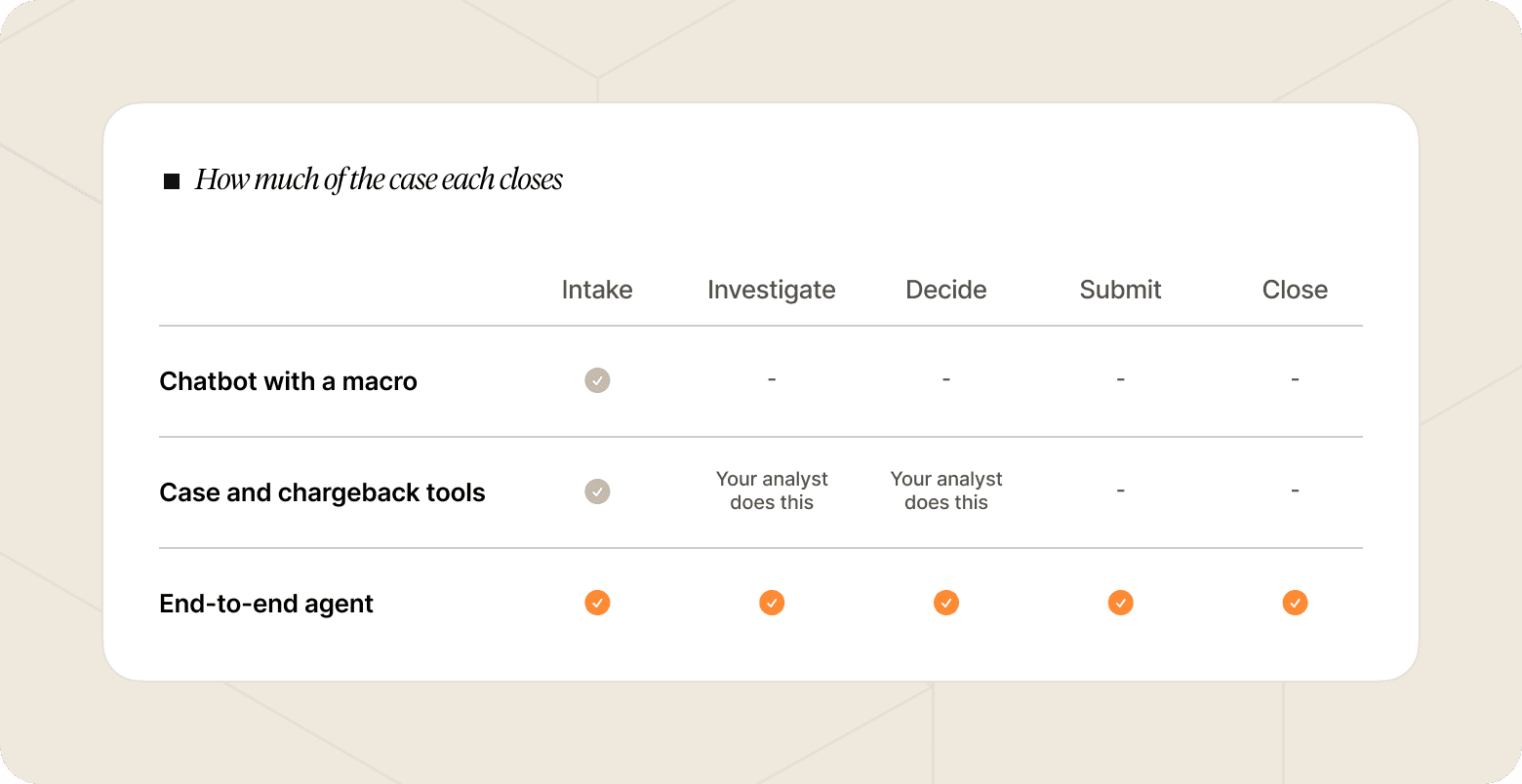
This is where most evaluations go wrong. Vendors blur the category on purpose, because a deflection tool and a resolution engine demo the same clean intake flow, and the difference only surfaces at volume. The deflection tool's cases pile back up on your analysts a day later, so the backlog you bought the tool to clear is still there. Getting the category right at the evaluation stage is cheaper than discovering it in production.
A scorecard for assessing AI dispute resolution tools
Turn the criteria into a scorecard you can run every vendor through, and score each one on evidence they show you rather than claims in a deck.
Criterion | What to ask the vendor | Red flag |
|---|---|---|
End-to-end coverage | How much of the case do you close without a human, through to chargeback submission? | Coverage stops at intake and classification |
Scheme-rule accuracy | What is your classification and decisioning accuracy, scored against Visa and Mastercard reason codes? | A single blended "confidence" number |
Compliance guardrails | Do guardrails run on every case, pre-configured for our regulations? | Compliance is a config layer you build yourself |
Human sign-off and audit trail | Can a specialist approve or override in one action, with a full audit trail per case? | Decisions you can't reconstruct for a regulator |
Volume coverage | Does it work the full queue 24/7, including the low-value cases you risk-accept today? | Automates only the easy, high-volume types |
Time to value | How long to production, and who maintains scheme-rule changes? | A multi-quarter integration your team owns |
Financial services depth | How many disputes has your tool decided in production, and who is on the delivery team? | A generic AI vendor with no regulated-ops track record |
The criteria are the easy part. The evaluation is only as good as the evidence behind each score, which is why the two sections that follow are about getting that evidence rather than taking it on trust.
How to test AI dispute resolution tools before you buy
A vendor's accuracy figure describes their data, not yours. Test the tool against your own disputes before you trust it with them.
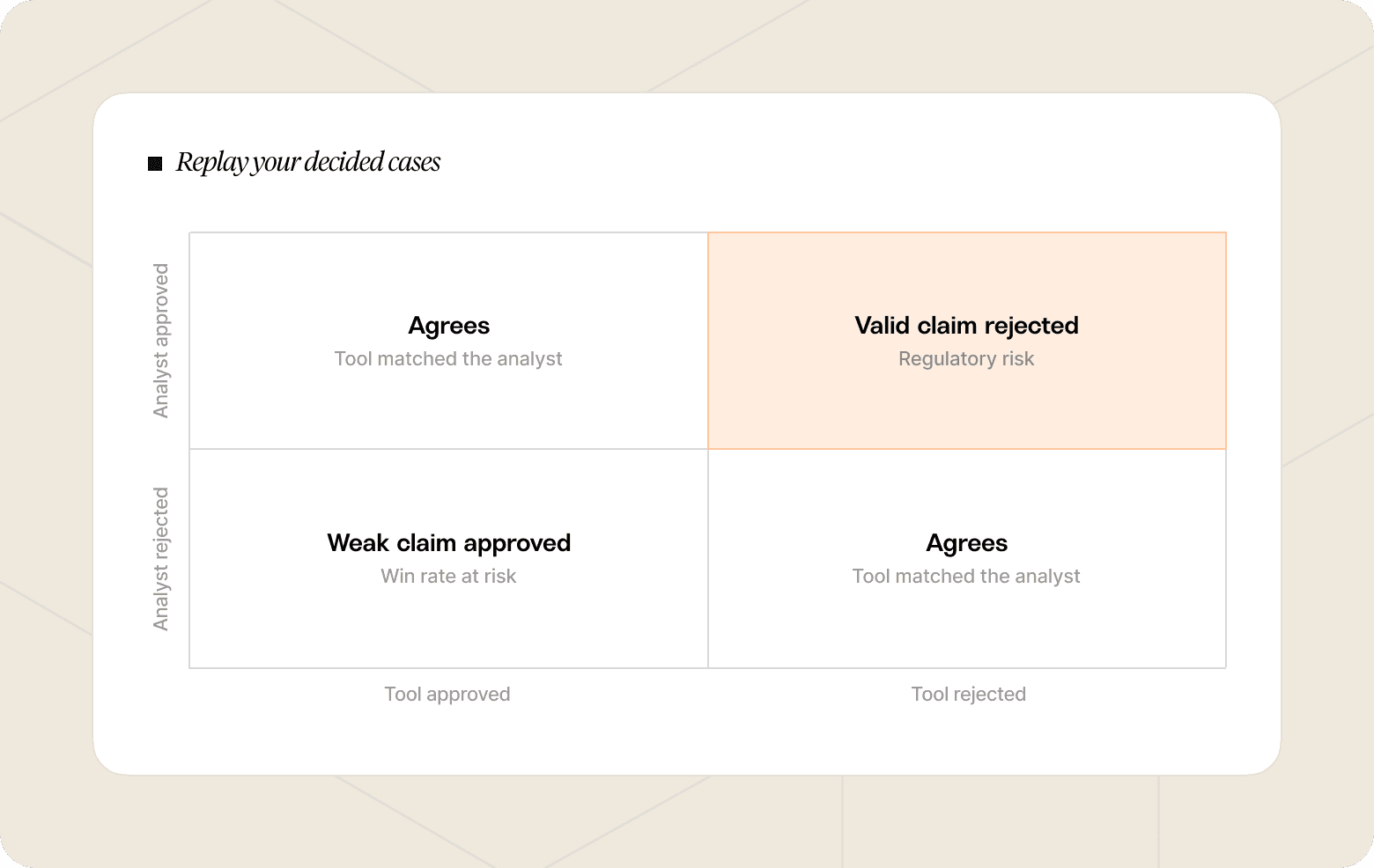
Replay your historic cases. Pull three to six months of decided disputes and run the tool over them in a sandbox. Compare its classification and recommended outcome against what your analysts actually decided. You are measuring two things at once: how often it agrees with a correct human decision, and how often it would have rejected a valid claim.
Test the hard cases, not the happy path. A demo runs the clean case. Your evaluation should run the incomplete evidence, the vulnerable customer, the edge reason code, and the repeat claimant. That is where a tool built for generic support starts to break and a tool built for regulated finance shows its guardrails.
Score accuracy against scheme rules. Ask for accuracy measured on Visa and Mastercard reason-code mapping and evidence sufficiency, case by case, not a blended confidence score. Weak-case detection belongs here too: a tool that flags a missing date or an invalid screenshot before submission protects your win rate on the cases you do raise.
Stress the guardrails. Try to make the agent give out-of-bounds advice, miss a complaint, or tip off a customer. A tool safe for a regulated environment reroutes the case or edits the reply before it sends. One that isn't will sail straight through.
Watch the escalation path. Check what happens on a case the tool can't resolve. It should hand off to a specialist with the full case context attached, not drop a half-worked case back into the queue for someone to start again.
The security and compliance due diligence
Your risk and compliance teams sign off the tool, so bring them evidence they can check rather than marketing. For a dispute resolution tool that touches customer data and makes regulated decisions, demand five things:
A real security certification. SOC 2 Type II, not Type I or "in progress", plus a public trust centre your team can review without booking a sales call.
Data handling you can document. Zero-day data retention agreements with every model sub-processor, GDPR compliance with DSAR and right-to-erasure handling, and encryption at rest and in transit. Ask exactly where your data goes and how long it lives.
An audit trail built for a regulator. Every decision, every piece of evidence reviewed, every guardrail check, and every customer message, logged per case and exportable. If you can't show your working, the automation is a liability.
Regulatory coverage that matches your markets. Regulation E and Reg Z in the US, FCA Consumer Duty and Section 75 in the UK, and PSD2 in the EU, pre-configured rather than left for you to encode.
Named accountability. Who maintains the guardrails and the scheme-rule logic as they change, and what the SLA is when a rule updates mid-quarter.
Run this list before commercial terms, not after. A tool that can't clear security due diligence never reaches production, however well it scored on the demo.
How Gradient Labs measures up
Run Gradient Labs' Disputes Agent through this evaluation and it holds up where it counts. It closes the case end to end: intake across voice, chat, and email, classification against Mastercard and Visa reason codes, evidence review, customer outreach to fill gaps, a recommended decision behind a human sign-off gate, and direct chargeback submission to the scheme. On the due-diligence side, it is SOC 2 Type II certified with a public trust centre, keeps zero-day data retention with every model sub-processor, and runs over 20 financial services guardrails on every case, pre-configured for Reg E, Reg Z, FCA Consumer Duty, Section 75, and PSD2. Disputes automation for banks is often the first back-office move a team makes, and it was built for that work from day one.
On the criterion buyers underrate, financial services depth, the team behind Gradient Labs built UK neobank Monzo's AI and data organisation and ran production machine learning under FCA regulation, and almost all of its engineers come from financial services. That shows in production. Yonder, the UK credit card, evaluated the agent against its own historic cases before launch, then put it live across frontline support, collections, and disputes. Its disputes now resolve in two to three days instead of five to seven, with a 90% disputes CSAT and four in five cases fully evidenced on first contact.
"We've used plenty of AI tools, and nothing else has come close to that, especially for disputes. It helps that Gradient Labs genuinely knows financial services; we're working with people who understand disputes as well as we do."
Antony Atkins, Senior Escalations Manager, Yonder
For a first-time buyer, the commercial model de-risks the decision further. Gradient Labs prices per resolution, with a deployment guarantee: once a use case is scoped, if it doesn't deliver what was agreed, you get your money back. That moves the risk of an unproven category onto the vendor, which is exactly where a bank running its first disputes evaluation wants it.
Bring your hardest dispute types to the evaluation: book a demo and test the Disputes Agent against your own cases.


Elizabeth Shew leads Brand and Advocacy at Gradient Labs, where AI agents handle customer support and back-office work for banks, lenders, and fintechs. Before that, she led customer marketing at Mastercard and built Dynamic Yield's customer marketing programme from the ground up, a decade spent turning customer results into industry-shaping stories. She writes about how support and operations teams actually put AI and technology to work. Before tech, she was a professional dancer in NYC.