
If you’ve deployed customer-facing AI agents, your reputation is now made up in part by interactions with no real-time human review. If you haven’t deployed customer-facing AI, that may be the exact thing holding you back. A customer asks about a missed payment at 2 AM, an AI agent answers, and that single exchange either deepens their trust or ends up as a screenshot on social media. For the operations and support leaders weighing AI in banking, your bank AI reputation is now managed by technology as much as by people, and the worry is fair: one clumsy bot reply can undo years of brand work. This guide is for the people who own that decision, and it makes the case that the risk runs both ways. But if deployed well, AI resolves problems faster, lifts CSAT, and turns everyday support into a reason customers stay. You will finish with a clear view of where your AI reputation is won and lost, what a trust-building deployment requires, and how to judge a vendor on brand safety before you commit.
What bank AI reputation actually comes down to
Your bank’s AI reputation is the trust your customers place in you, now shaped by automated interactions as much as by human ones. Reputation in banking was always built one interaction at a time. What changed is who, or what, handles the interaction.
AI in banking has moved well past the scripted chatbot. Modern AI agents resolve real cases end to end: they investigate a missing payment, work a subscription cancellation dispute, freeze a lost card, or handle an inbound collections query. Each of those is a core use case where AI in banking is already proving out, which is why reputation now rides on getting them right at launch. Each of these is a moment of truth, and each one now happens at a scale no support team could staff for manually. Older chatbots were a side channel customers learned to route around. A modern agent is often the whole interaction, which is why its quality is now inseparable from your brand.
The scale is the point, and it can be your advantage. When an AI agent handles thousands of conversations a week, its judgement, tone, and safety are your customer operations. Get the deployment right and every one of those interactions reinforces trust. Get it wrong and the damage compounds just as fast.
Why one bad interaction can cost years of customer trust
AI done wrong increases frustration, and in banking that frustration is expensive. A dead-end bot that loops a customer without resolving anything, a confident but wrong answer about their balance, or a tone-deaf reply to someone in genuine financial difficulty: each one erodes trust in the moment and travels far beyond it. Customers who feel mishandled tell other people, leave reviews, and move their money.
Picture a customer who has just lost their job and messages about a payment they cannot make. A generic bot reads the keywords, offers a link to the payments page, and closes the chat. The customer feels unheard at the worst possible moment, and that story spreads faster than any team can counter.
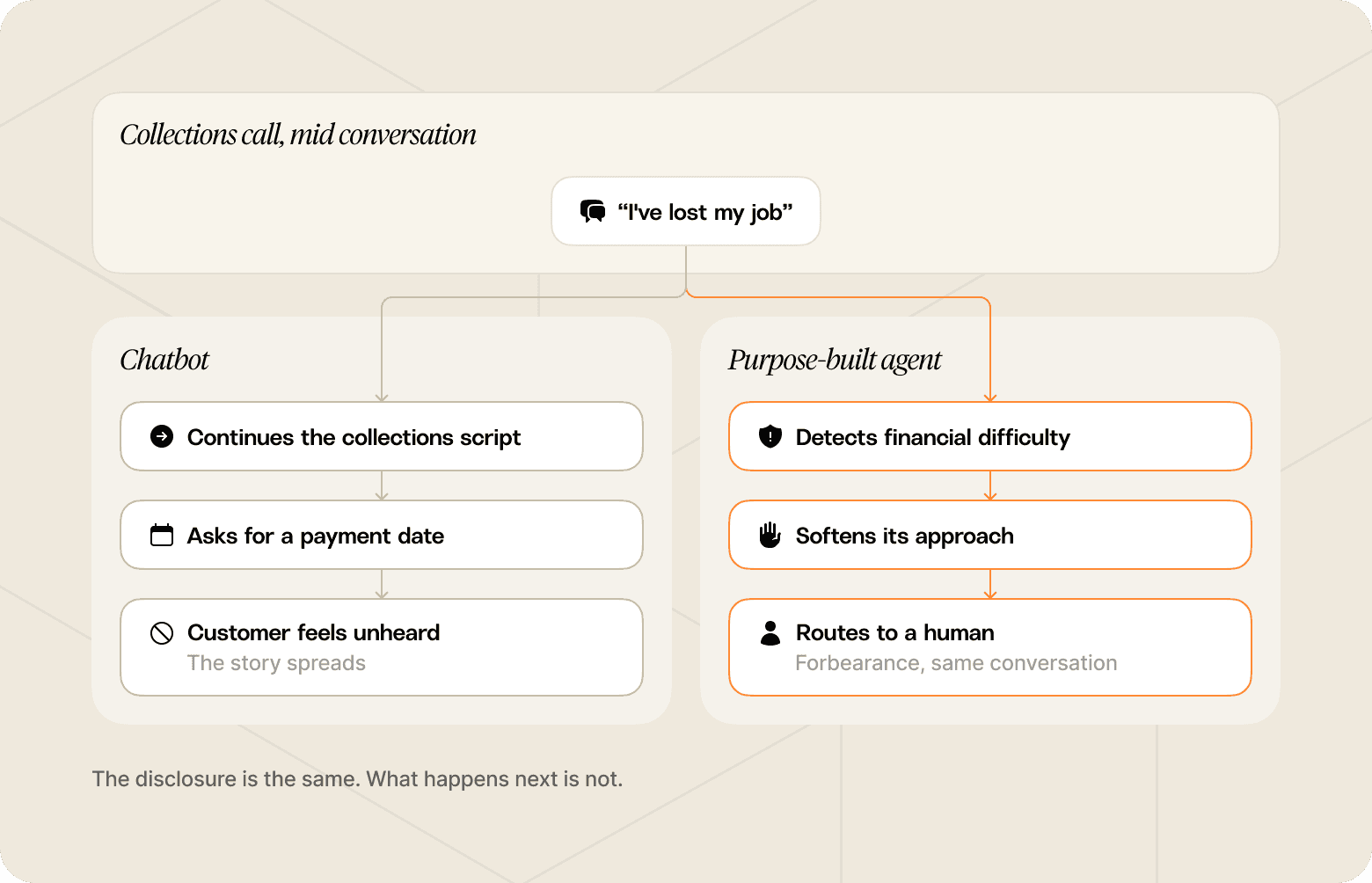
The stakes sit higher in financial services than in most sectors because the conversations are sensitive by nature. Vulnerability, complaints, fraud alerts, and arrears all demand careful handling, and a generic agent that misses those cues does real harm. The FCA's Consumer Duty raises the bar further, holding firms to good outcomes for customers, including the ones an automated system serves. When an AI agent mishandles a vulnerable customer, the damage is regulatory as well as reputational.
This is the downside banks rightly weigh before they automate. The mistake is treating that downside as the whole picture, because the same interactions that carry the risk also carry the biggest opportunity to build trust.
How AI done right turns support into a reputation win
When an AI agent resolves the problem, matches your brand's tone, and knows exactly when to bring in a human, customer satisfaction rises rather than falls. This is a reputational upside that also makes your teams faster and more cost-efficient at scale.
The proof shows up in customer satisfaction ratings (CSAT). At Yonder, the Gradient Labs agent handling inbound queries rates 90% CSAT, matching the score its disputes work earns, and holds that level even through spikes in volume. Customers came away from the automated interaction happier, not resigned to it. That is the difference between an AI deployment that protects your reputation and one that actively strengthens it.
That result is not luck. A well-built agent asks clarifying questions before it acts, so a vague 'where's my money?' query gets interpreted correctly as a delayed transfer, or an expected refund, or an unrecognised charge before the AI agent works to solve the problem. Well-built agents draw on how your best human agents handle the same cases, so the replies are accurate and sounds like your brand. Customers feel that difference against a bot that guesses and loops.
Resolution is what turns a good score into customer loyalty. A customer whose problem gets solved comes back and tells other people, while a deflection that leaves the problem unsolved does the opposite. Pockit saw exactly that:
"We truly think that if people have a problem and you solve it, that builds brand loyalty. That's why customer resolution is so important. With Gradient Labs, we have an AI agent that's actually resolving problems, boosting our CSAT rating, and absorbing growth without us having to scale the team."
Michiel Smet, Head of Operations, Pockit
Trust built this way becomes a competitive advantage. A bank whose customers consistently get fast, accurate, human-quality answers, at any hour and any volume, has something rivals running dead-end bots cannot match.
What a reputation-building AI deployment requires
The gap between AI that lifts your reputation and AI that damages it comes down to how the agent is built and run. A deployment that earns trust needs all of the following, not one or two:
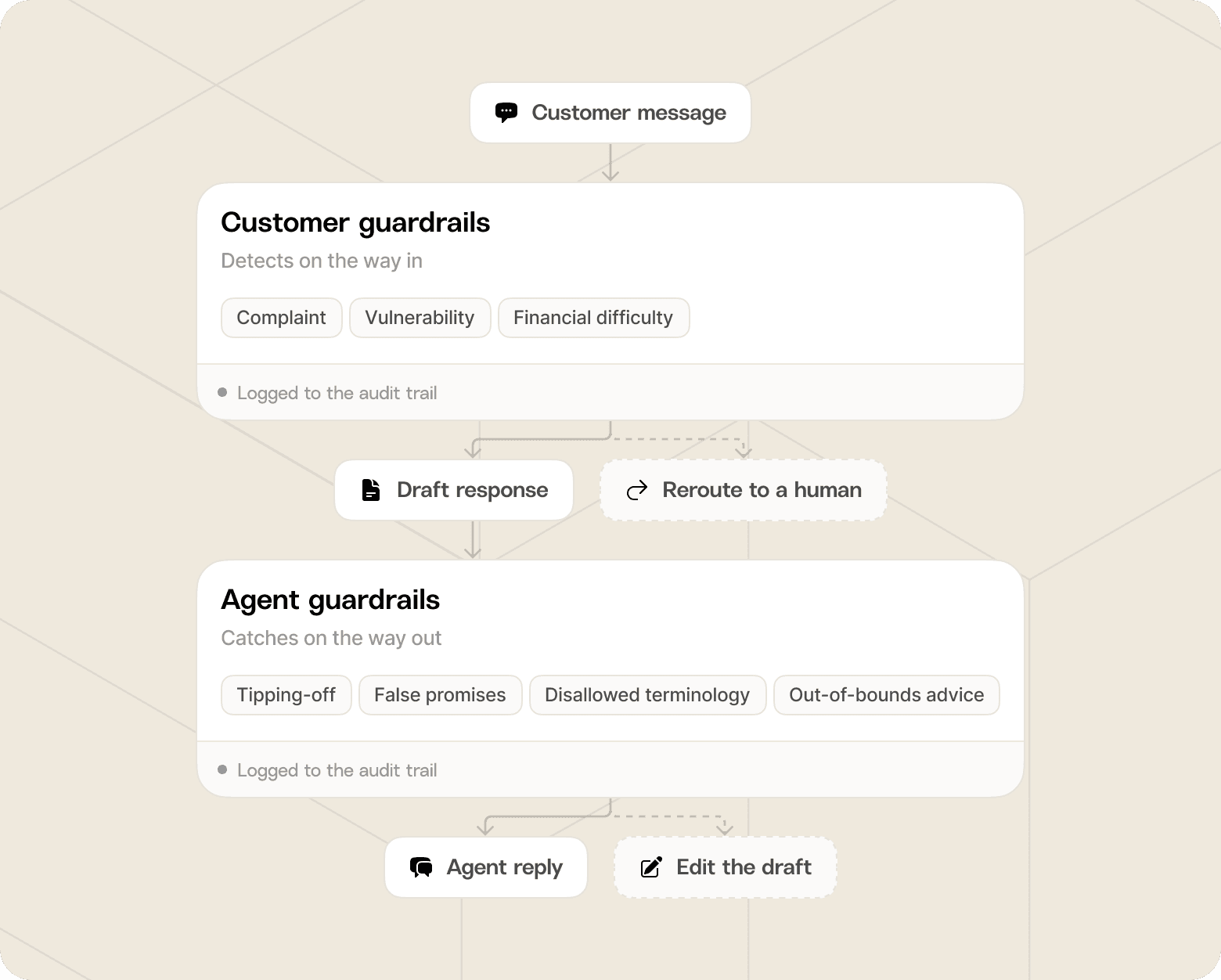
Guardrails on every turn. Financial-grade guardrails should check each response before it reaches the customer, detecting complaints, vulnerability, and financial difficulty and rerouting when needed. Gradient Labs runs more than 20 pre-built financial services guardrails on every interaction, alongside the option to bring your own.
Escalation that knows its limits. The agent has to recognise when a case belongs with a human and hand it over cleanly, with full context, rather than trapping the customer in a loop.
Tone that sounds like your brand. An agent that learns from your best human conversations answers in a voice customers recognise as yours, which is what keeps automated support feeling personal.
A full audit trail. Every action, data point, and decision the agent takes should be logged and reviewable, both for your own oversight and for regulatory scrutiny.
Financial services in the design, not bolted on. Handling sensitive banking conversations safely takes domain depth built into the product. Gradient Labs was designed around financial services from the start, with founders who ran a large digital bank's data organisation under FCA regulation and an engineering team drawn almost entirely from finance.
Security sits underneath all of it. Look for SOC 2 Type II certification, GDPR compliance, and zero-day data retention agreements with every model provider, so customer data is never a reputational exposure of its own. The specifics of deploying safely in a regulated bank are covered in our guide to secure AI agents for banking.
How to protect your bank AI reputation when you choose a vendor
Brand safety is a procurement decision as much as a technical one. When you evaluate an AI vendor, judge them on the things that decide whether the deployment builds trust or burns it:
Financial services depth. Does the vendor understand how a dispute gets investigated, how an arrears case is handled, and how vulnerability is spotted? Generic horizontal tools bolt compliance on afterwards. Ask what was built for finance from the start.
Guardrails and escalation. Are the guardrails financial-grade and running on every turn, and does the agent escalate sensitive cases to a human with full context?
Proof in production. Has the vendor deployed at regulated banks and fintechs at real volume, with CSAT and resolution numbers you can check? Ask to see results from customers who look like you.
Compliance and security posture. Confirm regulatory coverage for your markets and certifications like SOC 2 Type II. Emerging rules such as the EU AI Act make this table stakes, not a nice-to-have.
Pressure-test every answer against the sensitive conversations that decide your reputation, not the easy ones. Any vendor can handle a password reset, so the real question is what happens when a customer in financial distress gets in touch. Our guide on evaluating AI agents in financial services breaks these criteria down in more depth.
Where banks should start
The safest way to build reputation with AI is to start where the volume is high, the risk is contained, and a win is visible fast. A well-scoped surface in customer operations or back-office work, such as inbound collections queries or a common dispute type, lets you prove quality before you widen the remit. Deployments at large regulated financial institutions typically reach production in four to six weeks, so the payoff arrives quickly.
Track the reputation signal from the first week. CSAT and resolution rate on the automated conversations show you directly whether trust is rising, long before a review is ever posted, and they give you the evidence to widen the agent's remit with confidence.
From there, trust compounds. Each interaction the agent handles well is evidence for the next expansion, and a bank that gets the first deployment right earns the internal confidence to automate more of the lifecycle. Reputation built one resolved case at a time is exactly how banks earned trust before AI, and it is how the best of them will keep it.
See how Gradient Labs builds AI agents that protect and grow customer trust in regulated banking. Book a demo.


Elizabeth Shew leads Brand and Advocacy at Gradient Labs, where AI agents handle customer support and back-office work for banks, lenders, and fintechs. Before that, she led customer marketing at Mastercard and built Dynamic Yield's customer marketing programme from the ground up, a decade spent turning customer results into industry-shaping stories. She writes about how support and operations teams actually put AI and technology to work. Before tech, she was a professional dancer in NYC.