
If you run customer operations at a bank, lender, insurer, or fintech, you are under pressure to add AI in three places at once: your support queue, your back-office backlog, and your outbound calling list. Most teams treat them as three separate projects, each with a different tool and a different plan, rather than one effort to deploy AI agents for financial services customer operations as a whole. That fragmentation is why most automation stalls before it pays off, or never becomes truly cost effective. In regulated financial services, this costs you more than anywhere else: every manual gap between systems is a case that misses its SLA, a customer who re-explains their problem, and a compliance risk that never shows on a dashboard.
To deploy AI agents for financial services customer operations well, you have to treat the whole function as one connected workload, not a set of point problems solved one tool at a time. This guide walks an operations leader through the sequence that works: map the workload, pick a first use case that earns trust, clear the compliance bar before go-live, then expand agent by agent.
What deploying AI agents for financial services customer operations means
Before sequencing the work, it helps to agree what customer operations in financial services actually covers. Customer operations is the whole machine that keeps customers served and cases closed, not just the chat window. In a bank, a lender, or a fintech it spans three connected surfaces: frontline support (the inbound tickets, chats, and calls), the back-office case work underneath them (disputes, collections, KYC reviews, document processing), and outbound contact (payment reminders, hardship outreach, verification chases). Most teams buy AI for one surface and leave the other two manual.
That is the mistake this guide is built to avoid. A disputed transaction shows the problem clearly: it starts on the frontline when a customer flags a charge, runs investigation and chargeback work in the back-office, then closes on the frontline with an outcome. If your AI handles only the first reply, a human still carries the case across every gap between systems. Deploying AI for customer support in isolation caps the return before you begin.
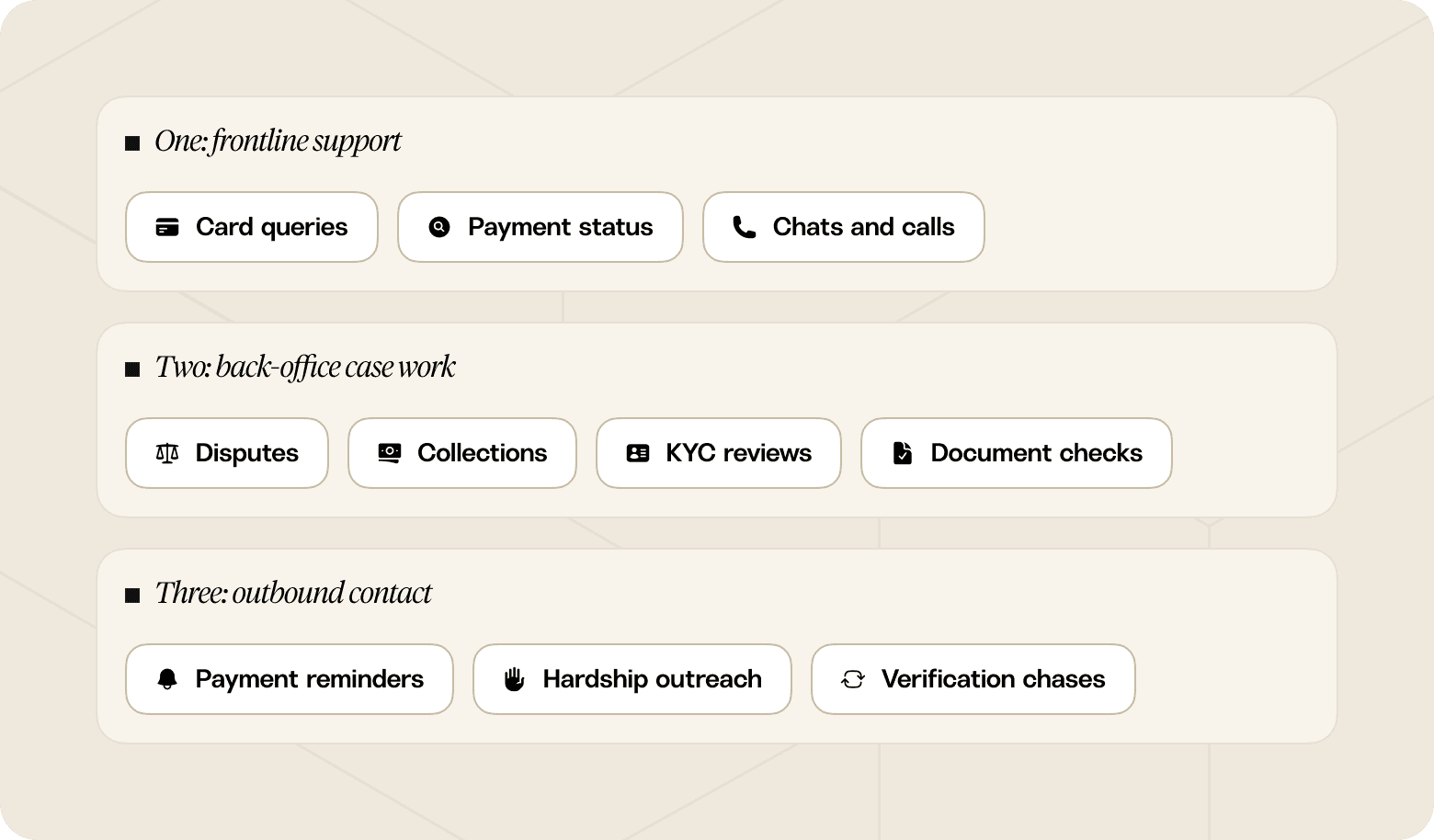
The cost of that fragmentation rarely shows on a dashboard. It surfaces as data typed by hand from one tool into another, cases that miss their SLA while they sit in a human's queue between systems, and a customer who re-explains the problem every time it changes hands. Each point tool looks efficient on its own report, but the overall operation still runs slow end to end.
The useful question, then, is not "which chatbot," but which parts of this connected workload an agent can run end to end, and in what order you hand them over. The rest of this guide answers that in sequence.
Map your customer operations workload, then pick the first use case
Before you evaluate a single vendor, map where the work actually is in your organisation. A quick pass over your own volumes and queues should show where an AI agent will return the most value up front, which will help you determine what order to hand the work over.
Audit where volume meets manual pain
List your highest-volume contact reasons and your slowest back-office queues side by side, and mark the ones that are still fully manual. The pattern you are hunting for is high volume plus a repeatable procedure: the work a team does hundreds of times a week by following the same steps. This is where customer support automation returns the most, because the agent learns one process and applies it at scale. Card queries, payment questions, and status checks like "where is my card" or "has my payment landed" sit here. So do the back-office queues that consume a team’s time, like dispute intake or document checks.
A quick way to rank candidates is to score each one on three axes: how much volume it carries, how repeatable the procedure is, and how contained the outcome is (can the agent finish the case, or does it always need a human decision?). The work that scores high on all three is where an agent earns its keep first.
Start with a contained, high-value process
Pick a first use case that is contained enough to trust and common enough to matter. The strongest candidates in financial services are well defined and high frequency, such as:
Disputes: classification, evidence review, customer follow-up, and chargeback submission all follow a clear procedure.
Collections: overdue-payment outreach and promises to pay run to a script that stays inside regulatory limits.
Hardship and forbearance: assessment against set criteria, handled with the care vulnerable customers need.
Business verification: document collection and checks that gate onboarding.
Resist the urge to start with your messiest, most judgement-heavy queue to "prove" the agent can cope. A clean win in a high-volume lane builds the internal trust you will spend later on the harder work.
What production readiness requires in a regulated environment
A demo that works on the happy path is not reliable, because real customer cases rarely follow the happy path. In regulated financial services, an agent is ready for live customers only when it holds up on the hard cases and leaves a record a regulator would accept. Four criteria to consider when selecting your agent:
Guardrails on every turn, not as an afterthought. The agent needs financial-grade controls running on each message: detecting complaints, vulnerability, and financial difficulty and rerouting them, and catching tipping-off, false promises, and out-of-bounds advice before a reply reaches the customer. Gradient Labs runs more than 20 pre-built financial services guardrails on every turn, and supports your own alongside them.
Regulatory coverage for your markets. Cover the rules that apply where you operate: FCA Consumer Duty and CONC in the UK, the EU AI Act and GDPR in Europe, and FDCPA, TCPA, and Reg F in the US. The agent should apply these as live constraints on what it can say and do, per market.
A full audit trail. Every action, every data point referenced, every tool called, and the reasoning behind each step should be logged and reviewable. This is what turns "the AI handled it" into evidence you can stand behind in a complaint or an audit.
Enterprise security your risk team will sign off. SOC 2 Type II certification, GDPR handling with right to erasure, and zero-day data retention agreements with every LLM sub-processor are the baseline for putting customer data near a model. For the deeper evaluation checklist, see our guide to evaluating AI agents in financial services.
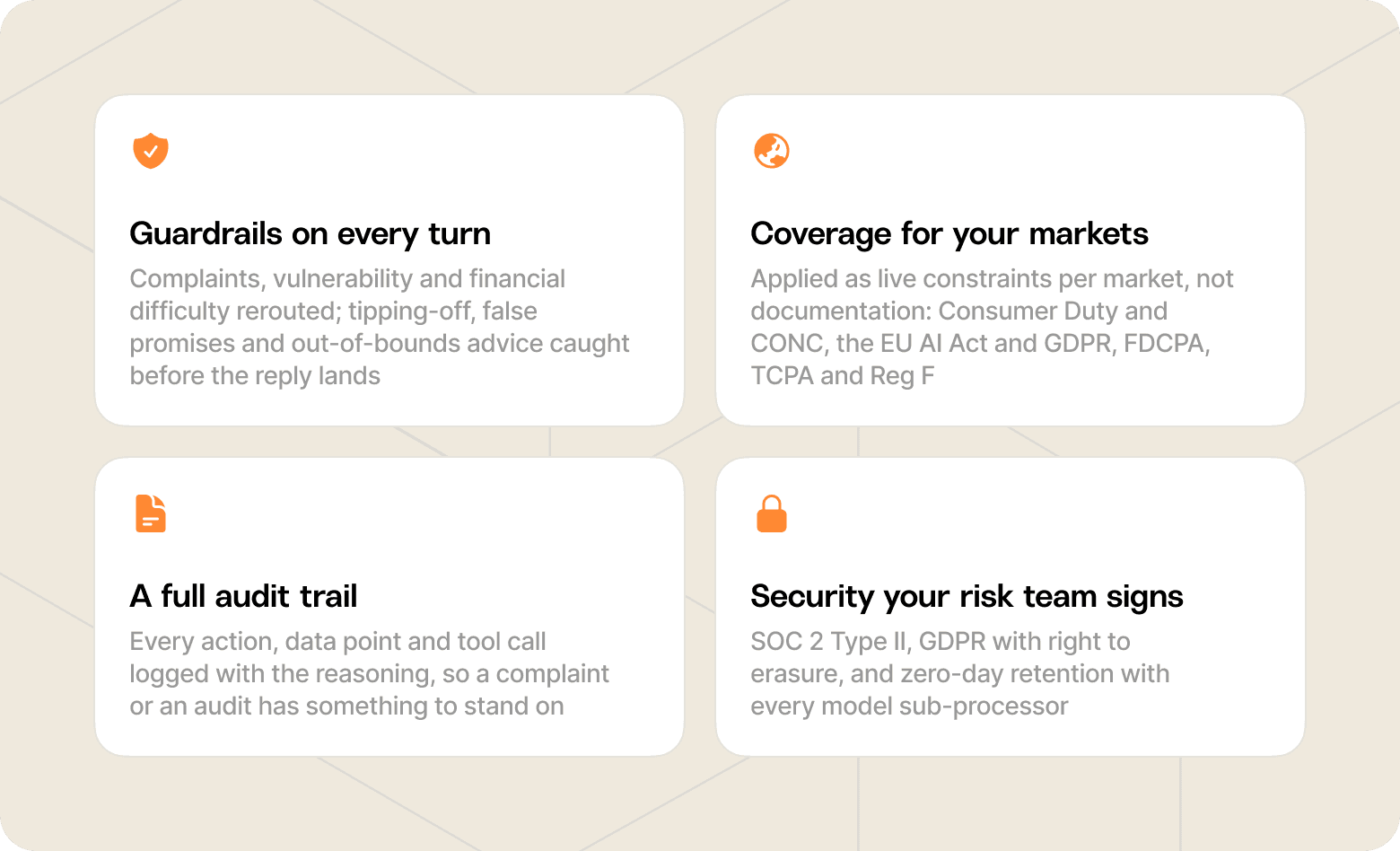
Treat these as go-live gates, not nice-to-haves. An agent that clears all four can take real customer conversations in a regulated operation; one that clears three is a pilot, not a deployment.
How to scale AI agents across financial services customer operations
Once your first agent is live and trusted, expand in a deliberate order rather than everywhere at once.
Move outward from the use case you proved. An AI customer service agent that resolves card and payment queries is the natural first step, because volume is high and the customer is in the loop to confirm the outcome. From there, extend into the back-office work sitting underneath those tickets, so a case like a dispute runs from intake to adjudication without a handoff. Then add outbound, where the same agent reaches customers first for payment reminders and hardship outreach.
The payoff of running this on one platform is that the agents share context and memory. A frontline agent and a back-office agent working the same case keep the full picture, so nothing is re-gathered and nothing is dropped between them. Yonder, a UK credit card provider, runs exactly this pattern for disputes:
"Gradient Labs' frontline and back office agents talk to each other and keep the full context of a case. If evidence is missing, the customer hears about it in the moment... Cases that took us the best part of a week to decide now take a day."
Antony Atkins, Senior Escalations Manager, Yonder
The same connected model runs outbound. SteadyPay, a UK lender, makes 33,000 collections calls a month with its agent and converts 60% of engaged customers to committed repayment dates, all inside FCA compliance.
Expect resolution to climb over months, not to peak on day one. Deployments start strong and improve as the delivery team identifies new data and API integrations, refines procedures, and adds use cases in production. Pockit, a UK neobank, saw a 70% lift in resolution rate and an 80% improvement in CSAT within six months on this model. The gains come from the operating model as much as the software: a finance-native delivery team works alongside your ops lead, reviews what the agent could not resolve, and turns each gap into the next improvement.
If you want the version of this sequence written for your institution type, we have specific guides for fintechs, neobanks, and community banks.
Measure the right things at each stage
The metric that proves an agent is working changes with whether a customer is in the loop. Measure each part of the operation with the metrics that fit it, rather than rolling frontline, outbound, and back-office work into a single number.
Where the agent works | Customer in the loop? | Lead metrics |
|---|---|---|
Frontline support and voice | Yes | CSAT, resolution rate, deflection or containment |
Outbound contact | Yes | Payment or recovery rate, commitment rate, contact rate |
Back-office case work | No | SLA compression, accuracy and false-positive rate, audit coverage, throughput |
On the frontline, CSAT and resolution rate carry the case, and quality shows early: Zego, a UK motor insurer, reached 77% consistent CSAT with its AI agent against a 61% standard for its human agents. In the back-office, where no customer is watching, the proof shifts to how quickly and accurately cases clear and whether every one leaves an audit trail.
In the first weeks, watch the leading indicators before the headline number settles: containment or deflection on the frontline, handoff rate, and how often the agent asks a clarifying question before it acts. These move before resolution rate does, and they tell you where the next improvement lies. Define resolution rate before you quote it, because buyers mean different things by the word: a ticket the agent closed without a human is a resolution to one team and only a deflection to another. Agree which you mean before the first board update, then hold the agent to it.
Deploying AI agents for customer operations is a sequence, not a single switch: map the workload, earn trust on one use case, clear the compliance bar, then expand across the lifecycle. Book a demo to see the agents run frontline and back-office work together in a regulated setting.


Elizabeth Shew leads Brand and Advocacy at Gradient Labs, where AI agents handle customer support and back-office work for banks, lenders, and fintechs. Before that, she led customer marketing at Mastercard and built Dynamic Yield's customer marketing programme from the ground up, a decade spent turning customer results into industry-shaping stories. She writes about how support and operations teams actually put AI and technology to work. Before tech, she was a professional dancer in NYC.