
Your fintech won customers by being easier and more human than the bank they left. That experience is your brand. AI reputation for fintechs comes down to one question: does automation protect that experience? Get it wrong and a dead-end bot makes you look like the call centre you were built to replace. You have no decades of legacy trust to soften the blow. Get it right and AI scales the fast, personal service you are known for, even through the growth spikes that would break a lean team. This guide is for founders and operations leaders weighing that call. It shows where your reputation is won and lost, what a safe deployment needs, and how to pick a vendor you can trust with your brand.
What AI reputation for fintechs really comes down to
AI reputation for fintechs is the trust your customers place in an experience they chose you for. Fintechs typically win on the feel of the product and the quality of support when something goes wrong, and that reputation lives on app-store ratings and platforms like Reddit, where a single bad interaction is public within minutes. A fintech does not get the benefit of the doubt a hundred-year-old bank does, so every automated interaction either earns that trust or spends it.
AI now sits in the middle of that experience. Modern agents handle real work end to end, from conversational onboarding through everyday support, at a scale a small ops team could never staff. Each interaction is a live test of the promise your marketing makes. When the agent resolves the issue quickly and sounds like your brand, the promise holds. When it loops the customer or misses the point, the gap between the pitch and the reality is exactly what gets screenshotted.
Why a bad bot hits fintechs harder than banks
A clumsy AI agent is more dangerous for a fintech than for an incumbent, because your whole pitch is that you do this better, and you’re more modern than a legacy bank. AI done wrong increases frustration, and a customer who was promised effortless banking has less patience for a bot that dead-ends them than someone resigned to their high-street bank. The disappointment is sharper, the review is angrier, and switching to a rival is a two-minute job.
Picture a customer who joined for the slick app and hits a problem with a failed payment. The bot answers a question they did not ask, offers no way through, and closes the chat. In that moment you are no longer the challenger, you are the frustration they downloaded you to escape, and they will say so in a one-star review that the next prospect reads.
The stakes are still regulatory as well as reputational. Most fintechs sit under the same rules as banks, and the FCA's Consumer Duty expects good outcomes from an automated channel just as it does from a human one. The mistake is treating AI purely as a risk to contain, because the same interactions decide whether your CX reputation scales with you or cracks under growth.
How great AI support scales the trust you were built on
When an AI agent resolves fast, matches your tone, and knows when to bring in a human, it does not dilute your customer experience, it multiplies it. This is the upside fintechs are best placed to capture, because a great support experience is already core to why customers chose them.
The results show it. At Morse for example, the Gradient Labs AI agent absorbed growth spikes that would have swamped the team:
"Gradient AI has been instrumental in enhancing our team's efficiency. It achieved a 50% resolution rate on day one."
Aliny Penrose, Head of Operations, Morse
Quality holds as the volume climbs. At Plum, the agent runs a 98.6% quality assurance score, so scale does not come at the cost of the experience customers signed up for. At the remittance fintech Nala, Head of Operations Joshua Black put it plainly: the Gradient Labs agent "has the highest CSAT of any of our agents." When the automated channel outscores the human one, automation stops being a compromise and becomes a reason customers stay.
There is a deeper reason fintechs are well placed to win here. Support is not a cost centre bolted onto the product, it is part of the experience customers rate you on. An agent that answers instantly, in your voice, at any hour extends the same responsiveness people love about the app into the moments they actually need help. That continuity between product and support is exactly what a bank running a legacy contact centre struggles to match.
That is the competitive point. A fintech that keeps CSAT high while it grows protects the one thing incumbents cannot easily copy, a support experience customers actually like, and it does so without hiring a support team the size of a bank's.
What a reputation-safe fintech deployment requires
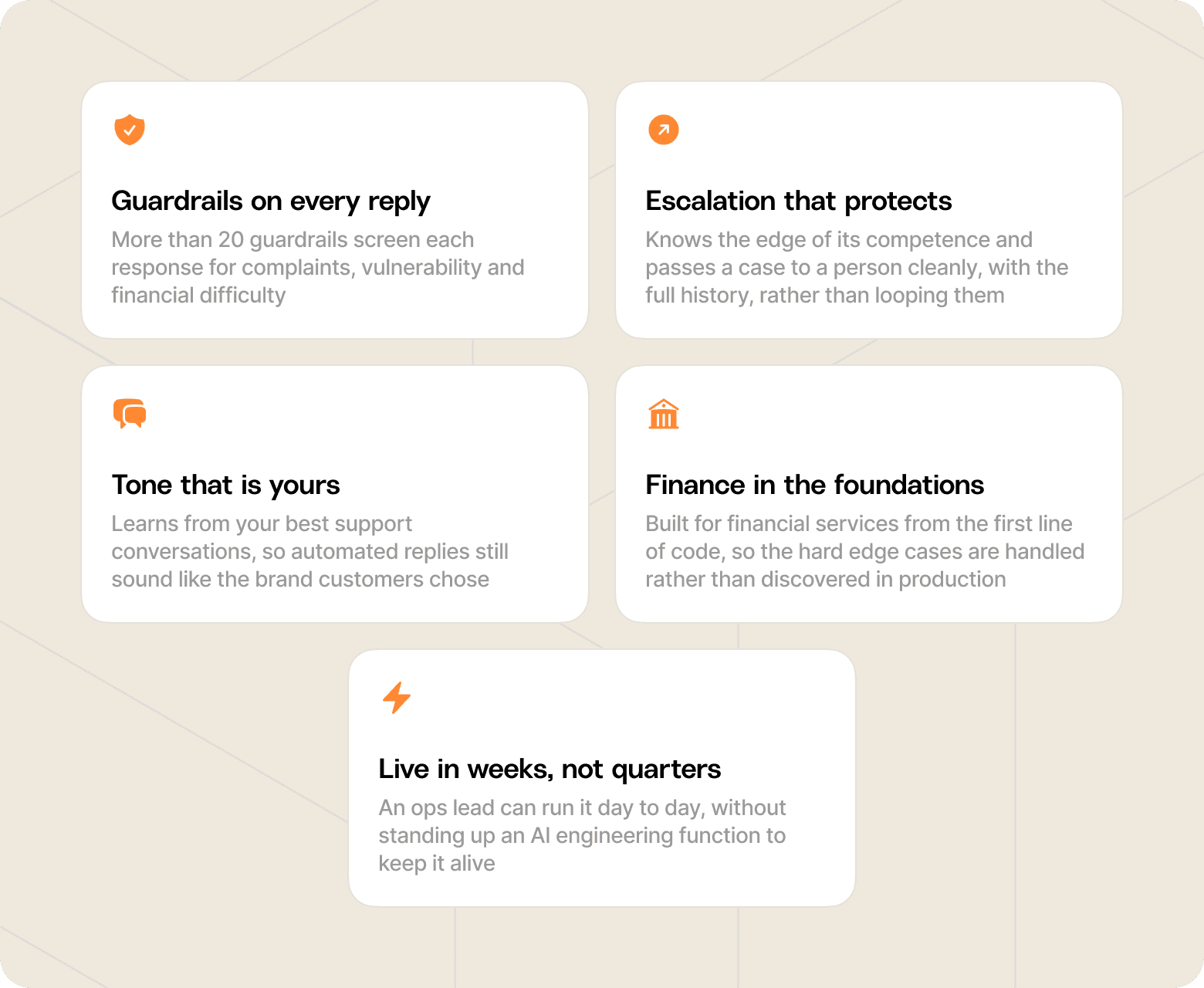
The gap between AI that grows your reputation and AI that dents it comes down to how the agent is built. A deployment worth trusting with your brand needs all of the following:
Guardrails that run on every reply. More than 20 financial services guardrails should screen each response for complaints, vulnerability, and financial difficulty, handing the sensitive ones to a human before anything goes out.
Escalation that protects the moment. The agent has to know the edge of its competence and pass a case to a person cleanly, with the full history, rather than trapping a frustrated customer in a loop.
Tone that is unmistakably yours. An agent that learns from your best support conversations answers in the voice customers associate with your brand, which is what keeps automated support feeling like you.
Speed to launch without a data team. A lean fintech should be able to go live in weeks with an ops lead, not stand up an AI engineering function, so the agent stays maintainable by the people who run the operation.
Financial services in the foundations. Gradient Labs was built for finance from the first line of code, by a team that came out of financial services and ran regulated systems at scale, so the hard edge cases are handled rather than discovered in production.
Security sits under all of it. Look for SOC 2 Type II certification, GDPR compliance, and zero-day data retention with every model provider, so a data incident never becomes the reputation story instead.
How to protect AI reputation for fintechs when choosing a vendor
Brand safety is a buying decision as much as a technical one. When you evaluate an AI vendor, judge them on what decides whether the deployment strengthens your CX or undermines it:
Financial services depth. Does the vendor understand how a regulated support conversation actually works, including vulnerability and complaints? Horizontal chat tools bolt compliance on afterwards. Ask what was built for finance from the start.
Guardrails and escalation. Are the guardrails financial-grade and running on every turn, and does the agent escalate sensitive cases to a human with full context?
Proof at fintechs like you. Has the vendor delivered high CSAT and resolution at fintechs at real volume, through growth, with numbers you can check? Ask for results from a comparable operation.
Compliance and security posture. Confirm regulatory coverage for your markets and certifications like SOC 2 Type II. The EU AI Act makes this a baseline rather than a bonus.
Pressure-test every vendor on the conversation that matters, the upset customer with a real problem, not the password reset. The same trust question runs under every AI deployment in finance, and we cover the wider version in our guide to bank AI reputation, alongside a fuller vendor checklist in the best AI use cases for fintechs.
Where fintechs should start
Start where volume is high and a quality win shows up fast, usually frontline support or onboarding, where customers form their first impression. Prove that the agent holds your CSAT and sounds like your brand on a contained slice of traffic before you widen it. Deployments reach production in weeks, not quarters, so a lean team sees the result quickly.
Track the reputation signal from week one. CSAT, resolution rate, and app-store or Trustpilot sentiment tell you directly whether the agent is protecting the experience customers chose you for, and they give you the evidence to expand with confidence. For a fintech, those public ratings are a growth input as much as a support metric, so holding them steady while volume climbs is the result that matters.
From there, trust compounds. Each interaction the agent handles well is proof for the next expansion, and a fintech that gets its first deployment right can scale support across the product without scaling the team behind it. The CX that won your customers is exactly what keeps them, and good AI is how you protect it through growth.
See how Gradient Labs helps fintechs scale support without losing the experience customers love. Book a demo.


Elizabeth Shew leads Brand and Advocacy at Gradient Labs, where AI agents handle customer support and back-office work for banks, lenders, and fintechs. Before that, she led customer marketing at Mastercard and built Dynamic Yield's customer marketing programme from the ground up, a decade spent turning customer results into industry-shaping stories. She writes about how support and operations teams actually put AI and technology to work. Before tech, she was a professional dancer in NYC.