
Search "AI agent companies" and you get a wall of logos with nothing to tell them apart. A development shop that builds custom agents sits next to a general-purpose chat platform, next to an open-source framework, next to a bank running its own build. They are not the same kind of business, and they do not solve the same problem. Gartner expects 33% of enterprise software applications to include agentic AI by 2028, up from less than 1% in 2024, so the list of AI agent companies is only getting longer and harder to read. This guide sorts them into five types, gives you a test for telling a real agent company from a wrapper, and shows which type fits the job you are actually hiring for.
What counts as an AI agent company?
An AI agent company builds software that takes actions and runs a task to completion, not just software that answers a question. That is the line that separates an agent from the three things buyers most often confuse it with:
A chatbot replies from a script or a knowledge base and stops at the answer.
A copilot drafts a suggestion and waits for a person to accept it, so a human still does the work.
A wrapper is a thin layer over a foundation model with a new logo on top, and little of its own underneath.
An agent is different in one specific way: it can investigate a case, call other systems, make a decision under policy, and close the loop without a person taking the next step.
Most companies in the search results mix these. Some sell a true agent, some sell a chatbot with "agent" in the headline, and some sell the tools to build one yourself. Knowing which is which is critical, so we’ve broken it down into five types.
To be honest, the “AI” category got crowded fast. When every vendor rebranded its chatbot as an agent and every consultancy started selling builds, "enterprise AI agents" became a phrase you could attach to almost anything. Sorting by what a company actually delivers, rather than what it calls itself, is the only way to compare like with like.
The five types of AI agent companies
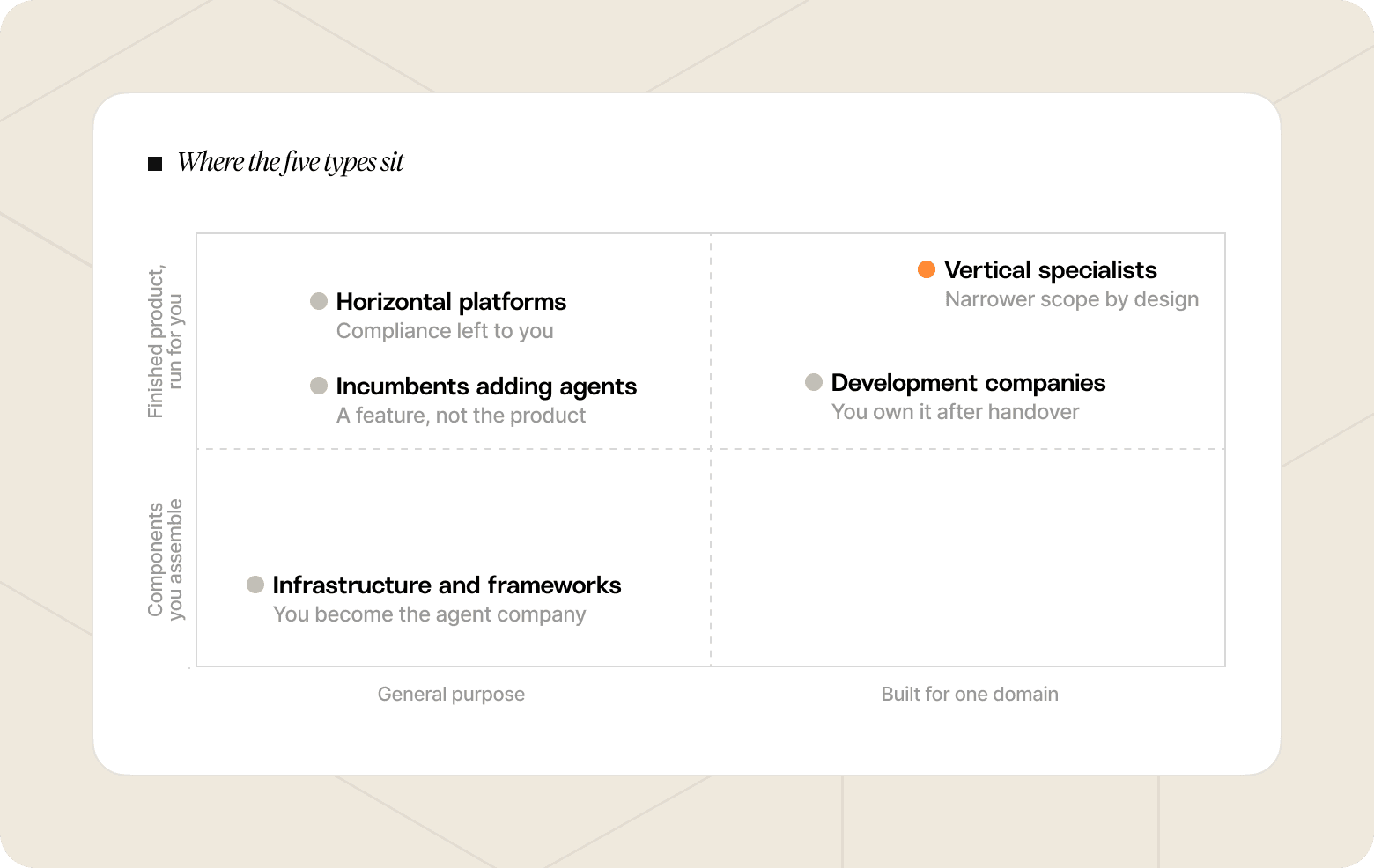
Almost every AI agent company falls into one of five groups. Each sells something different, suits a different buyer, and carries a different catch.
Type | What they sell | Best for | The catch |
|---|---|---|---|
Horizontal agent platforms | A general-purpose agent you configure | Broad, cross-industry automation | Compliance and domain depth are left to you |
AI agent development companies | Custom agents built as a service | One-off builds with no in-house AI team | You own the maintenance once they leave |
Vertical specialists | A finished agent for one industry or job | Regulated or high-stakes work | Narrower scope by design |
Incumbents adding agents | An agent layer on existing software | Teams standardising on one suite | The agent is a feature, not the product |
Infrastructure and frameworks | Building blocks for engineers | Teams building their own agents | You become the agent company |
Horizontal agent platforms. These sell one general-purpose agent that you configure for your use case, across any industry. They move fast and demo well on common tasks. The trade-off is depth: compliance, domain reasoning, and edge-case handling are left to you to assemble, which is where general platforms tend to stall on regulated or complex work.
AI agent development companies. These are agencies and consultancies that build a custom agent for you as a service, usually on top of a foundation model. This suits a one-off project when you have no in-house AI team. The catch is what happens after handover: you own an agent stack that has to be maintained, evaluated, and kept safe forever, and the engineers who built it have moved on. Most of the "top AI agent development companies" lists you find are this type.
Vertical specialists. These build a finished agent for one industry or one job, such as financial services, healthcare, or legal work. Because the product is built around one domain, the hard parts (guardrails, regulatory coverage, the way a case actually gets handled) are in the product rather than left to the buyer. The scope is narrower on purpose, which is the point for high-stakes work. Gradient Labs is a vertical specialist for financial services customer operations.
Incumbents adding agents. These are established software vendors bolting an agent layer onto a product you already run, such as a CRM or a help desk. If you have standardised on one suite, the agent is convenient and sits next to your data. The limitation is that the agent is a feature designed to keep you in the suite, not a product the vendor lives or dies by, so it rarely goes deeper than the surface of the work.
Infrastructure and frameworks. These sell the building blocks rather than a finished agent: orchestration frameworks like LangChain and CrewAI, and the foundation models from providers such as Anthropic and OpenAI that everything else runs on. They are essential and powerful, but they are components, not a solution. If you build on them directly, you have become the AI agent company, with all the product development and maintenance that implies.
How to tell a real agent company from a wrapper
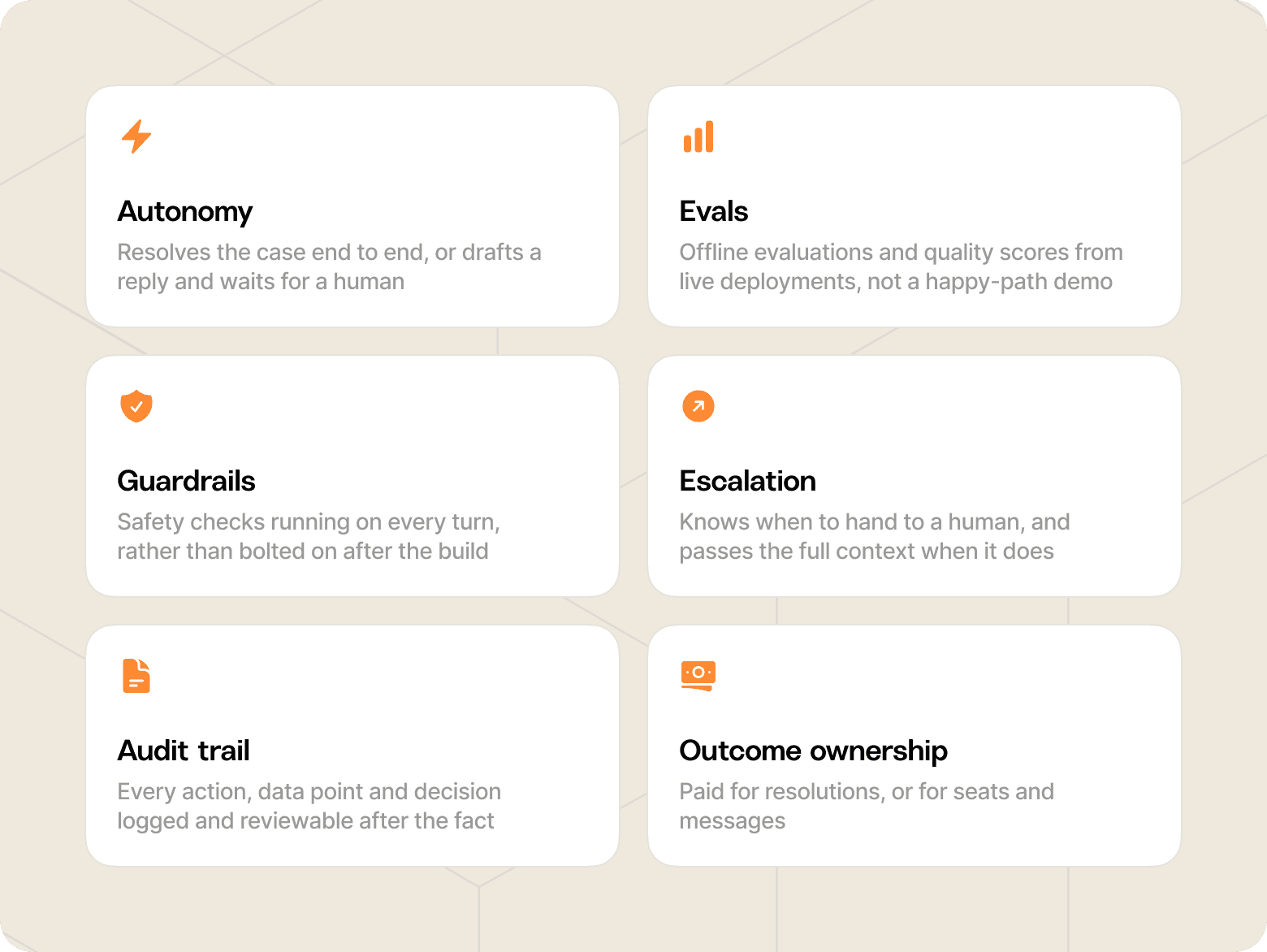
Type tells you what a company is. The next question is whether the agent actually works in production and delivers the promised results, and that is where a lot of the market thins out. Ask for evidence against these six criteria, not a demo:
Autonomy: does it resolve the case end to end, or draft a reply and wait for a human? A copilot dressed as an agent will reveal itself here.
Evals: can they show offline evaluations and quality scores from real deployments, or only a scripted demo on the happy path?
Guardrails: do safety checks run on every turn, or were they bolted on after the product was built?
Escalation: does the agent know when to hand off to a human, and does it pass the full context when it does?
Audit trail: is every action, data point, and decision logged and reviewable after the fact?
Outcome ownership: are they paid for resolutions, or for seats and messages? A company confident in the work will price against it.
A wrapper struggles on most of these because the hard engineering sits underneath, in the layer it skipped. A production agent company can answer all six with evidence from live customers.
Which type fits your problem
The right type depends on the work you want handled, not on which company has the biggest logo wall.
You want broad, low-stakes automation across a general operation. A horizontal platform is the natural starting point, as long as the work does not carry heavy compliance or edge-case risk.
You have a one-off internal use case and an engineering team to maintain it. A development company or an infrastructure-first build can work, if you accept the long-term ownership cost.
You are standardising on a single software suite and want convenience. An incumbent's agent layer is the path of least resistance.
The work is regulated, high-volume, or high-stakes, and getting it wrong is expensive. A vertical specialist is built for exactly this, because the domain depth and controls are in the product rather than on your to-do list.
Financial services sits firmly in that last row, which is worth its own section.
AI agent companies in financial services
Regulated buyers rarely get what they need from a horizontal platform or a development shop. In financial services, compliance, guardrails, and audit trails cannot be a configuration layer you assemble after the fact, because that is exactly where safety gaps and stalled deployments show up. The work itself is harder too: a dispute, a collections case, or a KYC review runs as a long process across days and systems, not a single question and answer. That higher bar is why AI agents for financial services are usually built by specialists, rather than adapted from a general-purpose tool after the fact.
This is why vertical AI agents exist for the sector. Gradient Labs was built for financial services from the ground up, by founders who built the AI and data organisation at a leading European digital bank. The platform runs more than 20 pre-built financial services guardrails on every turn, covers FCA, FDCPA, and EU AI Act requirements, holds SOC 2 Type II certification, and keeps a full audit trail of every action. Deployments reach 60% resolution on day one and 80–90% in mature use, with pricing per resolution rather than per seat.
If you are drawing up a shortlist, the vertical-specialist guides go deeper than a general list can:
Start from the work you want automated, match it to the type that is built for it, and hold every company you shortlist to the six criteria above.
See how a financial services agent runs a full case end to end. Book a demo.


Elizabeth Shew leads Brand and Advocacy at Gradient Labs, where AI agents handle customer support and back-office work for banks, lenders, and fintechs. Before that, she led customer marketing at Mastercard and built Dynamic Yield's customer marketing programme from the ground up, a decade spent turning customer results into industry-shaping stories. She writes about how support and operations teams actually put AI and technology to work. Before tech, she was a professional dancer in NYC.