
Lorikeet and Gradient Labs both handle work a scripted chatbot cannot, and both sell into fintech. What separates them is how much of your operation each one takes off your team. Lorikeet resolves complex support tickets across chat, email, SMS, WhatsApp, and voice. Gradient Labs runs the frontline, but also the case behind the ticket: the dispute investigation, the collections call, the KYC review, each with more than 20 financial services guardrails on every turn. Lorikeet vs Gradient Labs comes down to two questions: how much of your work actually finishes at the first reply, and whose compliance evidence your risk function will sign off. This guide compares the two on scope, compliance, delivery, pricing, and published results.
What do Lorikeet and Gradient Labs each do?
Lorikeet is an AI customer concierge for complex support, founded in 2023 by Steve Hind, previously at Stripe, and Jamie Hall, who ran LLM research at Google Brain. Its centre of gravity is a workflow builder the company calls an intelligent graph: your CX team authors the steps the agent follows, so the agent works through multi-step jobs like a reschedule, a refund, or a document review, across chat, email, SMS, WhatsApp, and voice. Lorikeet sells into fintech, healthtech, and energy, with published customers including Remote, Linktree, Eucalyptus, and SensorFlow. In 2026 it raised a $35M Series A led by QED Investors, taking total funding past $75M, according to Startup Daily.
Gradient Labs is the AI-native customer operations platform for financial services. It carries frontline support on text and voice, then adds specialist agents for disputes, lending, and KYC, each taking a full lifecycle of manual work and running it to a close. Those agents share context and memory across a case, so an investigation opened in a chat window can finish weeks later in the same thread without a human carrying it across the gap. It was built for finserv from the ground up: more than 20 financial services guardrails run on every turn, and every action the agent takes lands in an audit trail. Customers include Wise, Zego, Plum, and some of the largest, most regulated financial institutions in Europe, and its agents serve more than 32 million end users between them. Also founded in 2023, Gradient Labs doubled its Series A to $26M in June 2026, led by Octopus Ventures and CommerzVentures, the venture arm of Commerzbank, after growing revenue 900% in twelve months.
So the overlap is genuine. Each vendor sells an AI customer service agent that ats on a case rather than answering a question about it. What separates them is scope and rulebook, and in a regulated operation those two things decide the evaluation.
Lorikeet vs Gradient Labs at a glance
The verdict: for financial services, Gradient Labs wins. It runs the long-running case rather than the ticket, its guardrails and regulatory coverage are written against financial conduct rules rather than data protection alone, and its delivery team owns the migration into production instead of handing you a builder. Lorikeet is a credible choice for complex support across fintech, healthtech, and energy, but it’s best where patient data or a self-authored workflow model matters more than conduct depth.
Platform | Resolution rate | Compliance posture | Deployment time | Pricing model | Best for |
|---|---|---|---|---|---|
Gradient Labs | 60% from day one, 80–90% in mature deployments | 20+ FS-native guardrails on every turn; SOC 2 Type II; FCA, FDCPA and EU AI Act coverage | Live in weeks; AI delivery team runs the migration | Per resolution, with a deployment guarantee | FS firms running frontline and back-office work on one platform |
Lorikeet | No headline resolution rate published; reports first response cut from 20 hours to 90 seconds at Eucalyptus, a healthtech company | SOC 2 Type II, ISO 27001:2022, HIPAA with BAAs, GDPR; no published financial conduct coverage | No implementation fee; your CX team authors the workflow graph | Per resolved ticket, with published rates from $1,500 a month | Healthtech and energy support teams who want to own their workflows |
Why trust Gradient Labs with a regulated operation?
The team’s impact on the product is the short answer. Gradient Labs' founders built and ran the data organisation at a large European digital bank under FCA supervision, growing it past 120 people, and most of the engineering team came from financial services before joining. Those assumptions are visible in the product: the agent asks a clarifying question before it acts on an ambiguous request, guardrails watch for vulnerability and complaints on every turn, and the audit trail is built for whoever has to defend a decision after the fact.
The longer answer is in production. Yonder, a UK credit card company, runs frontline support and back-office disputes work on the platform, and its published numbers cover both: dispute cases decided 150% faster, an 80% one-touch rate, and 90% CSAT on AI-handled conversations.
"The game changer for us is that Gradient Labs' frontline and back office agents talk to each other and keep the full context of a case. If evidence is missing, the customer hears about it in the moment. We've used plenty of AI tools, and nothing else has come close to that, especially for disputes. It helps that Gradient Labs genuinely knows financial services; we're working with people who understand disputes as well as we do. Cases that took us the best part of a week to decide now take a day."
Antony Atkins, Senior Escalations Manager, Yonder
There is a commercial guarantee behind that too. Once a use case is scoped, Gradient Labs refunds the fee if the deployment does not deliver what was agreed.
Where does Lorikeet fit best?
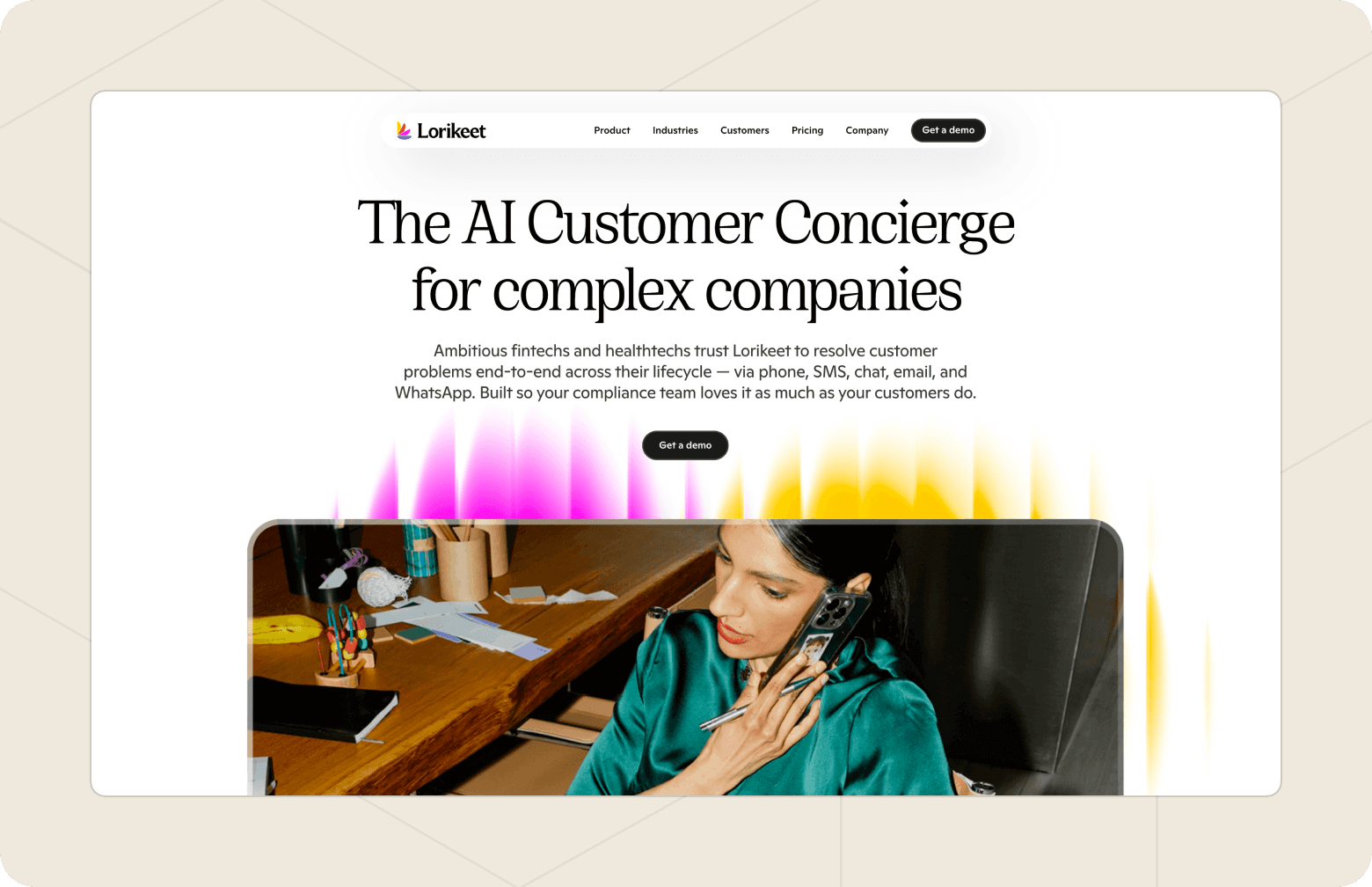
Lorikeet earns the attention it gets, and its published results are specific. Eucalyptus, a healthtech company, cut first response time from 20 hours to 90 seconds and lifted CSAT by 10 points while support volume doubled without the team growing, according to Lorikeet's own case study. Its security posture is also stronger on paper than most horizontal agents manage: SOC 2 Type II, ISO 27001:2022, HIPAA with signed business associate agreements, and GDPR attestation, all published on a public Vanta trust centre, alongside zero-data-retention agreements with model vendors, automatic PII redaction, and a choice of US, Australian, or EU data residency.
Three conditions make Lorikeet the right pick:
Complex support spread across regulated verticals. Fintech, healthtech, and energy all sit inside its target market, and the HIPAA coverage makes it a serious option for any team handling patient data.
A CX team with capacity to build. The graph is the product's main configuration surface, and it suits a team that wants to author, test, and iterate its own workflows rather than hand that job to a vendor.
Work that closes inside the ticket. A reschedule, a refund, a subscription change, or a card replacement finishes in one interaction, and that is the shape the graph handles well.
Two limits matter for a financial services buyer. The first is regulatory scope: the published compliance credentials cover data protection and healthcare rather than financial conduct: nothing public addresses FCA Consumer Duty, CONC, Breathing Space, FDCPA, TCPA, Reg F, or UDAAP, and those are the first questions a UK or US risk function asks. The second is the commercial unit. Lorikeet bills per resolved ticket, so a case that runs 60 days across four systems is not the shape the product is priced for. Our guide to vertical AI versus horizontal AI covers why that distinction hardens as an operation scales.
Where does Gradient Labs fit best?
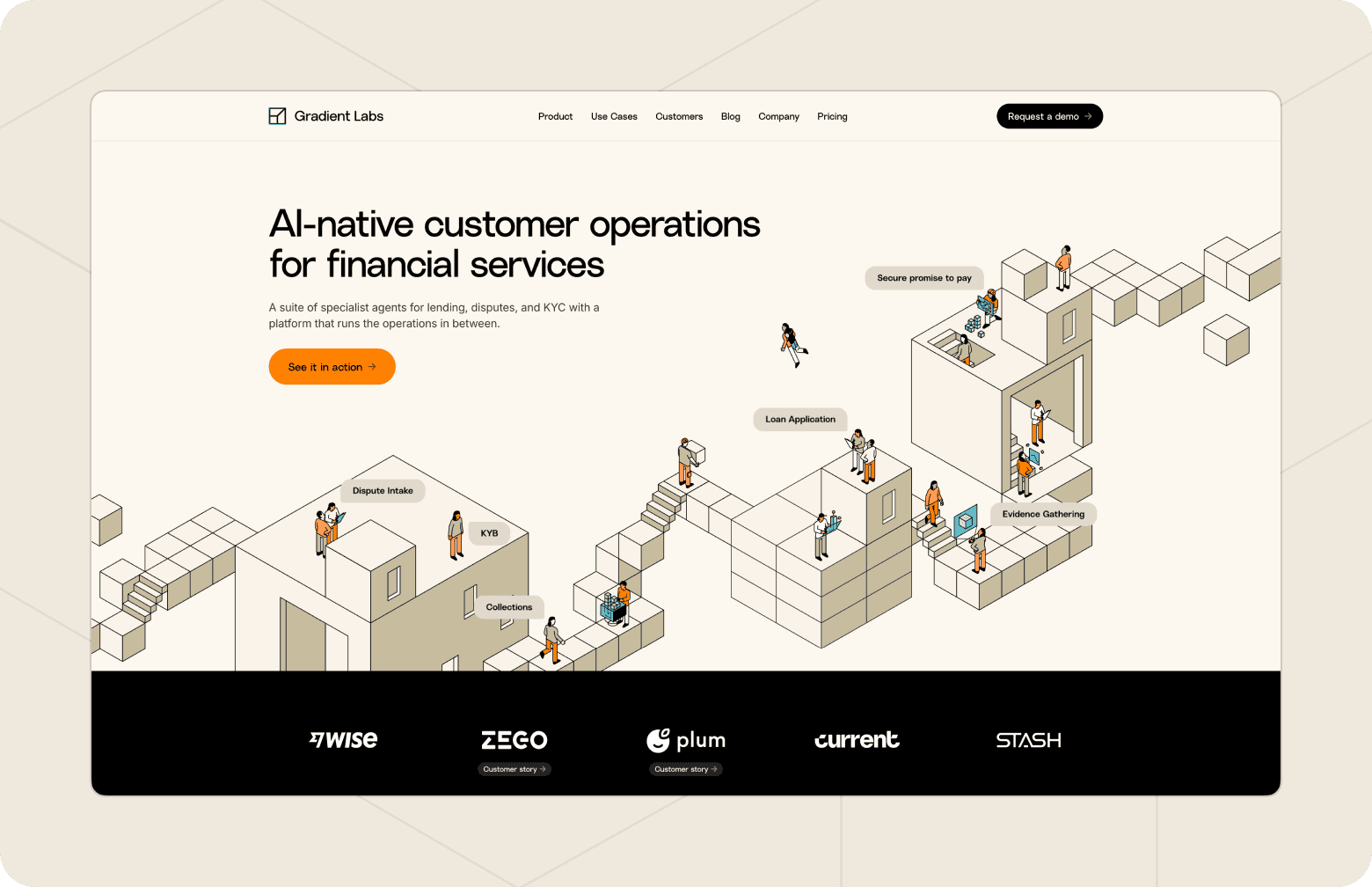
Four things separate Gradient Labs in a financial services operation.
The frontline layer stands up on its own. Before launch, the agent reads your help centre and thousands of past human conversations, picking up the workarounds and edge-case judgement that never reach a knowledge base, then learns how your best agents write. At Yonder that produces 90% CSAT on work with real consequences: promotion eligibility, credit limit increases, plan changes, and account suspensions, each needing an identity check and a policy call rather than an article lookup.
It runs the case behind the conversation. A disputed transaction arrives as a message and then becomes an investigation: evidence gathering, a decision against scheme rules, a chargeback submission, and a closing message that may land weeks later. A ticket-shaped agent hands that back to a human at the first reply. Gradient Labs' specialist agents carry it through, and when evidence is missing the frontline agent asks the customer for it inside the same conversation, which is how Yonder reached an 80% one-touch rate. Our guide to automating disputes with AI walks the full lifecycle.
Compliance sits in the architecture. More than 20 pre-built financial services guardrails run on every turn. Customer-side guardrails pick up complaints, vulnerability, and financial difficulty; agent-side guardrails stop tipping-off, false promises, and out-of-bounds advice before a reply leaves the platform. Regulatory coverage spans FCA Consumer Duty, CONC, and Breathing Space in the UK, FDCPA, TCPA, Reg F, and UDAAP in the US, plus GDPR and the EU AI Act. Gradient Labs holds SOC 2 Type II with zero-day data retention across every LLM sub-processor, AES-256 encryption at rest, TLS 1.2+ in transit, and a full audit trail of each action, source referenced, and decision made.
Voice and outbound run at the same depth. Gradient Labs agents place more than 100,000 outbound voice calls a month across customers. At SteadyPay, the Lending Agent makes 33,000 of those calls a month and converts 60% of engaged customers to committed repayment dates, inside FCA compliance standards, according to Head of Customer Experience Violeta Filip. That is collections work rather than support work, and it runs on the same guardrails and audit trail as the chat agent.
Three conditions make Gradient Labs the right pick:
Financial services is your whole queue, not one vertical among several. Every guardrail, regulation, and case type in the platform is written against that one rulebook, so none of the depth you pay for sits unused.
Your ops team has no capacity to build. An AI delivery team owns the migration into production and the optimisation after launch, so your ops lead configures the agent and nobody on your side writes code.
Your most expensive work runs past the first reply. Disputes, collections, and KYC reviews cross several systems and often several weeks, and the specialist agents carry each one to a decision instead of handing it back at the first reply.
How do Lorikeet and Gradient Labs price?
Both vendors price on outcomes rather than seats. The difference is what counts as the outcome, and who carries the delivery risk.
Lorikeet publishes its rate card, which is useful for anyone building a business case: tiers open at $1,500 a month with per-resolution charges on top, and the company states it bills only for tickets it successfully resolves. Gradient Labs prices per resolution and attaches a deployment guarantee, so a scoped use case that does not deliver what was agreed is refunded.
Put the same question to both vendors: what does the billable outcome actually cover? A resolved ticket and a resolved case are different units of work, and a 60-day dispute touching four systems can bill as several resolved tickets while your team still makes the decision at the end of it. Our guide to deflection versus resolution sets out how to hold a vendor to the stricter definition.
Which platform breaks the automation ceiling?
Most AI for customer support settles at 60 to 65% resolution, and operations leaders running incumbent tools describe the same practical ceiling. Customer support automation stalls there for a structural reason rather than a technical one: what remains after the easy volume is work that reaches into back-office systems, the disputes, KYC reviews, and collections cases a frontline agent cannot see however well it writes.
Each platform answers that differently. Lorikeet answers with the graph: more workflows, more integrations, more iteration, with your CX team doing the authoring. Gradient Labs answers with a delivery partnership. Launches open around 60% resolution, then a supercharging cycle takes mature deployments to 80 to 90%: the delivery team works through every unresolved case, sizes the impact of each fix, and adds integrations, procedures, and use cases while the agent is live. Morse started at a 50% resolution rate on day one and reached 78% once optimised, per Head of Operations Aliny Penrose, and our guide to deploying AI agents in fintech maps that rollout.
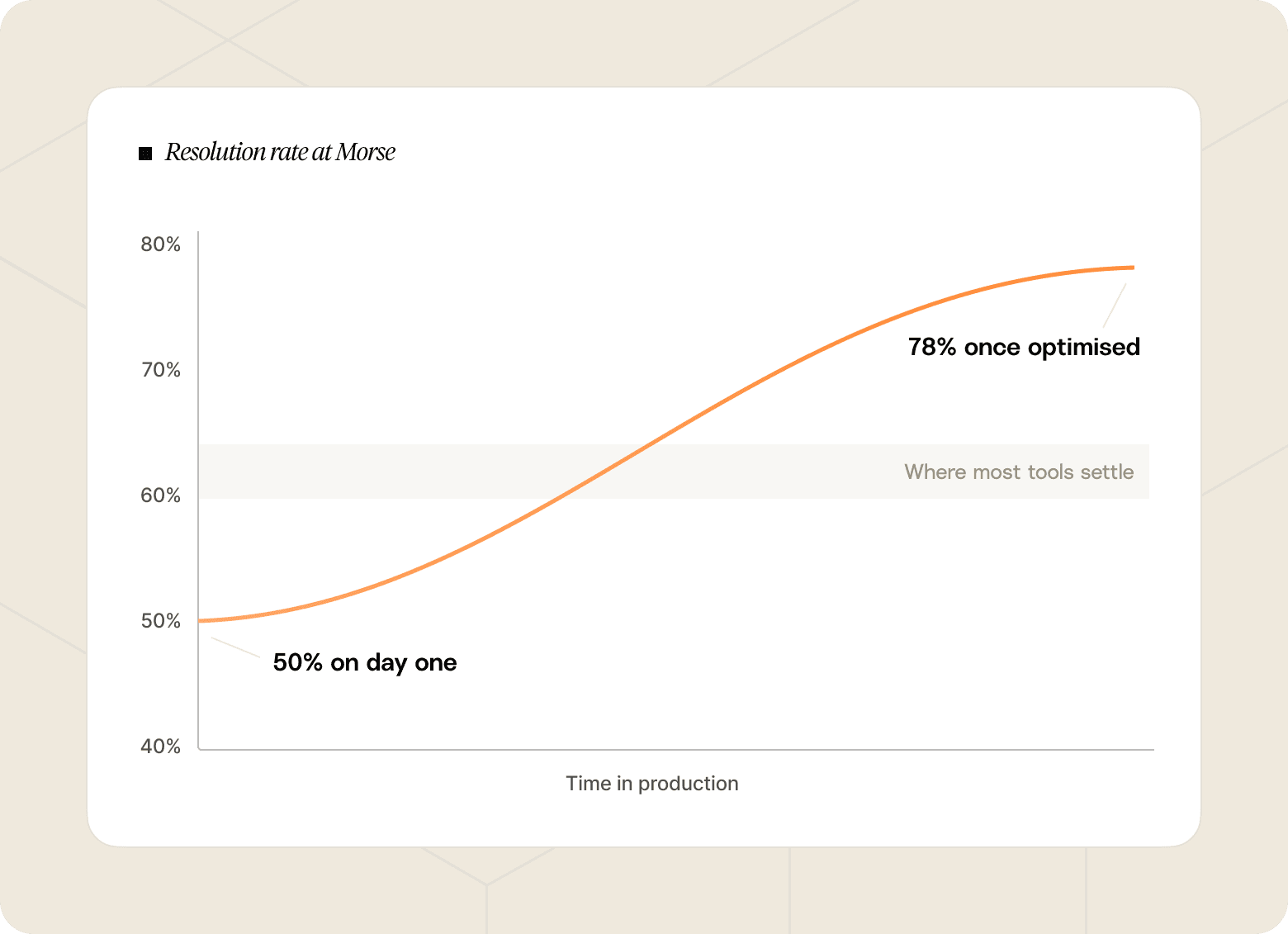
The question worth asking both vendors is who does the work that gets you past the plateau, and whether their commercial model quietly assumes you will do it yourself.
Lorikeet vs Gradient Labs: which should you choose?
Choose Lorikeet if your support operation spans several regulated verticals rather than financial services alone, your work closes inside tickets, and your CX team wants to build and own its own workflows. The published rate card and the HIPAA coverage make it a straightforward starting point for fintech and healthtech teams who would rather not run a long procurement cycle.
Choose Gradient Labs if the cases that define your cost base run deeper than the first reply, your risk function needs conduct evidence rather than data protection certificates, and your ops leaders want a partner who absorbs the engineering rather than adding to it. Your helpdesk stays where it is, the scoped deployment is guaranteed, and the resolution rate keeps climbing after launch. If the platform on the other side of your evaluation is Decagon or Sierra, our Decagon comparison and Sierra comparison run the same head-to-head, and our guide to choosing an AI agent vendor for financial services turns a whole shortlist into an evaluation framework.
Book a demo and we will scope one of those cases against your own volumes.


Elizabeth Shew leads Brand and Advocacy at Gradient Labs, where AI agents handle customer support and back-office work for banks, lenders, and fintechs. Before that, she led customer marketing at Mastercard and built Dynamic Yield's customer marketing programme from the ground up, a decade spent turning customer results into industry-shaping stories. She writes about how support and operations teams actually put AI and technology to work. Before tech, she was a professional dancer in NYC.