
Only 4% of banks have automated most of their KYC workflows, according to Fenergo's survey of more than 450 C-level executives. In the same study, 67% said they had lost clients because onboarding and KYC took too long, up 19 percentage points on the year before. The case for KYC automation is clear, so the hard part is scope: which checks an agent should run, which decisions stay with a named human, and what evidence your risk committee will want before either goes live. This guide walks through the five stages of an automated KYC verification flow, where the line between machine work and human work should sit, and the questions to put to any vendor before it touches a regulated onboarding journey.
What KYC automation covers
KYC automation means running the customer due diligence checks a regulated firm has to complete before and during a customer relationship, with software doing the collection, the checking, and the record-keeping. FinCEN's CDD rule sets out four core elements: identify and verify the customer, identify beneficial owners of legal entity customers, understand the purpose of the relationship, and monitor it on an ongoing basis. Automation reaches all four, though not to the same depth.
The commercially useful distinction is between the checks and the work around them. Running a document check or a sanctions screen through an API has been automated for a decade, and most banks already buy that capability. What stays manual is everything wrapped around it: chasing a customer for a clearer selfie, reading a company registry extract, deciding whether an adverse-media hit is even the same person, writing the case note that explains the outcome. That surrounding work is where the queue builds, and it is the part an AI agent takes on.
Stage of the KYC process | What automation handles well | What still needs a person |
|---|---|---|
Identity verification and document checks | Collects documents in conversation, retries failed captures, calls your IDV provider, chases whatever is missing | Reviewing an edge-case document your provider cannot read |
Beneficial ownership and business verification | Pulls registry data, maps ownership structures, requests missing officer detail from the applicant | Judging an opaque or multi-jurisdiction structure |
Sanctions, PEP, and adverse media screening | Runs the screen, clears unambiguous non-matches, drafts the rationale for everything else | Confirming a genuine match, and any suspicious activity report that follows |
Enhanced due diligence | Gathers source-of-funds evidence, assembles the case file, follows up until it is complete | Risk-rating the customer and signing the decision off |
Periodic and event-driven review | Detects the trigger, re-requests expiring documents, closes no-change reviews | Any review where the customer's risk rating moves |
Ongoing transaction monitoring sits outside this. It is a separate discipline with its own vendors and its own model risk governance, and it is not what a customer operations agent does.
Where manual KYC costs you
Financial crime compliance costs institutions in the US and Canada $61 billion a year, on LexisNexis Risk Solutions' figures, and labour is the largest line in it. Screening alert volumes rose at 83% of mid and large institutions in the same research, which explains the direction of travel: more alerts arriving, each one needing a human to look at it, against headcount that was never going to grow at the same rate.
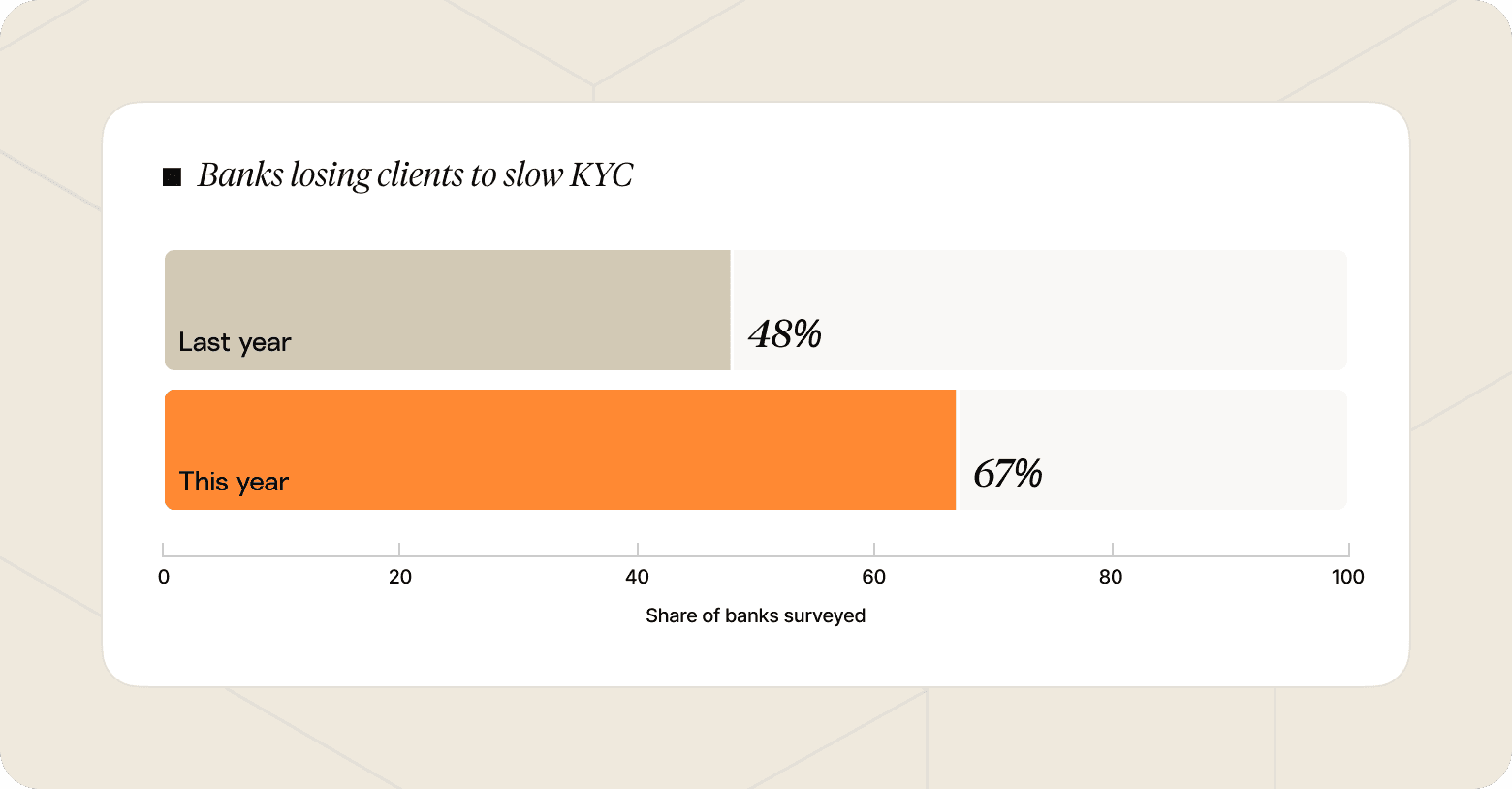
Three of those costs show up in numbers your board already tracks.
Applications you never convert. A customer who has to leave the flow, find a utility bill, and start again often does not come back. Acquisition spend is already committed by that point, so every drop-out at the document step is paid-for demand you lose to your own process.
A back-office queue that sets your onboarding SLA. Enhanced due diligence and periodic review are batch work handled by a small team of specialists. When volume spikes, the queue lengthens, and the SLA you quote your commercial team is really a function of how many analysts were in that morning.
Analyst time spent on cases that were never risky. Most periodic reviews end with no change to the customer's risk rating, and most screening alerts are not the person on the list. Your FinCrime analysts are expensive precisely because of the judgement they bring to the hard cases, and clearing routine ones is not where that judgement earns its keep.
The five stages of an automated KYC verification flow
Automated KYC verification works best when it is designed as one continuous case rather than a series of handoffs. Each stage below picks up where the last one finished, on the same case file, with the same audit trail running underneath.
Intake and document collection. The agent opens the conversation, explains what it needs and why, and collects documents in the channel the customer is already using. When a capture fails a quality check, it says what went wrong and asks again instead of dropping the applicant into a generic error. This is the same pattern as conversational onboarding, where the collection step doubles as the customer's first experience of you.
Verification and document checks. The agent calls the IDV and document providers you already run, reads the result, and acts on it. For business customers the same step covers business verification: pulling registry records, mapping the ownership chain, and going back to the applicant for the officer detail the registry does not hold.
Screening and match resolution. Sanctions, PEP, and adverse media screens run automatically. Unambiguous non-matches close with a recorded reason, and everything with a plausible match is packaged for an analyst with the evidence already assembled, rather than arriving as a bare alert.
Enhanced due diligence. For higher-risk customers the agent gathers source-of-funds and source-of-wealth evidence, chases what has not arrived, and keeps the case file current while it waits. The evidence-gathering is automated; the risk assessment on top of it is not.
Decision, record, and review. Every action, data point referenced, and tool call is written to an audit trail per case, which is what a regulator or an internal auditor will ask to see. The same record sets the next review date, and FinCEN's February 2026 exceptive relief narrowed when beneficial ownership has to be re-verified for existing customers, so an automated flow needs to reflect a risk-based schedule rather than re-running everything on a fixed cycle.
What to automate and what to keep human
Difficulty is the wrong test. The line follows regulatory accountability: who carries the consequence when the task is done wrong. Three practical rules come out of that.
Automate the gathering, keep the judgement. Collecting documents, calling providers, chasing gaps, and assembling a case file are all deterministic work with a checkable output. Deciding that an adverse-media article is about your customer, or that a source-of-funds explanation is credible, is a judgement your risk function owns and should keep owning.
Keep a named human on every high-risk decision. Standard due diligence on a low-risk retail customer can complete end to end without a person reading it. Enhanced due diligence, a risk-rating change, and anything heading towards a suspicious activity report need an accountable individual, and your policy should say who. The agent's job on those cases is to make the human's five minutes count by presenting a complete file.
Route the sensitive conversations out. Customers under financial pressure, in vulnerable circumstances, or making a complaint will surface in an onboarding flow, and guardrails should detect that and hand off before the agent replies. This is what guardrails are for, and Gradient Labs carries more than 20 of them written for financial services, screening both the customer's situation and the agent's draft reply before it sends.
How to evaluate KYC automation tools
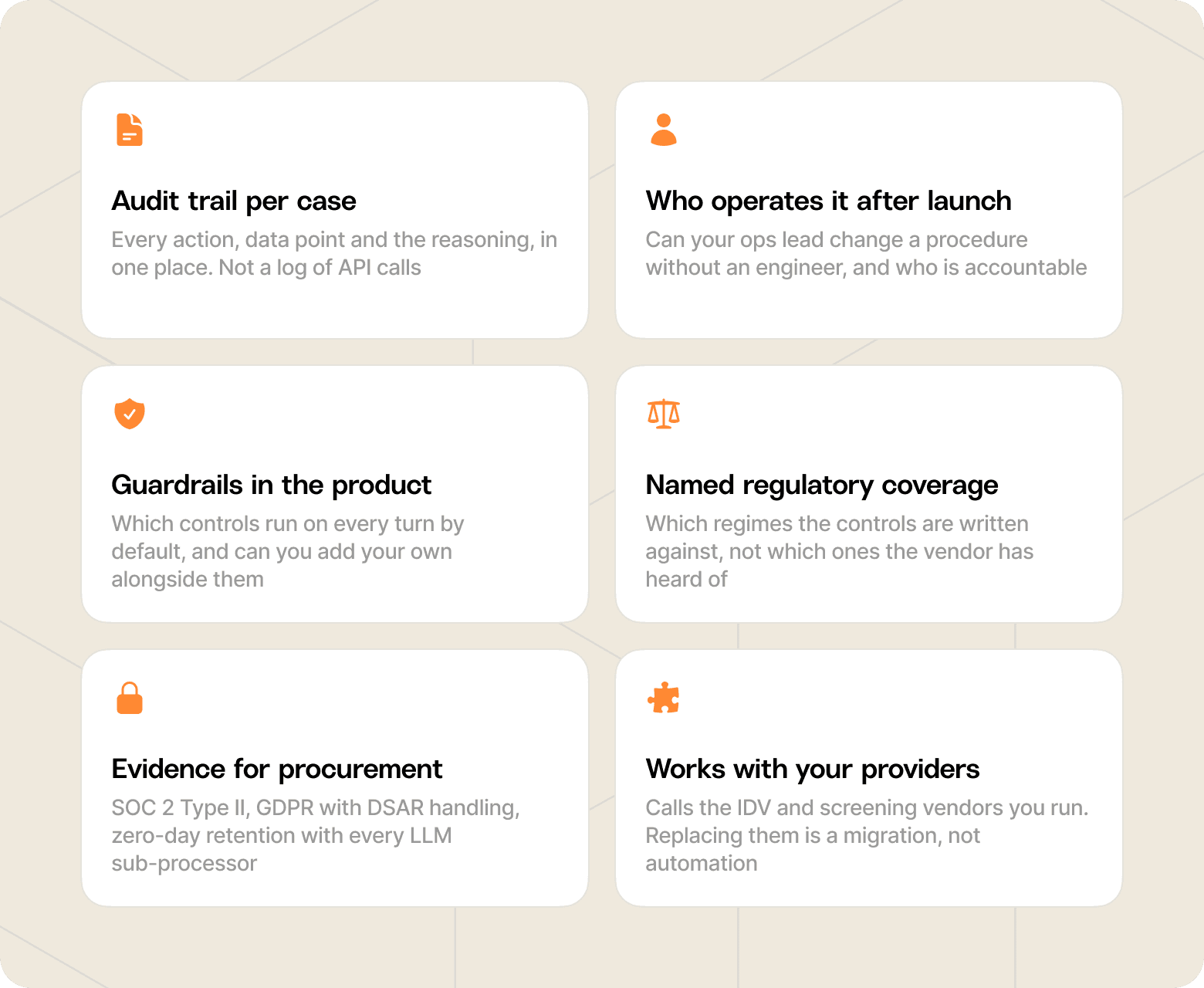
Most KYC automation solutions are strong at one layer and quiet about the rest, so the useful questions are about the layer you do not already own. Score any vendor against these:
Audit trail per case, not per system. Ask to see what an auditor would see for a single customer: every action taken, every data point referenced, and the reasoning behind the decision, in one place. A tool that logs API calls but cannot reconstruct a case is not audit-ready.
Guardrails built into the product. Compliance controls that come built into the platform hold up better than a configuration layer your team maintains. Ask which controls run on every turn by default, and whether you can bring your own alongside them.
Named regulatory coverage. Ask which regimes the controls are actually written against. Gradient Labs covers FCA Consumer Duty and CONC in the UK, FDCPA, TCPA, Reg F, and UDAAP in the US, and GDPR and the EU AI Act in the EU.
Security evidence you can hand to procurement. SOC 2 Type II certification, GDPR compliance with DSAR handling, and zero-day data retention agreements with every LLM sub-processor. Gradient Labs holds all three, with a public trust centre for due diligence. Our guide to secure AI agents for banking carries the full evaluation checklist.
Integration with the providers you already run. You have an IDV vendor, a screening vendor, and a case management system. A KYC automation tool that expects you to replace them is a migration project wearing a different name.
Who operates it after launch. Ask whether your ops lead can change a procedure without an engineer, and who is accountable when the agent gets something wrong. This is where the choice between a financial-services specialist and a general-purpose platform bites, a trade-off we work through in vertical AI vs horizontal AI in financial services.
The same discipline applies to any regulated back-office process you are assessing, and our guide to AI dispute resolution tools works the equivalent criteria through for disputes.
Getting KYC automation into production
KYC automation for banks tends to stall at the same point: the technology review passes, and then nobody can agree what the agent is allowed to decide. Getting past it is a scoping exercise rather than an engineering one. Pick one segment and one journey, write down the decisions the agent may take and the ones it must escalate, and test the whole thing against your own historical cases before a customer sees it.
At that scope, a first customer operations or back-office use case typically reaches production in four to six weeks at a large regulated institution, including procedure design, guardrail configuration, and testing. Our delivery team runs that migration alongside your ops lead rather than handing over a console. Almost all of our engineers came out of financial services, and our founders built and ran production machine learning under FCA regulation inside a large European digital bank at scale.
"Gradient's AI solution delivered impressive results with minimal effort on our part. The proof of concept made the decision clear... Seeing such a high CSAT and resolution rate validated our choice."
Yoan Yedrowiak, Head of Customer Success, Plum
If you want to see what an automated KYC verification flow looks like on your own journeys, book a demo.


Elizabeth Shew leads Brand and Advocacy at Gradient Labs, where AI agents handle customer support and back-office work for banks, lenders, and fintechs. Before that, she led customer marketing at Mastercard and built Dynamic Yield's customer marketing programme from the ground up, a decade spent turning customer results into industry-shaping stories. She writes about how support and operations teams actually put AI and technology to work. Before tech, she was a professional dancer in NYC.