
Most AI platforms for banking compliance are built to find problems, not to finish the work that finding one creates. That distinction decides whether a purchase takes real work off your team or just changes where the queue sits.
Here is what it looks like in practice. A monitoring tool flags a suspicious payment, and the work of resolving it with the customer still lands on a person. The volume of that second job is enormous. The National Crime Agency's UK Financial Intelligence Unit takes in more than 850,000 suspicious activity reports a year, and the FCA logged 857,757 banking and credit card complaints in the second half of 2025 alone. Both are worked by people reading, writing, and chasing.
So this guide sorts the market into three layers: platforms that detect the risk, platforms that write regulation into your policies and controls, and platforms that run the case afterwards. It ranks seven of them by which layer they cover, so you can tell whether the vendor in front of you closes your gap or sits next to it, and it says plainly where Gradient Labs fits and where it does not.
What counts as an AI platform for banking compliance?
Banking compliance work splits three ways, and the split matters because most vendors sit in only one part of it.
Detection finds the risk. Transaction monitoring, sanctions and PEP screening, customer risk rating, and fraud signals all live here. Most of the conversation about AI in banking sits in this layer, and it is the one buyers picture first.
Interpretation writes the regulation into your policies and controls. A regulator publishes an obligation in prose, and someone has to decide what it requires of your business, write it into a policy, build the controls that enforce it, and update all of that when the rule changes. Today lawyers and compliance analysts do that by hand. Platforms in this layer do it in software, and check work against the result: whether an email to a customer meets a conduct standard, for example.
Operations runs the case to a finish. Detecting a problem is what starts the work, and the work itself is mostly contact: telling the customer what has happened, asking them for the document you need, chasing it when it doesn't arrive, making the decision, and recording each step so a supervisor can reconstruct it a year later. Deadlines apply throughout. Reg E gives a US bank a fixed number of days to resolve a disputed card transaction, and FCA Consumer Duty expects a lender to spot a customer in difficulty and do something about it. Detection alone satisfies neither one, because both are judged on what you did for the customer.
Most banks buy well in the first layer and staff the third with people. That gap is what this ranking is built around. For the security-posture view of the same stack, a separate guide to the best secure AI agents for banking maps the field by the job each agent owns.
How should banks compare AI platforms for banking compliance?
Score any shortlist against these criteria:
Which layer it covers: detection, interpretation, operations, or more than one. A platform that scores well on the wrong layer leaves your gap exactly where it was.
Regulatory regimes named: a vendor that names OFAC, FinCEN, the FCA, or the EU AI Act in its own documentation has done work that a vendor relying on generic "global compliance" language may not have.
Evidence a supervisor accepts: model documentation, decision explainability, and a per-case audit trail. In AML, explaining a decision is a regulatory expectation rather than a product feature.
What happens after the alert: whether the platform hands you a queue or works the queue.
Published security posture: what the vendor states on its own trust centre, rather than what you have to ask for under NDA.
Which AI platforms lead for banking compliance in 2026?
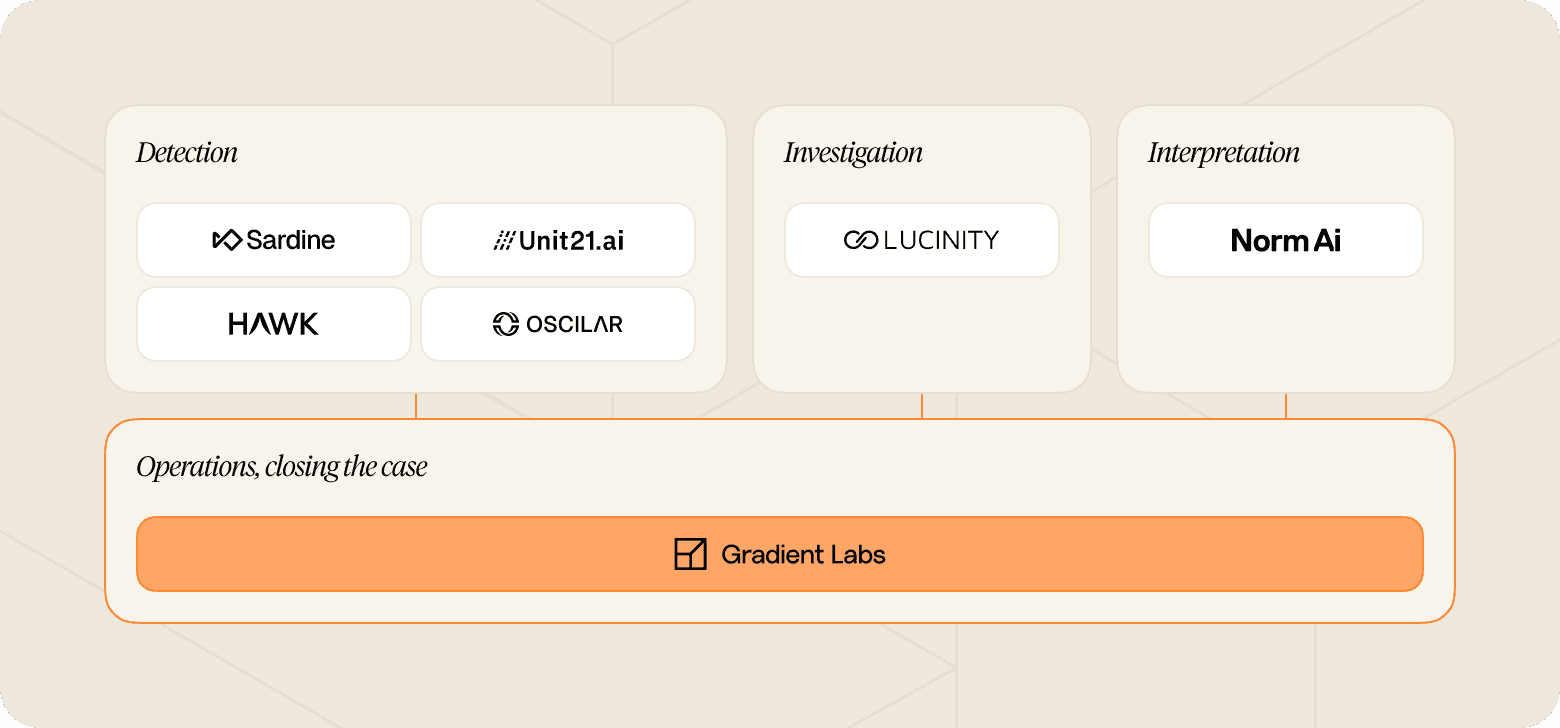
Gradient Labs leads for compliance operations, the layer still staffed by people at most banks. The six platforms below lead for their own layer.
Platform | What it does | Where it fits | Compliance posture | Best for |
|---|---|---|---|---|
Gradient Labs | Runs the customer contact, document collection, and case progression that follows an alert or a complaint | Operations | SOC 2 Type II, GDPR, 20+ FS guardrails on every turn, full per-case audit trail; UK, US and EU regulatory coverage | FS firms whose compliance obligations generate customer contact and casework |
Norm Ai | Turns regulatory text into machine-readable rules and agents that apply them | Interpretation | Publishes a trust centre; engaged by Delaware's Secretary of State on regulatory parameters for AI agents | Legal and compliance teams codifying rules across a large regulated estate |
Hawk | Transaction monitoring, customer and payment screening, risk rating, SAR and CTR filing | Detection | Explanations on every AI decision, plus model governance documentation built for regulatory review | Banks needing AML detection a supervisor can interrogate |
Sardine | Device intelligence, behaviour biometrics, fraud detection, AML monitoring, screening agents | Detection | Named agents for sanctions screening, PEP screening, and SAR generation; global sanctions, watchlist, PEP and adverse media coverage | Banks and merchants wanting fraud and AML signals on one platform |
Unit21 | Real-time monitoring, case management, screening, and regulatory filing across fraud and AML | Detection and filing | SOC 2 and GDPR published on their own site; names FinCEN, OFAC, NACHA, and MiCA | Risk teams wanting detection and SAR, STR, CTR and 314(a) filing in one place |
Lucinity | Luci agent gathers evidence, analyses cases, and drafts investigation narratives | Investigation | Separate security portal; narrative consistency built for regulatory reporting quality | FinCrime analysts buried in case write-ups |
Oscilar | AI risk decisioning across fraud, credit, onboarding, and AML, with 13+ named agents | Detection and decisioning | Names FinCEN 314(b) and NACHA rule changes; agents for compliance narratives and SAR filing | Teams unifying fraud, credit, and compliance decisioning |
Gradient Labs: best for compliance operations
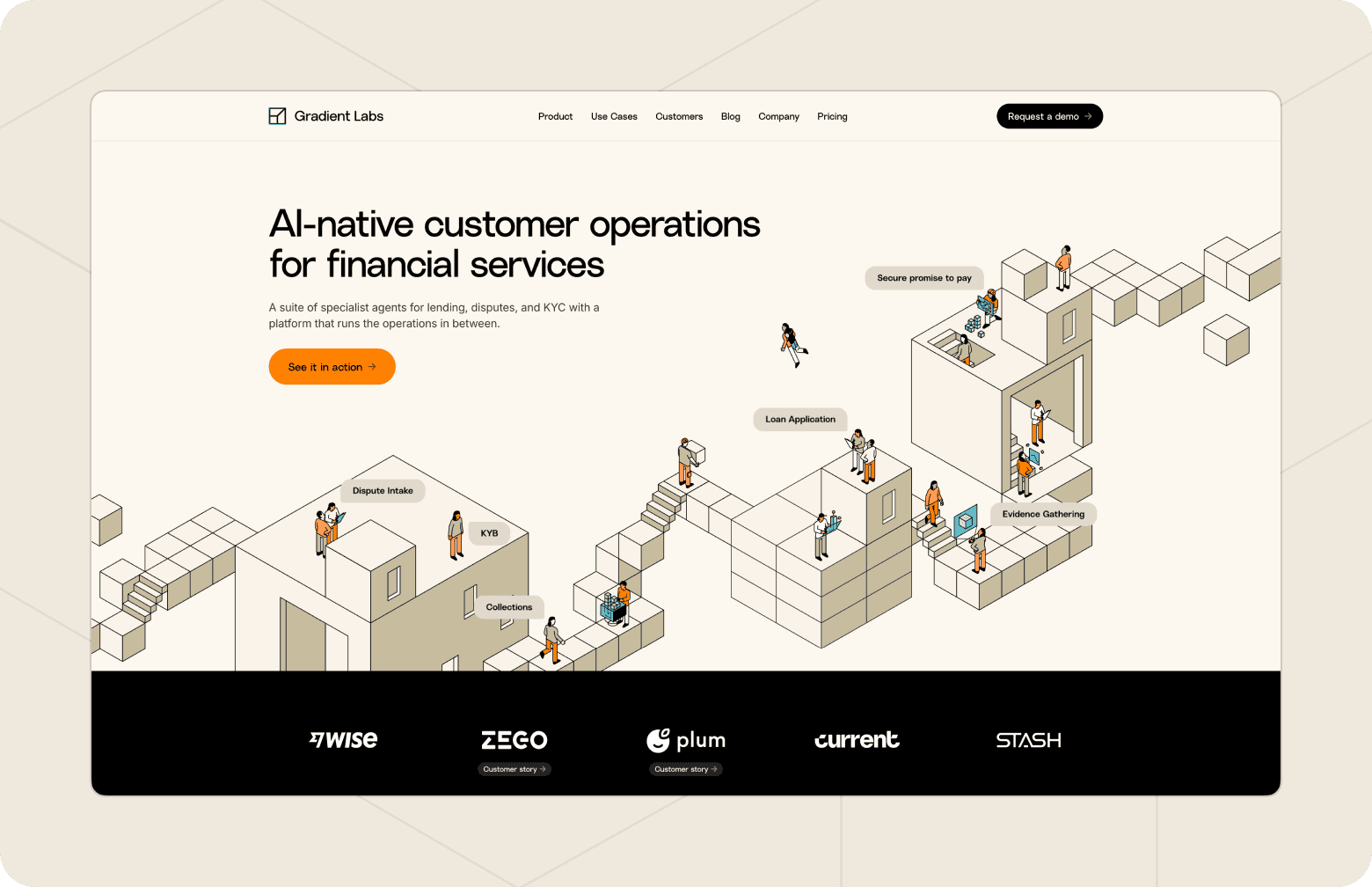
Gradient Labs is an AI-native customer operations platform for financial services. Where the six platforms below detect risk or interpret rules, it runs the work that follows an alert: contacting the customer, collecting what is missing, moving the case to a decision before the deadline, and recording every step.
What it does: frontline conversations and back-office case work run on one platform, so a case that starts with a customer message and ends in a decision never gets handed across a gap. Named agents cover disputes, collections, and business verification.
Compliance posture: more than 20 financial services guardrails run on every turn. Customer guardrails detect complaints, vulnerability, and financial difficulty, then hand off or reroute. Agent guardrails catch tipping-off, false promises, disallowed terminology, and out-of-bounds advice, editing the draft before it reaches the customer. Regulatory coverage spans the UK (FCA Consumer Duty, CONC, Breathing Space), the US (FDCPA, TCPA, Reg F, UDAAP), and the EU (GDPR, EU AI Act). Gradient Labs is SOC 2 Type II certified, holds zero-day data retention agreements with every LLM sub-processor, and keeps a full audit trail of every action taken, data point referenced, tool executed, and reasoning step.
The proof: at SteadyPay, a UK lender, the agent now makes 33,000 outbound collections calls a month inside FCA compliance standards, converting 60% of engaged customers to a committed repayment date.
"Before Gradient Labs, we needed to find a way to reach our growing number of customers effectively. Now we make 33,000 calls a month, converting 60% of engaged customers to committed repayment dates, all within FCA compliance standards. It has fundamentally changed how we manage the collections layer of our lending infrastructure."
Violeta Filip, Head of Customer Experience, SteadyPay
Best for: banks, neobanks, lenders, and insurers whose compliance obligations generate customer contact and casework: complaints and vulnerability under Consumer Duty, card disputes on a Reg E deadline, KYC refresh, EDD document collection, and arrears.
Where it is not the right fit: Gradient Labs does not do transaction monitoring, and does not score or review your human agents. If your gap is detecting the risk rather than working the case that follows it, one of the six platforms below is the better buy.
Norm Ai: best for turning regulation into machine-readable rules
Norm Ai builds AI agents that embed law directly into automation systems, describing the work as the embedding of law into AI agents to automate legal and compliance tasks. The company says it serves institutions managing over $35T in combined assets, and has raised more than $140M from investors including Coatue, Bain Capital, and Citi Ventures.
Where it fits: the interpretation layer, and it is the clearest example of that layer in the market. Rather than flagging a transaction, a Norm Ai agent reads a rule and produces a control that other systems can apply.
Compliance posture: Norm Ai publishes a trust centre, and its public regulatory work runs unusually deep for a vendor at this stage. Delaware's Secretary of State engaged the company on a public-private partnership setting the regulatory parameters for autonomous AI companies.
Best for: legal and compliance teams at large regulated institutions with a wide rule estate to codify, particularly where the same obligation has to be applied consistently across many business lines.
Where it stops: interpretation produces the rule, not the resolved case. A codified control still needs a detection platform to apply it and an operations layer to work whatever it surfaces.
Hawk: best for AML detection a supervisor can interrogate
Hawk covers transaction monitoring, customer risk rating, customer screening against global sanctions, watchlist, PEP and adverse media databases, payment screening, an AML investigative agent, and SAR and CTR filing. The company raised a $56M Series C in 2025 led by One Peak, taking total funding to $83M, and names Ecobank, Worldline, and Synctera among more than 80 customers.
Where it fits: detection, with a strong secondary position in investigation through its AML investigative agent.
Compliance posture: explainability is the differentiator worth noting here. Hawk pairs every AI decision with an explanation an analyst can defend, and publishes model governance documentation built specifically for regulatory review. Deployment runs as SaaS or private cloud, which matters where data residency is a first-order requirement.
Best for: banks that need false positives down without losing the ability to explain a decision to a supervisor, and teams whose model risk function blocks black-box AML tooling.
Where it stops: Hawk tells you the alert is real. Contacting the customer, collecting the evidence, and closing the case around it stays with your team.
Sardine: best for fraud and AML signals on one platform
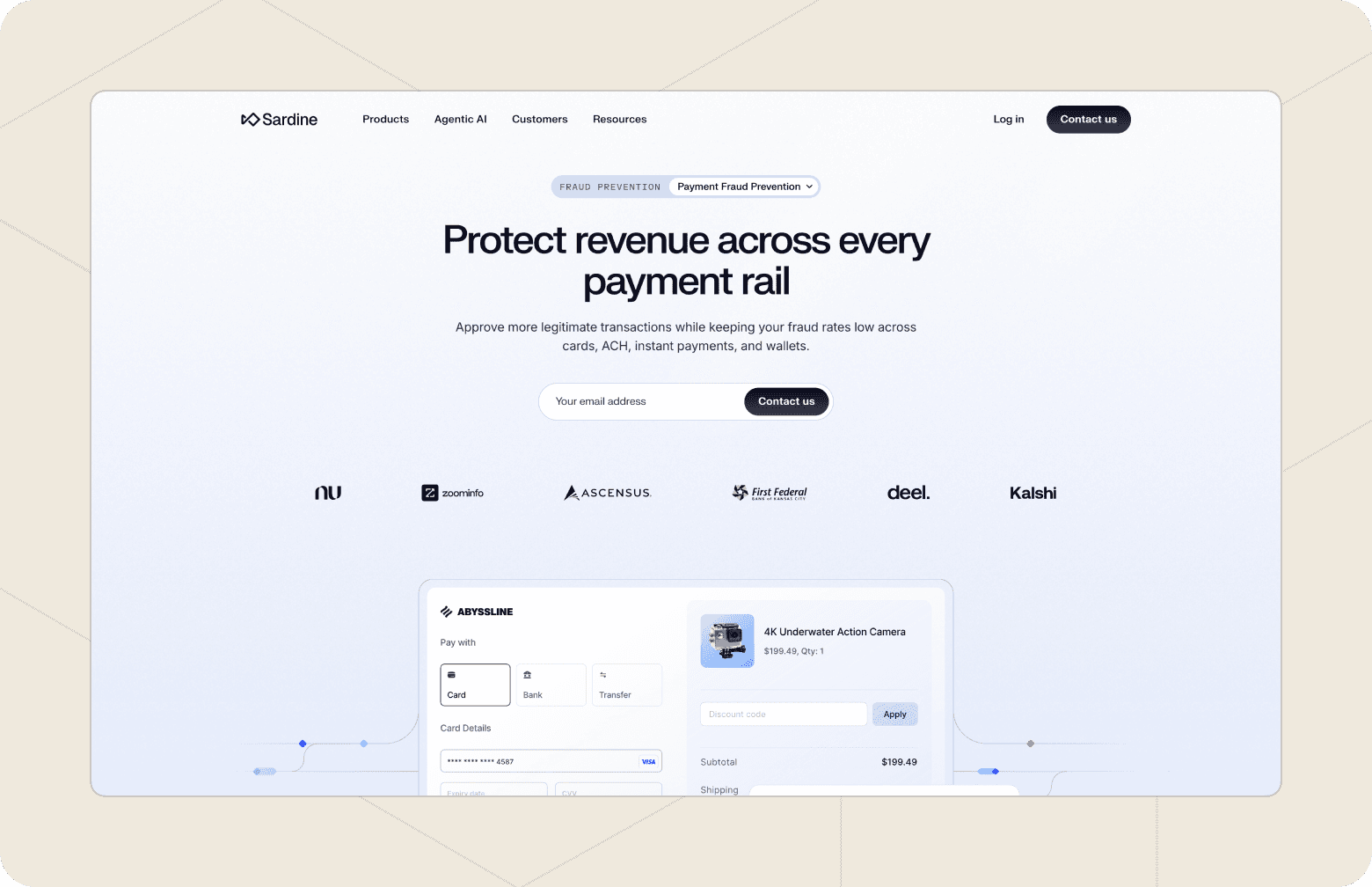
Sardine combines device intelligence and behaviour biometrics with fraud detection, AML transaction monitoring, sanctions screening, PEP detection, customer risk rating, case management, and KYC and KYB verification. Its agent set includes an OSINT search agent, a business due diligence agent, a sanctions screening agent, and a SAR generation agent. Sardine raised a $70M Series C in 2025 led by Activant, bringing total funding to $145M, and works with more than 300 companies including FIS, Deel, and GoDaddy.
Where it fits: detection, with the widest signal coverage of anyone on this list. The device and behaviour layer is genuinely distinctive, and useful well beyond AML.
Compliance posture: screening covers global sanctions lists, watchlists, PEP lists, and adverse media, and the SAR generation agent takes the drafting burden off analysts.
Best for: banks and merchants that would rather run fraud and financial crime on one signal platform than stitch two together, particularly where scams and AI-driven attack patterns are the live problem.
Where it stops: breadth across detection does not extend into the regulated customer conversation. A vulnerability disclosure mid-conversation, or a Consumer Duty obligation triggered by what a customer says, sits outside what a risk platform is built to handle.
Unit21: best for detection and regulatory filing in one place
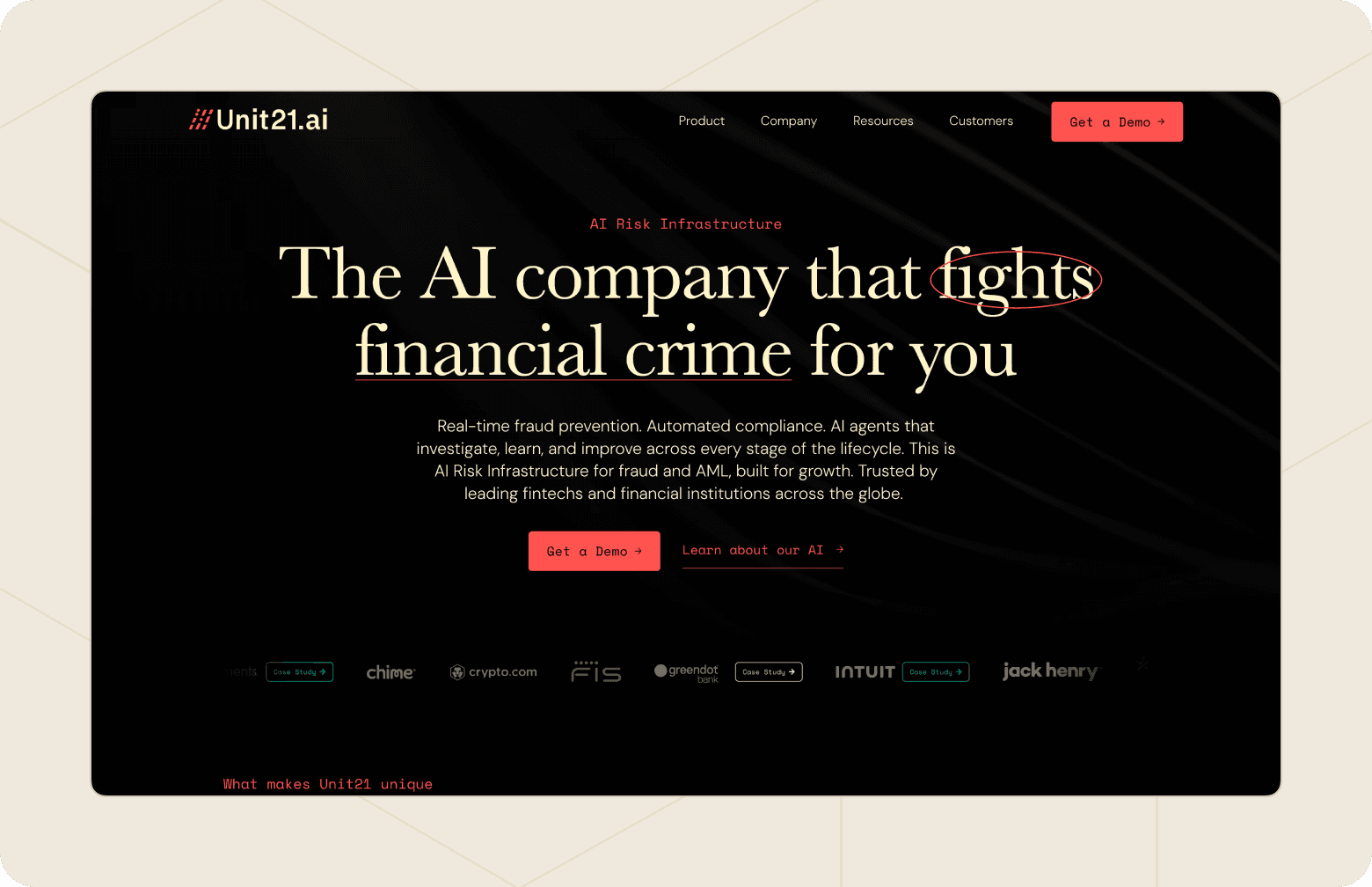
Unit21 provides AI risk infrastructure spanning real-time monitoring across RTP, FedNow, ACH, cards and crypto, device intelligence, transaction monitoring, case management with graph analysis, payment and sanctions screening, customer risk rating, and regulatory filing. Its AI agents cover detection and investigation, including automated case analysis and narrative generation. The company raised a $45M Series C in 2023, taking total funding to roughly $92M, and serves more than 200 customers including Intuit, Chime, and Sallie Mae.
Where it fits: detection through to filing, which is a wider span than most of the field.
Compliance posture: the most explicit of any vendor here. Unit21 publishes SOC 2 and GDPR on its own site alongside third-party security assessments, and names FinCEN, OFAC, NACHA, and MiCA directly. Filing coverage runs to SARs, STRs, CTRs, 314(a) requests, and goAML.
Best for: US risk teams that want one platform to detect, investigate, and file, and that value a vendor naming the specific regimes it supports.
Where it stops: the filing is the regulatory output, not the customer outcome. Where an alert requires you to contact a customer, request documents, or explain an account restriction, that work stays manual.
Lucinity: best for FinCrime investigation write-ups
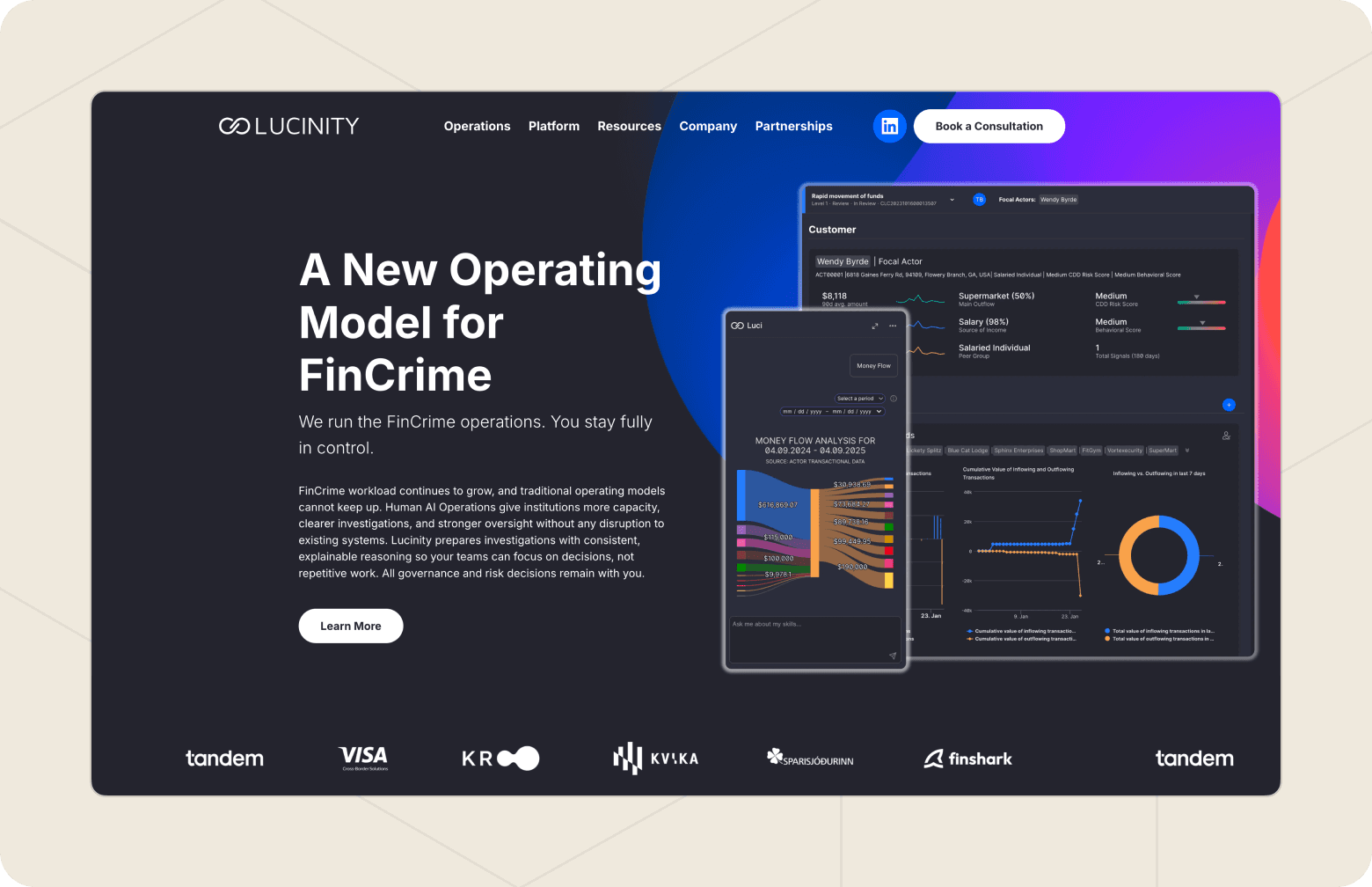
Lucinity pairs human and AI operations on a financial crime platform, with its Luci agent automating evidence gathering, analysis, and narrative creation so cases arrive consistent and ready for review. The platform also covers case management, scenario-based and AI-based transaction monitoring, SAR support, and a customer intelligence view combining KYC, transactional, and behavioural data. Lucinity has raised $26M in total, including a $17M Series B in 2022, and counts Pleo and Visa Currencycloud among its customers.
Where it fits: investigation, and specifically the write-up. The narrative is where FinCrime analyst time disappears, and where quality varies most between analysts.
Compliance posture: Lucinity maintains a separate security portal, and the case for the product rests on reporting quality. Consistent, complete narratives improve the SAR itself, which is what the UK Financial Intelligence Unit has repeatedly asked reporters for.
Best for: FinCrime teams whose backlog is a writing backlog, and banks under pressure to raise SAR quality rather than volume.
Where it stops: Lucinity is deliberately narrower than the platforms above. It sharpens the investigation rather than replacing detection, and it does not touch the customer.
Oscilar: best for unified risk decisioning
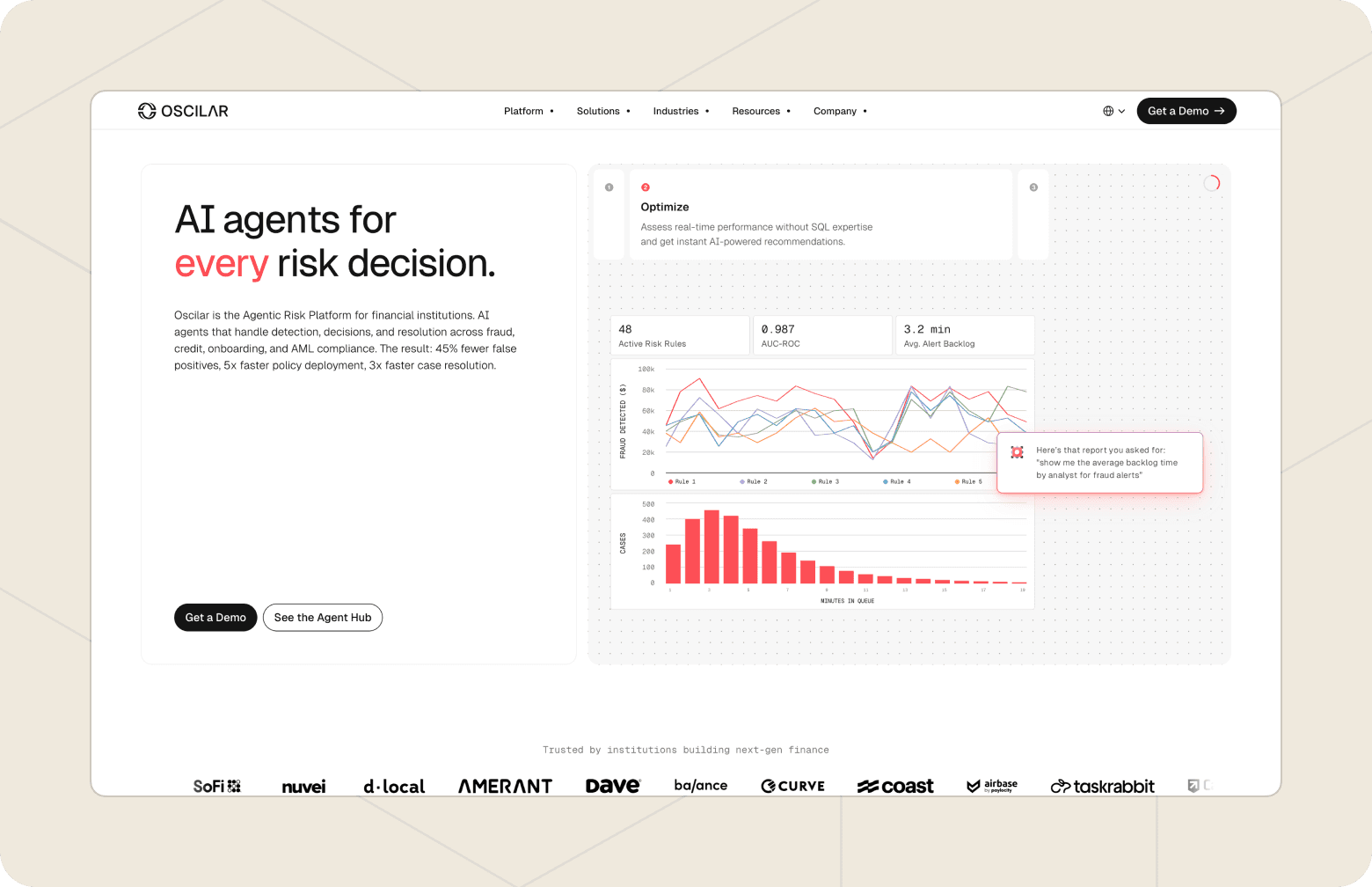
Oscilar unifies fraud, credit, and compliance on an AI-native risk decisioning platform, with agents handling detection, decisions, and resolution across fraud, credit, onboarding, and AML. Coverage spans account opening fraud, account takeover, transaction fraud, first-party fraud, scam identification, B2C and B2B credit underwriting, portfolio monitoring, AML screening, sanctions and PEP screening, and CTR and SAR filing. The company is bootstrapped with no outside funding, and works with more than 100 companies including SoFi, MoneyGram, and Nuvei.
Where it fits: detection and decisioning, across a wider set of decisions than the AML-focused platforms above.
Compliance posture: Oscilar names FinCEN 314(b) and forthcoming NACHA rule changes in its own material, and includes more than 13 agents covering narrative generation and translation.
Best for: teams tired of running separate decisioning stacks for fraud, credit, and compliance, particularly fintechs and sponsor banks where the same customer triggers all three.
Where it stops: unified decisioning still produces decisions. Explaining a declined application, collecting a document to reverse it, or handling the complaint that follows remains operational work.
Which AI platform should your compliance team choose?
Start by deciding what you want to automate. Pick the process where the manual work is heaviest and the cost of getting it wrong is highest, then buy for that process.
Six scenarios cover most of what banks are trying to fix:
Your AML analysts work through alerts that mostly turn out to be nothing: that is a detection problem. Choose Hawk if your model risk function needs every decision explained, or Sardine if you want fraud and AML signals on one platform.
Your analysts spend longer writing cases up than investigating them: Lucinity targets the narrative directly, and consistency across write-ups raises the quality of the SAR itself.
You report into several regimes and the filing is manual: Unit21 covers SARs, STRs, CTRs, and 314(a) requests alongside detection.
Fraud, credit, and compliance each run on their own decisioning stack: Oscilar unifies the three, which matters most where the same customer triggers all of them.
The same obligation has to be applied consistently across many business lines: Norm Ai is the only platform here built to codify a rule once and apply it everywhere.
The work is customer contact: complaints and vulnerability under Consumer Duty, card disputes on a Reg E deadline, KYC refresh, EDD document collection, and arrears calls. That is the operations layer, and it is where Gradient Labs runs. It is also the layer most banks have never bought for, which is why complaint and dispute volumes still land on human desks.
A separate ranking of the best back office AI platforms covers the operations layer in more depth, and a comparison of AI customer support for regulated industries goes deeper on how to assess a vendor for regulated conversations.
Most banks will end up buying in two layers rather than one, because a platform in one layer does not remove the work in another. Detection tells you the case exists, and operations closes it.
Want to see what the operations layer looks like on your own compliance workload? Book a demo.


Elizabeth Shew leads Brand and Advocacy at Gradient Labs, where AI agents handle customer support and back-office work for banks, lenders, and fintechs. Before that, she led customer marketing at Mastercard and built Dynamic Yield's customer marketing programme from the ground up, a decade spent turning customer results into industry-shaping stories. She writes about how support and operations teams actually put AI and technology to work. Before tech, she was a professional dancer in NYC.