
Salient built its agents inside American consumer lending operations, and you can see where they were built: five named agents covering servicing, collections, regulatory audit, total-loss claims, and disputes, with $75M raised behind them. So why do lenders search for Salient alternatives? Because two questions sit outside what a US loan-servicing specialist answers. A lender operating in the UK or the EU needs conduct evidence Salient publishes no track record on, and a lender that is also a bank, a card issuer, or a neobank runs a customer operation that carries on well past the loan book. This guide compares Gradient Labs and Salient head to head, then maps the tools that complete the stack around either one.
How does Gradient Labs compare to Salient?
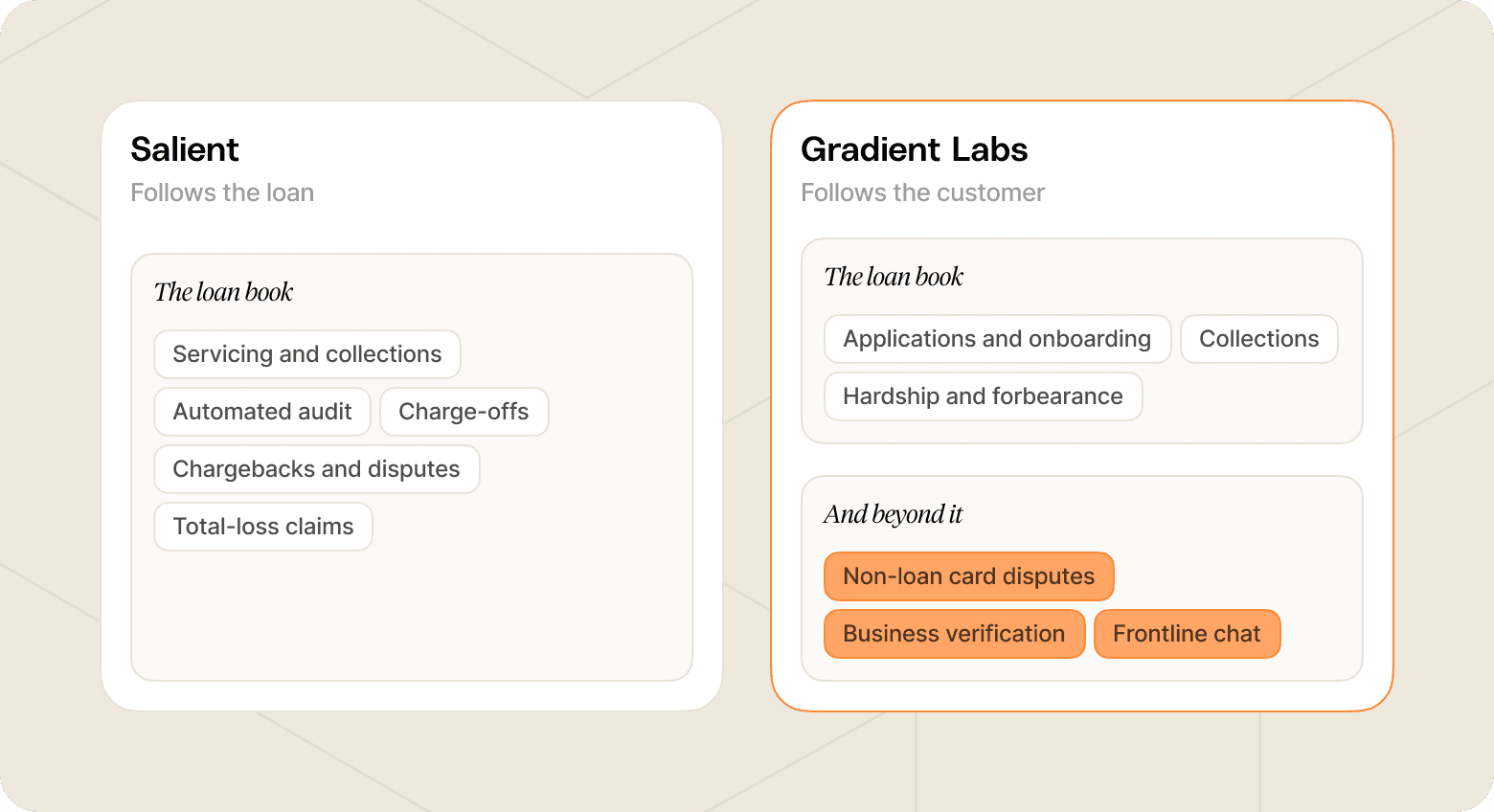
The verdict: Gradient Labs is the Salient alternative for lenders whose borrowers sit outside the United States, and for lenders whose customers are more than borrowers. The same platform runs the borrower conversation, the back-office case it creates, and the rest of the customer operation around it, with more than 20 financial services guardrails vetting every turn across UK, US, and EU regimes. Salient remains a strong pick for a US consumer or auto lender that wants deep servicing and collections automation and nothing outside the loan book.
The resolution column comes with a caveat. Salient reports outcomes a servicing team recognises, such as right-party contact rate and audit coverage, per customer rather than across its base. Our figure counts borrower cases closed end to end, including the back-office steps that never reach a phone call, so the two numbers answer different questions.
Platform | Resolution rate | Compliance posture | Deployment time | Pricing model | Best for |
|---|---|---|---|---|---|
Gradient Labs | 60% from day one, 80–90% in mature deployments | 20+ FS-native guardrails on every turn; SOC 2 Type II; FCA Consumer Duty, CONC and Breathing Space, FDCPA, TCPA, Reg F and UDAAP, GDPR and the EU AI Act | 4–6 weeks to production; CSV-only outbound collections live in a day; AI delivery team runs the migration | Per resolution, with a deployment guarantee | Lenders and multi-product financial services firms running the borrower lifecycle and the wider customer operation on one platform |
Salient | No published resolution rate; customer results cover right-party contact and audit coverage, including a 34% increase in right-party contact at Westlake Financial | Built around US supervision: FDCPA, TCPA, CFPB expectations, and state-level rules. No published UK or EU conduct coverage | Not published; pilots co-designed with the lender's risk, compliance, and operations teams | Not publicly listed | US consumer and auto lenders automating servicing, collections, and regulatory audit |
Why look for a Salient alternative?
Salient is built for the way its launch partners work: large US consumer lenders, examined by US regulators, running servicing and collections at volume. For a lender that matches that description, the fit is close. Three questions get harder to answer as soon as the lender sits slightly outside it.
The regulatory surface is drawn around the United States: Salient describes its compliance as designed around how lenders are actually supervised and examined, from CFPB expectations to state-level rules, and Taylor 2.0 carries native FDCPA, TCPA, and CFPB coverage. That is the right regime map for an American lender and the wrong one for a British or European one. A UK collections call has to recognise a vulnerable borrower mid-conversation, apply FCA Consumer Duty outcomes, stay inside CONC, and stop the moment a borrower enters Breathing Space. In the EU, an agent that informs a lending decision about an individual falls under Annex III of the EU AI Act, with logging, human oversight, and explanation obligations attached. None of that is a translation job. It is a different conduct model, and the FCA found 7.4 million UK adults struggling to pay bills and credit commitments in its most recent Financial Lives survey, which is the volume those rules exist to protect.
The agents follow the loan, not the customer: Taylor, Marshall, Flyn, Alex, and Melanie each own a stage of loan servicing, and the set stops where the loan book stops. A neobank with a credit product, an embedded lender inside a payments business, or a card issuer with an instalment offering runs one operation across borrowing and everything else the customer does, and wants one AI customer service agent covering all of it. The frontline chat, the KYB review, the card dispute that has nothing to do with a loan, the ISA transfer waiting on a counterparty: none of that is in scope for a loan-servicing specialist, so it goes to a second vendor or stays manual.
Auto and specialty finance shaped the product: Salient's two published case studies are Westlake Financial, a captive auto lender, and American Credit Acceptance, a specialty auto finance company, and its solutions pages address banks and credit unions, captive lenders, and specialty finance. Serving US auto finance that well is a real achievement, and it also sets what gets built next. A GAP claim deadline engine and a total-loss appraisal clause are precisely what an auto lender needs, and neither moves an unsecured consumer lender or a fintech any closer to production.
Why trust Gradient Labs?
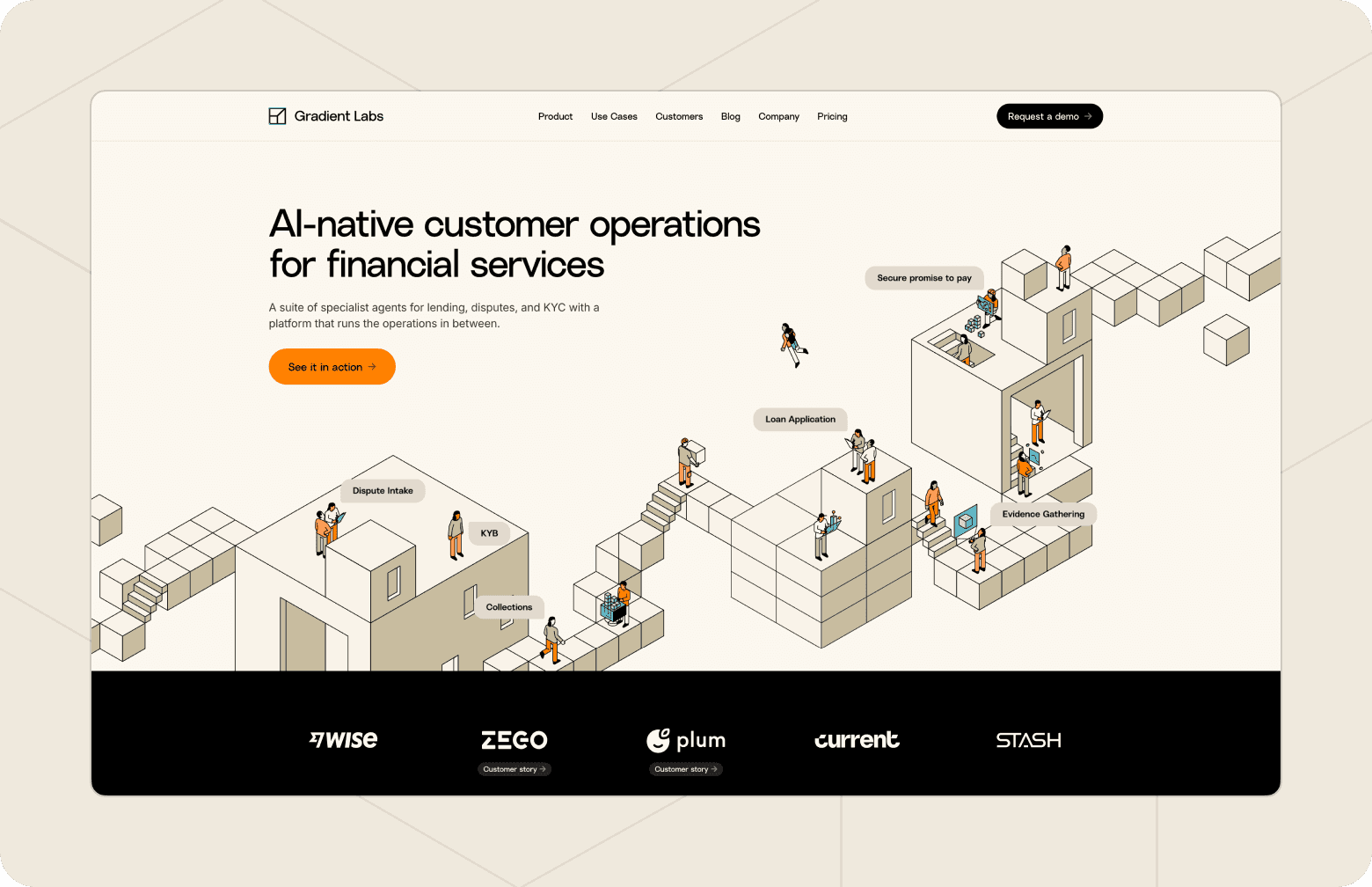
Lenders, banks, insurers, and fintechs run their customer operations on us in production today, and they let us say so: Wise, Pockit, Yonder, Zego, Plum, and Morse. At Yonder, 85% of collections is now processed by the agent, which also runs disputes and frontline support on the same platform, and that multi-product picture is exactly what a loan-servicing tool cannot cover. The reason we can do this work is the team: the founders built and ran the data and AI organisation at a large UK neobank, past 120 people, under FCA supervision, and almost every engineer here arrived from a financial services company.
One of our lending customers describes the change in her own words:
"Before Gradient Labs, we needed to find a way to reach our growing number of customers effectively. Now we make 33,000 calls a month, converting 60% of engaged customers to committed repayment dates, all within FCA compliance standards. It has fundamentally changed how we manage the collections layer of our lending infrastructure."
Violeta Filip, Head of Customer Experience, SteadyPay
Our agents place more than 100,000 outbound voice calls a month across customers, recovering at a rate that matches human collectors rather than trailing them. There is a guarantee attached to all of it. Scope a use case with us, and if the agent misses the result we agreed on, we refund the fee.
What is Salient and how does it work?
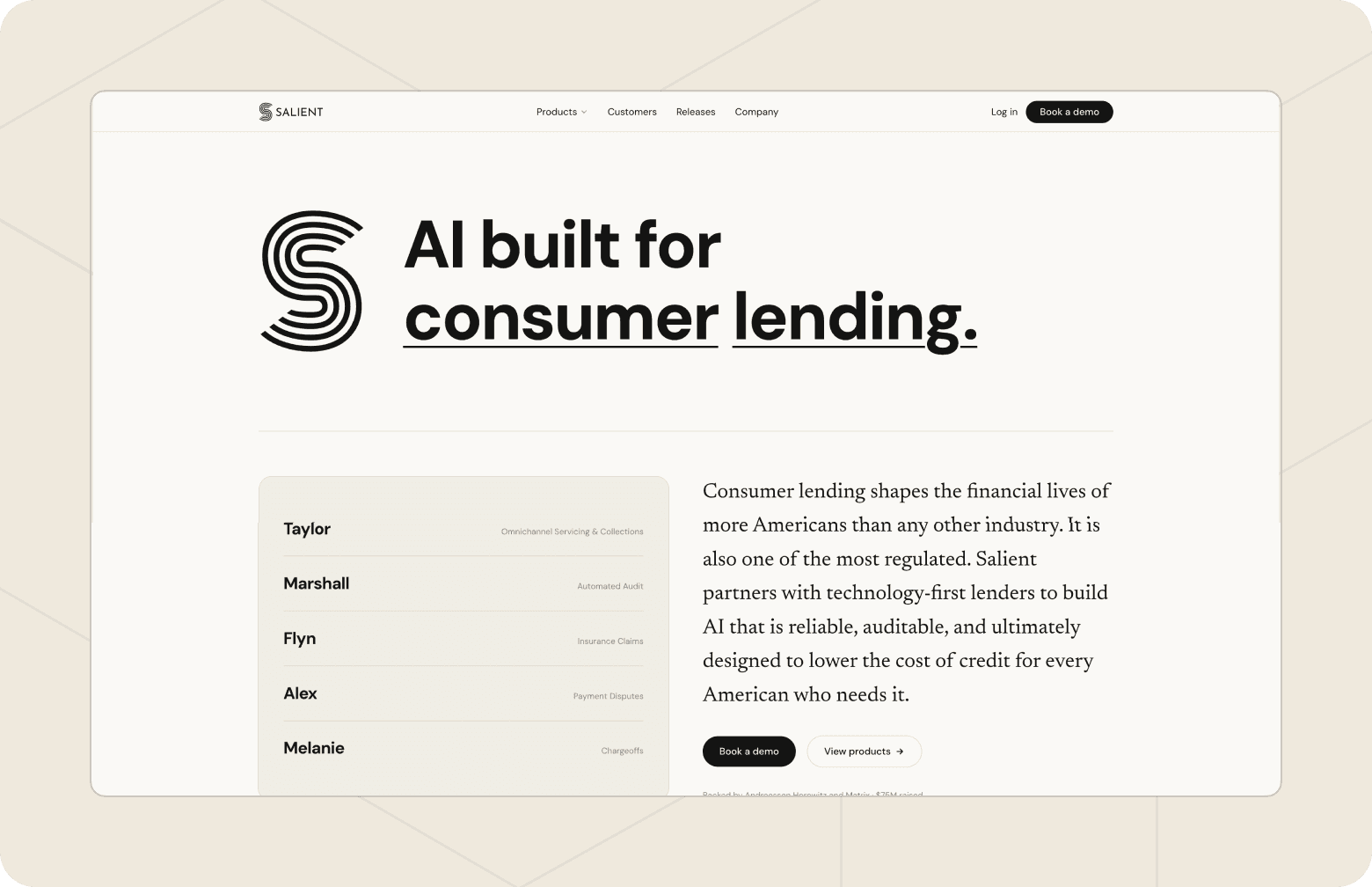
Salient is an AI-native loan servicing platform for US consumer lenders. Arijit Malik, previously in sales and finance at Tesla and investment banking at Goldman Sachs, and Mukund Tibrewala, previously a tech lead at Airtable and Dropbox, founded it in the third quarter of 2023 and built it inside the operations of large American lenders rather than in a lab. It has raised $75M in total, with Andreessen Horowitz leading a $60M Series A alongside Matrix Partners and Y Combinator, and the company says it is the most widely deployed consumer finance AI in the United States, touching more than 1.5 million Americans every day.
The product is a set of five named agents rather than one general one:
Taylor: omnichannel servicing and collections across voice, text, email, and web chat, covering payments, due-date changes, extensions, and payoffs.
Marshall: automated audit, enforcing controls against a live repository of state and federal law and producing an exam-ready trail on demand.
Flyn: total-loss insurance claims, including GAP claim automation and appraisal-clause deadlines.
Alex: chargebacks and payment disputes.
Melanie: chargeoffs.
Published results come from individual case studies rather than a benchmark across the base. Westlake Financial deployed Taylor across its outbound collections portfolio and reported a 34% increase in right-party contact rate within 60 days, without changing its core servicing system. American Credit Acceptance moved from a 3% manual audit sample to Marshall reviewing 100% of interactions ahead of a regulatory examination. JPMorgan Chase selected Salient for its Hall of Innovation Award. Pricing is not published.
Why do lenders look beyond Salient?
Start with what Salient gets right, because a fair reading matters here. Automated audit is the sharpest idea in the set: sampling 3% of interactions is how most servicers still evidence compliance to an examiner, and moving that to full coverage genuinely changes the conversation in an exam. Borrower-level memory across promises to pay, hardship conversations, and prior disputes is also the correct architecture for collections rather than a bolt-on, and the company states plainly that its compliance model follows US supervision rather than implying wider coverage it has not built.
The reason lenders keep shortlisting other vendors is scope, not execution. One jurisdiction in the regime map, one product line in the agent set, and the deepest customer evidence concentrated in US auto finance: all three are defensible choices for a specialist serving American lenders, and all three land as unbudgeted work on a team operating across markets or products. Absorbing that work is what a purpose-built Salient alternative is for.
What should replace Salient for a multi-market lender?
Gradient Labs is an AI-native customer operations platform, built for finserv from the ground up. Three things change once a lender moves across.
The whole borrower journey, then everything after it: the agent chases incomplete applications, onboards new borrowers, supports active ones, runs outbound collections and the inbound queries that follow, and completes hardship assessment and forbearance when a borrower says they cannot pay. The same platform then handles the card dispute, the business verification, and the frontline chat that have nothing to do with the loan. Specialist agents share memory and context across every stage of the lifecycle, which is why a borrower who set out their circumstances on a hardship call in March does not repeat the story to a chargeback agent in June.
Three regimes live inside the product rather than inside your configuration: more than 20 financial services guardrails inspect every turn before a borrower hears a word, screening for complaints, vulnerability, hardship signals, and advice the agent has no business giving. UK coverage runs to FCA Consumer Duty, CONC, and Breathing Space; US coverage to FDCPA, TCPA, Reg F, and UDAAP; EU coverage to GDPR and the AI Act. Behind all of it sits a full audit trail on every action, SOC 2 Type II certification, and zero-day data retention agreements with each LLM sub-processor.
Your collections lead can own this without borrowing an engineer: our finserv-native AI delivery team runs the migration off whatever you use today and gets to production in four to six weeks, and a CSV-only outbound campaign can be dialling within a day of signing, with no integration work at all. Procedures in a regulated lender then keep moving, from a new Consumer Duty outcome to a reworded scheme reason code, and keeping up with them is our job rather than a standing ticket in your engineering backlog.
Expect roughly 60% resolution in the first weeks and 80–90% once the deployment matures, a climb the delivery team drives by adding integrations, tightening procedures, and bringing new work live while the agent already carries volume. The Lending Agent also handles more than 30 languages and regional accents out of the box, from Castilian to regional UK dialects, so a lender operating across several European markets buys one deployment rather than one per country.
Where Gradient Labs is the wrong choice: if you are a US-only auto or specialty finance lender whose priority is total-loss claims automation or LMS-level audit coverage, Salient has built for that exact operation and will serve you better than we will. We are the right answer when borrowers sit in more than one jurisdiction, or when the customer relationship runs wider than the loan.
Which tools complete the lending stack?
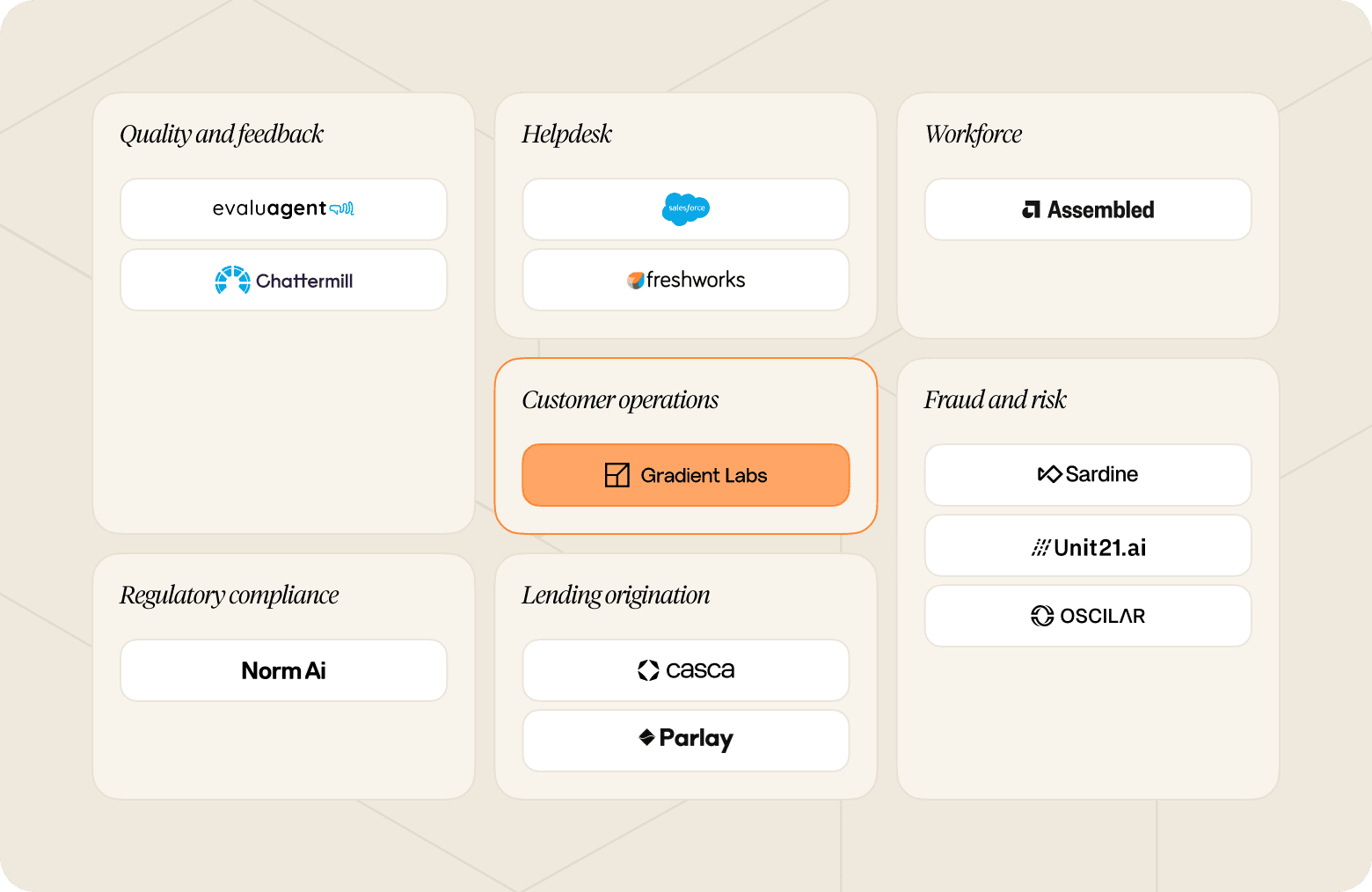
Replacing the agent that speaks to your borrowers does nothing to the rest of the lending operation. Most AI agent companies are competing over that conversation, while the tools below own the decisions, checks, and evidence sitting either side of it, and none of them competes with Gradient Labs. A well-built lending stack pairs one customer operations agent with a handful of them.
Company | What it does | Where it fits | Best for |
|---|---|---|---|
Salesforce Service Cloud / Freshworks | Helpdesk and CX platform | Where the agent deploys, so no replatforming is needed | Teams keeping their existing helpdesk |
Casca | AI-native loan origination | SBA and business lending intake, ahead of servicing | Banks digitising origination |
Parlay | Loan-readiness intelligence | Qualifying applicants before they reach underwriting | Community banks and credit unions |
Oscilar | AI risk decisioning hub | Credit, fraud, and onboarding decisions the agent works around | Risk teams consolidating tools |
Sardine | Fraud, AML, and compliance platform | Risk decisions beside the servicing workflow | Fraud and FinCrime teams |
Unit21 | Agentic fraud and AML monitoring | Monitoring transactions and cases behind the servicing book | Risk ops at scale |
Norm Ai | Regulatory compliance agents | Converting new rules into checks the operation can run | Compliance teams working under changing regulation |
EvaluAgent | Automated QA scoring of every conversation | QA evidence in regulated contact centres | FCA-regulated collections teams |
Chattermill | Voice of customer analytics | Turning borrower feedback into operational decisions | Lenders operating across several markets |
Assembled | Workforce management | Sizing the collections team automation leaves behind | Collections and support teams rebalancing headcount |
Two of those layers do the heaviest lifting once borrower conversations run themselves. Evidence matters first, because customer support automation at scale turns QA into the artefact your risk committee asks for: EvaluAgent scores every voice, chat, and email conversation instead of a sample, and Chattermill consolidates borrower feedback across markets and languages. Decisions matter next, since Casca and Parlay own the origination call, and Oscilar, Sardine, Unit21, and Norm Ai each own a risk or regulatory judgement our agent has to route around rather than make itself. The best secure AI agents for banking covers that layer properly, funding and named customers included.
Choosing the right Salient alternative
For a US auto or consumer lender that wants servicing, collections, and audit automated by a team that learned the work inside a servicer, Salient will do the job, and it will do it well. The decision looks different once borrowers sit under more than one regulator, or once those borrowers also hold a card, an account, or a policy with you.
Gradient Labs was built for that second operation, and moving is cheaper than it looks, because your servicing system and your helpdesk both stay exactly where they are and the deployment carries a guarantee. If you are still building the shortlist, the best AI agents for lending ranks the wider field by the job each agent owns, choosing an AI agent vendor for financial services sets out the questions to put to every name on it, and evaluating AI agents in financial services covers what to measure once a pilot starts.
Book a demo and we'll run the numbers on one of your own portfolios.


Elizabeth Shew leads Brand and Advocacy at Gradient Labs, where AI agents handle customer support and back-office work for banks, lenders, and fintechs. Before that, she led customer marketing at Mastercard and built Dynamic Yield's customer marketing programme from the ground up, a decade spent turning customer results into industry-shaping stories. She writes about how support and operations teams actually put AI and technology to work. Before tech, she was a professional dancer in NYC.