
Lorikeet built its product for the tickets other AI agents hand straight to a human: replacing a lost card, chasing a payment that never arrived, unpicking a claim. That focus has taken it a long way, and QED Investors led a $35 million Series A on the strength of it. So why do operations leaders at banks, lenders, and fintechs still search for Lorikeet alternatives? Because complex support and regulated customer operations are different jobs. A card dispute, a collections case, or a business verification runs for weeks past the conversation that opened it, under conduct rules a support platform doesn't publish coverage for. This guide compares Gradient Labs and Lorikeet head to head for financial services, then maps the tools that complete the stack around whichever agent you choose.
How does Gradient Labs compare to Lorikeet?
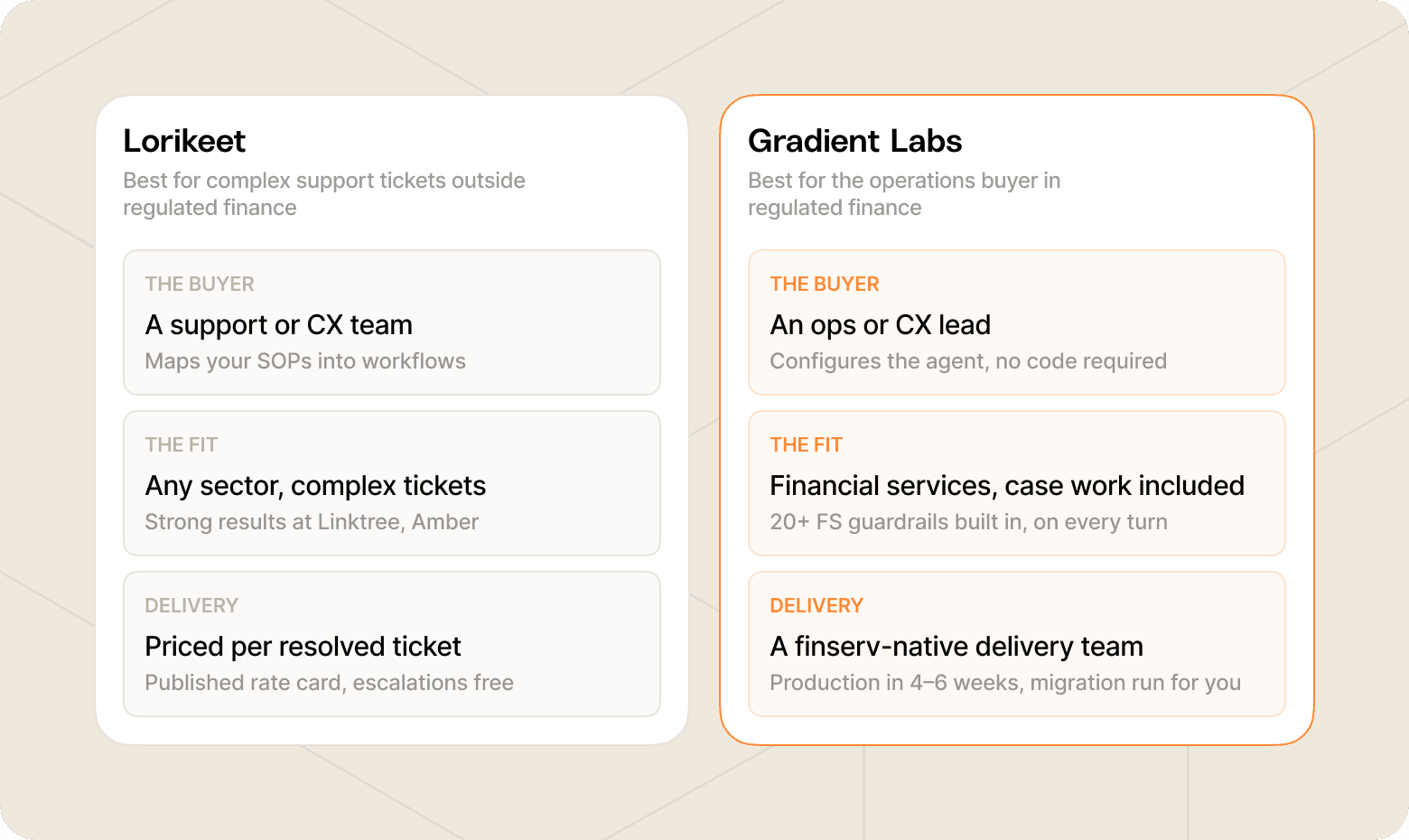
The verdict: Gradient Labs is the Lorikeet alternative built for financial services. The same platform answers the customer on the frontline and then does the work that conversation created, across disputes, collections, and KYC, with more than 20 financial services guardrails vetting every turn and an AI delivery team carrying the migration instead of your engineers. Lorikeet stays a credible pick for a business whose hardest tickets sit outside regulated finance and that wants one concierge on every channel.
Read the resolution column carefully, because the two rows measure different things. Lorikeet's published figures are customer-reported and cover support tickets, with each customer setting the bar for what counts as resolved. Gradient Labs counts cases closed end to end inside financial institutions, the back-office steps included.
Platform | Resolution rate | Compliance posture | Deployment time | Pricing model | Best for |
|---|---|---|---|---|---|
Gradient Labs | 60% from day one, 80–90% in mature deployments | 20+ FS-native guardrails on every turn; SOC 2 Type II; UK, US, and EU conduct coverage | Live in weeks; AI delivery team runs the migration | Per resolution, with a deployment guarantee | FS firms running frontline and back-office work on one platform |
Lorikeet | No published resolution rate; customer-reported results cover routing accuracy and response speed | SOC 2 Type II, ISO 27001:2022, HIPAA with BAAs, GDPR; runtime guardrails detect sensitive topics and escalate | Not published; implementation maps your SOPs into Lorikeet workflows | Per resolved ticket, published: $0.80–$0.95 chat, email, and SMS, $1.20–$1.50 voice, plus a monthly platform fee | Frontline support tickets in fintech, healthtech, and consumer apps |
Why look for a Lorikeet alternative?
Lorikeet is built for the way its best customers work: complex, action-heavy tickets answered on whatever channel the customer reached for. For a company with hard support and nobody asking how each reply was reached, that model fits well. An ops or CX leader weighing AI for customer support inside a regulated operation answers a different set of questions, and three of them are hard to answer with a support platform.
Compliance depth stops at the certificate: Lorikeet publishes SOC 2 Type II, ISO 27001:2022, HIPAA, and GDPR attestation on its trust page, signs business associate agreements for healthcare customers, and holds zero-data-retention agreements with its model vendors. That posture clears a security questionnaire without answering the conduct question. A UK lender's agent has to recognise a vulnerable customer mid-conversation, log a complaint that FCA Consumer Duty obliges it to log, and stay inside CONC and Breathing Space when a borrower says they can't pay this month. Lorikeet's published guardrails detect sensitive topics and escalate to your team, which is sensible generic behaviour, and it leaves every regime-specific rule for your team to write and then maintain.
The roadmap answers to fintech and healthtech together: Lorikeet sells to both, and its own customer wall spans creator platforms, payroll, energy, and crypto marketplaces alongside them. Serving that spread well is a genuine achievement, and it also sets what gets built next. HIPAA coverage and signed BAAs are exactly what a healthtech buyer needs, and none of that work moves a bank's risk committee closer to sign-off.
The unit of work is the ticket: Lorikeet's published rate card bills per resolved chat, email, SMS, or voice ticket and doesn't charge for escalations, which is a fair deal for the buyer. It also describes the shape of the product. A card dispute takes around 60 days from intake through investigation, chargeback submission, and customer follow-up, and a lending relationship runs across application, repayment, and collections for years. Plenty of financial services work has no customer in the conversation at all: an ISA transfer-out sitting in a queue, a KYB review waiting on one document, a chargeback that has to reach the card network before a scheme deadline. Generic customer service AI typically maxes out around 60% automation on a complex financial services operation, because the remaining work never arrives as a ticket, and that residue is where the back office AI platforms question starts.
Why Gradient Labs?
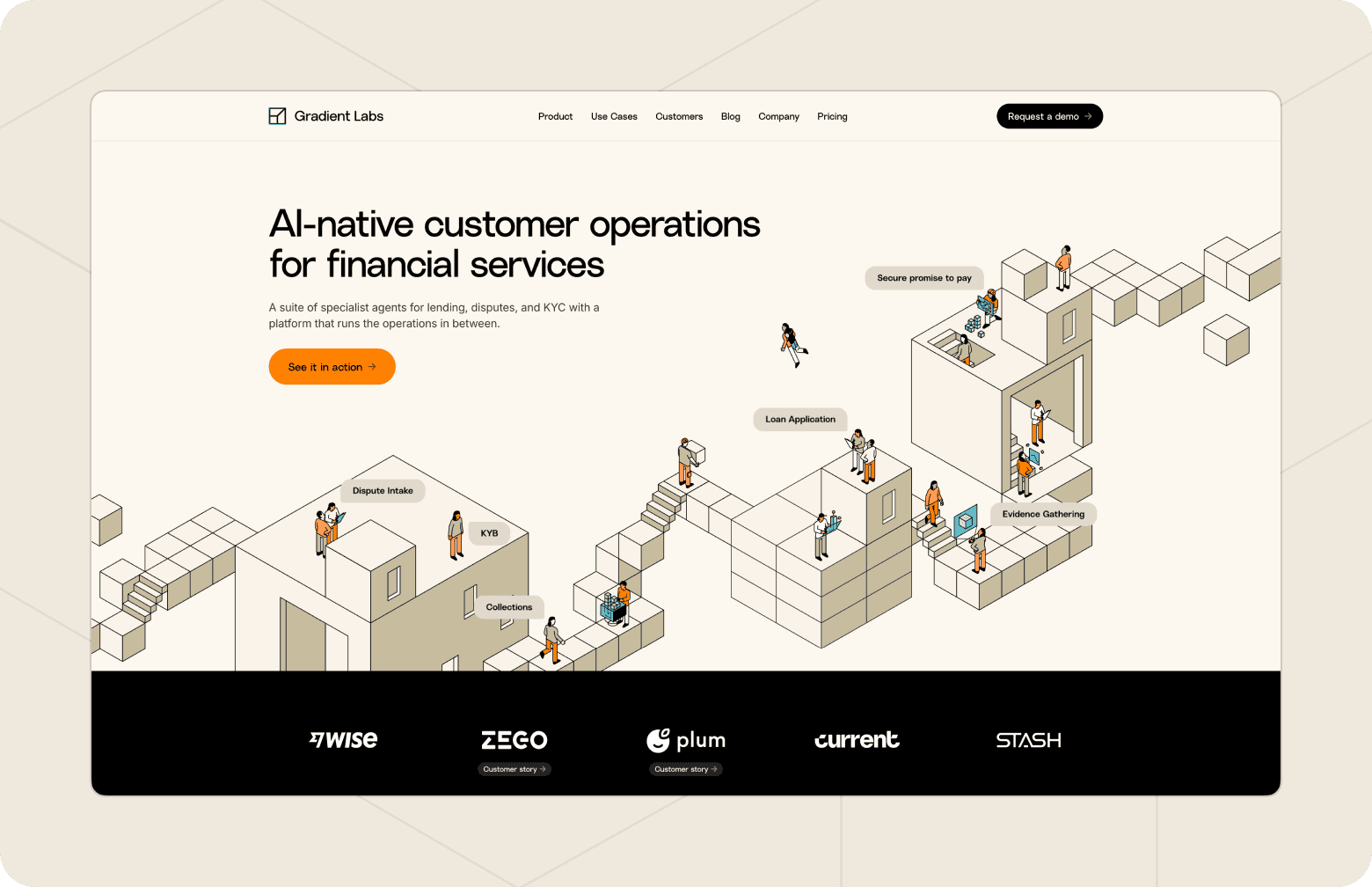
When it comes to finance, Gradient Labs has the receipts. Banks, lenders, insurers, and fintechs already run their customer operations on Gradient Labs. Wise, Pockit, SteadyPay, Zego, Plum, and Morse are all named publicly, and at a large European digital bank the agent has served half a million unique customers at a 98% quality assurance score, ahead of the human team it works beside. Almost every engineer here came from a financial services company, and the founders built and ran the data and AI organisation at a large UK neobank, past 120 people, under FCA supervision.
Customers put it better than a positioning line can:
"The game changer for us is that Gradient Labs' frontline and back office agents talk to each other and keep the full context of a case. If evidence is missing, the customer hears about it in the moment. We've used plenty of AI tools, and nothing else has come close to that, especially for disputes. It helps that Gradient Labs genuinely knows financial services; we're working with people who understand disputes as well as we do. Cases that took us the best part of a week to decide now take a day. Better for our customers, and better for our team."
Antony Atkins, Senior Escalations Manager, Yonder
Yonder holds an 80% one-touch rate on disputes, with 90% CSAT on the cases the agent handles itself. Every deployment carries a guarantee as well: scope the use case with us, and if the agent misses the result we agreed, you get your money back. The full set of published customer results sits on one page.
What is Lorikeet and how does it work?
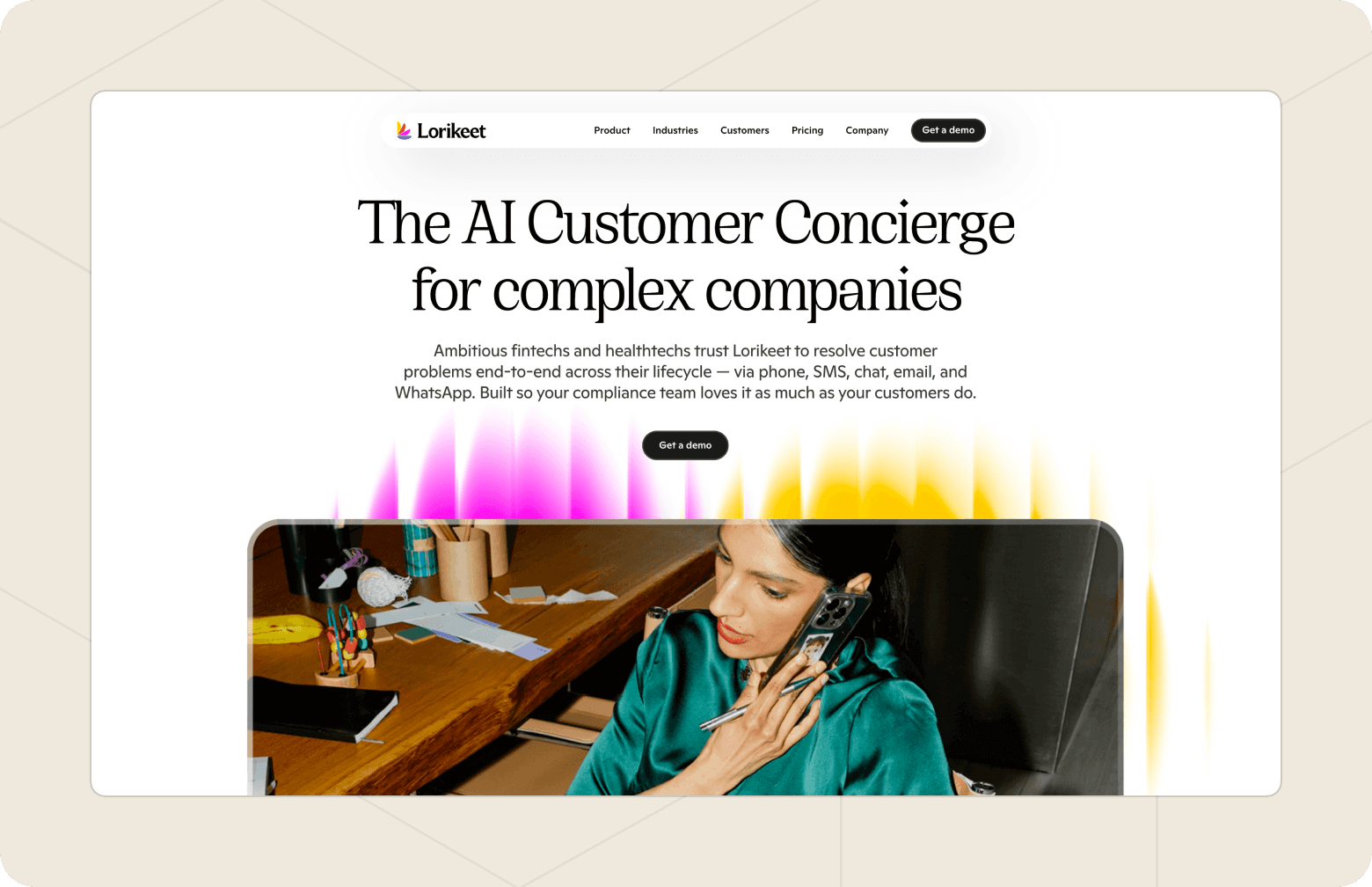
Lorikeet is an AI customer service agent, which the company calls a concierge, built for tickets that need work done rather than a better answer. Steve Hind, previously at Stripe, and Jamie Hall, previously an AI engineer at Google, founded it in Sydney and brought it out of stealth in October 2024 with a $5 million seed round reported by Fortune. QED Investors led a $35 million Series A in 2025, taking the total raised to roughly $50 million.
The product starts from your standard operating procedures. You map a procedure into a Lorikeet workflow, connect the systems the agent needs to touch, and it runs the steps in order: reading a record, calling an API, taking an action, and handing the case to a person when it hits judgement it doesn't have. It answers on chat, email, SMS, WhatsApp, phone, and voice, and integrates with the helpdesks, CRMs, and payment systems most support teams already run. A companion QA agent, Coach, scores conversations, human and AI alike.
Its published results come from individual case studies rather than a benchmark across the customer base: 99% accuracy routing tickets to the right team at Amber, the Australian energy retailer, and at Linktree a 60% uplift in conversion with first-response times cut from around 30 minutes to about one. Named customers include Linktree, Eucalyptus, the payroll platform Remote, and Amber. Pricing is published in full, which is rare in this category: $0.95 per resolved chat, email, or SMS ticket and $1.50 per resolved voice ticket on the entry plan, dropping to $0.80 and $1.20 at scale, on top of a monthly platform fee.
Why do teams look beyond Lorikeet for financial services?
Credit where it belongs: Lorikeet picked the right fight. Most customer support automation was built to deflect a question, and the tickets that cost a financial services operation real money need work done rather than a better answer. Lorikeet is also straighter with buyers than much of this category, publishing both its rate card and its certifications where others publish neither.
What sends a bank, lender, or insurer looking elsewhere is scope rather than quality. The agent is scoped to the ticket, the compliance evidence is scoped to security and healthcare, and the roadmap answers to two industries at once. Each of those is a fair trade-off for a platform serving complex support across several sectors, and each one arrives as work and risk on a financial services team. Taking that work away is the job of a purpose-built Lorikeet alternative.
What should replace Lorikeet for financial services?
Gradient Labs is an AI-native customer operations platform, built for finserv from the ground up. Three differences show up in practice.
One agent, the whole case: the customer conversation on chat and voice, then the investigation that conversation triggered, across disputes, collections, and business verification. Specialist agents share memory and context across every stage of the lifecycle, so someone who flagged a payment last Tuesday is never asked to explain it twice. That connected setup is what the Yonder dispute numbers above are measuring.
Conduct rules live in the product: more than 20 financial services guardrails vet every turn before a customer sees a word, watching for complaints, vulnerability, tipping-off, and advice the agent has no business giving. One of them checks what the agent said against what it actually did, so nobody is told their chargeback is filed when nothing reached the card network. The regimes covered run from FCA Consumer Duty, CONC, and Breathing Space in the UK to FDCPA, TCPA, Reg F, and UDAAP in the US, with GDPR and the EU AI Act on top. Every action is written to a full audit trail, under SOC 2 Type II certification and zero-day data retention agreements with each LLM sub-processor.
An ops lead owns it, and engineers join by choice: a finserv-native AI delivery team takes the migration from whatever you run now and reaches production in 4–6 weeks, then keeps going. Procedures in a regulated operation change constantly, from a new Consumer Duty outcome to evidence to a chargeback reason code the scheme has reworded, and that maintenance is our job rather than a standing ticket for your engineers. Teams that want deeper control still get it: bring your own guardrails, load proprietary policies and knowledge, and set the boundaries on what the agent may do.
Resolution starts near 60% and climbs to 80–90% as the delivery team wires in more integrations, sharpens procedures, and brings new work into production. On the outbound side, our customer service AI agents place more than 100,000 voice calls a month between them, and a CSV-only collections campaign can be dialling inside a day with no integration at all.
Where Gradient Labs is the wrong choice: if you run support for an energy retailer, a marketplace, a creator platform, or a healthtech, Lorikeet will serve you better than we will, and its published pricing makes the business case easy to build. We are the right answer when a regulator can ask how any single decision was reached, and when the work carries on long after the customer has stopped typing.
Which tools complete the stack around your AI agent?
Changing your AI customer service agent leaves the rest of the operation where it is. Plenty of AI agent companies are fighting over the frontline; the tools below own the checks, decisions, and evidence around it, and none of them competes with Gradient Labs. The strongest financial services operations run one agent next to a handful of these.
Company | What it does | Where it fits | Best for |
|---|---|---|---|
Salesforce Service Cloud / Freshworks / LiveChat | Helpdesk and CX platform | The system your AI agent deploys on; no replatforming needed | Teams keeping their existing helpdesk |
MaestroQA | Support QA scorecards and coaching | Proving agent quality, human and AI alike | Enterprise QA programmes |
EvaluAgent | Automated QA scoring of 100% of conversations | QA in regulated contact centres | FCA-regulated support teams |
Chattermill | Voice of customer analytics | Turning feedback into product and CX decisions | Fintechs consolidating feedback across markets |
Assembled | Workforce management | Balancing human and AI capacity after automation | Support teams rebalancing post-AI |
Guru | Verified knowledge management | Keeping the knowledge your agent answers from accurate | Compliance-conscious knowledge ops |
Glean | Enterprise search | Finding knowledge scattered across 100+ apps | Large orgs with fragmented knowledge |
Sardine | Fraud, AML, and compliance platform | Risk decisions beside the support workflow | Fraud and FinCrime teams |
Unit21 | Agentic fraud and AML monitoring | Transaction and case monitoring | Risk ops at scale |
Hawk | AML monitoring and sanctions screening | Explainable AI for FinCrime | Banks needing explainability |
Lucinity | FinCrime investigation copilot | Speeding investigator casework | AML investigation teams |
Norm Ai | Regulatory compliance agents | Turning regulation into executable checks | Compliance teams |
Oscilar | AI risk decisioning hub | Fraud, credit, and onboarding decisions | Risk teams consolidating tools |
Casca | AI-native loan origination | SBA and business lending intake | Banks digitising origination |
Parlay | Loan-readiness intelligence | Qualifying SBA applicants earlier | Community banks and credit unions |
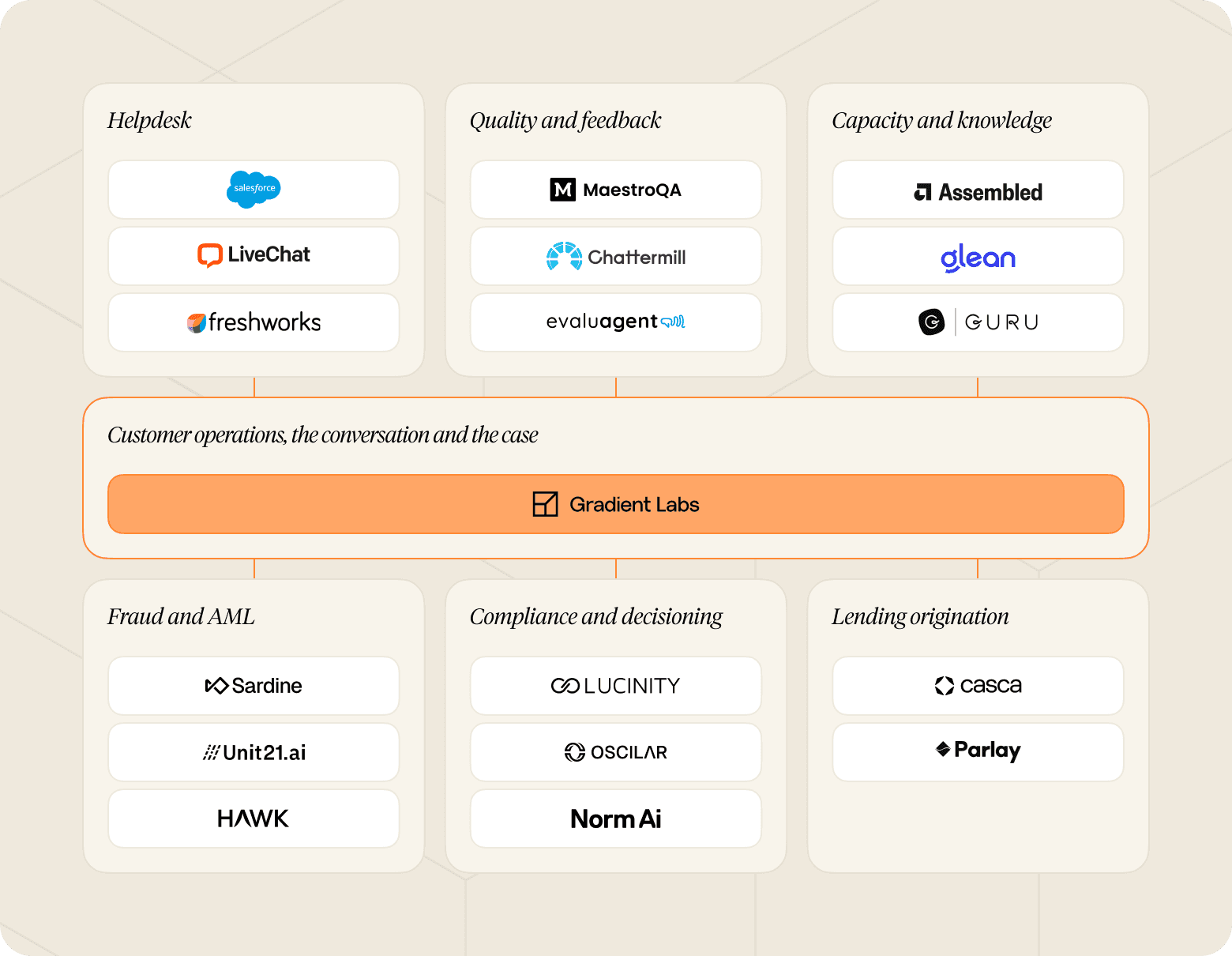
Three layers of that stack matter most once the frontline is automated.
Quality evidence. MaestroQA, with $33M raised, sits behind a lot of enterprise QA programmes on configurable scorecards and coaching workflows, and UK-founded EvaluAgent scores every voice, chat, and email conversation automatically for a customer base that leans regulated, Vitality and Jet2 among them. Automate most of your volume and QA becomes the evidence your risk committee asks to see. Chattermill covers the same ground from the customer side, pulling feedback together across markets and languages for Wise and Qonto, and Wise rated it highly enough to invest in its $26M Series B.
Capacity and knowledge. Assembled ($71M raised; Stripe, Robinhood, and Canva) was built by machine learning engineers out of Stripe and answers the problem automation creates, which is what to do with the human capacity left over. Its automated schedule generation launched in January 2026, per SiliconANGLE. On knowledge, Guru restricts AI answers to content an expert has verified, which is the difference between a helpful reply and a mis-stated product term, while Glean, valued at $7.2B in June 2025, finds knowledge buried across more than 100 enterprise apps.
Financial crime, risk, and lending. Sardine, Unit21, Hawk, Lucinity, Norm Ai, and Oscilar each own a decision our agent has to work around rather than make, and Casca and Parlay do the same at origination. Our guide to the best secure AI agents for banking maps that layer properly, with funding and named customers for each.
Choosing the right Lorikeet alternative
Lorikeet is a serious product with a serious thesis, and where the hardest tickets genuinely are tickets, it will do the job. A bank, lender, insurer, or fintech is weighing something different. The case behind the ticket needs automating, the conduct rules need to sit inside the product rather than inside your configuration, and every automated step needs evidence a regulator will take.
That is the operation we built Gradient Labs for, and the switch costs less than it looks: the helpdesk you have stays, the stack around it stays, and the deployment is guaranteed. For the diligence, evaluating AI agents in financial services covers what to measure and choosing an AI agent vendor for financial services covers what to ask everyone on the shortlist. When you reach the rollout, deploying AI agents in banking walks the migration step by step.
Book a demo and we'll scope your first use case against your own numbers.


Elizabeth Shew leads Brand and Advocacy at Gradient Labs, where AI agents handle customer support and back-office work for banks, lenders, and fintechs. Before that, she led customer marketing at Mastercard and built Dynamic Yield's customer marketing programme from the ground up, a decade spent turning customer results into industry-shaping stories. She writes about how support and operations teams actually put AI and technology to work. Before tech, she was a professional dancer in NYC.