

If you're comparing Salient vs Gradient Labs for lending operations, you're deciding between two AI agents that handle the loan itself rather than just routing the case to a human. Salient is a venture-backed platform built for US loan servicing, collections, and chargeoffs, with Westlake Financial and Ally Financial among its lenders. Gradient Labs runs customer operations, including lending, disputes, and KYC, for financial services firms across the US, UK, and EU.
The choice comes down to two things: how far your queue runs past the loan itself, and whose rulebook the product was written against. This guide compares scope, compliance, delivery, pricing, and published results.
What do Salient and Gradient Labs each do?
Salient is an AI-native loan servicing platform, founded in 2023. It sells five named agents: Taylor for omnichannel servicing and collections, Marshall for automated audit, Flyn for total-loss insurance claims, Alex for chargebacks and disputes, and Melanie for chargeoffs. Taylor 2.0 runs inbound and outbound conversations across voice, text, and email, takes card and ACH payments live on the call, and carries what the company describes as native FDCPA, TCPA, and CFPB compliance. Published lenders include Westlake Financial, American Credit Acceptance, Ally Financial, and Exeter Finance. Salient raised $60M in July 2025 from Andreessen Horowitz, Matrix Partners, Michael Ovitz, and Y Combinator, according to fintech.global, and reports processing more than $1B in transactions while cutting lender handle times by 60%.
Gradient Labs is the AI-native customer operations platform for financial services. Its frontline agent picks up whatever a customer brings on chat, email, or voice, and specialist agents run the case work underneath: the Lending Agent across applications, onboarding, servicing, and collections, alongside disputes and KYC. Those agents share memory and context across a case, so a hardship conversation that opens on an outbound call finishes in the back office without a human carrying it over the gap. Built for finserv from the ground up, the platform runs more than 20 financial services guardrails on every turn and records each action the agent takes in an audit trail. Customers include Wise, Zego, Plum, and SteadyPay, across the UK, EU, and US.
On the loan book itself, the overlap is real, so a shortlist holding both is sensible. What separates them is everything sitting outside the loan, and the set of regulators each product was designed to satisfy.
Salient vs Gradient Labs at a glance
The verdict: for a US auto or consumer finance book where nearly every conversation is about a loan, Salient is a serious choice, and its audit and chargeoff agents cover work most vendors leave alone. For a financial services firm whose queue runs wider than the loan, or whose borrowers sit under FCA and EU rules as well as CFPB supervision, Gradient Labs is the stronger platform: frontline and back-office work across lending, disputes, KYC, and general support, on one system, in three jurisdictions.
Platform | Resolution rate | Compliance posture | Deployment time | Pricing model | Best for |
|---|---|---|---|---|---|
Gradient Labs | 60% from day one, 80–90% in mature deployments | 20+ FS guardrails on every turn; SOC 2 Type II; UK FCA, US FDCPA and TCPA, EU AI Act | 4–6 weeks; outbound collections live in under a day on a CSV | Per resolution, with a deployment guarantee | FS firms running frontline and back-office work on one platform across the US, UK or EU |
Salient | No headline resolution rate published; reports handle times cut 60%, and a 34% rise in right-party contact at Westlake Financial | Native FDCPA, TCPA and CFPB compliance plus state-level rules; US supervision only | Co-designed pilot with risk, compliance and operations; no published timeline | Not publicly listed | US auto and consumer lenders automating loan servicing, collections and audit |
Why trust Gradient Labs with a regulated lending book?
Start with who built it. Gradient Labs' founders ran the data organisation at a large European digital bank under FCA supervision, taking it past 120 people, and financial services is where most of the engineering team worked before joining. A regulated lender feels that in how the agent behaves under pressure: an ambiguous request gets a clarifying question rather than a guess, guardrails watch for vulnerability and financial difficulty on every turn, and the audit trail is written for whoever has to defend a decision to a regulator months afterwards.
Production evidence backs it. SteadyPay, FCA-authorised embedded lending infrastructure serving neobanks and fintechs across the UK and Europe, runs overdue payment collections on the platform, including payment plan negotiation and identity verification on top of its existing telephony and helpdesk stack.
"Before Gradient Labs, we needed to find a way to reach our growing number of customers effectively. Now we make 33,000 calls a month, converting 60% of engaged customers to committed repayment dates, all within FCA compliance standards. It has fundamentally changed how we manage the collections layer of our lending infrastructure."
Violeta Filip, Head of Customer Experience, SteadyPay
The same deployment reactivated 20% more cold customers inside a month. There is a commercial guarantee behind the work too: once a use case is scoped, Gradient Labs refunds the fee if the deployment does not deliver what was agreed.
Where does Salient fit best?

Salient earns the attention it gets, and its published results are specific rather than promotional. Westlake Financial deployed Taylor across its outbound collections portfolio and reports a 34% increase in right-party contact rate within 60 days, with no changes to its core servicing system. American Credit Acceptance moved from a 3% manual review sample to every interaction reviewed by Marshall ahead of a regulatory examination, with an exam-ready audit trail produced on demand. In 2026 the company was selected for JPMorgan Chase's Hall of Innovation Award.
Three conditions could make Salient a good pick:
A US book supervised by the CFPB. The product is designed around how American lenders are examined, from federal rules down to state-level requirements, and that focus is a genuine advantage inside those borders.
Auto and specialty finance servicing. Total-loss insurance claims and chargeoffs are unglamorous, expensive processes that most AI vendors will not touch, and Salient has built named agents for both.
Audit coverage as the pressing problem. If your compliance function is reviewing a single-digit percentage of calls by hand and an exam is coming, Marshall addresses that directly.
Two serious considerations. The first is scope: Salient's frontline is genuinely capable, but every conversation it handles is a conversation about the loan, such as payments, due dates, payoffs, hardship, insurance, etc. A customer who calls about a frozen card, a missing transfer, or a charge they do not recognise falls outside what the platform is built to answer. The second is geography. Nothing Salient publishes addresses FCA Consumer Duty, CONC, Breathing Space, GDPR, or the EU AI Act, which are the first questions a UK or European risk function asks. Our guide to vertical AI versus horizontal AI covers how narrow a vertical can get before the specialism starts costing you coverage.

Where does Gradient Labs fit best?
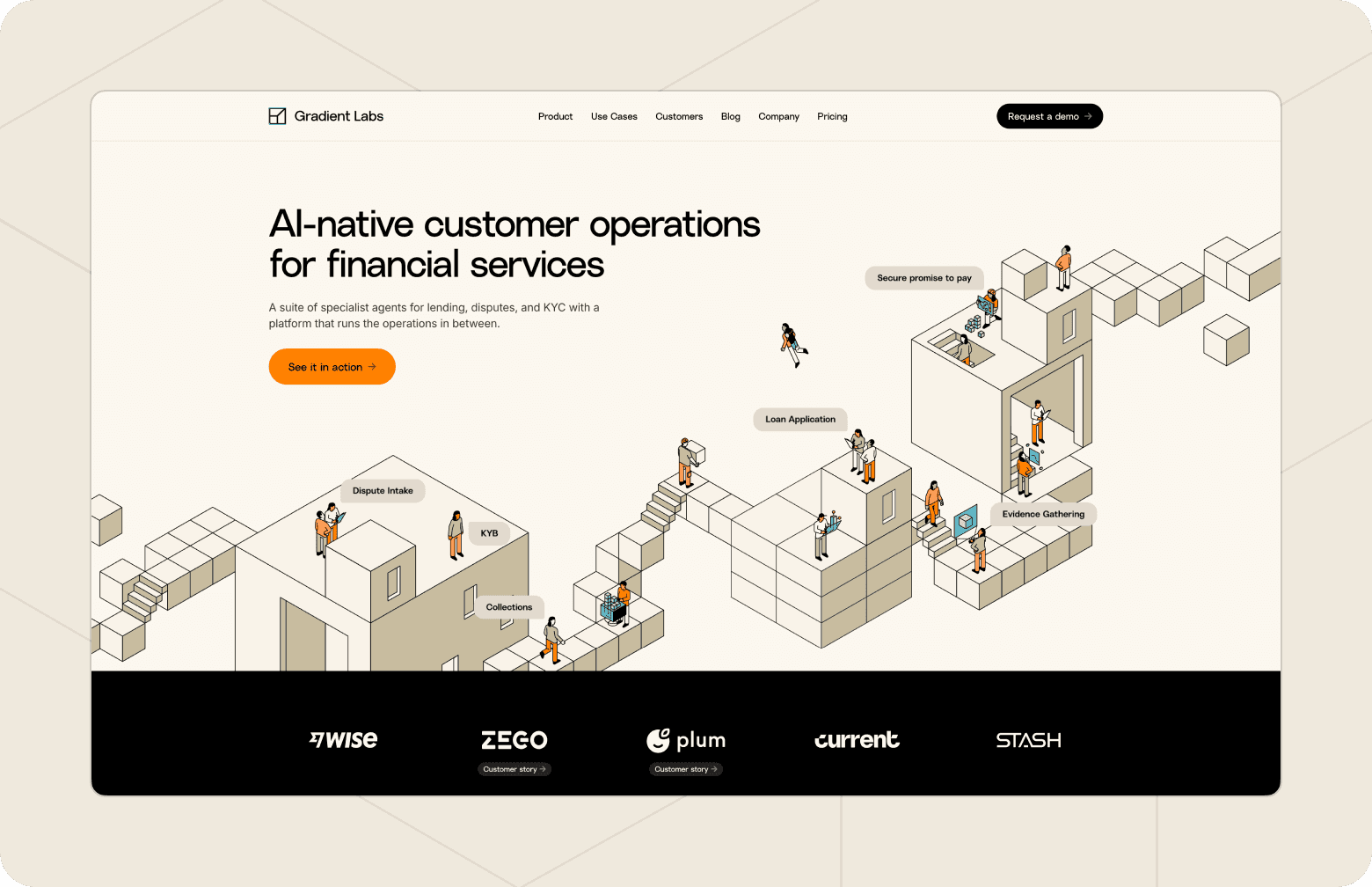
Four things separate Gradient Labs in a lending operation.
The frontline agent takes whatever arrives. Its pre-launch training runs over your help centre and thousands of resolved human conversations, so it starts with the workarounds and edge-case judgement your knowledge base never captured, and with your best agents' writing style. An AI customer service agent that only knows the loan hands back every query that is not about the loan, and in most financial services operations that is a large share of the queue. At a large European digital bank, the agent resolved 280,000 conversations for half a million unique customers at a 98% quality assurance score, across a queue that spans cards, payments, and account admin as well as lending.
The lending lifecycle runs from application through to recovery. The Lending Agent re-engages application abandoners, walks new borrowers through their repayment schedule and sets up direct debit live on the call, supports active borrowers on balances and payment-date changes, runs outbound collections, and handles hardship assessment and forbearance when the signal lands. Each stage inherits the same identity verification, live servicing data, and post-call follow-up, and our round-up of AI use cases for lenders covers the full set.
Compliance spans three rulebooks. Over 20 pre-built financial services guardrails sit on every turn, split by direction: the customer-side set routes complaints, vulnerability, and financial difficulty to a human, while the agent-side set catches tipping-off, false promises, and out-of-bounds advice and edits the draft before it reaches the borrower. Coverage runs across FDCPA, TCPA, Reg F, and UDAAP in the US, FCA Consumer Duty, CONC, and Breathing Space in the UK, and GDPR and the EU AI Act in Europe. Gradient Labs is SOC 2 Type II certified with zero-day data retention across every LLM sub-processor and a full audit trail of each action, source referenced, and decision made.
Voice runs at scale, in the borrower's own language. Across customers the agents place over 100,000 outbound voice calls each month, in more than 30 languages and regional accents, Castilian, Catalan, Galician, and regional UK dialects among them. For a lender collecting across several European markets, that removes the choice between a local call centre and an agent that sounds foreign to half the book.
What happens when the work runs past the loan book?
Most customer support automation settles around 60 to 65% resolution, and what remains is rarely more chat. It is case work: an investigation, a review, a decision that reaches into systems the frontline cannot see. A point solution answers that by going deeper into its one process. A platform answers it by taking the next process.

That distinction decides how the second year of a deployment goes. A lender that starts with collections usually finds the same team owns complaints, card disputes, KYC refreshes, and general support, and each of those needs either another vendor or another integration project. Gradient Labs' specialist agents share the case context, so a disputed transaction arrives as a message, becomes an investigation, and closes weeks later in the same thread. Yonder, a UK credit card company, decides dispute cases 150% faster on that model with an 80% one-touch rate, and processes 85% of its collections work on the same platform.
Resolution rates follow the same logic. A launch opens around 60%, and the climb to 80 to 90% comes from a delivery cycle rather than a model upgrade: the team reviews every unresolved case, sizes what each fix would be worth, and adds integrations, procedures, and use cases while the agent stays live. Pockit lifted its resolution rate by 70% that way, according to Head of Operations Michiel Smet. Our guide to deploying AI agents in lending maps what each week of that rollout involves.
How do Salient and Gradient Labs price and deploy?
Neither vendor sells seats, and neither publishes a rate card, so the business case comes down to what you are billed for and who carries the delivery risk.
Salient describes a co-designed pilot: risk, compliance, and operations define the guardrails and success metrics before anything goes live, which is a sensible way to reach an exam-safe launch and does mean a longer runway to first value. Gradient Labs prices per resolution with a deployment guarantee attached, so a scoped use case that does not deliver what was agreed is refunded. Most customer support and back-office deployments at large regulated institutions reach production in four to six weeks, and outbound collections can start dialling in under a day where the lender can provide a CSV.
Ask both vendors to define the billable outcome precisely. A contained call and a resolved case are different units of work, and our guide to deflection versus resolution sets out how to hold a vendor to the stricter definition before the contract is signed.
Salient vs Gradient Labs: which should you choose?
Choose Salient if your book is US auto or specialty consumer finance, your conversations are almost entirely about the loan, and audit coverage or total-loss claims are the processes costing you most. It is a focused product with real lenders behind it, and the CFPB-first design is an advantage inside those borders.
Choose Gradient Labs if your customers ask about more than their loan, your risk function needs FCA and EU AI Act evidence alongside FDCPA and TCPA, or you would rather add the next process to a platform you already run than start another procurement cycle. Your servicing system is left alone, the scoped deployment carries a refund if it underdelivers, and the resolution rate keeps climbing long after launch. If your shortlist also holds a horizontal agent, our ranking of AI agents for lending covers the wider field, and our guide to choosing an AI agent vendor for financial services turns a shortlist into an evaluation framework.
Book a demo and we will scope one of your own lending cases against your volumes.

Elizabeth Shew leads Brand and Advocacy at Gradient Labs, where AI agents handle customer support and back-office work for banks, lenders, and fintechs. Before that, she led customer marketing at Mastercard and built Dynamic Yield's customer marketing programme from the ground up, a decade spent turning customer results into industry-shaping stories. She writes about how support and operations teams actually put AI and technology to work. Before tech, she was a professional dancer in NYC.