
Introduction
AI has become normal. More than 8 in 10 people now use it in everyday life, yet most people say its rapid rise leaves them uneasy. More than a third (37%) believe AI will become impossible for humans to control within ten years. Regardless, almost half would happily hand a personal AI agent the power to make decisions on their behalf.
Gradient Labs surveyed 3000 people across four generations to understand the gap between what people say and believe about AI, and how they actually use, judge, and delegate to it.
In this report:
How different generations use AI
AI agents are more misunderstood than feared
Why people prefer human support, and when AI changes their minds
People worry about losing control of AI, but imagine very different futures
What this means for customer operations
While the love-hate relationship with AI is evident, the real story here is the gap between what people say about AI and what they do with it.
How different generations use AI
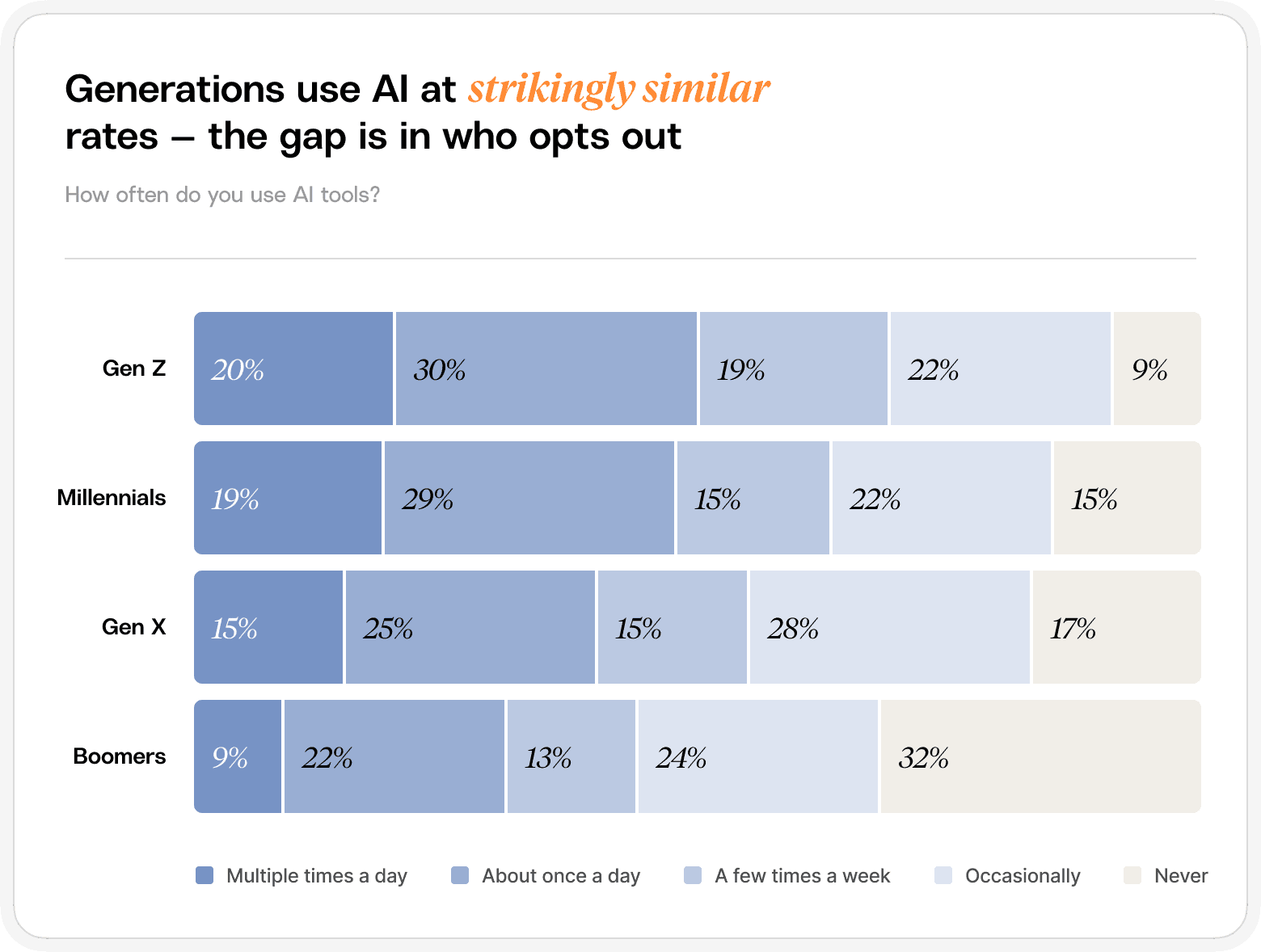
AI has settled into daily life, and it's not just for young people. When you examine how often people use AI, you will see the generations begin to converge. Among people who use it at all, the cadence is noticeably similar across ages. The real divide is in who opts out entirely: 32% of Boomers never use AI tools, versus just 9% of Gen Z.
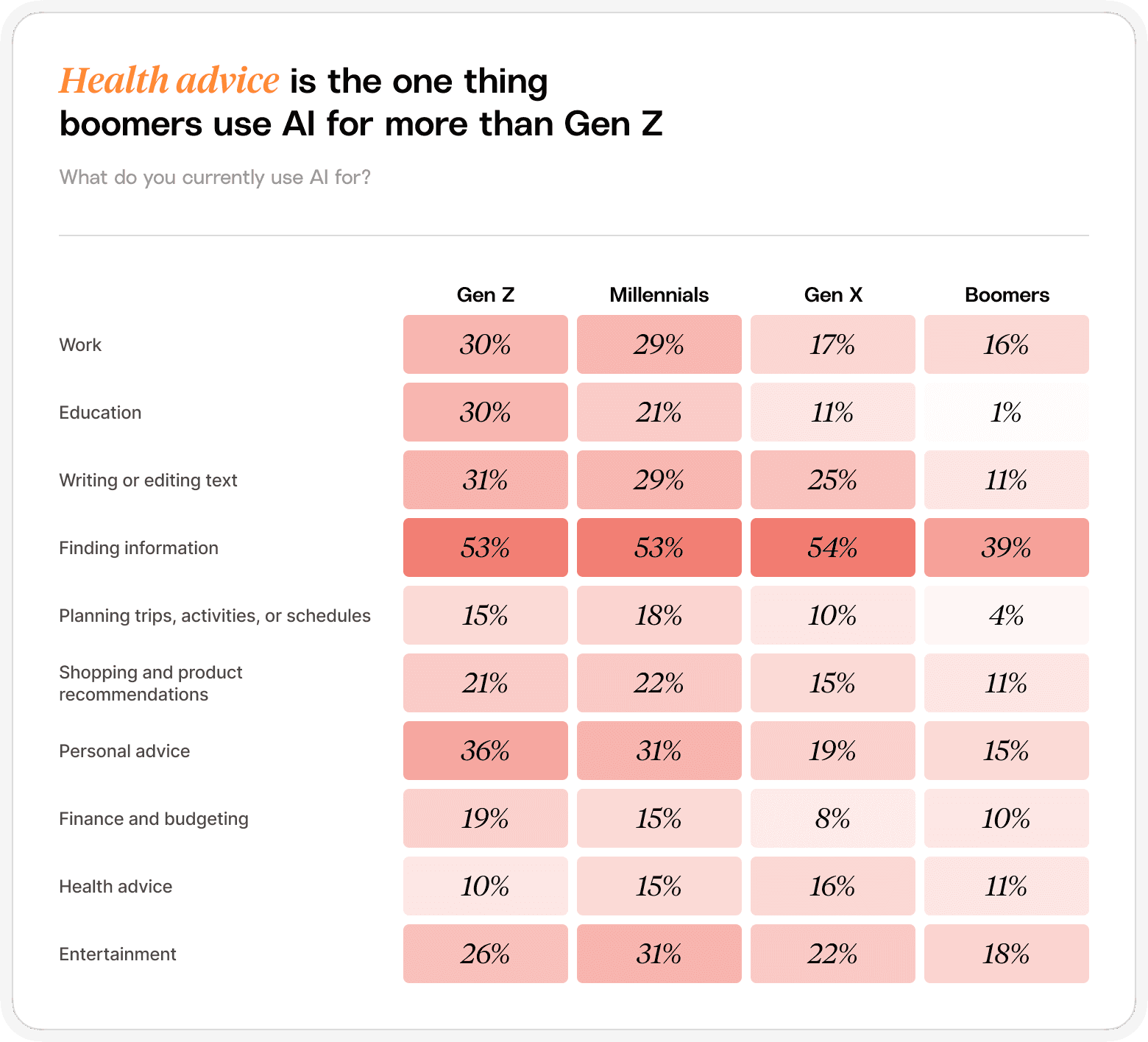
The requests people turn to AI for are consistent too. Finding information sits on top of this list in every generation (53–54% of under-60s, and still 39% of Boomers). Gen Z edges out the 60+ on work, education, and writing.
There is, however, an interesting flip to this pattern worth noticing: Boomers turn to AI for health advice more regularly than Gen Z does (11% vs 10%, and highest of all among Gen X at 16%). Of all generations, Boomers, who claim to be most sceptical of AI, are seeking answers from AI on some of the most personal matters in their life.
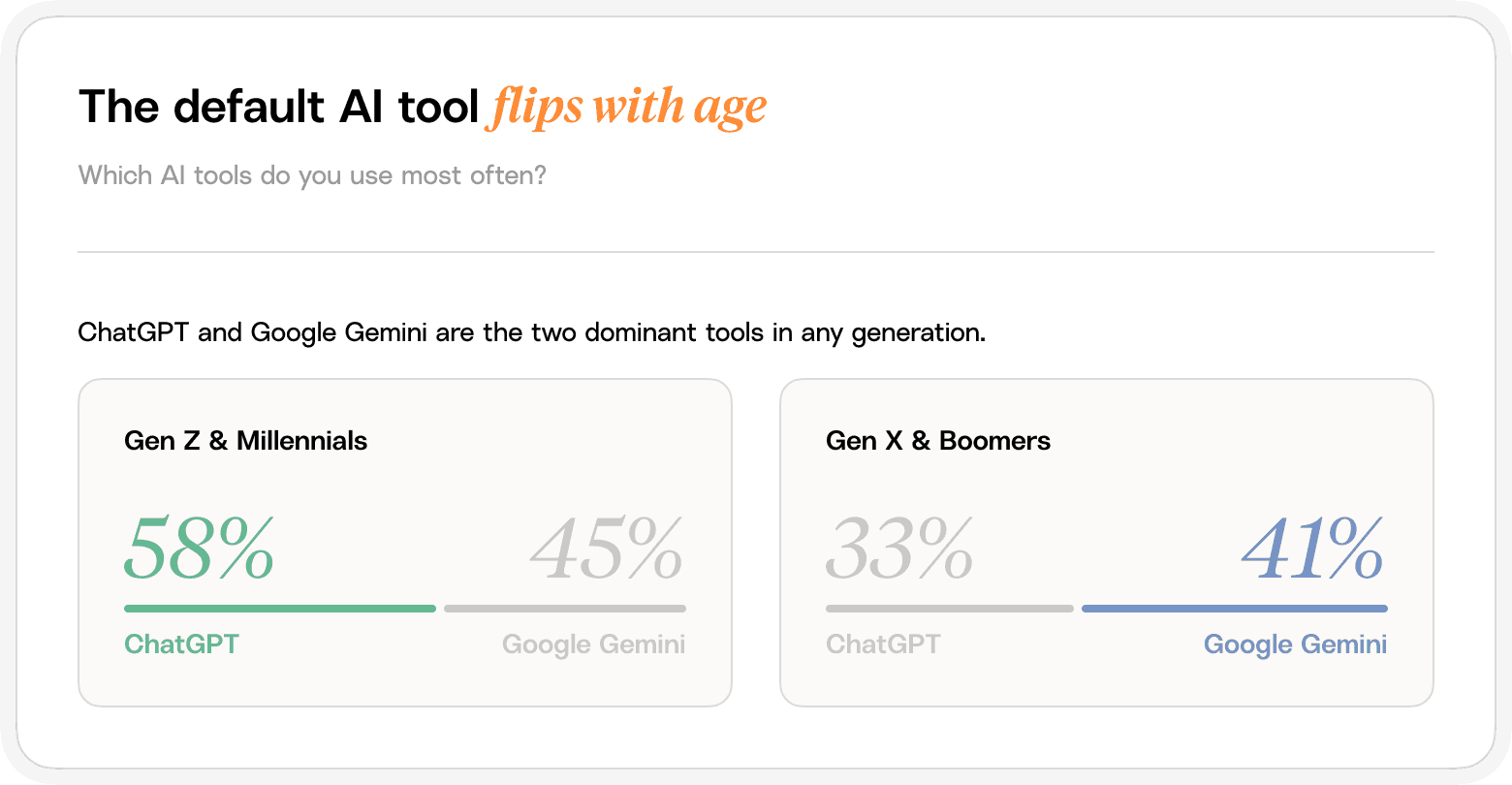
The default tool flips with age. Among Gen Z and Millennials, ChatGPT leads at 58%, with Google Gemini at 45%. Among Gen X and Boomers the order reverses: Gemini edges ahead at 41% to ChatGPT's 33%, most likely because Gemini rides in on the Google products that older users already live in.
AI agents are still widely misunderstood
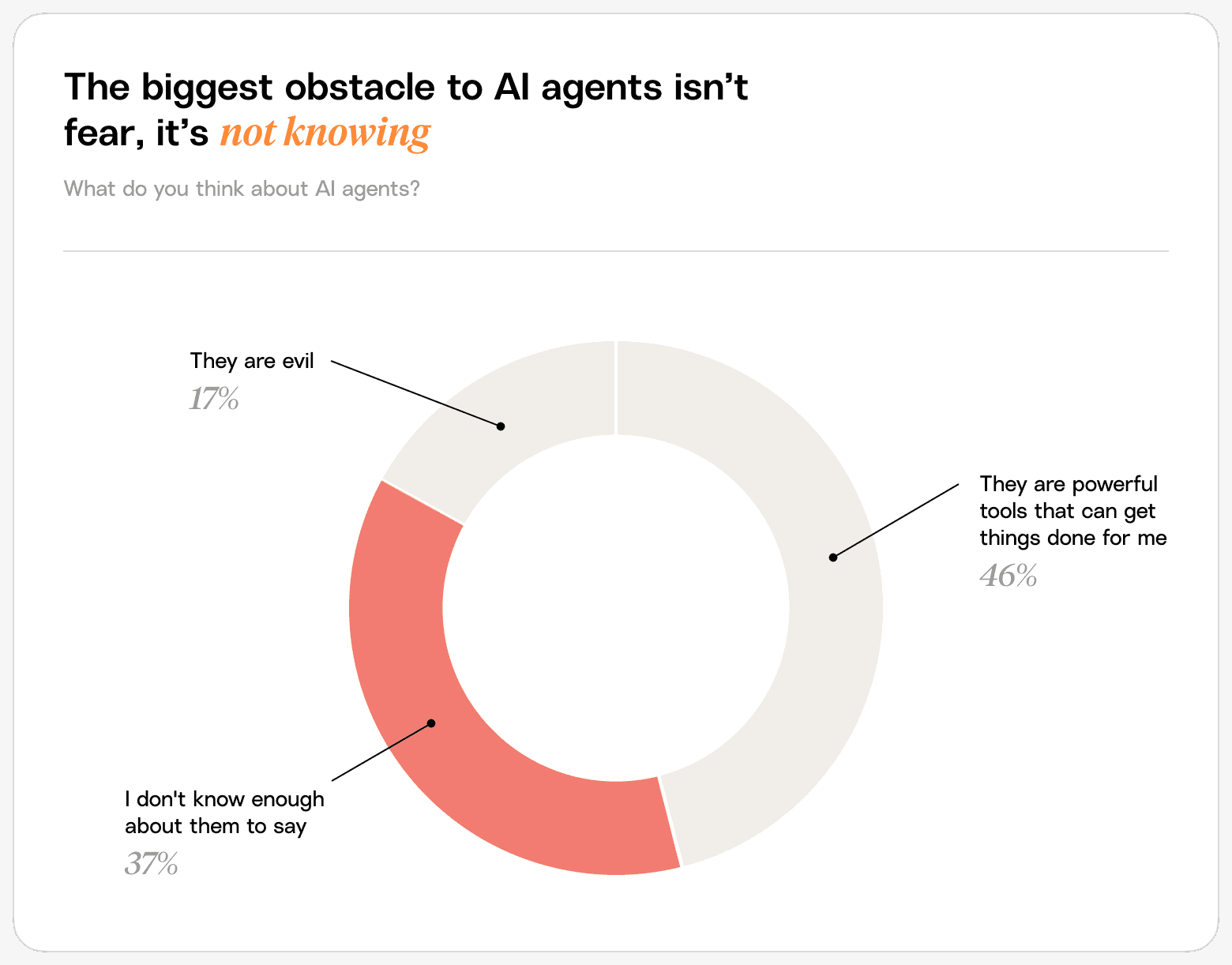
Switch the question from AI in general to AI agents specifically, and the biggest single answer is "I don't know enough to say." 37% sit there, ahead of the 46% who already call AI agents powerful tools that get things done, and the 17% who call them 'evil'. Most people who've formed a view lean positive. The real work is with the more than a third who haven't formed one yet, and that's a job for education, not persuasion: show people what an AI agent actually does, and the number who don't know starts to shrink.
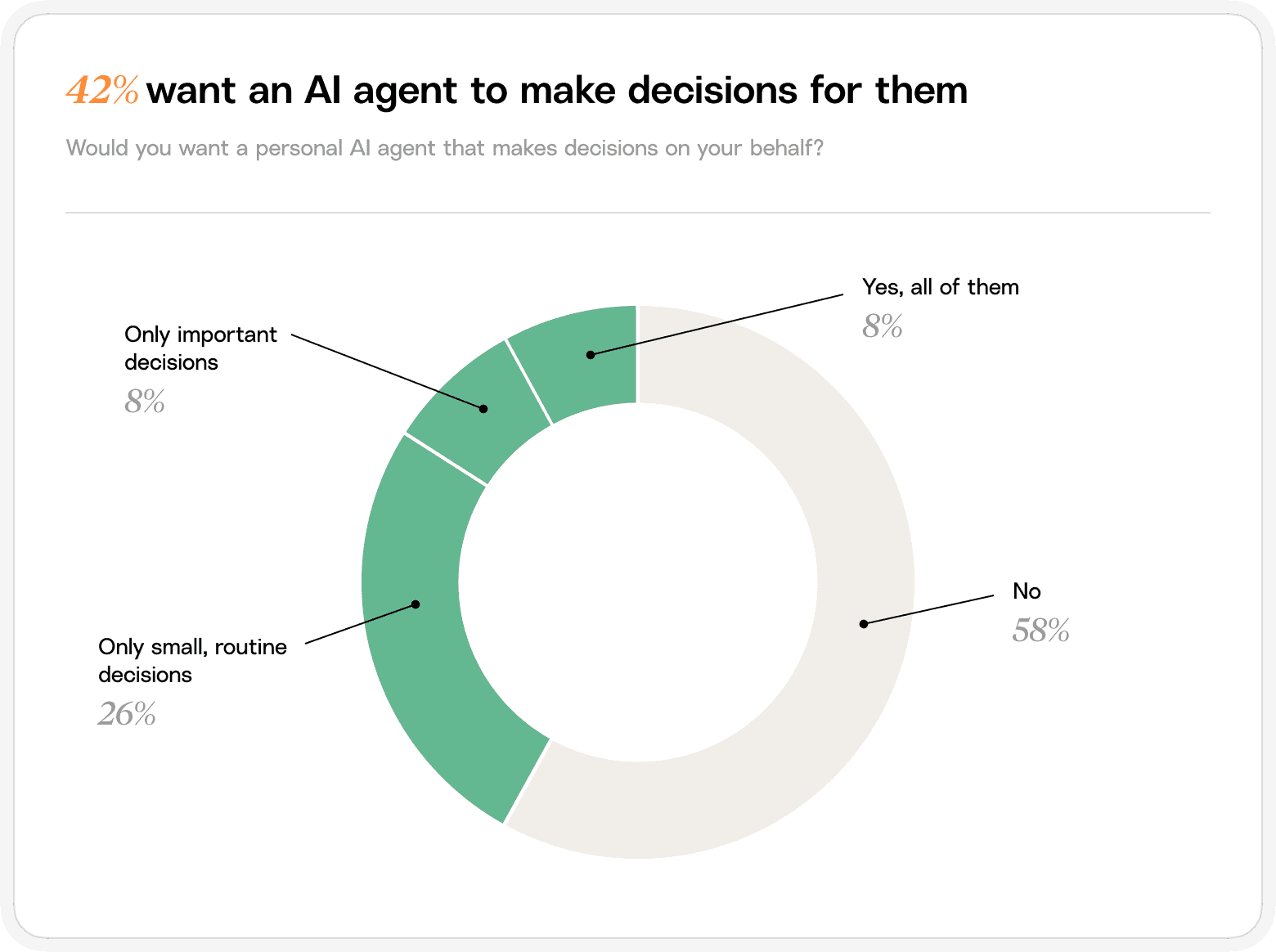
And the appetite for utilising AI agents is already bigger than the scepticism suggests. Despite 58% of the respondents saying they'd want no AI agent making decisions for them, 42% would hand one actual decisions: 26% for small, routine choices, and 16% for decisions as significant as money and business. People aren't interested in vague promises about what AI agents can do. Instead, they want to see practical proof before they believe or buy into it.
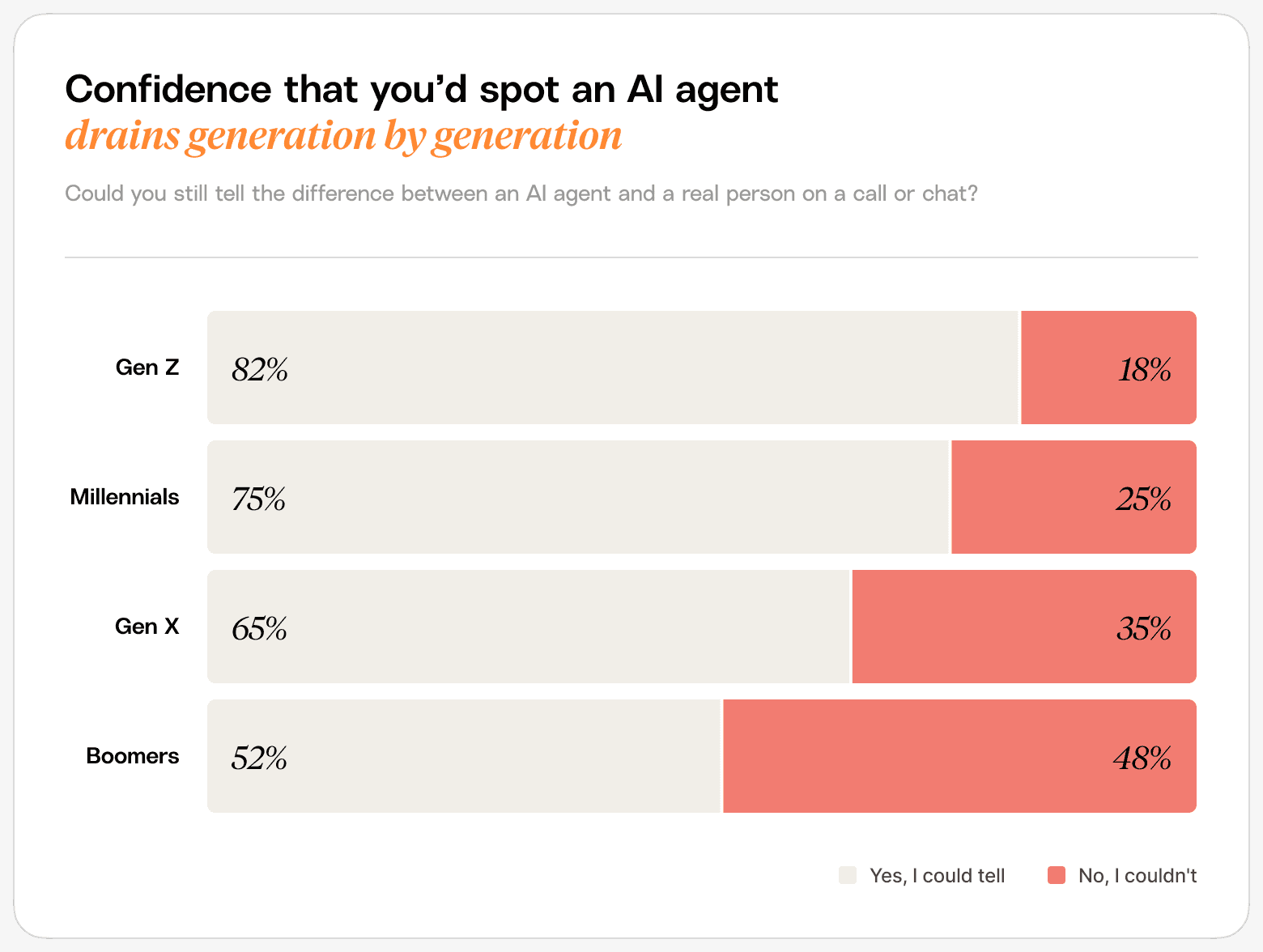
The confidence that you could still tell an AI agent from a real person drops drastically by generation: 82% of Gen Z are certain they'd spot it. This falls to 75% of Millennials, 65% of Gen X, and just 52% of Boomers.
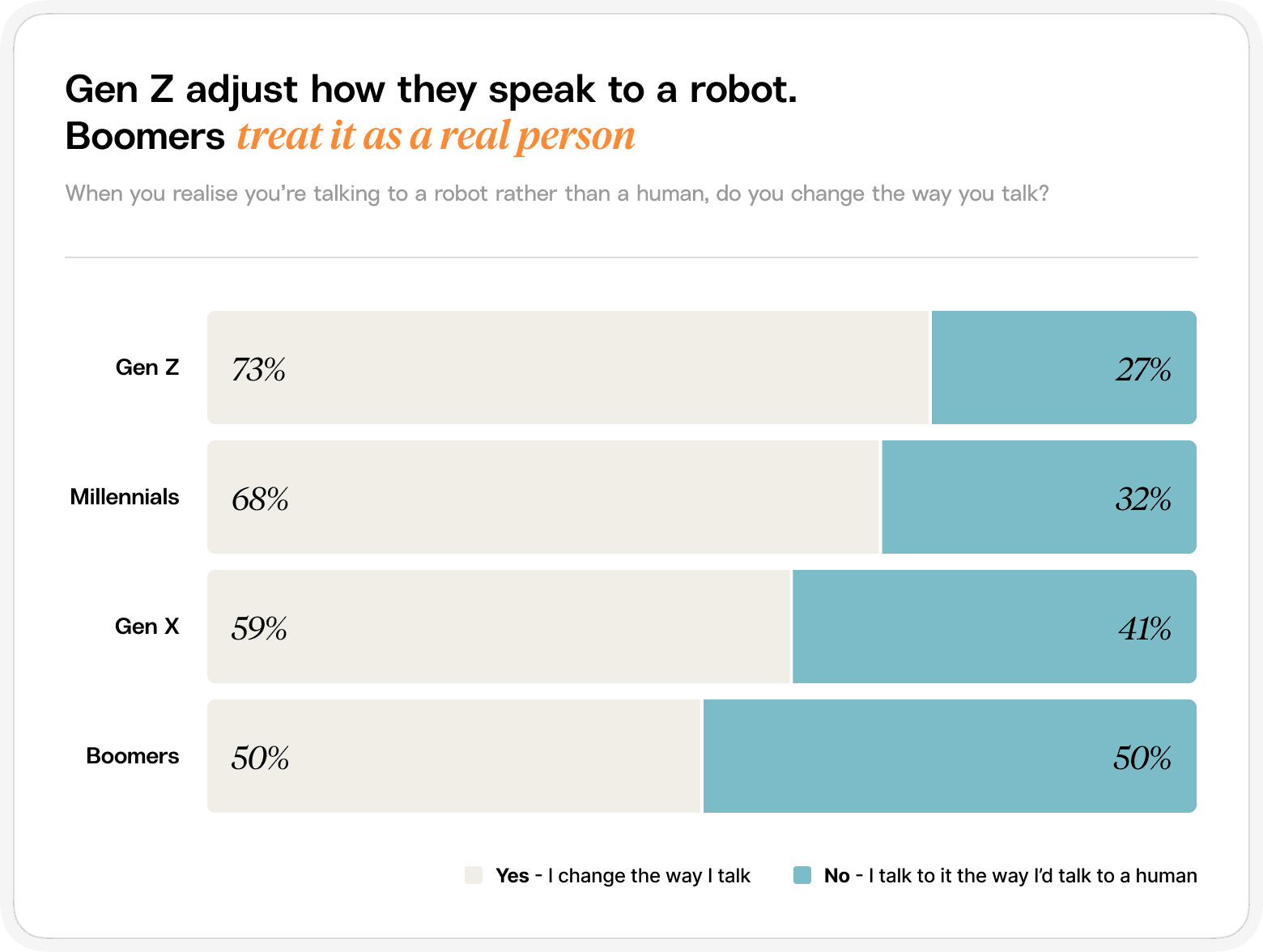
When people do realise that they're speaking with an AI agent, the resulting behaviour varies by generation. 73% of Gen Z change how they talk once they realise they are talking to a robot, and speak differently than they would if there were a human on the other end. Boomers are split 50/50, with half speaking to the machine the way they would speak to any human.
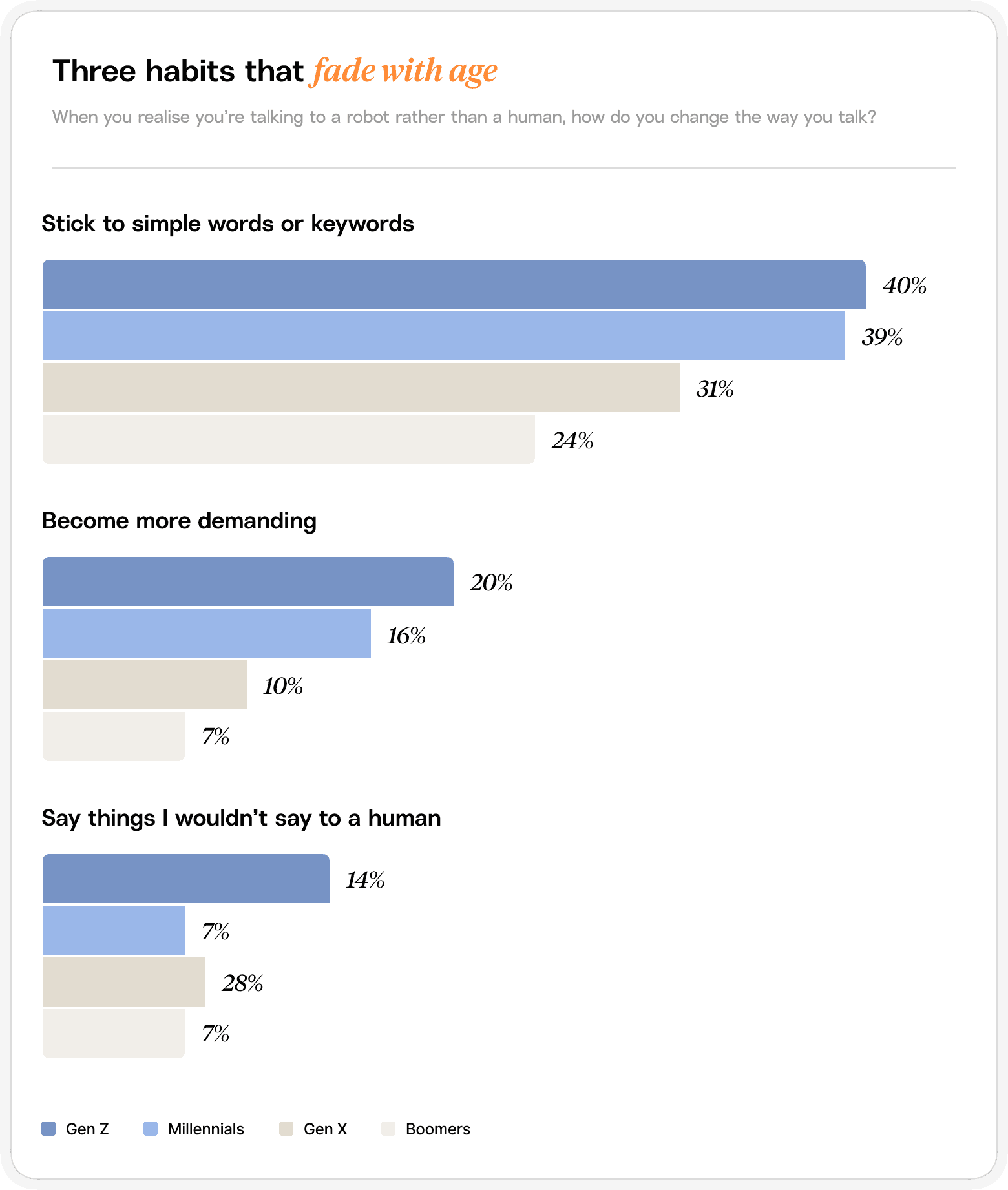
As for what changes people make when they realise they're talking to an AI agent, three habits stand out, and Gen Z leads every one of them. Sticking to simple words is the most common: 40% of Gen Z do it, falling to 24% of Boomers. Becoming more demanding follows the same pattern, from 20% of Gen Z down to 7% of Boomers. Saying things you wouldn't say to a human is the least common of the three, but still highest among Gen Z at 14%.
Why people prefer human support, and when AI changes their minds
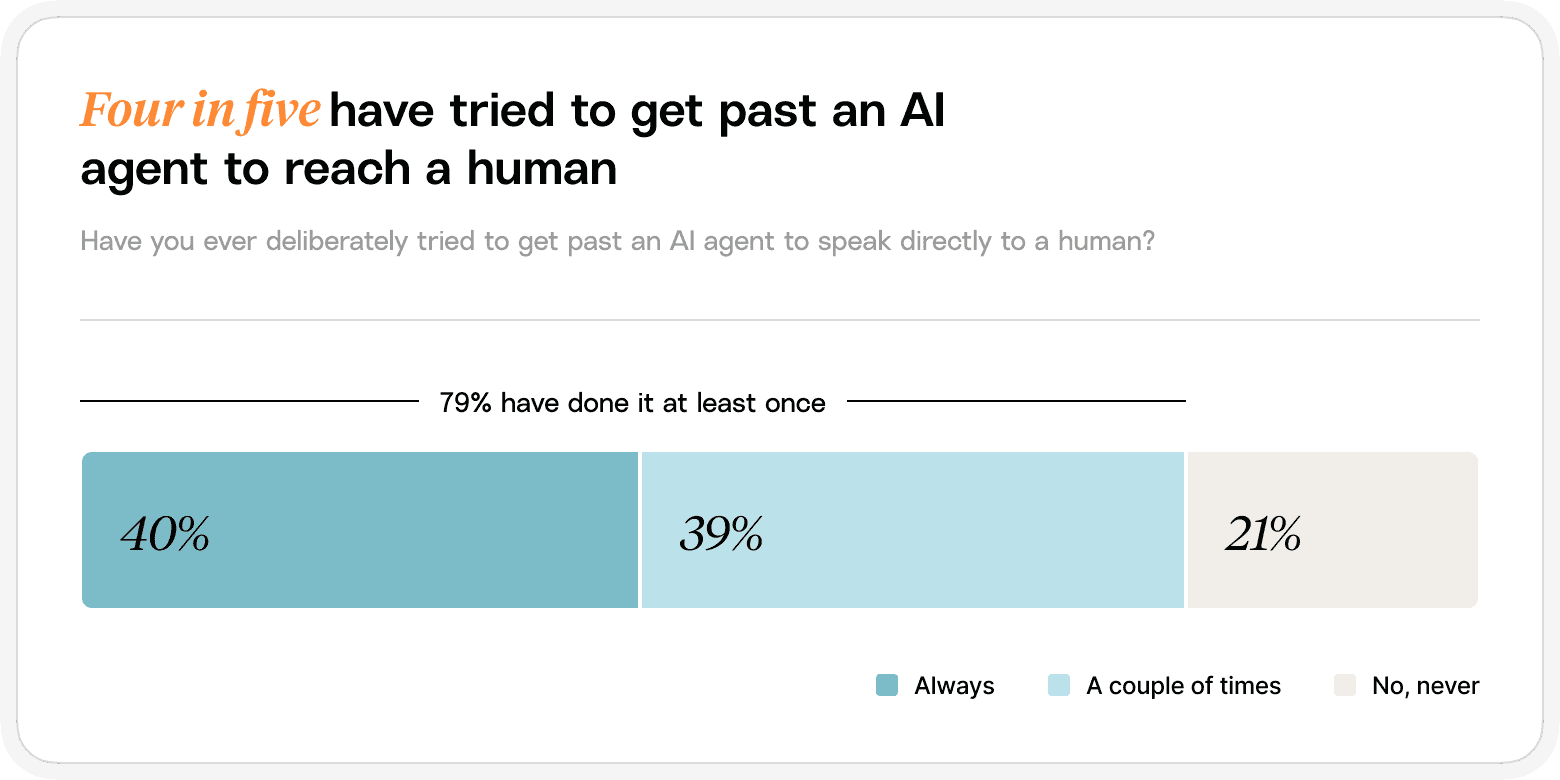
Many people still see human support as the destination. Four in five respondents have deliberately tried to get past an AI agent to reach a human. However, their preference can change depending on the situation and what they need.
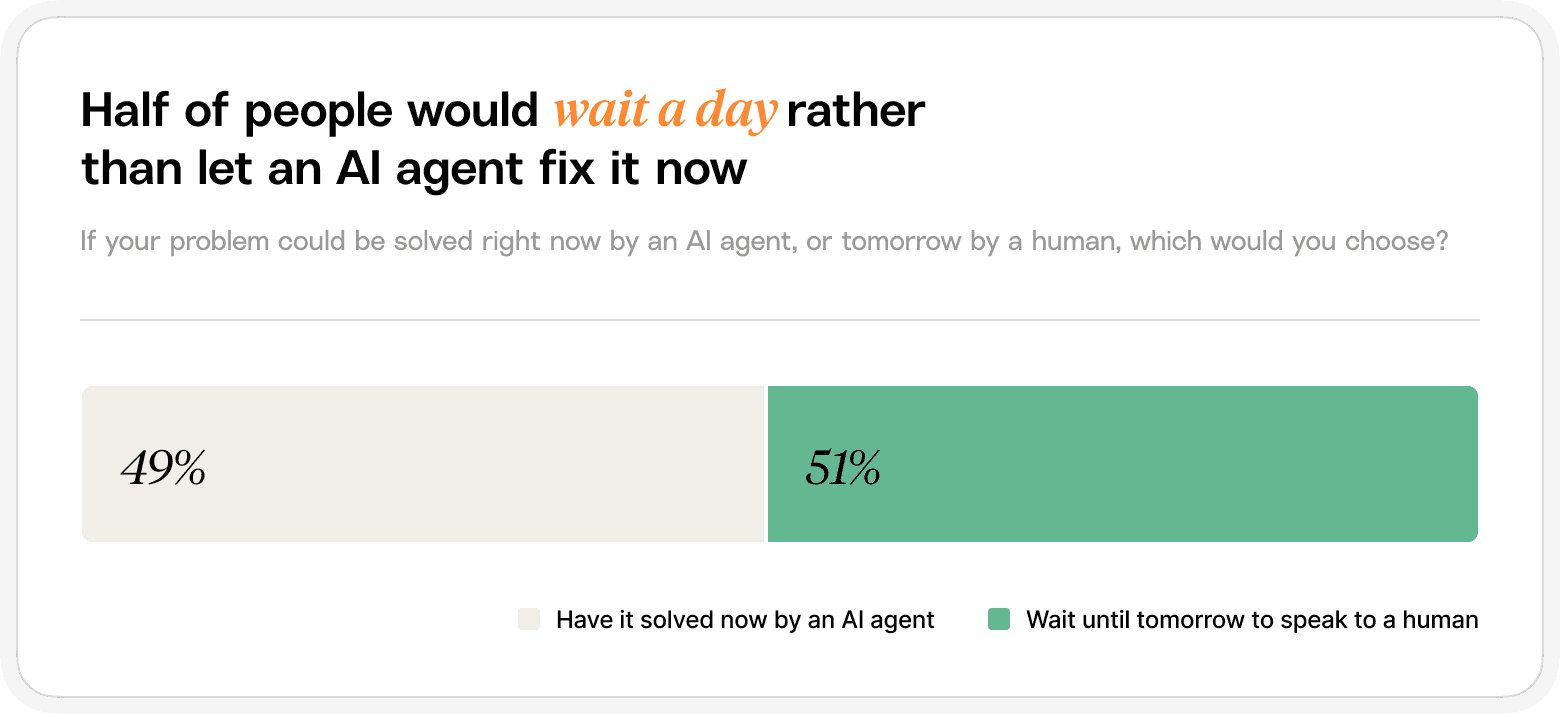
When it comes to choosing between speed and speaking with a person, what people say they prefer clashes with what they actually do. When it comes to preference, 51% would rather wait until tomorrow to speak to a human than have an AI agent fix the problem immediately.
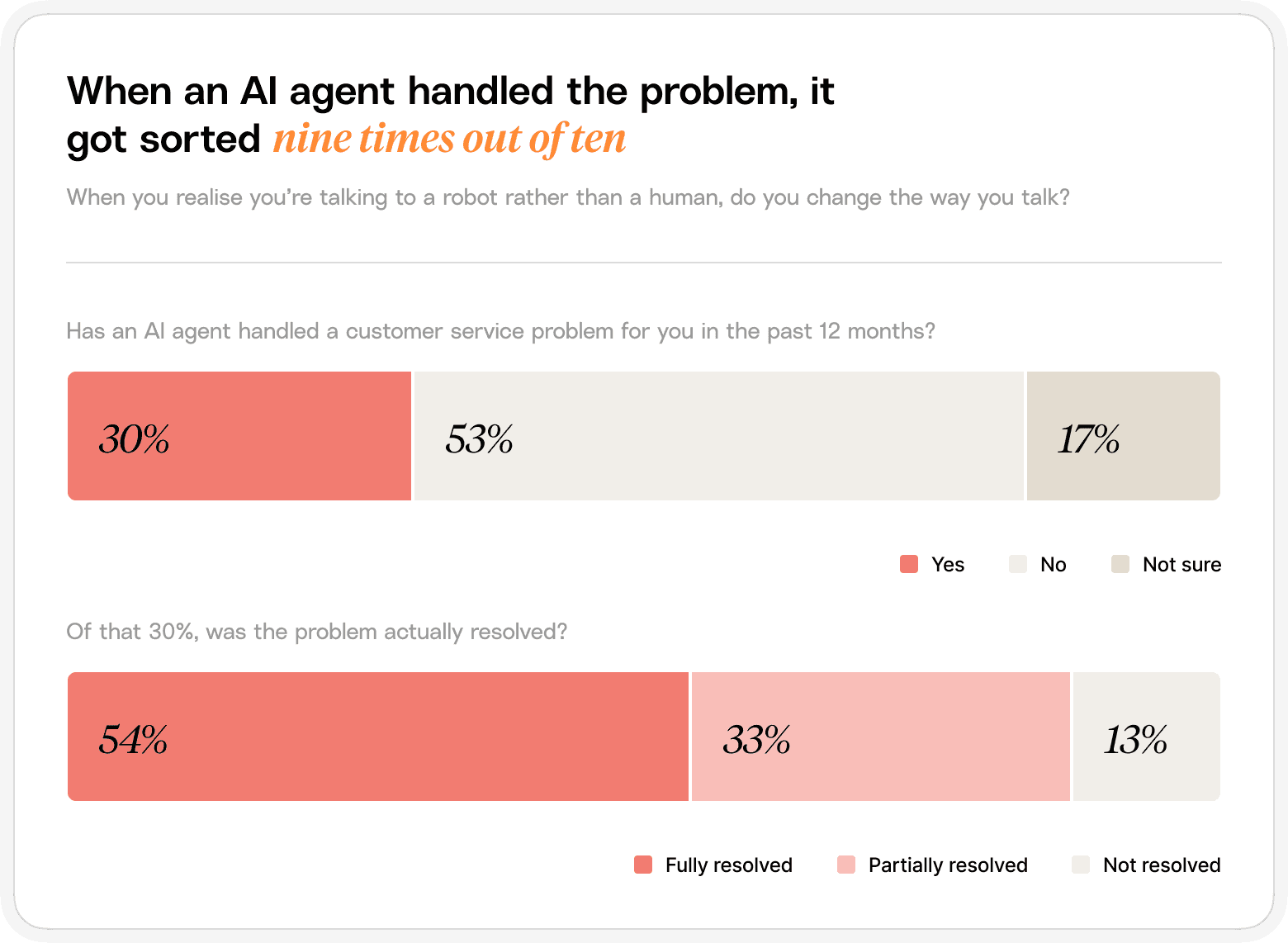
Taking a closer look at what happens when an agent actually gets a support case, only 30% of people recall an AI agent handling a customer service problem for them in the past year. But among those who had it, the problem got sorted nearly nine times out of ten: 54% fully resolved, another 33% partly, and only 13% left unresolved. The resistance is real, but the resolution numbers are strong
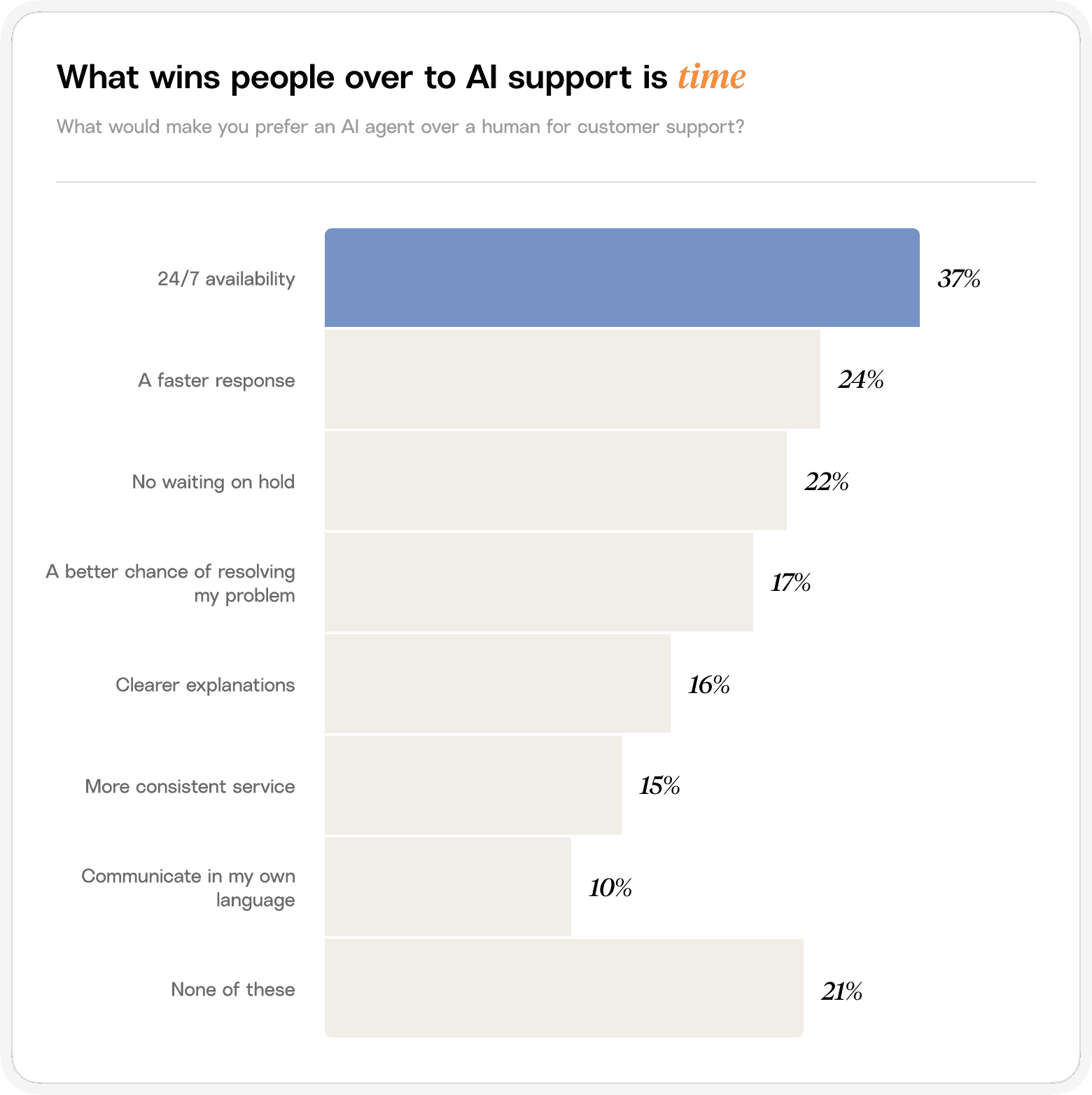
What would turn that resistance into preference? Time. The top reasons AI wins people over are 24/7 availability (36%), faster response times (30%), and no waiting on hold (28%). In customer support, AI removes friction by being there outside normal office hours, being available in any language, and eliminating queues. These numbers contradict the earlier responses, in which most people claimed they'd rather wait for a human instead of having an immediate solution with AI. It appears that timeliness is, actually, a critical reason humans would choose AI support.
People worry about losing control of AI, but imagine very different futures
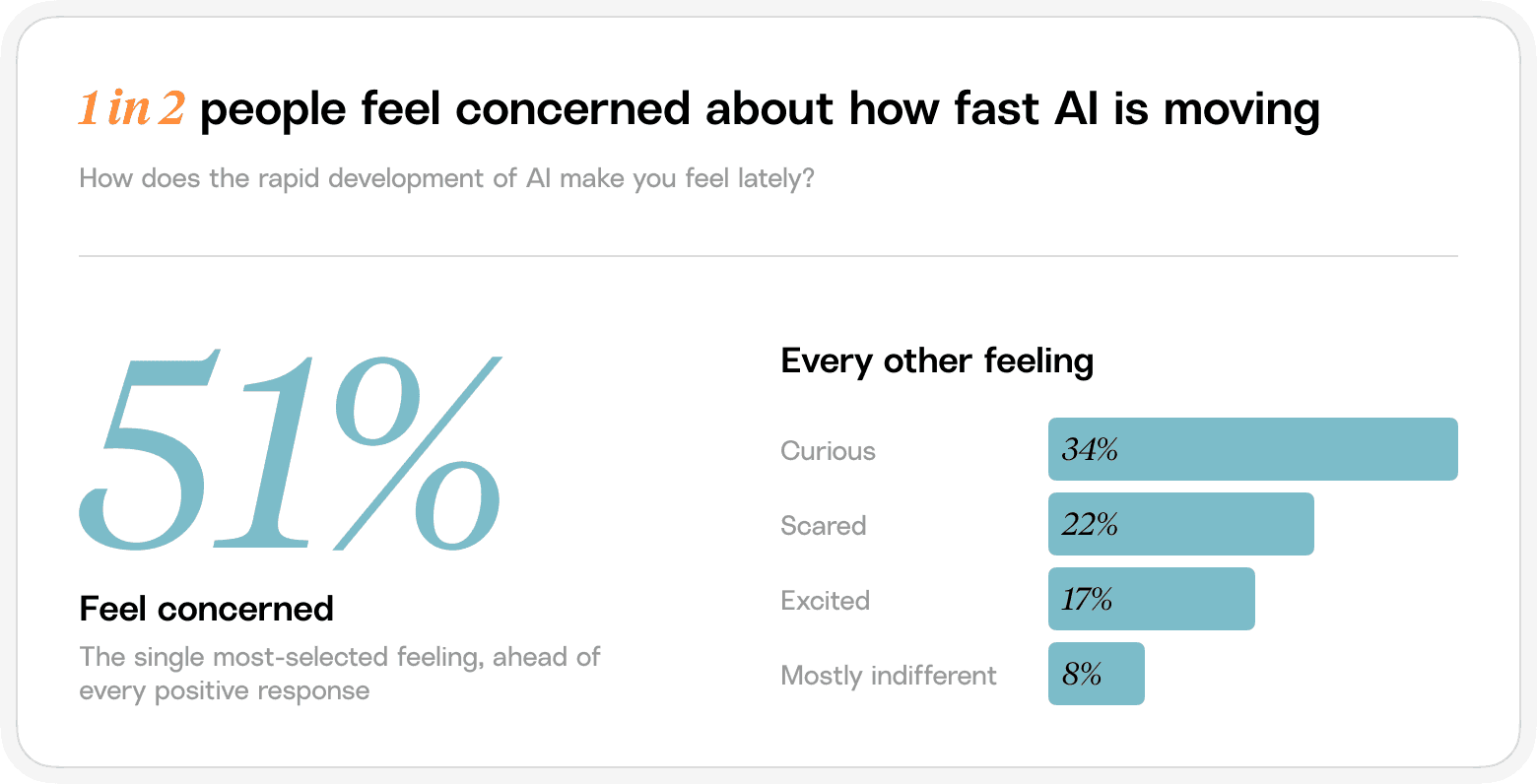
For all the everyday use, the underlying mood is wary. When you ask how people feel about the rapid development of AI, excitement and curiosity are nowhere near the most selected answer. What emerges instead is concern. 51% feel concern, ahead of curiosity (34%). 22% are scared and merely 17% are excited. This indicates a public that is not hostile, but is cautious.
Where this technological train is headed has yet to be agreed upon. This is another interesting aspect when comparing generations. 35% of boomers replied that humans will merge with AI through technology. The same amount think AI could become impossible to control. Meanwhile, an astounding 36% of Gen Z (the highest of any generation) expect that people will develop a preference for using AI in romantic relationships and friendships. The younger generation aren't the wide-eyed optimists and the older generation aren't the doubters; both just imagine a different means of how the line between human and machine might blur in the future.

What this means for customer operations
When looked at as a whole, all the contradictions still point in one direction. The companies who will succeed in AI-powered service will be the ones whose agents actually resolve issues. Currently, 37% of people 'do not know enough to say' if AI agents are genuinely helpful. But these are exactly the kind that will switch opinions with consistent, good experiences. Likewise, the resistant 51%, who would rather wait a day for a human to help with their problem, would also reduce once they are in contact with an agent who, nearly nine times out of ten, closes out their case successfully.
An already sceptical customer who is ready to escalate an issue does not give the AI agent any room for a best-effort guess. AI agents must have the skills to decipher the issue and follow the correct procedure, while acting on customer data in a compliant manner at every turn. This is what helps to resolve the case, instead of deflecting. After all, it is deflection bots that have caused this much scepticism in AI support. Agents that resolve are what change their minds.
This is the gap that Gradient Labs has been built to close. We build specialist AI agents for financial services that resolve customer enquiries over chat, email, and voice. They are available 24/7, in any language, and with best-practice financial guardrails running at every turn. We do this so that the statistically rare positive experience in our data becomes the default one.
Methodology: Gradient Labs surveyed 3,000 people across four generations, Gen Z, Millennials, Gen X and Boomers, about how they use AI tools and how they feel about AI agents handling everyday tasks like customer service. The survey was conducted online. Percentages are based on valid responses to each question; multiple-select questions sum to more than 100%, and questions shown only to relevant respondents (such as whether an AI agent resolved a problem) are reported on that smaller base.


Gradient Labs builds AI agents that eliminate the manual work of customer operations. Their suite of specialist AI agents automate long-running processes in financial services, from lending and disputes to KYC. These agents work together across frontline support on voice, text, and email, back-office workflows, and all the operations in between. Founded by Monzo's former AI leadership and trusted by some of the biggest names in finance, including Wise, Current, and Zego, Gradient Labs is purpose-built for finance and the regulatory compliance it requires. Their AI agents outperform human teams on CSAT and QA scores and remain undefeated on resolution rate, driving widespread adoption across financial services, including some of the largest AI deployments in the industry.