
Search "AI agent companies" and you get a list of logos with nothing to separate them. The company writing your bank's code sits next to the one screening your sanctions alerts, next to the one answering your customers, as though a buyer would ever choose between them. Goldman Sachs makes the point neatly: it put an autonomous coding agent to work across a 12,000-person engineering division, and that decision told it nothing about which agent should handle a disputed card transaction. Gartner expects 40% of enterprise applications to carry task-specific agents by the end of 2026, up from under 5% in 2025. This guide maps that field by the job each agent owns.
What counts as an AI agent company in 2026?
An AI agent completes work end to end. It reads the case, calls the systems it needs, makes a decision inside the rules you set, and writes the outcome back. That separates it from the customer support automation of the previous generation, where a bot matched an intent and served an article, and from a copilot, which drafts something a person still has to check and send. We cover the distinctions in detail in AI agent vs AI chatbot and AI copilot vs autonomous agent.
The confusion in this category comes from the word "agent" covering all of it. A financial institution buying AI in banking today is really running nine separate procurement exercises, each with a different owner, a different risk profile, and a different set of vendors. A head of operations and a CTO can both say they are "evaluating AI agent companies" and have no overlap at all in their shortlists.
The useful way to map this category is therefore by job rather than by alphabet or funding round.
The 2026 AI agent landscape at a glance
Category | What the agents do | Where it sits | Regulatory exposure | Companies to know |
|---|---|---|---|---|
Customer operations | Resolve customer conversations and the back-office cases behind them | Support, operations, disputes, collections | High: every action touches a customer outcome | Gradient Labs |
Financial crime and risk | Triage alerts, investigate cases, write up findings | Financial crime, fraud, risk | High: audited by the regulator | Sardine, Unit21, Hawk, Lucinity, Oscilar |
Regulatory compliance | Turn rulebooks into machine-readable controls and monitor against them | Compliance, legal, risk | High: the control itself | Norm Ai |
Identity and onboarding | Verify people and businesses, adjudicate edge cases | Onboarding, KYC, KYB | High: regulated obligation | Persona, Sumsub, Middesk, ComplyAdvantage |
Lending | Assemble applications, run decisions, service the loan | Credit, originations, servicing | High: affordability and fair-lending rules apply | Casca, Parlay, Taktile |
Documents and unstructured data | Turn statements, contracts, and forms into structured data | Everywhere upstream of a decision | Medium: quality feeds regulated decisions | Reducto, Extend |
Research and analysis | Pull, model, and summarise market and portfolio data | Investment banking, markets, strategy | Medium: information barriers apply | Rogo |
Legal and contracts | Draft, review, and compare contracts and filings | In-house legal, procurement | Medium: privilege and confidentiality | Harvey |
Engineering and internal support | Write and review code, answer employee IT and HR questions | Technology, IT, HR | Low: no customer in the loop | Cognition, Anthropic, Moveworks |
Only the first row competes for the same budget as the rest of your customer operations stack. Everything below it sits next to Gradient Labs rather than against it, and most institutions end up buying from four or five of these rows at once.

What do AI assistants actually name when you ask for AI agent companies?
Buyers increasingly build their first shortlist by asking an AI assistant, so it is worth knowing what those assistants return. In the week of 26 August to 1 September 2026, we tracked roughly 3,000 buyer prompts about AI agents across ChatGPT, Google AI Overviews, Microsoft Copilot, and Perplexity, grouped into seven job-shaped topics. Three findings came out of it, and all three argue against treating this as one market.
The answer changes almost entirely with the job. Twenty-nine distinct companies appear across the seven topic top tens, and twelve of them appear in exactly one. The overlap between neighbouring jobs collapses fast:
Two jobs compared | Companies in common, top 10 each |
|---|---|
AI customer support and customer service automation | 8 |
AI customer support and back-office AI | 6 |
AI customer support and regulated industries support | 4 |
AI customer support and AI for financial services | 3 |
AI customer support and AI for lending | 1 |
AI for lending and back-office AI | 0 |
The answer changes with the assistant as well. Among the ten most visible companies in the category, the median gap between a company's strongest assistant and its weakest is 3.6 times, and the widest is 16 times. Three different assistants lead for different companies, so a shortlist drawn from one of them is not the shortlist a colleague gets from another.
Very little of it rests on independent review. Across 1,161 cited domains, independent review platforms including G2, Capterra, and Gartner account for 1.5% of all citations, and Reddit for a further 0.5%. Most of the rest is vendor marketing and affiliate round-ups.
Put together, a shortlist assembled from one assistant on one phrasing of the question is a sample rather than a map. Naming the job first is what makes the answers comparable, which is what the rest of this guide does.
Customer operations: Gradient Labs

Best for: Banks, lenders, insurers, and fintechs that want frontline conversations and the back-office work behind them handled by the same agent.
Most AI customer service agents stop at the reply. The harder problem is the case underneath it: the dispute that needs evidence gathered, the collections account that needs an affordability conversation, the transfer that needs chasing across two providers. Gradient Labs runs both halves, with the frontline agent and the back-office agent sharing context on the same case.
That design is the reason the numbers hold up past the first month. Our agents resolve around 60% of conversations from day one and reach 80 to 90% in mature deployments, measured as resolutions rather than deflections, a distinction we set out in deflection vs resolution. At Yonder, the disputes agent hit an 80% one-touch rate and cut decision times from most of a week to a day.
"The game changer for us is that Gradient Labs' frontline and back office agents talk to each other and keep the full context of a case. If evidence is missing, the customer hears about it in the moment. We've used plenty of AI tools, and nothing else has come close to that, especially for disputes."
Antony Atkins, Senior Escalations Manager, Yonder
More than 20 pre-built financial services guardrails run on every turn, covering FCA Consumer Duty, CONC, and Breathing Space in the UK, and FDCPA, TCPA, Reg F, and UDAAP in the US. Gradient Labs is SOC 2 Type II certified, holds zero-day data retention agreements with every LLM sub-processor, and keeps a full audit trail of every action, source, and decision.
Where we are not the answer: if the job is screening a sanctions alert, adjudicating an identity document, or reviewing a credit agreement, one of the categories below owns it and does it better.
Financial crime and risk: Sardine, Unit21, Hawk, Lucinity, Oscilar

Best for: Fraud, AML, and financial crime teams drowning in alerts that mostly turn out to be nothing.
Financial crime was the first place agents earned trust inside a bank, because the work is high volume, well documented, and already audited. These agents triage the queue, gather the evidence a human investigator would gather, and write the narrative that goes in the case file.
Sardine runs fraud, AML, and compliance for more than 300 companies including FIS, Deel, and GoDaddy, and raised a $70M Series C in 2025 to take $145M total. Unit21 works with Intuit, Chime, and Sallie Mae across 200-plus customers. Hawk focuses on explainable AML monitoring and sanctions screening for Ecobank, Worldline, and Synctera, with $83M raised. Lucinity built its investigation copilot Luci for teams at Pleo and Visa Currencycloud, and Oscilar covers fraud, AML, credit, and onboarding risk in one hub for SoFi, MoneyGram, and Nuvei without ever raising outside capital.
These sit upstream of us. When a customer asks why their payment was held, the alert has already been worked by one of these agents, and the answer the customer gets is ours.
Regulatory compliance: Norm Ai

Best for: Compliance teams that want the rulebook enforced by software rather than by memory.
Norm Ai converts regulation into machine-readable controls that run against marketing copy, disclosures, filings, and product changes before they go out. Backed by Coatue, Bain Capital, and Citi Ventures with more than $140M raised, it works the compliance problem from the policy side.
The complement to us is direct. Norm Ai governs what the institution is allowed to say and do, and our agents operate inside those limits on every customer conversation.
Identity and onboarding: Persona, Sumsub, Middesk, ComplyAdvantage

Best for: Onboarding teams whose conversion dies in manual review.
Verification is a check with a binary answer, and the expensive part is everything around it: the customer who fails once, the business with a messy corporate structure, the document that is genuine but photographed badly. Persona raised $200M at a $2B valuation and ran more than 300 million verifications in 2024 across 200-plus countries. Sumsub covers global KYC and AML orchestration, Middesk specialises in business verification for KYB, and ComplyAdvantage brings screening and adverse media into the same decision.
The handover is clean. Those platforms decide whether an applicant passes, and our agents run conversational onboarding and the follow-up around the ones that do not.
Lending: Casca, Parlay, Taktile

Best for: Lenders whose origination process still runs on email and spreadsheets.
Lending has more agent-shaped work than any other part of a bank. Casca automates loan origination for SBA and business lending at Live Oak Bank, Huntington National Bank, and Bankwell Bank, on $33M raised. Parlay works the front of that funnel, getting applicants loan-ready for community banks and credit unions such as Locality Bank. Taktile handles the decision itself, running hundreds of millions of risk decisions a month for Mercury, Zilch, Allianz, and Rakuten Bank, and raised a $110M Series C led by Goldman Sachs Alternatives in 2026.
Our agents pick up where the decision ends, handling hardship assessment and forbearance, inbound borrower questions, and outbound collections calls under the same guardrails.
Documents and unstructured data: Reducto, Extend

Best for: Any team whose agents are only as good as the PDFs feeding them.
The failure mode here goes unnoticed until something downstream is wrong. Bank statements, pay slips, incorporation documents, and signed agreements arrive as images, and every downstream agent inherits whatever the parser got wrong. Reducto raised a $75M Series B led by Andreessen Horowitz and has processed more than a billion pages. Extend built specialised models for complex financial documents on $17M raised from Innovation Endeavors and Y Combinator.
Document extraction rarely appears on a shortlist of AI agent companies, and it belongs on this map because every other row depends on it.
Research and analysis: Rogo

Best for: Investment banking, markets, and strategy teams doing analyst work at volume.
Rogo builds agents for finance professionals inside Excel, PowerPoint, and the firm's own data warehouse. More than 35,000 professionals at over 250 institutions use it, including Rothschild & Co, Jefferies, Lazard, Moelis, and Nomura, and the company raised a $160M Series D in 2026 to pass $300M total.
Rogo is a useful reminder that the agent buyer inside a large institution is rarely one person. The team buying Rogo and the team buying customer operations agents may never meet.
Legal and contracts: Harvey

Best for: In-house legal teams reviewing contracts, filings, and diligence at scale.
Harvey has become the default answer here, used by more than 100,000 lawyers across 1,300 organisations and valued at $11B in March 2026. For a bank, the work lands in vendor contracts, regulatory correspondence, and diligence on acquisitions.
Legal is often the team that reviews your AI agent contracts, so it is worth knowing they are running agents of their own.
Engineering and internal support: Cognition, Anthropic, Moveworks

Best for: Technology and IT functions, where no customer sits at the other end.
Goldman's pilot of Cognition's Devin across its engineering division was the first time a major bank put an autonomous coding agent into production work, and Cognition has since been valued at around $10.2B. Anthropic's Claude runs the same kind of work through developer tooling at a growing number of institutions. On the employee side, Moveworks answers IT and HR questions internally and was acquired by ServiceNow for roughly $2.85B in a deal that closed in December 2025.
Regulatory exposure is lowest here, which is exactly why these deployments moved first and why they are a poor guide to what customer-facing agents will need.
How should a financial institution actually compare AI agent companies?
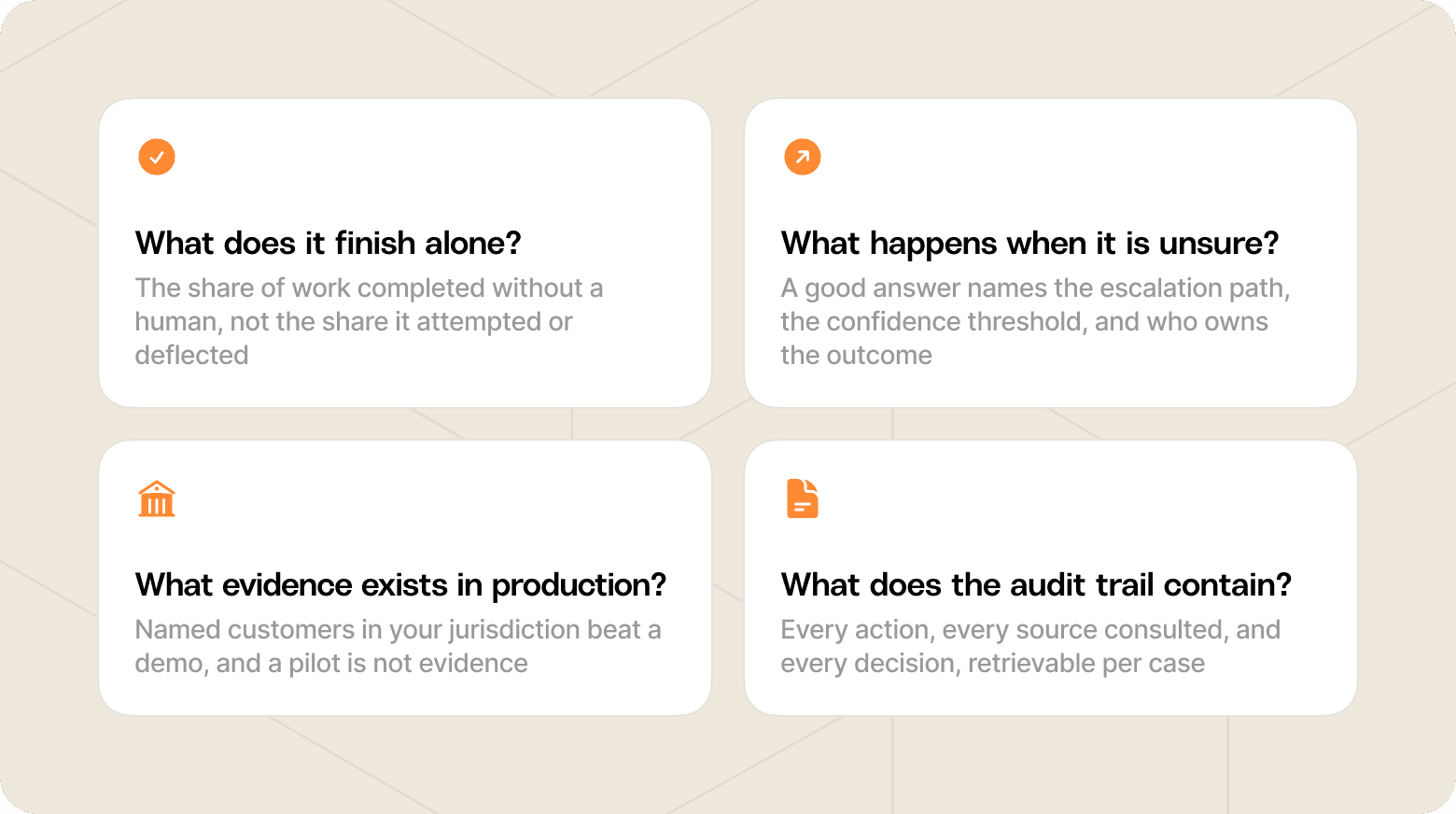
Comparing across these rows is a mistake. A fraud catch rate, a loan conversion lift, and a resolution rate measure different things, and a vendor that leads one column will look average in another. Compare inside a row, and use the same four questions in every one:
What does the agent finish on its own? Ask for the percentage of work completed without a human, not the percentage it attempted or deflected
What happens when it is unsure? A good answer names the escalation path, the confidence threshold, and who owns the outcome
What evidence exists in a regulated production environment? Named customers in your jurisdiction beat a demo, and a pilot is not evidence
What does the audit trail contain? Every action, every source consulted, and every decision, retrievable per case
The assistant will not do this work for you: on the citation data above, under 2% of what it draws on comes from independent review. Our full method for scoring a shortlist is in evaluating AI agents in financial services, and the security and compliance criteria specific to banking sit in best secure AI agents for banking.
One more thing worth planning for. Gartner expects more than 40% of agentic AI projects to be cancelled before the end of 2027, mostly for unclear ROI and weak risk controls. The institutions avoiding that outcome are the ones buying against a named job with a measurable result attached, one row at a time.
Where to start
Pick the row where the work is highest volume, best documented, and most painful today. For most financial institutions that is customer operations, because the queue is visible, the cost is known, and the result shows up in the same month. Book a demo and we will scope it against your own volumes.


Elizabeth Shew leads Brand and Advocacy at Gradient Labs, where AI agents handle customer support and back-office work for banks, lenders, and fintechs. Before that, she led customer marketing at Mastercard and built Dynamic Yield's customer marketing programme from the ground up, a decade spent turning customer results into industry-shaping stories. She writes about how support and operations teams actually put AI and technology to work. Before tech, she was a professional dancer in NYC.