
Your team is being asked to handle more cases without more people, and the queue that's hardest to shrink is the regulated one: disputes, arrears calls, verification checks, complaints. Those cases take several steps each, touch more than one system, and have to stand up to a regulator afterwards, which is more than most AI agents for customer service are built to carry.
What's on your AI agent shortlist falls into two groups. One answers a handful of common questions and passes everything else back to your team. The other takes a dispute from first message through to chargeback submission.
This guide sets out how those two differ in practice, where agents fit across the frontline, outbound, and back office, and what to ask a vendor before you put one near a regulated case.
What AI agents for customer service actually do
AI agents for customer service work on chat, email, SMS, or the phone, answering customer questions and taking account actions across your customer operations. One question separates them from everything else: do they close the case, or just pass it on?
Many AI solutions in customer service act as deflection tools, which recognise the question, point the customer at an article or a person, and stop there. An AI customer service agent goes further: it verifies who it's speaking to, reads the live account, applies your policy, takes the action, and completes the job. That might be a refund, a cancellation, a payment arrangement, a chargeback submission, or many other kinds of use cases. The agent owns it end to end instead of handing it off.
For a support leader, that distinction shows up in the workload. A tool that deflects keeps a contact out of the human queue for a day, then the customer re-contacts when the problem isn't solved. A tool that resolves clears it permanently, which is why resolution matters more than deflection rate: it measures whether the work got done, not whether a contact escaped the queue.
Customer service AI agents run in two layers: frontline (chat, email, voice, messaging) and back office (investigation, decisioning, action, audit). A platform built to handle both well is rare. Most stop at the frontline and leave the expensive work to your team. See how an AI agent differs from a chatbot for the fuller breakdown.
Why resolution decides ROI
Deflection rates commonly plateau around 60–65% because what sits underneath the easy questions is usually multi-step work. A disputed charge needs investigation and chargeback submission. An arrears call needs verification, balance explanation, and a repayment negotiation. A verification case stalls until someone checks the documents against policy. None of that fits the single-turn exchange that deflection rewards.
When a vendor reports a 70% or 80% deflection rate, ask three follow-up questions. First, what happens after the chat closes: if the agent handles only the reply and your team handles the investigation, chargeback, or decisioning, the deflection number doesn't reflect that manual work. Second, how do they account for re-contacts: if a customer comes back with the same issue and it counts as a fresh deflected contact, the number doesn't count the unsolved case underneath it. Third, what does the resolution rate look like after six months, not on day one. Deflection often stays flat; resolution climbs as the vendor refines procedures and integrations.
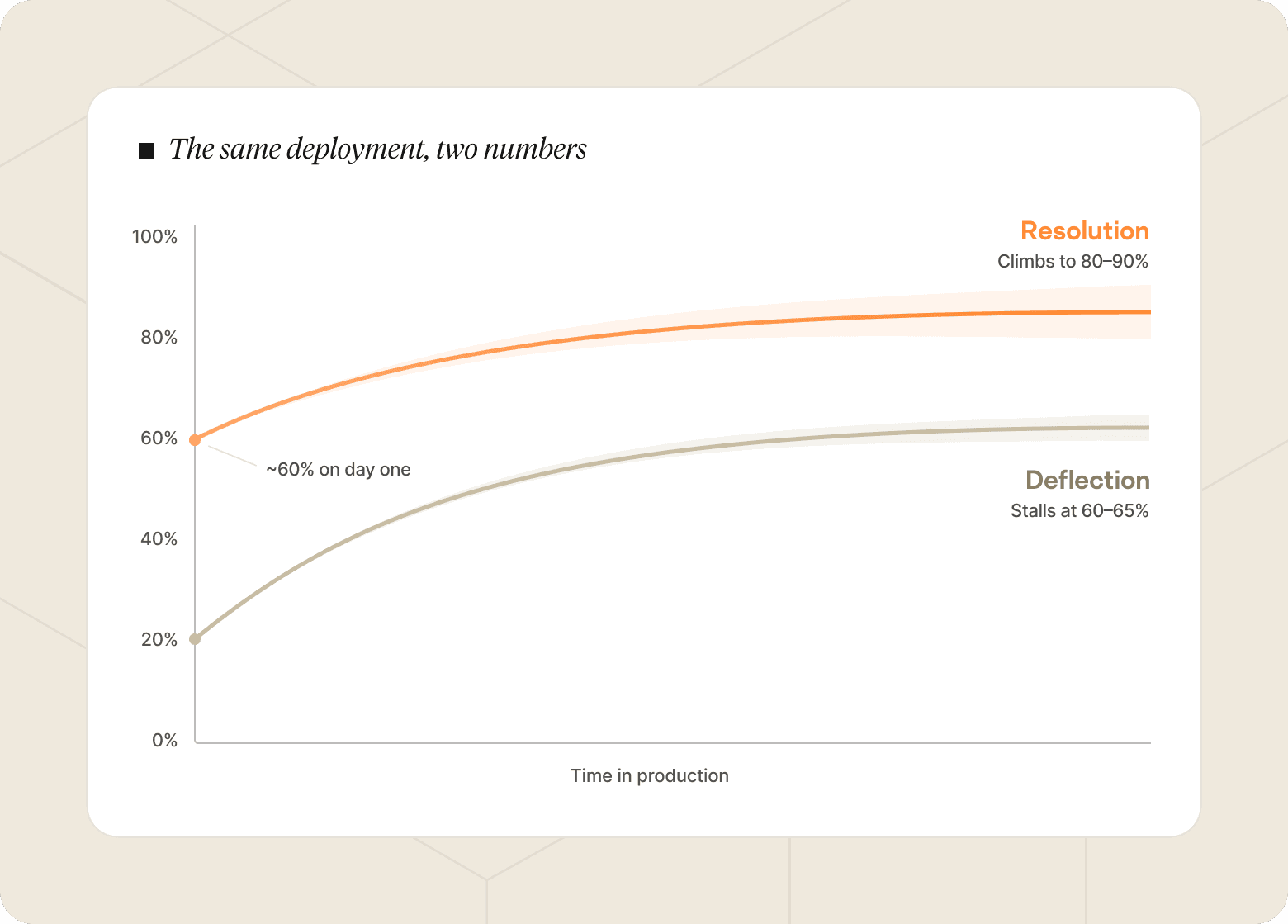
Real resolution reaches the back office. That is why resolution rates at mature deployments climb to 80–90%, while deflection plateaus at 60–65%. The cases that cost you most, disputes, collections, complaints, and verification, live in that gap. An AI agent that runs both frontline and back office resolves them; one that stops at the reply just moves the work downstream. Deflection vs resolution in AI customer service covers the mechanics of that gap in more depth.
Where AI agents for customer service fit in your operation
AI for customer support works best where volume is high, the work is repetitive, and the rules are clear. That spans three layers: inbound frontline (answering customer questions on chat or email), outbound (calls, SMS, or email to customers), and back office (investigation, decisioning, and case completion behind the visible conversation).
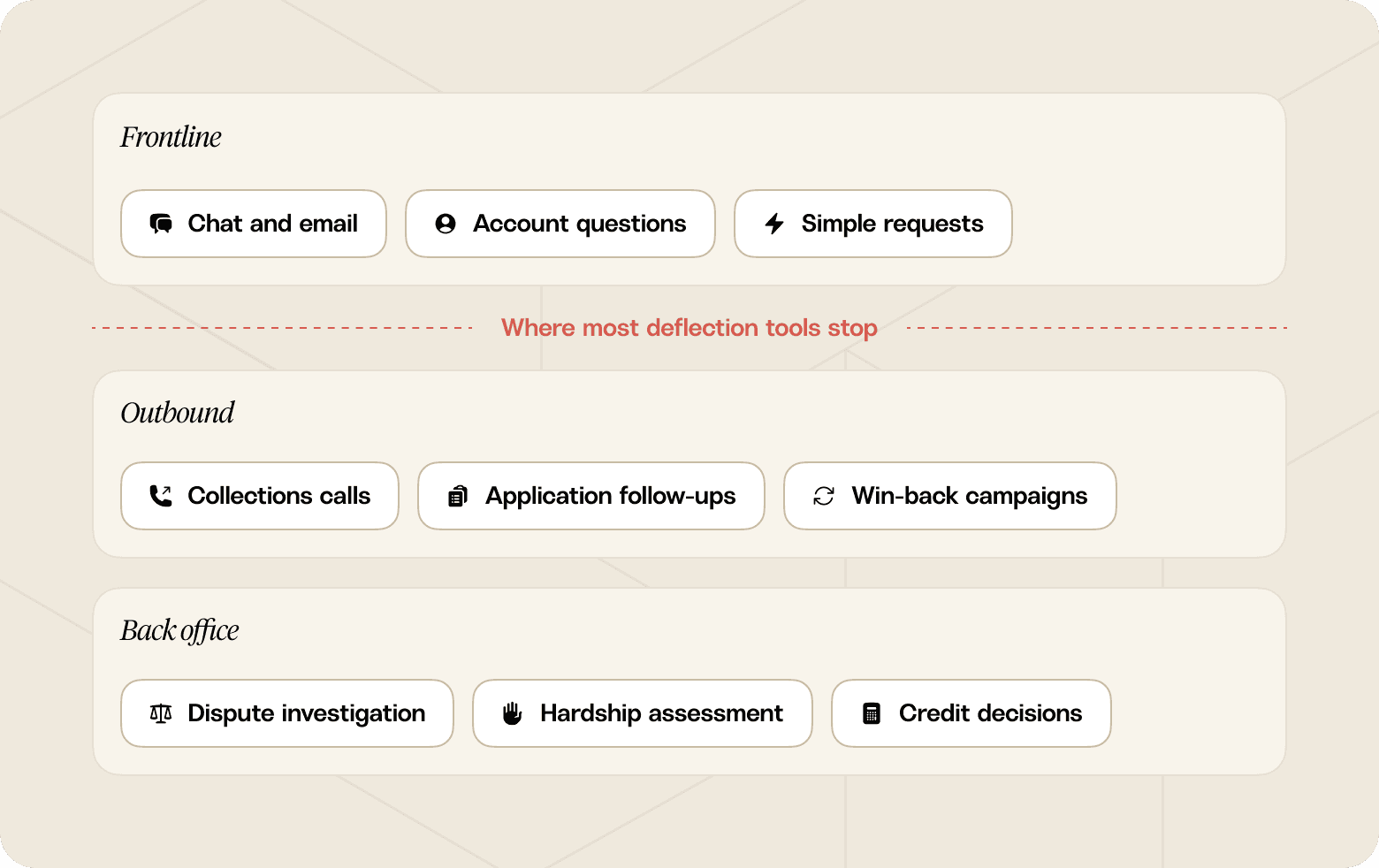
Frontline chat and email are the fastest wins. An AI help desk agent can answer account questions, process simple requests, and escalate edge cases in real time, cutting queue depth from day one.
Outbound is where the real savings sit. Collections calls, application follow-ups, and win-back campaigns are repetitive, high-volume, and governed by strict rules. An agent that can verify identity, pull the account, negotiate a payment, detect hardship, and log compliance disclosures on a call resolves the bulk of outbound volume end to end, well past what a human team manages on a comparable shift.
Back office is where most customer support automation stops short. A dispute investigation, a hardship assessment, or a credit decision is invisible to the customer but critical to your costs and compliance. An agent that can gather evidence, apply your policy, and write a decision memo cuts specialist review time sharply. Most platforms don't touch this layer because it requires deep integration and domain knowledge that generic tools don't carry.
How to evaluate AI agents for customer service
Score any shortlist against these five criteria. They expose where vendors deflect and where they resolve, and pair well with a full vendor evaluation framework if you want the structured version.
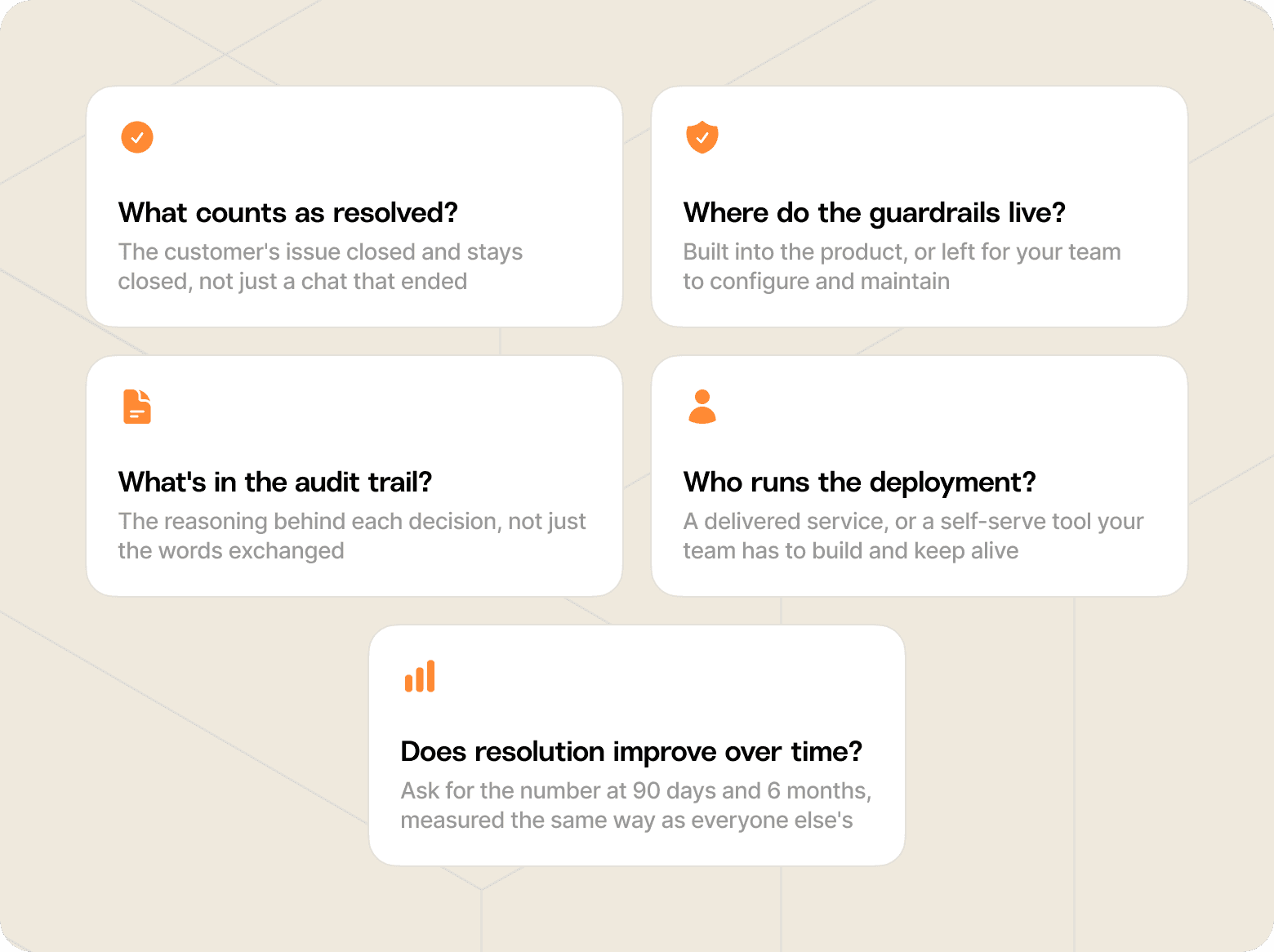
What counts as resolved? Ask how the vendor defines and measures a successful outcome. If a closed chat counts as resolved even when the customer's problem remains open, you are being sold deflection. Real resolution counts cases where the customer's issue is closed and stays closed: no re-contact, no follow-up escalation.
Where do the guardrails live? In regulated sectors like financial services, the agent has to detect vulnerability, log compliance disclosures, and hold up under obligations like the FCA's Consumer Duty and the EU AI Act. Ask whether this is built into the product or left for your team to configure and maintain. Built-in guardrails are a product feature; configurable ones are a services project that never ends.
What's the audit trail? When a regulator or your risk team asks why the agent did something, you need a complete record: every action, decision point, data point, and disclosure. Ask to see a single resolved case and the record it produces. A transcript on its own isn't enough. You need the reasoning behind the decision, not just the words exchanged.
Who runs the deployment? Self-serve tools assume you have a team to build, integrate, and maintain them. A delivered service absorbs that load, so your operations team can own the agent without an AI team. Know which model you are buying, because it decides your real timeline, cost, and whether the agent survives the first quarter.
Does the resolution rate improve over time, and was it measured the same way as everyone else's? Day-one numbers are a poor predictor, and vendors rarely define resolution the same way. Ask what the number looks like at 90 days and six months. See our resolution rate benchmark for the specific lines vendors fudge: the denominator, re-contacts, and the measurement window.
A useful test in practice: ask a shortlisted vendor to walk through one case end to end, from first contact to close, using your own queue data rather than a demo script. Watch for where a human still has to step in, what triggers that handoff, and whether the agent explains its own reasoning at each step or just produces an answer. A vendor confident in their resolution numbers will show you the messy case, not just the clean one. If they can only demo the happy path, that's the plateau showing up before you've even signed.
If you're building a shortlist from scratch, our list of AI agent companies worth evaluating is a reasonable starting point.
Two mistakes that stall AI customer service deployments
The most common failure is overselling deflection and underestimating the integration work. A team pilots an agent on a clean, high-volume queue: password resets, FAQ questions, balance enquiries. It sees a strong deflection rate on day one and assumes the technology is ready for the harder cases. It isn't.
The jump from simple FAQ deflection to regulated, multi-system case work is a chasm. An agent that answers "what's my balance?" doesn't automatically handle disputes, collections, or KYC. Those require guardrails, integrations, procedures, and audit trails that most tools don't include by default. The teams that move the dial scope the hard cases first, not last. They ask what case type costs the most or carries the highest regulatory risk, build the agent for that, pilot it with real cases, and only then expand into adjacent work.
The other mistake sits in pricing. Many customer service AI vendors quote per-outcome or per-ticket, which creates an odd incentive: if the vendor bills you for a handoff to a human, you pay full price even when the agent couldn't resolve the case, and the vendor's margin goes up when the agent fails. Look for pricing that aligns with your outcome, charged per resolution rather than per contact.
If your queue is carrying more complex, regulated work than a deflection tool can close, book a demo and bring your hardest case type.


Elizabeth Shew leads Brand and Advocacy at Gradient Labs, where AI agents handle customer support and back-office work for banks, lenders, and fintechs. Before that, she led customer marketing at Mastercard and built Dynamic Yield's customer marketing programme from the ground up, a decade spent turning customer results into industry-shaping stories. She writes about how support and operations teams actually put AI and technology to work. Before tech, she was a professional dancer in NYC.