
Ada has automated customer conversations since before the wave of AI, and most customer support teams consider it because a large share of inbound volume is comprised of the same handful of questions: where's my card, how do I reset my PIN, when will my transfer arrive? Ada answers those across chat, email, and voice so your team doesn't have to. If you run support at a bank, lender, or fintech, Gradient Labs often ends up on the same shortlist once you want to automate the conversations that come after those questions. Those are the ones that need a decision, like freezing a card after an identity check, reviewing a document against policy, or agreeing a repayment plan within the rules. Below, we compare what each platform was built for, where Ada is the right choice, why financial services teams tend to outgrow it, and three conversations to test on both before you sign.
How did Ada and Gradient Labs get here?

Ada, often called Ada CX after its web address, was founded in Toronto in 2016 by Mike Murchison and David Hariri, who had both worked in customer support before building software for it, which makes it one of the longest-running names in its category. It began as a scripted chatbot but now describes itself as an agentic customer experience platform. Its Reasoning Engine generates answers from your knowledge base, Playbooks turn standard operating procedures into automated flows, and a set of tools it calls Ada Computer lets the agent take actions in connected systems across voice, messaging, and email. Ada reports more than 4 billion customer conversations across 350+ businesses in 85+ countries, with customers including Life360, IPSY, and Cebu Pacific. It raised a $130M Series C in 2021 at a $1.2B valuation, according to BetaKit.
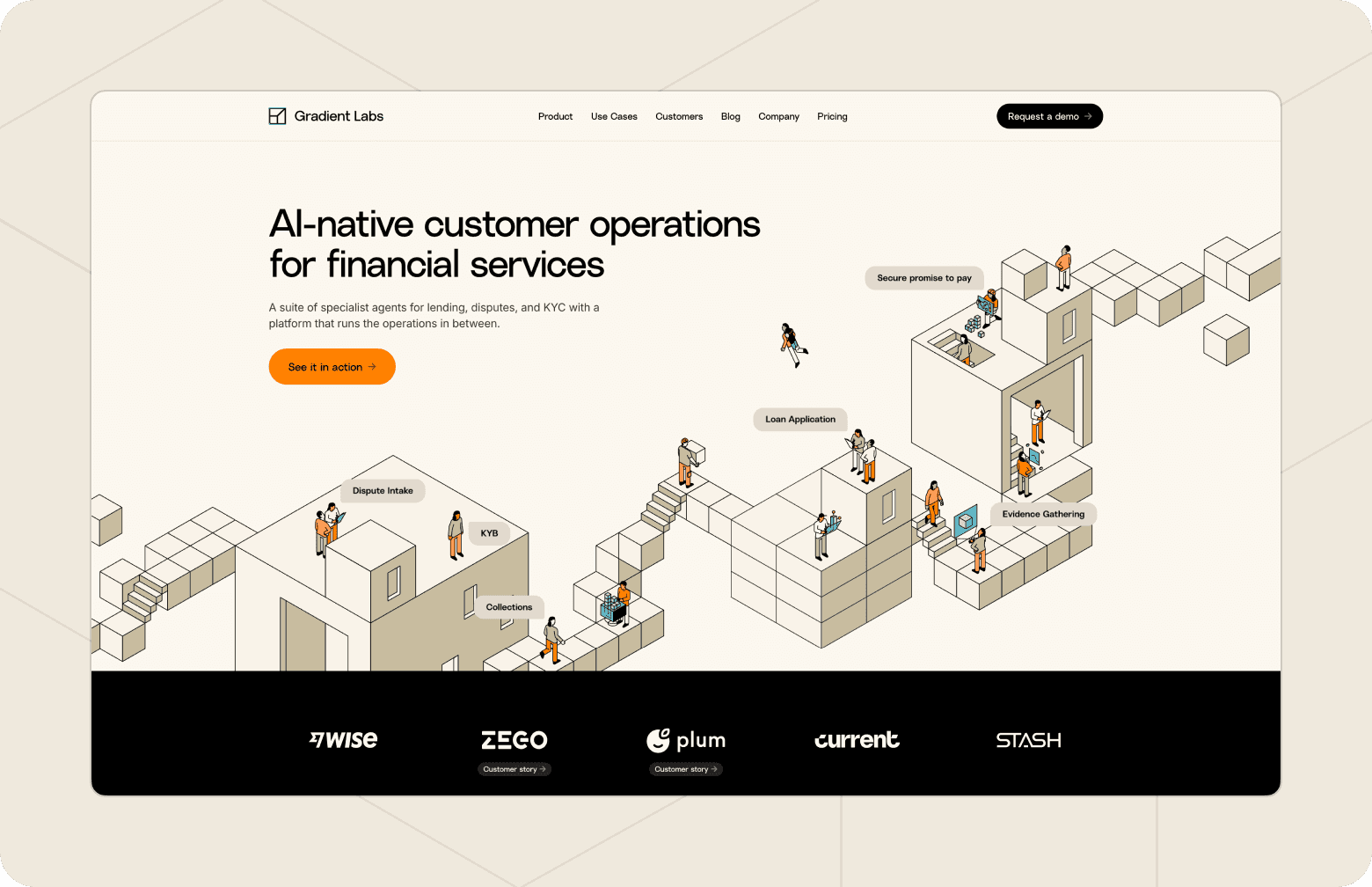
Gradient Labs was founded in 2023 as the AI-native customer operations platform for financial services. Its agents answer frontline conversations on chat, email, and voice, and specialist agents such as the Disputes Agent and Lending Agent run the back-office work underneath them: disputes, collections, and KYC. Customers include Wise, Zego, Plum, and Pockit, and the company doubled its Series A to $26M in June 2026.
The two arrive from opposite directions. Ada spent a decade making conversation automation work for hundreds of brands at once, starting with chatbots and adding agentic capabilities and voice later. Gradient Labs' founders built Monzo's AI and data organisation from zero and ran production machine learning under FCA regulation, so they had already seen which customer conversations carry regulatory weight: the investigation, the arrears plan, the vulnerable customer. They built Gradient Labs as an agentic platform for that regulated work first, then built the conversation layer around it.
Ada vs Gradient Labs: the short answer
For a regulated financial services operation, Gradient Labs is the better choice. Ada wins on breadth but not depth: more industries, and a longer record of high-volume consumer support for surface-level questions coming in at scale. Gradient Labs wins once a conversation turns into regulated work, because its guardrails, verification steps, and specialist agents were designed around financial conduct rules, and its delivery team carries the deployment
Platform | Resolution rate | Compliance posture | Deployment time | Pricing model | Best for |
|---|---|---|---|---|---|
Gradient Labs | 60% from day one, 80–90% in mature deployments | 20+ FS guardrails on every turn; SOC 2 Type II; Consumer Duty, Reg F, and EU AI Act coverage | 4–6 weeks at large regulated institutions; AI delivery team owns the migration | Per resolution, with a deployment guarantee | Banks, lenders, insurers, and fintechs running regulated cases end to end |
Ada | Ada-reported 84% automated resolution, scored by its own AI review | SOC 2, PCI DSS, HIPAA, GDPR, AIUC-1; no published financial conduct coverage | About 2 months to implement, per G2 buyer data | Custom quotes; Ada publicly favours per-conversation billing | High-volume consumer brands automating support across many languages |
What can Gradient Labs show your risk team?
A risk function wants to know who built the controls and where they already run. Gradient Labs' founders ran data and machine learning at Monzo, a UK digital bank regulated by the FCA, and they hired engineers who had worked inside banks, lenders, and payments firms. You can see that background in the product's defaults: an ambiguous request gets a clarifying question before any action, a customer in difficulty gets routed for care, and a compliance reviewer can replay any decision step by step.
The production numbers back it up. At a large European digital bank, the agent has resolved 280,000 conversations for half a million customers with a 98% quality assurance score. Pockit's Head of Operations explains why resolution, rather than containment, is the number that matters:
"We truly think that if people have a problem and you solve it, that builds brand loyalty. That's why customer resolution is so important. With Gradient Labs, we have an AI agent that's actually resolving problems, boosting our CSAT rating, and absorbing growth without us having to scale the team."
Michiel Smet, Head of Operations, Pockit
Behind the numbers sits a commercial commitment: Gradient Labs guarantees every deployment it scopes, and if it doesn't deliver what it said it would, you get your money back.
What is Ada strongest at?
Ada has earned its place on most shortlists, and a fair comparison starts with what it does well.
Language coverage: Ada's documentation lists 60 languages for messaging and email, with a smaller set on voice. A brand serving customers across dozens of markets gets one agent instead of a patchwork of regional tools.
Scale and maturity: a decade of deployments and more than 4 billion conversations mean Ada's team has seen most failure modes in consumer support before you hit them. Buyers rate it 4.6 out of 5 across roughly 170 reviews on G2.
A stated quality bar for resolution: Ada defines an automated resolution as a conversation that is relevant, accurate, and safe without a human involved, and states that a conversation which avoids a handoff but gives a wrong answer doesn't count. That is stricter than the containment figures some vendors quote.
Broad certifications: Ada lists SOC 2, PCI DSS, HIPAA, GDPR, CCPA, and AIUC-1, a standard written specifically for AI agents, alongside zero data retention with its model providers and annual penetration tests that include the models.
Its strongest published results come from travel and consumer apps. According to Ada's own case studies, the Philippine airline Cebu Pacific raised automated resolution by more than 34% and CSAT by more than 50%, and Life360's AI agent carries a workload Ada equates to 400 full-time staff.
Where do financial services teams outgrow Ada?
The limits show up when the customer conversation carries regulatory weight or outlives a single session.
Conduct rules sit with your team. Ada's certifications cover security, privacy, payments data, and health data. Nothing it publishes addresses FCA Consumer Duty, CONC, Reg F, UDAAP, or FDCPA, or describes built-in detection of vulnerable customers and complaints. In practice your team writes those controls into Playbooks and keeps them current every time a rule or policy changes, which turns compliance into a standing configuration project.

Security flows need more than an answer. Account recovery, a change of address with proof of identity, or a card replacement after suspected fraud each ask the agent to read a document or image, judge it against policy, and act in core systems. Ada publishes no results for these flows in financial services, so make one part of any evaluation rather than assuming the platform handles it.
The case outlives the conversation. Ada scores resolution per conversation and treats a conversation as finished after 24 hours of customer silence, according to its documentation. Regulated cases run on longer clocks. Under Regulation E, a US bank investigating an unauthorised transfer has 10 business days to decide or provisionally credit the customer, and a dispute can stay open for weeks after that. An agent that closes the conversation leaves the investigation, the evidence requests, and the customer follow-up in your ops queue. Our guide to the Reg E 10-day clock sets out which steps are worth automating.
Ada's 84% figure deserves context too. It is a cross-customer average, scored by Ada's own AI review of sampled conversations, and its strongest public results come from consumer brands. Ask for figures from financial services deployments specifically, and compare them on the same definition; our AI resolution rate benchmark guide explains how.
What does Gradient Labs do after the first reply?
Take a customer who messages at 11:00pm to say their card is missing and two payments on their statement look wrong. The agent verifies their identity, freezes the card and orders a replacement to the address on file, and opens a dispute for the two payments in the same conversation. From there the Disputes Agent gathers the evidence, asks the customer for anything missing, decides each claim against scheme rules, and reports the outcome back in the same thread days later. Nobody on your team picks up the case unless the agent flags a genuine edge case, and the flag arrives with the groundwork done. Our guide to automating disputes with AI walks the full lifecycle.

Four capabilities make that possible:
Guardrails on both sides of the conversation: more than 20 pre-built financial services guardrails run on every turn, with no Playbook for your team to write. If a customer mentions a bereavement or a lost job, the agent flags the vulnerability and changes how it handles the case; if a draft reply would warn someone under fraud investigation, promise a refund that policy doesn't allow, or drift into financial advice, it is stopped before it reaches the customer. The rulebook behind those checks spans UK conduct rules (Consumer Duty, CONC, Breathing Space), US collections and consumer protection rules (FDCPA, TCPA, Reg F, UDAAP), GDPR, and the EU AI Act, and the platform holds SOC 2 Type II.
Documents read against your policy: in business verification, the agent reads every document a company submits, extracts what your policy requires, checks it against sanctions lists, chases anything missing or out of date, and routes only the genuine edge cases to a person.
People answer questions instead of inheriting tickets: when a step needs human judgement, the agent sends a reviewer a structured task with the context attached, keeps talking to the customer, and finishes the case once the answer comes back. Andy Murray, Head of Strategy and Enablement at Zego, puts the effect plainly: "The ask-a-human feature helped us drop human handling time from 12 mins to just over 3, and lift CSAT scores in the process."
Voice with the same controls: Gradient Labs runs voice AI at scale, a first in finance. Collections reminders, repayment conversations, and other proactive outreach go out by phone under the same guardrails and audit trail as chat, adding up to more than 100,000 outbound calls each month across its customers.
Ada's headline claim is that its agents outperform human teams. Gradient Labs makes the same comparison on financial services work: Zego's AI agent scores 77% CSAT against 61% for its human agents, according to Zego CEO Sten Saar.
Per conversation or per resolution: which pricing protects you?
Ada doesn't publish a rate card, but it has published its view. In a 2025 post on its own blog comparing the two models, Ada argues that per-resolution billing makes costs rise as the agent improves, calling the model one that "punishes success", and recommends per-conversation pricing for most enterprises. The argument has real merit on predictability: a conversation is easy to count, and a budget built on volume is simple to forecast.
The trade-off is what you pay for when the agent fails. Under per-conversation billing, a conversation that ends with a wrong answer, an abandoned customer, or a handoff costs the same as one that solved the problem, so the vendor's revenue doesn't depend on the case closing. Gradient Labs prices per resolution, so you pay when a customer's problem is solved end to end, and the deployment guarantee covers the scoped use case on top. A rising bill under that model means more of your customer operations running without your team.
Settle it with your own numbers. Ask both vendors to price last quarter's volume line by line, including the conversations that failed or reached a person, then compare the cost per case your team no longer touches. Our guide to deflection versus resolution covers how to hold each vendor to a definition you can audit.
Which conversations settle Ada vs Gradient Labs?
Demos run on the happy path. Script three conversations from your own queue instead, and run each through both platforms:
Conversation to script | What to watch for |
|---|---|
A customer locked out of their account who uploads a photo of their ID | Whether the agent reads the document, checks it against your policy, and restores access in your systems, or routes the whole case to a person |
A customer who mentions losing their job while asking to delay a repayment | Whether the agent detects financial difficulty, adjusts its handling, and records the disclosure for your audit trail |
A disputed payment with one receipt missing | Whether the case continues after the chat closes: evidence requested, a decision made against scheme rules, and the outcome sent back to the customer |
Each one tests a different layer: verification, conduct, and the work that runs after the conversation ends. An agent built for consumer support can sound excellent on all three during the first reply, so judge each platform by where the case stands a week later. Our guide to evaluating AI agents for financial services turns these into a full scorecard.
Ada or Gradient Labs: which fits your queue?
Ada is the better fit for high-volume consumer support across many markets and languages, where conversations mostly finish inside a single session and your team has the capacity to build and maintain Playbooks, including any compliance controls your industry needs. It is a mature platform with a long record on exactly that work.
Gradient Labs is the better fit when your queue carries regulatory weight: identity and document checks, customers in financial difficulty, and disputes or collections that run for weeks after the first message. You get guardrails built for financial services, specialist agents that keep working once the chat closes, and a delivery team that owns the deployment with a guarantee behind it, all on a headless platform that leaves your helpdesk in place. If your shortlist runs wider than Ada, our comparisons with Intercom Fin, Decagon, Sierra, and Lorikeet work through the same questions, and our Salient comparison covers lending operations.
Book a demo and bring the three conversations above; we will run them on your cases.


Elizabeth Shew leads Brand and Advocacy at Gradient Labs, where AI agents handle customer support and back-office work for banks, lenders, and fintechs. Before that, she led customer marketing at Mastercard and built Dynamic Yield's customer marketing programme from the ground up, a decade spent turning customer results into industry-shaping stories. She writes about how support and operations teams actually put AI and technology to work. Before tech, she was a professional dancer in NYC.