
If you run AI customer service at a bank, lender, or insurer, the strongest Ada alternative works the case behind the conversation as well as the chat. Ada handles high volumes of similar questions well, but a card dispute, an arrears case, or a business verification still lands in your back-office queue once the reply is sent, and FCA Consumer Duty or US debt collection rules apply to every step. Below, we compare Ada alternatives for financial services on conduct rules, delivery, and pricing, and map the tools that sit around whichever agent you choose.
How does Gradient Labs compare to Ada?
The verdict: Gradient Labs is the Ada alternative built for financial services. With Gradient Labs, one platform answers the customer and then works the case the conversation opened, across disputes, collections, and KYC, with more than 20 financial services guardrails checking every turn and an AI delivery team running the migration for you. Ada remains a strong pick for a high-volume consumer brand outside regulated finance that wants a single agent across voice, messaging, and email.
The resolution column needs a careful read, because the two figures count different things. Ada's homepage reports an 84% automated resolution rate across its customer base. Gradient Labs counts a case as resolved only when it is closed end to end inside a financial institution, back-office steps included. Our guide to deflection vs resolution explains why that definition decides any vendor comparison.
Platform | Resolution rate | Compliance posture | Deployment time | Pricing model | Best for |
|---|---|---|---|---|---|
Gradient Labs | 60% from day one, 80–90% in mature deployments | 20+ FS guardrails on every turn; SOC 2 Type II; named UK, US, and EU conduct coverage | 4–6 weeks; AI delivery team runs the migration | Per resolution, with a deployment guarantee | FS firms running frontline and back-office work on one platform |
Ada | 84% automated resolution, Ada-reported cross-customer average | SOC 2, PCI DSS, GDPR, HIPAA, AIUC-1; no published conduct-rule coverage | Not published | Custom quotes; no rate card on ada.cx | High-volume consumer brands across many industries |
Why look for an Ada alternative?
Ada built its business on volume. Its homepage counts more than 4 billion customer conversations across 350+ businesses, and for a brand whose main job is answering a flood of similar questions, that record carries weight. Teams searching for Ada CX alternatives inside a regulated firm usually have three further questions, and a general-purpose platform answers each of them less directly.
Compliance coverage stops at data security: Ada lists SOC 2, PCI DSS, GDPR, HIPAA, CCPA, PIPEDA, and AIUC-1, plus zero data retention with its model providers. That clears a security questionnaire, yet it doesn't tell your risk committee how the agent behaves when a borrower says they can't pay this month, or when a customer shows signs of vulnerability that FCA Consumer Duty obliges you to act on. Ada doesn't publish coverage of named conduct rules such as Consumer Duty, CONC, FDCPA, or Reg F, so writing and maintaining those controls falls to your team.
The roadmap serves many industries at once: Ada's industry pages put financial services beside betting and gaming, travel, ecommerce, and SaaS. Serving that range at scale is a real achievement, and it also decides what gets built next. Work on an airline rebooking flow or a sportsbook does little for a bank's model risk review, which is the trade-off our guide to vertical AI vs horizontal AI unpacks.
The case stays with your team: Ada's banking pitch covers account self-service, such as checking a balance or a credit limit, and lets customers report a compromised card or transfer to a specialised human agent. The investigation, hardship assessment, or chargeback submission that follows still lands in your back-office queue, and that residue is where much of the handling time in a financial services operation goes.

Why Gradient Labs?
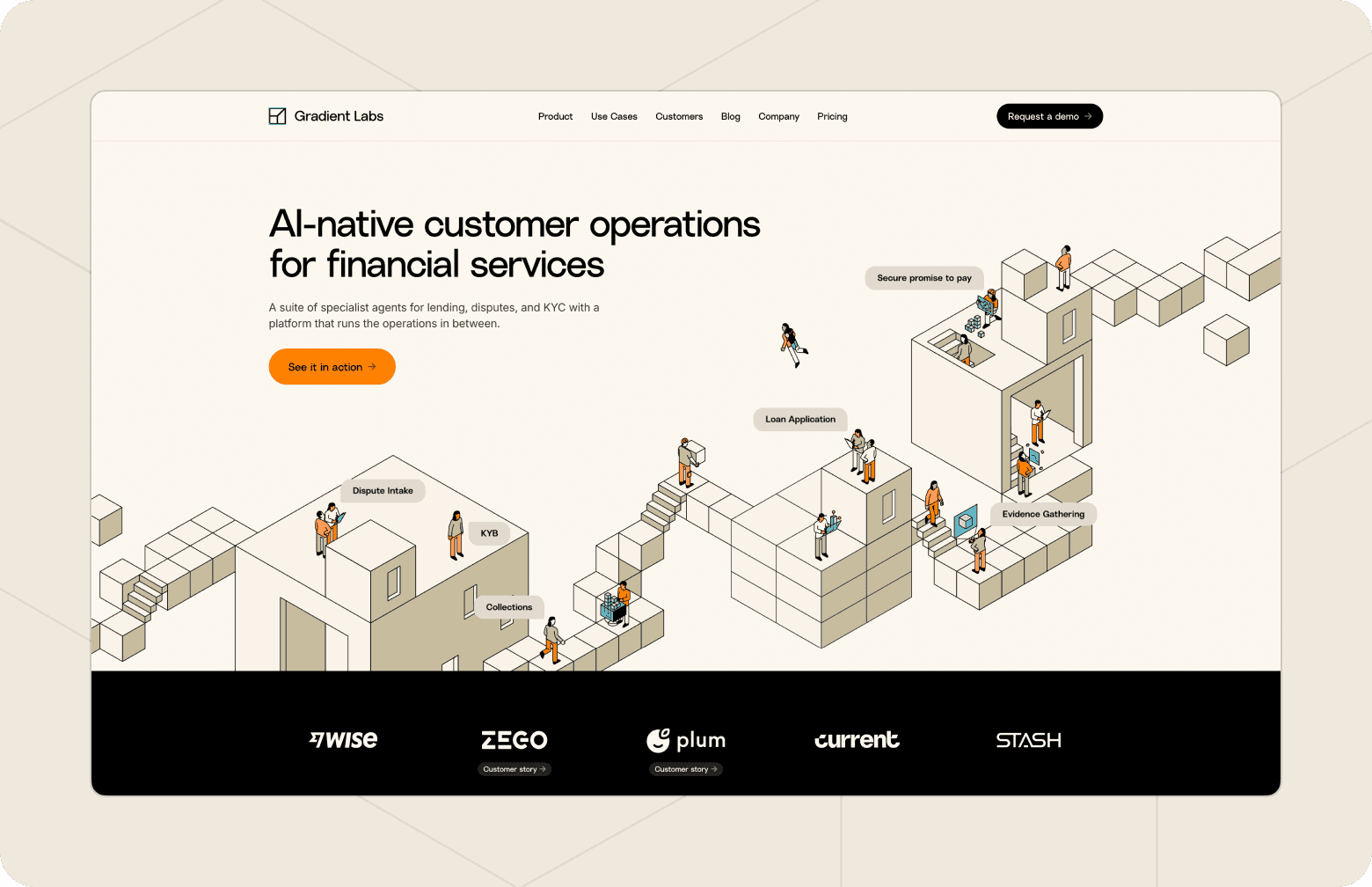
Gradient Labs runs customer operations for banks, lenders, insurers, and fintechs, with Wise, Yonder, SteadyPay, Pockit, Plum, and Morse among the names published. At a large European digital bank, the agent has resolved 280,000 conversations for half a million customers at a 98% quality assurance score. The founders built and ran the data and AI organisation at a large UK neobank, past 120 people, under FCA supervision, and almost every engineer on the team came from a financial services company.
At Zego, half of insurance claims are now self-served, and the team credits the way the work gets done as much as the software:
"What sets Gradient Labs apart is their way of working... they understand fintechs. They work like an extension of our team that knows our pain points and shares our goals. Alex now fully automates some complex workflows that previously wouldn't have been possible."
Ian Kershaw, VP of Customer Service, Claims and Fraud, Zego
That way of working comes with a commercial promise: once we have scoped a use case, we guarantee the deployment, and if we don't deliver what we said we would, you get your money back. Every result above, and more, is on the customer stories page.
What is Ada and how does it work?

Ada is a Toronto-based AI customer service platform that now calls itself an agentic customer experience platform. It became a unicorn in 2021, when a $130 million Series C led by Spark Capital valued the company at $1.2 billion and took total funding to around $200 million.
The product puts an AI agent on voice, messaging, and email, connected to the helpdesk and business systems a support team already runs. It answers from your knowledge base, takes actions through integrations, and hands the conversation to a person when it reaches a limit. Named customers include Pinterest, monday.com, Sky, and Loop Earplugs, and Ada's published results lean consumer: 42% lower average handle time at monday.com, an estimated $2.7 million a year saved at IPSY, and 80% CSAT at Loop Earplugs after automating support.
Ada CX pricing is sales-led. The pricing page on ada.cx offers a demo and an ROI model rather than a rate card, so expect a custom quote sized to your conversation volume.
Why do teams look beyond Ada for financial services?
Credit where it belongs: few vendors in AI customer service have run as many conversations in production as Ada. It holds a 4.6 out of 5 average on G2, where reviewers often mention how quickly a team can stand up a first version of the agent.
The same reviews point to the friction a regulated operation feels most. G2 reviewers ask for deeper, more customisable reporting, which matters when a risk committee wants evidence behind each automated decision. Several describe conflicting data and limitations when Ada runs alongside external helpdesks such as Zendesk and Kustomer. Independent reviewers also describe a full enterprise rollout as a substantial project, even when the first version goes live quickly.
None of that makes Ada a poor product. What sends a bank, lender, or insurer to look at Ada competitors is scope: the agent is scoped to the conversation, the compliance evidence covers data security rather than conduct, and the roadmap answers to many industries. Each is a sensible trade-off for a platform built for volume across sectors, and each one turns into work and risk for a financial services team.
What should replace Ada for financial services?
Gradient Labs is an AI-native customer operations platform, built for finserv from the ground up. Three differences show up once it is in production.
One platform, the whole case: the customer conversation on chat and voice, then the work it triggers, across disputes, collections, hardship and forbearance, and business verification. Specialist AI agents share memory and context across every stage of the lifecycle, so a customer who reported a missing payment last week never has to explain it twice. At Yonder, that connected setup holds an 80% one-touch rate on disputes with 90% CSAT on the cases the agent handles itself.
Conduct rules live in the product: more than 20 pre-built financial services guardrails run on every turn. Customer guardrails detect complaints, vulnerability, and financial difficulty and hand off or reroute, while agent guardrails catch tipping-off, false promises, disallowed terminology, and out-of-bounds advice before the customer sees a reply. Coverage spans FCA Consumer Duty, CONC, and Breathing Space in the UK, FDCPA, TCPA, Reg F, and UDAAP in the US, and GDPR and the EU AI Act in Europe, under SOC 2 Type II certification with zero data retention agreements across every LLM sub-processor.
An ops lead owns it, with no engineering project: a finserv-native AI delivery team runs the migration from whatever you run today and reaches production in 4–6 weeks, then keeps improving the deployment. Teams that want more control can bring their own guardrails, policies, and proprietary knowledge alongside ours.
Resolution starts near 60% and climbs to 80–90% as the delivery team adds integrations, sharpens procedures, and brings new work into production. Plum opened at 52% on day one and Morse at 50%, and Pockit now resolves 70%.
When Ada is the better fit: an airline, retailer, betting operator, or SaaS company handling high volumes of similar questions across many markets will get more from Ada than from us. Gradient Labs earns its place when each automated decision has to stand up to a regulator's question, and when the case keeps running after the customer has logged off.
Which tools complete the stack around your AI agent?
Replacing the agent on your frontline leaves your helpdesk, QA, and risk tooling where they are. The companies below sit beside Gradient Labs in a financial services operation rather than against it.
Company | What it does | Where it fits | Best for |
|---|---|---|---|
Salesforce Service Cloud / Freshworks | Helpdesk and CX platform | The system your AI agent deploys on; no replatforming needed | Teams keeping their existing helpdesk |
MaestroQA | Support QA scorecards and coaching | Proving agent quality, human and AI alike | Enterprise QA programmes |
EvaluAgent | Automated QA scoring of every conversation | QA in regulated contact centres | FCA-regulated support teams |
Assembled | Workforce management | Balancing human and AI capacity after automation | Support teams rebalancing post-AI |
Guru | Verified knowledge management | Keeping the knowledge your agent answers from accurate | Compliance-conscious knowledge ops |
Sardine | Fraud, AML, and compliance platform | Risk decisions beside the support workflow | Fraud and FinCrime teams |
Unit21 | Agentic fraud and AML monitoring | Transaction and case monitoring | Risk ops at scale |
Hawk | AML monitoring and sanctions screening | Explainable AI for FinCrime | Banks needing explainability |
Norm Ai | Regulatory compliance agents | Turning regulation into executable checks | Compliance teams |
Oscilar | AI risk decisioning hub | Fraud, credit, and onboarding decisions | Risk teams consolidating tools |

For an operation moving off Ada, two of those layers deserve attention first.
Evidence of quality: once the agent handles most of your volume, QA results become the evidence your risk committee reads. MaestroQA gives enterprise QA teams configurable scorecards and coaching workflows, and EvaluAgent, founded in the UK, automatically scores every voice, chat, and email conversation for a customer base weighted towards regulated firms. Assembled helps you plan the human capacity automation frees up, and Guru keeps the knowledge your agent answers from checked by an expert.
Financial crime and risk: Sardine, Unit21, Hawk, Norm Ai, and Oscilar each own a decision that a customer operations agent works around rather than makes. Our ranking of the best secure AI agents for banking covers that layer company by company, with funding and named customers.
Choosing the right Ada alternative
Ada is a capable, mature platform, and for a consumer brand answering high volumes of similar questions it does the job well. A bank, lender, insurer, or fintech has a harder brief: automate the case behind the conversation, keep conduct rules inside the product rather than in your own configuration, and keep a record of every automated step that a regulator will accept.
Gradient Labs was built for that brief, and moving to it disturbs less than most teams expect, because your helpdesk and the tools around it stay in place and the deployment is guaranteed. Our Ada vs Gradient Labs comparison goes deeper on verification and pricing, with three conversations to test on both platforms. Before you sign with anyone, evaluating AI agents in financial services sets out what to measure and choosing an AI agent vendor for financial services lists the questions to put to every vendor. When you are ready to plan the rollout, deploying AI agents in banking covers the migration stage by stage, and if your shortlist runs wider than Ada, our Fin AI alternatives and Decagon alternatives guides cover the same ground.
Book a demo to see how your hardest cases run on Gradient Labs.
Elizabeth Shew leads Brand and Advocacy at Gradient Labs, where AI agents handle customer support and back-office work for banks, lenders, and fintechs. Before that, she led customer marketing at Mastercard and built Dynamic Yield's customer marketing programme from the ground up, a decade spent turning customer results into industry-shaping stories. She writes about how support and operations teams actually put AI and technology to work. Before tech, she was a professional dancer in NYC.